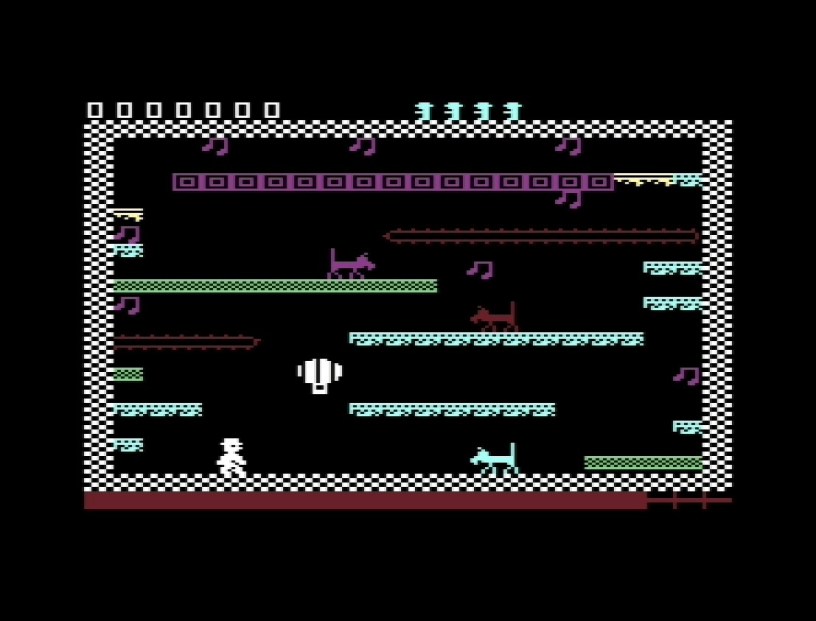
I first wrote about The Perils of Willy on the VIC-20 in April 2018, and looking back at it now, I was intrigued by what seems to be the first shoots of the way I’d end up covering games like that here today, rather than the shorter, diary-like features that preceded it… Not that those shoots particularly grew much for a while – this was the first time I’d written anything for six months, then, aside from a few bits and pieces on Enduro Racer, V-Rally 3 and Olli and Lissa over the next couple of weeks (which admittedly did continue to evolve things), that seems to have been it for another six months! There was still no grand plan though – I was just documenting the games that had been a part of my own history, in my own way, when I fancied, and with little rhyme or reason, and that’s also now a part of my own history, which I’ve no intention of rewriting. However, as time went on, I continued to experiment with new features and formats, and an example of those is one I did on The Perils of Willy’s sacrilegious appearance on the ZX Spectrum back in 2020! I’ll try and come back to that at the end but seriously, that was a fantastic homebrew, even if it was the final nail in the coffin of the only vague boast I ever had over any Spectrum or Commodore 64 owner back then!

A few months after that, I returned to the game one more time with another one-off experimental feature called The Battle of 1984, although that one did also kind of evolve into what became my monthly Retro Rewinds, where I currently flick through an exactly forty-year old copy of Computer & Video Games magazine. Anyway, while I was looking through my enormous collection of those, I noticed both The Perils of Willy and Elite were reviewed in the same issue back in October 1984, and that they scored pretty much the same across the board, so I did a bit of a side-by-side analysis. And now we had three separate features on the same game! Speaking of my Retro Rewinds though, as I’ve been putting those together, I’ve also unearthed even more history on The Perils of Willy I either didn’t have or didn’t realise I had at the time of writing them, so there’s another reason why we’re gathered here today. Similarly, time hasn’t been kind to the creaking old default free WordPress theme I started out with here, and likewise the very small number of low-res and generally tiny screenshots I was brute-forcing out of what I guess was the VICE emulator running on an ancient MAC (though I have since been back and swapped out some of those). And finally, at some point I’ll no doubt want to cover other games in Miner Willy’s saga, so I reckon I should get my own history with it in order first! Which is where these Revisiting features come in – as said, not rewriting history, and I’ll only do them for a select few games that for some reason (or several in this case) I’ve wanted to come back to for ages and give them the definitive deep-dive treatment, so let’s get on with it!

Twelve-year old me got a VIC-20 for Christmas 1984… I think… My original Perils of Willy piece actually said 1983 but based on what I’ve dug up since, as well as researching other games like Arcadia on there I’ve covered since, I think it was actually 1984 after all! Whenever, it was the best present ever! For the next few years, it was my entire life too, even during those painful times later on when the new games had long-since dried-up, the old ones were gone from the shelves, and I was living off the occasional type-in games listings you’d still get in C&VG when they were still trying to get us desperate owners of old relics like mine and the Dragon 32 and the Oric to keep buying their magazine, even though they were only really interested in the Spectrum and the C64 by then… Just like my best friend, who’d previously got a VIC-20 the same Christmas as me! As much as I loved it though, even during those first couple of glory years, it soon became apparent that the plain old 3K RAM model wasn’t going to cut it for long, and never more so than when that friend got a copy of The Perils of Willy for his birthday a few months later! Obviously, he got the exotic 16K RAM expansion you needed to run it too, and if ever there was an advert for that nondescript thing that plugged into the back of the computer to make it future-proof, then this game was it! I adored it from the first time he loaded it up, and while it would take until the next Christmas for me to convince my parents I also needed this anonymous little grey box of memory that cost the same as a Walkman (or at least a knock-off one!) and they didn’t understand in the slightest, I got there in the end, and I also got my own copy of what to this day is not only still my favourite VIC-20 game but also a top twenty-five favourite game on any platform ever!

But despite even that kind of crazy high praise from me, The Perils of Willy has continued to be perceived as some kind of cut-down version of Manic Miner elsewhere, just like it was at the time – have a look at Moby Games or similar if you want to see for yourself! That said, having decided to give the game the proper deep-dive treatment here, I do have to admit that on the surface, there’s not a huge amount to dive into, so I thought I’d take the opportunity to do some digging instead, and see if I can convince you otherwise with a bit of an investigative timeline from all the tools now at my disposal… Meaning more copies of Computer & Video Games magazine from 1983 to 1985 than I owned previously! Anyway, really I just want to see how it fits into the series timeline, and try and give it some recognition as a standalone entry rather than a stripped-back port. And I’m going to start in the September 1983 issue of C&VG, with a very unassuming review of Manic Miner, hidden away in the middle of a page of text near the back of the magazine, with no pictures or any fanfare whatsoever, but a very respectable set of nines across the board at the end! There doesn’t seem to be a lot of buzz around it for the next couple of months either, but that changes in January 1984, first with a report on its creator, Matthew Smith, parting company with its publisher, Bug Byte, amidst talk of falsified sales numbers and unpaid royalties, while a clause in his contract allowed him to take Miner Willy, as well as rights to the game and any sequels, with him… Which brings us to the huge, double-page, full-colour advert a few pages later, announcing not only his new home with Software Projects, but also the upcoming Commodore 64 port and the sequel, Jet Set Willy, on the way to the Spectrum!

This is also where the game starts making an impact on the business end of the software charts, and while I’m not sure this version ever hit the top spot, it certainly hung around up there for a long time. In the March issue (which would have arrived in February), we learn that Manic Miner grabbed third place in the prestigious 1983 Golden Joystick Awards’ Game of the Year category, behind Jetpac and The Hobbit, then a month later, that C64 version came along. The April 1984 review tells us it’s effectively identical to the Spectrum version, but all the same, it’s got some seemingly serious competition from China Miner, which it’s pitched head-to-head against in the review, and while the latter features more screens and more casual racism, only one of them was realistically ever heading straight to the top of the charts that month! The Spectrum version had a bit of a resurgence in May too, heading all the way back to number two, one place behind its brand new sequel, Jet Set Willy! That scored big in its review too, although not big enough to achieve Game of the Month… No, that pesky Far Eastern superpower had the last laugh after all, with the award going to, er, Chinese Juggler, possibly for the C64 based on the screenshot, but it doesn’t actually say anywhere! It’s all good though because in the June issue, Miner Willy is the cover star, thanks to an exclusive type-in program for the 16K Spectrum, containing the “missing screen from Jet Set Willy!” What with the full game still riding high at the top of the charts, this was the magazine seller that month, I imagine, and I’ll come back to exactly what it was a bit later.
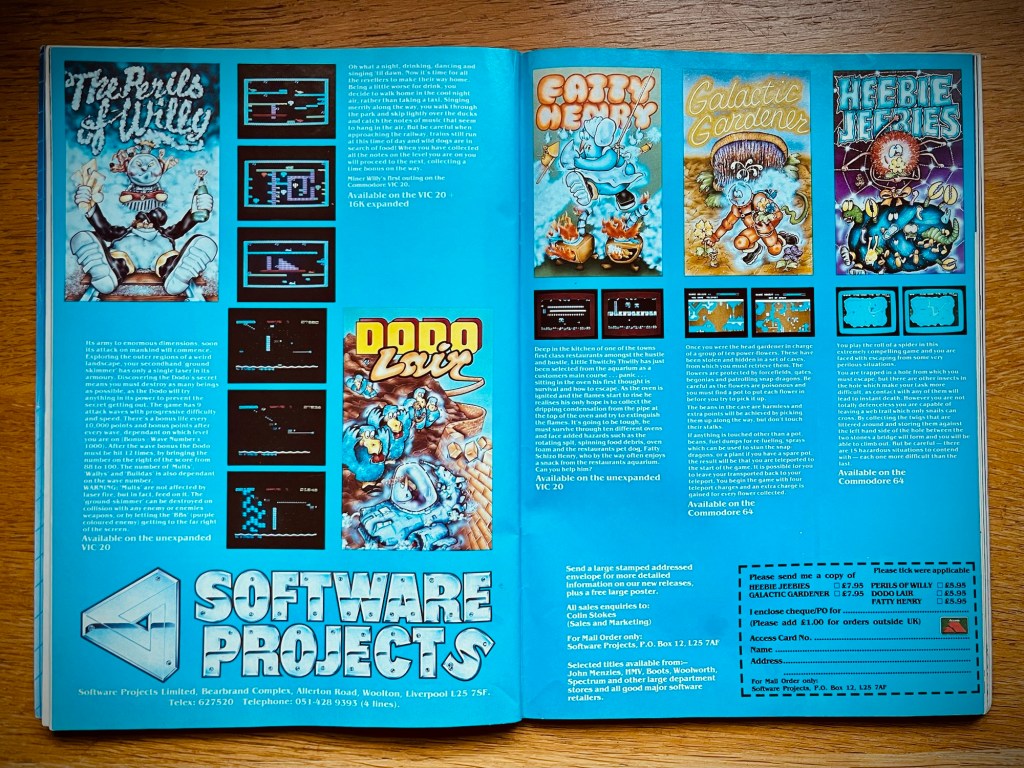
The September 1984 issue gave us our very first sight of The Perils of Willy, with it listed on another double-page, cinema frontage-styled ad, together with all the other Software Projects goodies you could now get your hands on. It was soon followed up by its own advert, heralding “Miner Willy’s first outing on the Commodore VIC-20!” A review also marked its release in the November issue… “Perils of Willy brings all the fun of Miner Willy to the Vic 20 for the first time… Willy is faithfully created in Vic graphics right down to his bowler hat… It’s a real Willy — not just a vague representation, as some Spectrum to Vic conversions tend to be… Comparisons with the original game are inevitable even if they are a little unfair… No, the game is not as good as the original Manic Miner or Jet Set Willy, but it is one of the best climbing games I have seen on the Vic 20.” Mmmm, not sure about that last bit but apart from that, I could probably rest my case here! We’ll finish off the story all the same though, with Jet Set Willy arriving on the C64 in December, where it’s not only deemed even better than its version of Manic Miner, but also one of the top five games ever on the platform! Obviously, that’s with the caveat they clearly never got to the end of it though, as initial copies shipped with a bug that meant you couldn’t! Didn’t stop it selling well though, even if not quite enough to top Decathlon and Elite in the Christmas charts that year. We can then conclude our tale with Jet Set Willy II, which arrived a few months later in 1985, and was confusingly a port of the expanded port of the original game for the Amstrad CPC, rather than a proper sequel, and while it still came from Software Projects, it was put together by Derrick Rowson and Steve Wetherill and not Matthew Smith. And whatever the reason for that was is probably the same reason behind why the final game in the originally planned trilogy, Miner Willy Meets The Taxman, never materialised.
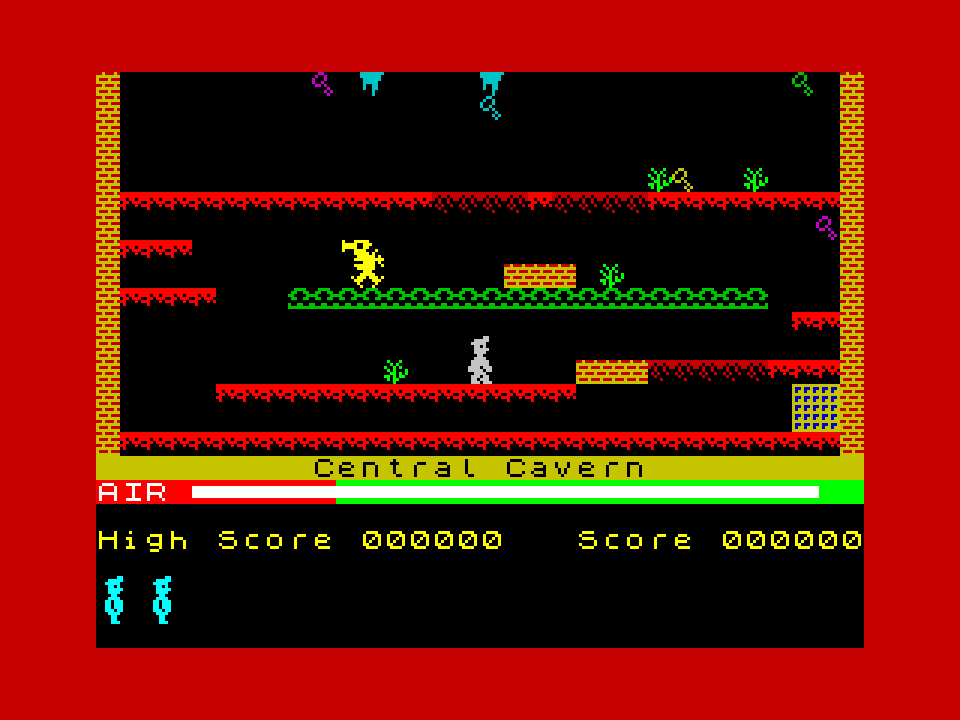
As just alluded to, the conversions for almost all of those that did materialise would keep coming, with ports to pretty much everything else at the time, from the Dragon 32 to the Commodore 16 and every other obscurity in-between, and later everything from the Amiga to the Game Boy Advance, all the way to the Xbox 360 and mobile phones and homebrews and mods and beyond! Not The Perils of Willy though, which stayed exclusive to the VIC-20 all the way until that homebrew port for the Spectrum in 2020, and that sounds like a good time to work out exactly where it fits! When we first met Miner Willy in Manic Miner, he’d stumbled upon an ancient and abandoned but fully automated and active mine beneath his hometown of Surbiton, so we needed to help him grab the riches that had been piling up over the centuries from its twenty fiendishly 8-bit, platform-strewn, hazard-filled screens. Which, in theory at least, he somehow managed to do because in Jet Set Willy we’re tasked with cleaning up his huge (sixty screens originally) new mansion after his housekeeper totally lost it with him after a particularly rowdy party the night before! I know it’s only a curio but I’m counting Andrés Night Off (the C&VG type-in by Matthew Smith from earlier) as cannon all the same, and it comes next, where we find Willy wanting something to eat after all that exertion but as well as his troubles with the housekeeper, now the cook has disappeared for the night too, so he heads off to the kitchen to make a sandwich… Only to find it swarming with man-eating pizzas you need to help him escape from!
It’s no wonder he fancied a night away from the mansion as we now head to The Perils of Willy, and catch-up with party-boy after being out on the town… “Oh what a night, drinking, dancing and singing ’til dawn. Now it’s time for all the revellers to make their way home. Being a little worse for drink, you decide to walk home in the cool night air, rather than taking a taxi. Singing merrily along the way, you walk through the park and skip lightly over the ducks and catch the notes of music that seem to hang in the air. But be careful when approaching the railway, trains still run at this time of day and wild dogs are in search of food!! When you have collected all the notes on the level you are on you will proceed to the next, collecting a time bonus on the way.” That’s the game – I said there wasn’t a lot to it! Doesn’t sound much like a cut-down version of anything set inside a mine or a mansion though. It does, however, sound like just the kind of thing our Willy might do after the last game, and also the perfect scenario for a fall down the stairs, leading to him getting some work done on his house while he’s recovering in hospital, only for the builders to turn out to be aliens, who’ve not only added a rocket room to the new extension, but are going to lead us on a journey into space, across well over a hundred rooms in Jet Set Willy II!
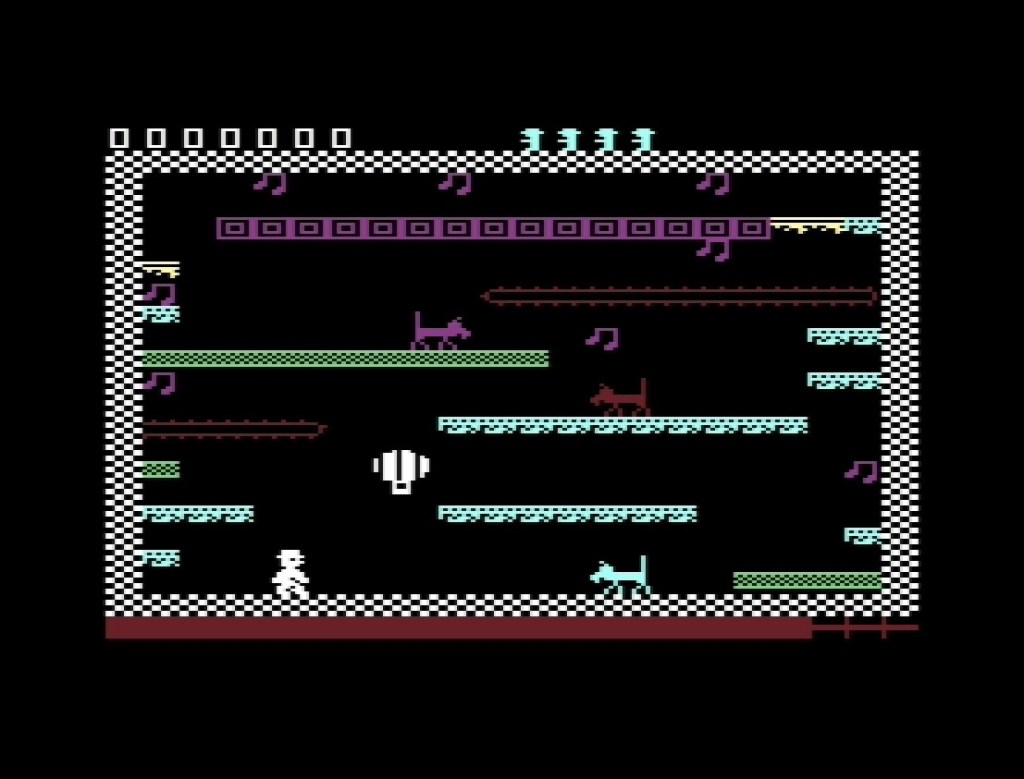
That’s all in his future though… For now, we’re going to have enough trouble just getting boozy Willy home to his mansion, which is about thirty-two (not thirty-three as advertised) screens away, although it could just as easily be a hundred because good luck even seeing half of them! It all starts so well too, as you’re eased into your moonlit stroll, skipping lightly over the ducks… Yeah, right! Don’t believe that back of the box blurb for a second because this game hates you from your very first step, and they certainly ain’t ducks! It’s certainly Miner Willy though, perfectly ill-proportioned in his familiar bowler hat, and while he’s clearly been enjoying his new-found wealth (and he flickers a bit), he’s also totally authentic, from his dumpy waddle (which is really nicely animated) to the wide but ultimately pixel-perfectly predictable arc of his jump, and it’s all elegantly mapped to left, right and fire on your choice of keyboard or joystick. Beautiful! Which, unfortunately, can’t really be said for the most grating piece (and I mean “piece”) of music in the history of video games, which greets you once you’ve hit CTRL on the title screen. Speaking of which, I don’t want to forget its attract mode, of sorts, which kicks in after a few minutes and takes you through stills of all the screens you’re probably going to miss out on! Anyway, that music, and it’s the opening six seconds or so from Led Zeppelin’s Stairway to Heaven, comprising two miserable, virtually monotone channels of slowed down, heavy-handed melody of sorts, looped endlessly, or at least until the harsh squark of you colliding with something (which is about the only other sound) mercifully stops it in its tracks! Like it or not, it’s a real ear-worm regardless though, and there’s no chance you’re ever forgetting it!
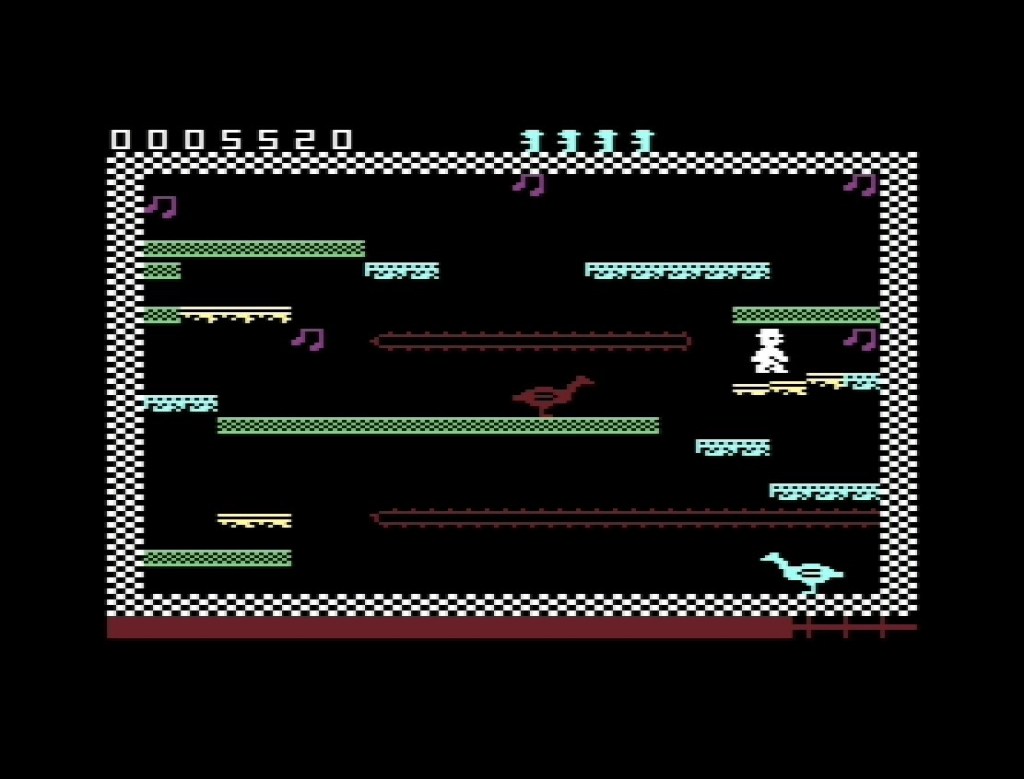
Once you’re in the swing of jumping, and the demands of the collision detection, and one of rock music’s greatest anthems being totally ruined though, the first screen isn’t so bad… As long as you don’t hang around because I forgot to mention the timer counting down on each one! Anyway, the general flow is working out the optimal route to each of the musical notes on the screen you need to collect to get your bonus for time remaining then move on to the next. It’s a similar setup to Willy’s previous adventures, but more abstract this time, in part because none of the screens have a name here, and it’s amazing how much personality such a simple thing can inject into a game when you notice it’s absent – would you know Manic Miner’s Central Cavern is a central cavern if it didn’t say so? It works though, and I’ll come back to this later! It’s also partly down to the necessary reliance on textures on the platforms to give them variety rather than mixing things up with wild colours – like on its bigger sibling, muted is the order of the day on this system, although thankfully it’s a bit more easy on the browns than the C64! But while it’s not so in your face, the platform placement is superb, combining regular horizontal structures, moving conveyor belt things (yes, in a park), and crumbling walkways into proper puzzles as you try to traverse each screen. By the way, those crumbling walkways will never cease to be a marvel to me wherever I still come across them, just like they were forty years ago right here!
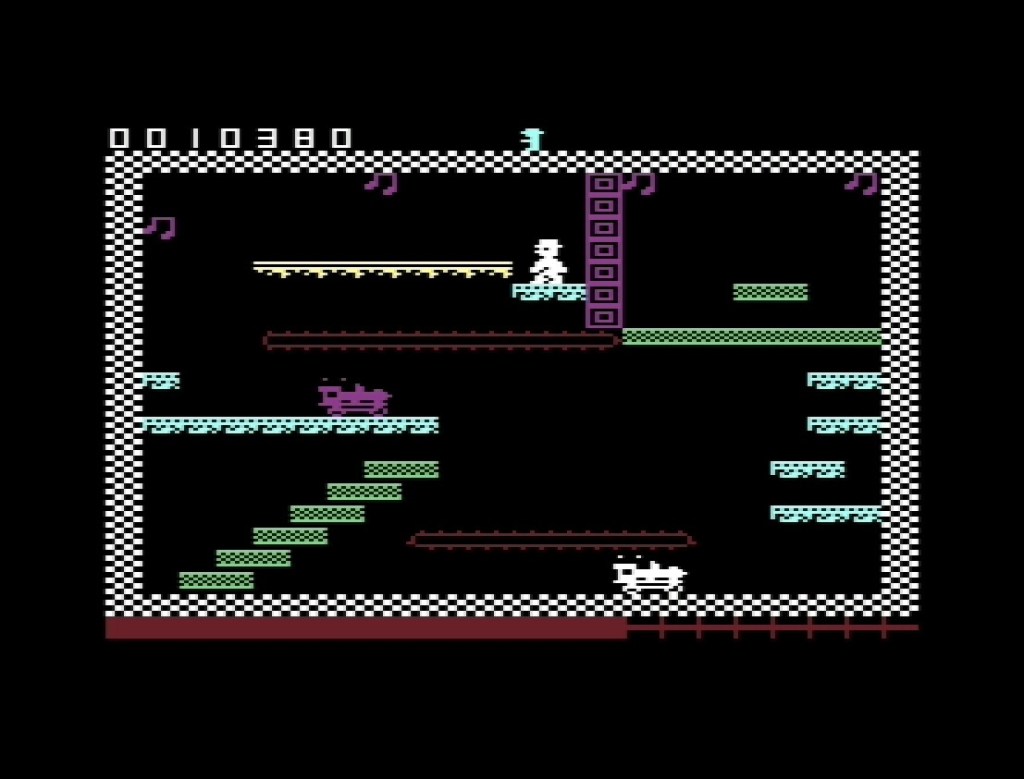
Of course, painfully logically positioned platforms are one thing but they’re no fun until you throw in wild dogs, wild ducks and, er, hot air balloons floating up and down in the middle of the night to hinder your progress! Obviously, the slightest touch from any of them is one of your five lives gone, and as well as the wildlife and air-filled aircraft, later on you’ve also got trains, and every one has its own slight variance to keep you (and the necessarily very responsive controls) honest. For example, the duck (which I’m sure is actually a goose) moving its head up and down to impede your takeoff, or likewise the dogs’ wagging tails as you land. The screen really starts to fill up with them too once you’re a few screens in, while platforms get shorter (unless they’re the crumbling ones) but more dense, just like the packs of wild beasts they’re supporting, demanding both timing and precision and just a bit of luck, just like a real Miner Willy game should! Some real leaps of faith on a couple of them too, with musical notes suspended way above big drops, and if you’re dropping any more than about twice your height then that’s another life lost. And although you’ll definitely be experimenting with navigation for a very long time on some of these, while also trying to perfect the preceding screens because you’ll soon need to get all the way back to them first too, there’s only so many times you can come into even the briefest contact with a crumbling platform before it’s not there anymore, meaning a painful wait for the timer to expire so you can expire too and try again. And again!

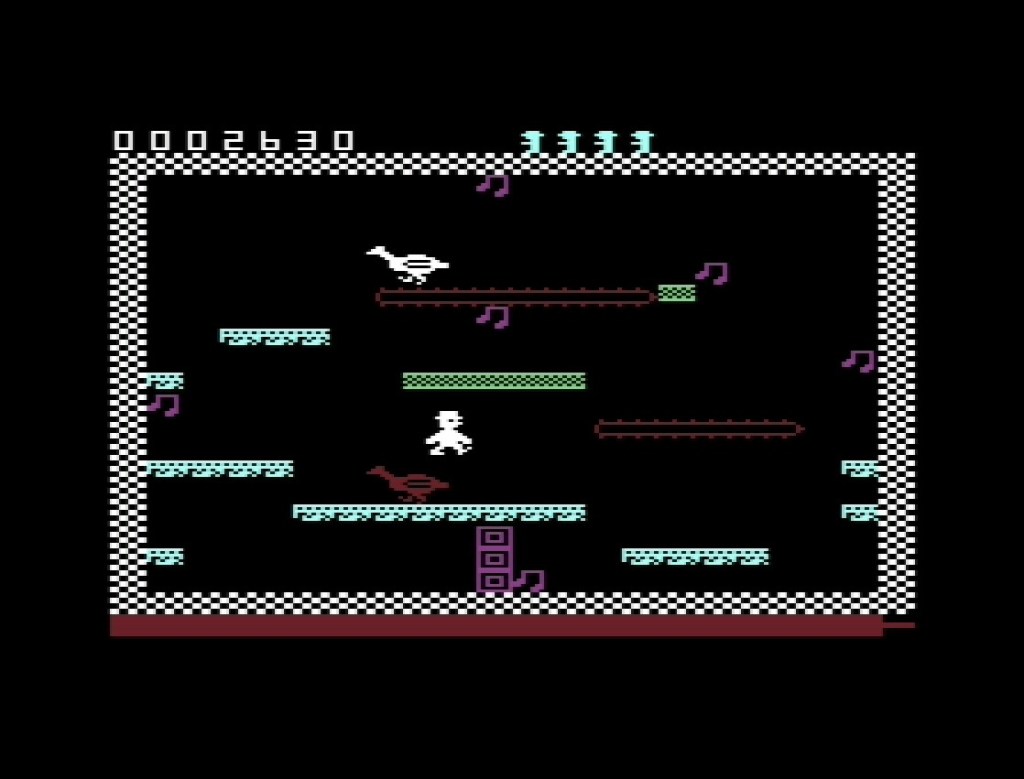
It’s undeniably brutal but puzzling out routes and timings and risks you can and can’t take is all part of the fun, and you’ll soon forget that apart from a load of ducks or geese and dogs and trains and hot air balloons, the only thing remotely tying you to a tipsy journey home through the park was being told on the box that’s what you’re doing, but don’t worry because your imagination is already filling in the blanks and it’s the best park ever… Just like the Central Cavern was the best central cavern ever! And yes, it might lack the colour and the madcap variety of its predecessors, but it’s got all their movement and life and energy and outrageous but outrageously fair difficulty in spades. There’s even a bit of colour clash for full authenticity! And if you want a bit more of that and all of the above, you could always try that wonderful ZX Spectrum homebrew version from earlier instead… Really gorgeous loading screen (pictured above) followed by a whole new world of Led Zeppelin played Spectrum-style, then you’re into a stylish recreation of the game (pictured below), built out of Manic Miner, with spruced-up enemies featuring some really nice extra animation, a less harsh in-game take on Stairway to Heaven, and more vibrant colours.
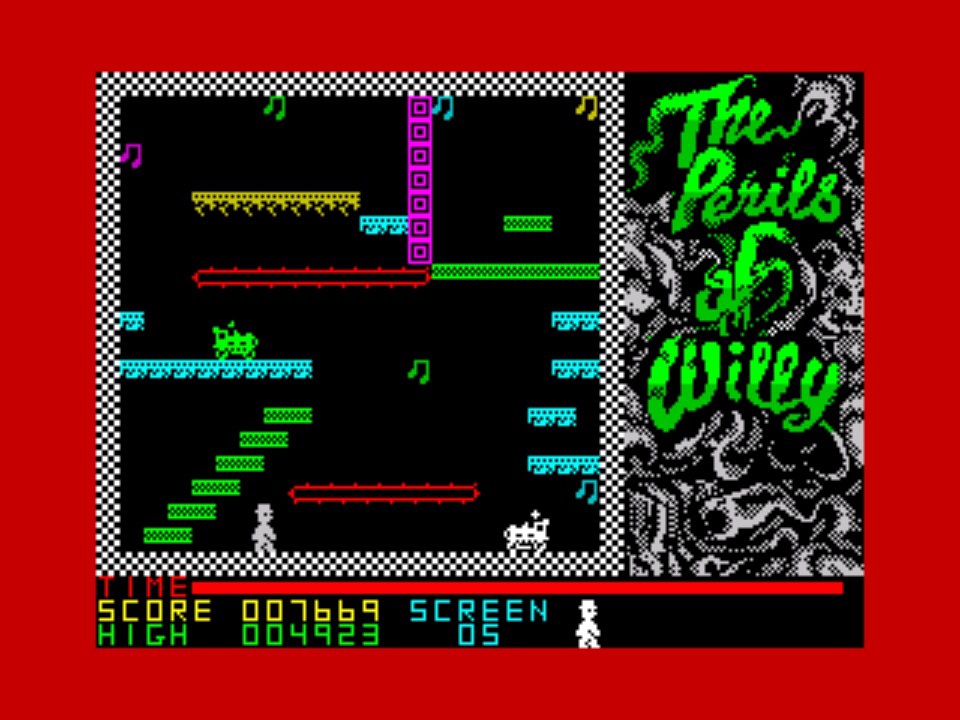
It’s now played inside in a square checkerboard border too, with a fancy bit of decoration down the right side and cleaned-up scores and so on down below, but the level layouts are the same, and the platforms also look the same apart from the colours. I think it plays slightly faster too, and with a more forgiving jump, but even on a Spectrum, it’s still totally distinct to Manic Miner, so I think that’s the final nail on that cut-down coffin! Very nice work all the same, and you can still grab it here: https://happycodingzx.itch.io/the-perils-of-willy. Be sure to check out Happy Coding’s other Spectrum stuff while you’re there too! Of course, I’d go on to join the Spectrum brigade too, experiencing the best of both worlds long before a homebrew would allow, and would soon count both Manic Miner and the first Jet Set Willy at least among my all-time favourite games as well. But while it might not have the glamour or the character of either of those, my first interaction with Miner Willy on the VIC-20 is always going to be extra special to me, and not just because it was the one I had (but no one else did!) but because – as we’ve now learned – it’s a perfectly self-contained, standalone experience in its own right, and without doubt an extension to the tale rather than a simplification of it. Hell of an 8-bit platformer too, and forever my own manic miner!
As always, I’ll never expect anything for what I do here but if you’d like to buy me a Ko-fi and help towards increasingly expensive hosting and storage costs then it will always be really appreciated! And be sure to follow me on Instagram, X (formerly Twitter) or Threads for my latest retro-gaming nonsense!
 Retro Arcadia
Though I had played the C64 Manic Miner version before I got Perils of Willy for my Vic, I was extremely pleased with it. Played as well, looked practically as good, and the music was actually better – though very gloomy! But I missed the room names. Like you said, it’s amazing how much personality such a simple thing can inject.
The ZX Spectrum might have got its homebrew in 2020, but Vic 20 got its homebrew of Main Miner in 2018! Also 16K expansion required and very faithful to the original (which I finally got to play last week on my newly acquired “The Spectrum” from Retro Games Ltd.)
LikeLiked by 1 person
Sorry, I totally missed this before. You’re right, it is gloomy, but I only really noticed it when I was grabbing screenshots here! I’ll have to look up VIC Manic Miner – something else I totally missed! Glad you’re enjoying The Spectrum. I love it!
LikeLiked by 1 person
I love it too – the collection of games included is absolutely amazing. So many unique games and so many awe-inspiring
isometric games to explore!
LikeLiked by 1 person