Considering how much I like a list, and how much I also like a shoot ‘em up, it’s been far too long since the first one of these, where I covered my top ten favourite horizontal shoot ‘em ups! Not like I didn’t know exactly how the countdown was going to look either… Anyway, we’re here now, and this is the second in a series of top tens for the various flavours in the genre, so at some point we’ll also still get to single screen ones, 3D ones, isometric ones, multidirectional ones, maybe rail-shooters and so on – before finally bringing everything together for the definitive top ten, which isn’t going to be quite as straightforward to whittle down as this instalment, though on current form it might be a few years before I need to worry about that!

Right, let’s get back to today’s order of business, which is the vertically scrolling shoot ‘em up or schmup or stg or shooter, as we used to say! Same format as the horizontally scrolling one, as well as stuff like my ZX Spectrum and Commodore 64 loading screen countdowns before it, meaning we’ll be going in reverse order with a quick look at what each game is all about, followed by my own thoughts on why it’s included. And I’ll try to limit that to a paragraph each so we’re not here all day! No other rules in particular – as long as the screen’s moving up (or sometimes down) and you’re moving around it shooting stuff then it’s all good, so let’s jump in!
10. Twin Hawk (Arcade)
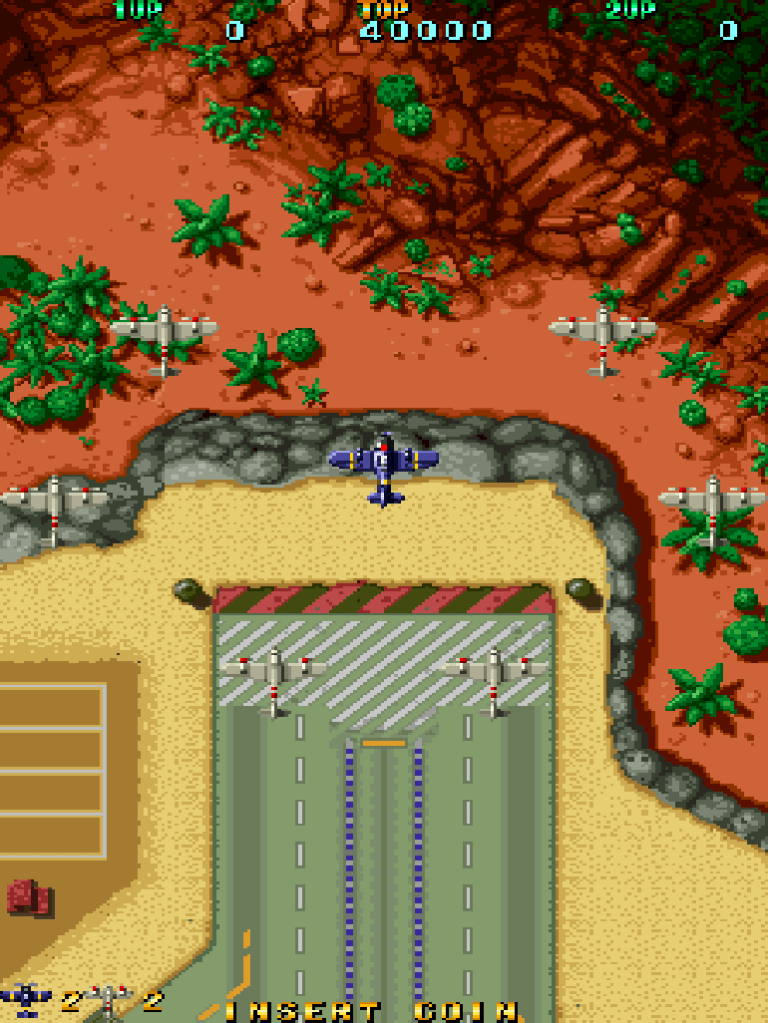
Our first game, developed by Toaplan and published by Taito in 1989, sees us in an alternate World War II timeline, although specifics seem to be dependent on which version you’re playing as well as where you’re playing it! Can safely say it will be a load of nonsense regardless, and, if you’ve ever played stuff like Flying Shark, Twin Cobra, or other Toaplan stuff from around then, it’s going to start out familiar too – fighter plane flying over a surprisingly tropical landscape, considering it’s supposed to be set in Europe, with lots of other planes, gun emplacements and increasingly large tanks to shoot before they shoot you, with the latter the more likely scenario until you learn where they’re coming from! All the usual power-ups too, but the bomb button is where it starts to do it’s own thing, with it calling in six support planes to fight alongside you until they’re shot down, at which point they’ll go kamikaze on the nearest enemy! Disturbingly, you can also command the whole lot to do exactly that before they get a shot away, or you can replace them with a regular bomb instead before they get into formation. It’s set over four seamless levels separated by bosses and a change in background music, which starts out like nothing you’ve heard in one of these games before – like an even more mellow take on the Out Run high score table! Soon becomes a bit livelier though, as your plane and its helpers take off across its stunning, almost volcanic (but definitely tropical!) landscape, full of burnt reds and oranges that give way to seas and beaches and militarised zones. Best of Toaplan in all respects, I reckon!
9. TwinBee (Arcade)

All the way back to 1985 for our next game, Konami’s pioneering cute ‘em up that would evolve into well over a dozen more TwinBee games that included more really fantastic shooters but also extended to RPGs, roguelikes and puzzlers! Actually, as alluded to before, while this list pretty much wrote itself, this was the only game I had second (and third) thoughts about because I am really fond of Pop’n TwinBee on the SNES and Detana!! TwinBee (or Bells & Whistles) on the PC-Engine, but having revisited them all back-to-back just now is was clear there’s one I love above the rest! The premise is similar in all of them though – a kind of cartoon-Xevious, with your airship fighter, TwinBee, together with WinBee if you’ve got a player two, battling the evil King Spice who turned up from outer space and invaded your home, Donburi Island. As well as shooting and bombing his forces, including a bunch of madcap bosses at the end of each of the five stages, you’ll also want to be shooting all the passing clouds because they probably hide bells, and that’s where you can amass some really big scores or keep shooting them a certain number of times to change their colour for speed-ups, gun upgrades, shields or a replica ship for extra firepower. This literal juggling act quickly forms the game’s central mechanic, with you balancing the possibility for chaining regular bells for score or shooting them just enough times (and not more) to change their colour for survival, and all in the midst of vicious enemy bullets! It’s a unique and thrilling concept, heightened by the cacophony of bells and whistles (good name too!) and relatively simple but imaginative and vibrant graphics. Timeless game.
8. Star Force (Arcade)

This started out a NES game for me, which I came to pretty late, but it was love at first sight… And then I found the 1984 original – also known as Megaforce – which, at the time, had just got an Arcade Archives release on Nintendo Switch, and there was no going back! This was by Tehkan, later called Tecmo and today known as Koei Tecmo, of Dynasty Warriors, Ninja Gaiden and Dead or Alive fame, among many others, and while it’s maybe not as familiar as those, it seems to have done well enough in Japan to get a strangely genre-crossing NES sequel, Super Star Force, in 1986, as well as an arcade follow-up, Final Star Force, in 1992, which, unfortunately, I’ve never found to be particularly exciting. That said, I’m not sure how exciting I can make Star Force sound – it’s just a really good, high-score chasing sci-fi shoot ‘em up that for some reason I instantly clicked with and haven’t left alone since! You’re in a spaceship taking down waves of enemy spaceships and ground installations on space-island stages named after letters of the Greek alphabet, each with an end of level boss that you’ll need to beat before it moves out of view or you’ll have to replay a bit more of the level before having another go, a bit like 1943. There are a couple of cool scoring mechanics, not unlike a well-known Cave game we’ll come to later on, such as a fossil that sometimes appears, and depending on which side of the screen that happens, shooting on the other side will make Cleopatra appear, giving you a whopping million point bonus if you shoot her too. There’s also more accessible ones, like not shooting when you hear a tune that means a mini-boss is about to appear, and instead lining yourself up for a single shot when it’s middle flashes white; another has you trying to shoot chains of arrows, and there’s all kinds of other hidden bonuses to discover, and these are what you’re living for in Star Force and make it so addictive! It’s also a really good-looker for the time, with a gorgeous parallax starfield behind these almost Bitmap Brothers-style metallics, contrasting with the organic textures beneath them. Fantastic catchy music too and just a beautiful experience!
7. Xenon 2: Megablast (Atari ST)
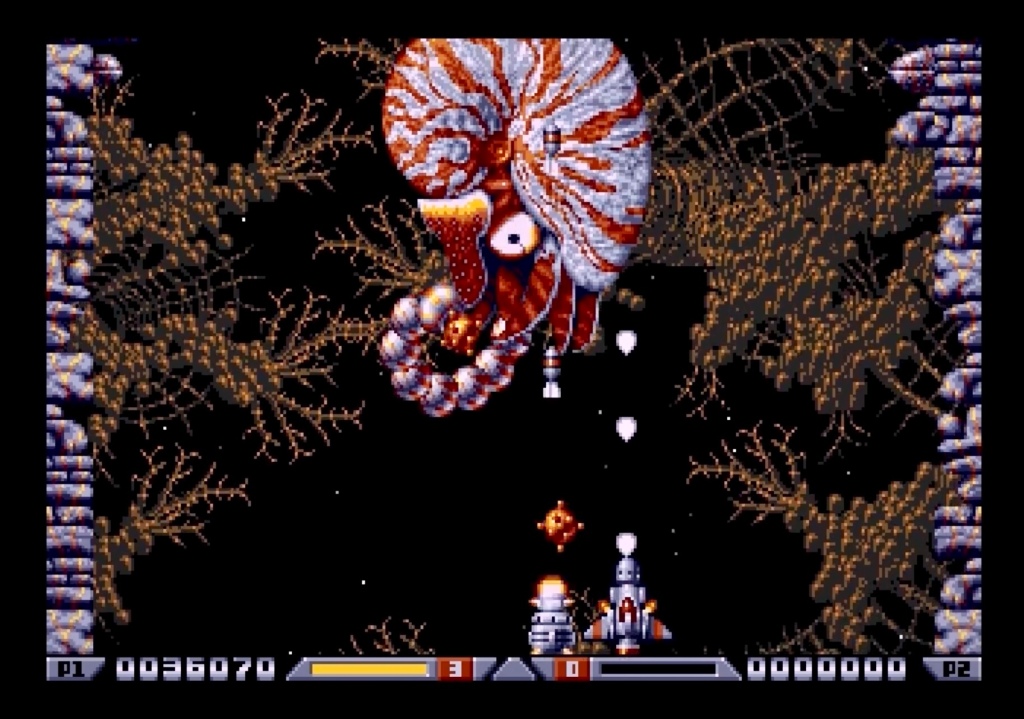
I genuinely didn’t plan this but speaking of Bitmap Brothers… Actually, I should probably start this one by acknowledging the Amiga version is probably the one that should be here, given its more extensive soundtrack, but that’s not in the giant box that’s sitting inches away from me as I type, and I never liked Bomb the Bass anyway, so less is more as far as I’m concerned! Right, whatever your 16-bit computer of choice (and I mean computer and not console), this 1989 sequel to what I reckon was the first time we’d had arcade quality at home was absolutely lauded on release as pretty much the best shoot ‘em up ever, and at the time I was in total agreement! While I wasn’t so fussed about the soundtrack, it looked like nothing else I’d seen before, with horrifyingly realistc organic meshes and vibrant rock-forms scrolling beautifully over dense, parallax starfields that put even Star Force to shame, and some of those fossilised enemies are still among the most impressive you’ll see outside of a Darius boss battle, and would stand the test of time as some of the 16-bit era’s most iconic sights! Period showcase it might be but it’s got the gameplay too, set a thousand years after the original game when the Xenites decided it was finally time for revenge and planted five bombs throughout history, in turn causing the local wildlife to mutate, which you need to sort out! There’s more to that than just shooting stuff too – the levels become increasingly maze-like, so you’ve got a reverse gear on your ship, which you’ll also be collecting currency for so you can get the best upgrades in Crispin’s Swop Shop, and there’s loads of them to get to grips with, offering far more strategy to later levels than you’d normally get in a vertical shooter. Stunning game in all respects both then and now. By the way, I did a deep-dive on this one here if you’re interested!
6. Dragon Spirit (PC-Engine)

I had quite the journey to the version of Dragon Spirit I would eventually come to adore with the arrival of the PC-Engine Mini in 2020, which began all the way back in 1989 with the ZX Spectrum port of the 1987 Namco arcade game! Very impressive port it was too, at least until stage eight, when I understand a game-breaking bug prevented it from loading, although I was never good enough for that to be a problem I’d ever experience! Hard as it soon got though, it was nothing on the original, which had you controlling a He-Man-style dragon over nine immediately brutal prehistoric fantasy-themed levels to rescue a princess from a demon. There’s loads of variety, as you fly along rivers and over jungles and glaciers and more, breathing fire at all sorts of flying enemies with different attacks to anticipate, as well as dropping bombs on ones on the ground, similar to TwinBee from earlier, and also occasional eggs that will power you up with an extra head for extra flames, or a stronger shot, and sometimes you’ll collect orbs for special weapons like homing shots. It was all very unique at the time, and looking and sounding as good as it does didn’t hurt either, but as good as it felt to play, it was just so hard, with really rough checkpointing to boot that would often spit any kind of strategy required for the next bit right back in your face! But while it’s still a hell of a challenge, what the PC-Engine port loses in a couple of missing levels, it more than makes up for in balance, and the soundtrack is absolutely exquisite, making it one of the great ports on the system and the game the original never quite lived up to the promise of being, for me at least. I reckon the same is true of its platform-exclusive port of the sequel, Dragon Saber, too, which is definitely also worth a look!
5. Mushihimesama (Arcade)

There’s a terribly cringeworthy line in Bram Stoker’s Dracula where Keanu Reeves and his dreadful English accent says, “the impression I had was that we were leaving the West and entering the East.” Well, all the same, that’s more or less the impression I get as we move into my top five here, with most of them being not only a more “modern” take on the genre, but sharing a lot of the same heritage too! Moving on then, we’ve already seen some visually stunning games here, but I reckon Mushimesama – vaguely translating to Bug Princess – by Cave in 2004 might be the pick of the whole bunch! Its beautifully crafted forest floor and other bug-filled (not to mention bullet-filled) environments are outrageously full of life and variety, with five levels of brilliantly paced waves of insect enemies and skin-crawling giant bosses, one of which makes up the entire level by itself! And then there’s the spectacular but ultimately navigable bullet-patterns, unless, of course, you’re on one of the insane difficulties, of which there are many if you go for the Switch version I play nowaday! For bullet-hell it’s relatively accessible and survival is definitely learnable, but there’s also mad depth to the scoring too. The music is great and there’s even a story explaining why you’re on a beetle trying to save your family from a mysterious plague, and it’s all quite the thriller!
4. Espgaluda II (Arcade)

A lot of what I’ve just said about Mushihesama also applies to Espgaluda II, another bullet-hell arcade shooter from Cave in 2005 that I’m also most familiar with today on Nintendo Switch; worth saying that for both games, I believe these versions are based on the previous Xbox 360 Black Label releases that added all kinds of modes, not just to make them more welcoming (which they can be) but also add new scoring modes as well things like shield meters, allowing a bit of contact with a bullet and new evasive strategies. Anyway, this one takes place in more of a fantasy, futuristic medieval-type setting, with a bonkers story set over six levels about the original Espgaluda’s alchemically-engineered heroes coming out of hiding to take on some new evil threat three years later. These present a great choice of characters that will really let you find your own play style, and with all those modes on offer on top you can properly tailor this one to be your ideal shoot ‘em up. Some pretty complex gameplay mechanics though, rewarding going aggressive while also offering stuff like gauged invulnerability, bullet clearing and massive multiplier possibilities, but that’s just the beginning! It’s another beauty too, with so much variety and chaos behind all those mesmerising bullets and explosions and gold drops, backed by a relentlessly dramatic soundtrack. And it’s as exhilarating as it gets!
3. 1942 (Arcade / ZX Spectrum)
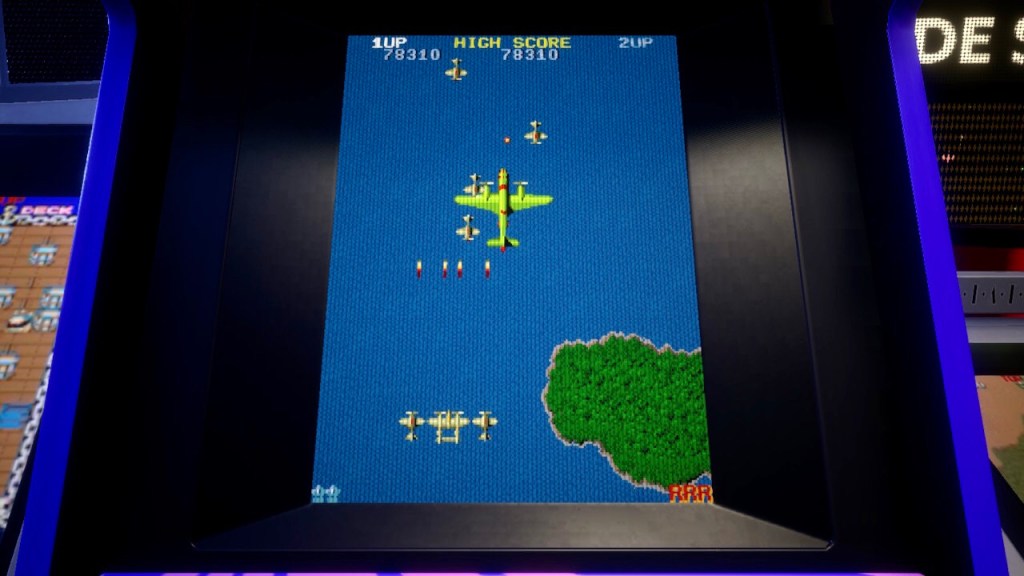
While “exhilarating” is a word associated with most Cave games, it’s maybe not so much associated with 1942, although if we’re talking plain old enjoyable then I don’t think it gets much better! I first played Capcom’s pioneering World War II shooter on a ferry to Ireland not long after its 1984 arcade release, and its toned-down but authentically playable Spectrum port would go on to be one of my favourite games on the system, with that unique loop-the-loop dodge mechanic as mesmerising at the time as any crazy bullet pattern since, and power-ups and huge boss planes like we’d never seen before! Hard as nails too, with its Battle of Midway-era Pacific Theatre setting (which would feature more directly in its erroneously-set 1943 sequel) providing an exotic but starkly vulnerable backdrop to wave after wave of historically accurate Japanese air forces to shoot down en-route to Tokyo thirty-two stages later! Like Star Force earlier, it’s simple, undiluted fun, all about getting a bit further for the highest possible score, and that’s all it ever needed, although it could have done without the non-stop, totally inexplicable ear-splitting whistle all the way through! I’ve also done a deep-dive on this one if you fancy a bit more, and if I remember rightly, there’s even a photo of me on that very ferry in there too!
2. Batsugun Special Version (Arcade)

I think this must be the only game in any countdown list I’ve ever done that was never properly released! Plain old Batsugun certainly was though, unfortunately marking what was just about the end of Toaplan when it launched in arcades in 1993, despite evolving the genre and paving the way for bullet-hell, with new levels of bullet density and enemy patterns, progressive RPG-like weapon upgrades and the introduction of the all-important hitbox! They were just about bankrupt by the time Special Version appeared in 1994 but it survived them and – as much as I still enjoy the original – is the reason that Batsugun is in this list, with what I reckon is way better balancing on the first “loop” (where the first version just got way too hard for me before it ended after five stages), offering a smaller hitbox, a shield that absorbed one hit, bigger bombs and new scoring mechanics. It’s regular world domination sci-fi fare that’s (thankfully!) light on story but doesn’t scrimp on the polish, with tons of detail in its environments, tons of colour in everything, and so much stuff being thrown all over the place, staying just on the right side of being overwhelming. Love the vaguely cyber-goth music too, set off as it is by the total chaos of the sound effects! Apart from 1942, this is undoubtably the game here I’ve played the most, taking the very best of everything that Toaplan had going before it, then throwing in everything else they had left at that point, which, given its legacy, turned out to be quite a lot! Whichever version you go for, it plays like a dream and is way more than just a pioneer… It’s simply the best of all worlds to me.
1. DoDonPachi (Arcade)

From the ashes of Toaplan – and that Batsugun Special Version in particular – quickly emerged Cave, further evolving those pioneering foundations into mechanics that would become synonymous with their output as well as defining in the genre to this day… And, as far as I’m concerned, not surpassed since DoDonPachi hit the arcades in 1997! As I said in my deep-dive for this one, I see this as Mega Man 2 to its DonPachi predecessor from 1995, simply refining something that was fundamentally already touching greatness into the timeless masterpiece I first came across on a dodgy PS1 (which I also expand upon in that deep-dive)! It’s military sci-fi of the most sinister order, set seven years after the original, where we find out all those mechanised aliens you wiped out first time around were actually your own squadron, who are now out for your blood! You’ve got six levels on the first loop and a seventh on the second but even if you get that far you’re then met with the craziest of entry requirements, so mere mortals are unlikely to see any of that bee-obsessed nonsense true endgame! Doesn’t matter though because whatever the duration, and while its presentation and some of it mechanics might have been surpassed by Cave’s later releases, as far as I’m concerned, the sheer exhilaration it offers never was; in fact, I can’t think of many games in any genre where it ever has been! And that’s not to say it doesn’t look and sound absolutely spectacular for what it is either, with so much exploding all over the place around all the enemies and bullets already all over the place, and all at the same time, as you sweep impossibly across the face of its majestic carnage, juggling shot types, chaining kills and trawling points on a massive scale as you take down bosses and uncover its secrets, which I’ll probably never fathom but will gladly die trying!

I know I said a couple of times before that there was little deliberation required in putting this lot together but had it been a top twenty instead then that would be a whole different matter, so I’m going to finish with a few honourable mentions for some of the games that just missed out! I could probably have filled the rest of a top twenty only with Cave games too because I do have a bit of a thing about them but I’ll just mention Cyvern as a real favourite, Muchi Muchi Pork! as an emerging one, and much like I said in the horizontal version of this countdown about Darius Gaiden over G-Darius, if I’d played a bit more of Mushihimesama Futari over the original then that might have been here instead! Likewise, I could also have gone for a bunch of the 19XX series, and in particular 19XX: The War Against Destiny or 1944: The Loop Master. I do have a thing about World War II shooters in general, so I’ll also mention the Sega Saturn version of Strikers 1945 and the Atari ST version of Flying Shark (mainly because it suits my colourblindness better than the original). Then I can’t close without also throwing in Raiden Fighters 2, Castle Shikigami 2 on PlayStation 2 and the incredible Light Force on ZX Spectrum, pictured just above! And I know Ketsui and DoDonPachi DaiOuJou and Truxton and Ikaruga and so on are supposed to be in there too but it’s my list and I really hope you enjoyed reading it as much as I did putting it together! And I’ll see you for the next one sometime, when I’ll be counting down my top ten favourite single-screen shoot ‘em ups!
 Retro Arcadia
This genre has never been for me although I enjoyed reading through this. I can tell you are passionate though. I haven’t played any of the games in your top 10, except possibly 1942 for a brief period. These games are usually too fast and difficult for me.
LikeLiked by 1 person
Thanks! Appreciate it! I know they’re not for everyone but some are definitely more accessible than others and there’s a lot of really good beginner-friendly games where you can learn a few basic principles. A guy called Schmup Junkie has some really good videos on his YouTube channel covering these if you’re interested.
LikeLiked by 1 person
That’s really kind of you. Thanks! I’ve got a few more top tens pencilled in for the rest of the year already. I really enjoy putting them together too! You should check out Schmup Junkie on YouTube. He did some excellent beginner guides which tell you what to play first and how to play them. Some are definitely more accessible than others!
LikeLike
Where’s Slap Fight (Alcon in North America)? Where’s Alpha Mission II? Where’s Xevious ?
LikeLiked by 1 person
Good games just not my top ten favourites!
LikeLike
I was going to ask the same thing! – loved Slap Fight a lot!! (And completed it 3 times over on the same go…!!)
LikeLiked by 1 person
Nice going! Just not a top ten for me.
LikeLike
I played many scrolling shooting games in the arcades and at home,but I tended to veer towards adventure games and strategy types, although there was a few ‘curve balls’ thrown in like Atari’s ‘Battlezone’, especially the site down cabinet version,also others included in my list are ‘Williams, Defender ‘, which I really wish I could get a working cabinet version,but I doubt I could afford it, lastly going way back was the ‘talking’ Berserk, very simply but quiet sinister and eerie,there are many others that were off the grid so to speak in the Eighties,so if anyone wants to add and contribute I would be more than happy.thanks Authors and other contributers to this blog,I will bookmark and keep reading 👍😊🇬🇧
LikeLiked by 1 person
Thanks a lot for the kind words! Just one person here and it’s really appreciated! I’d love another go on that Battlezone arcade cabinet! I didn’t really play many shooters in the arcades either – preferred more value for money because I was useless! Cheers, Steve.
LikeLike
I love a good shmup! Gunhed on the PC Engine, and Super Star Soldier are right up there for me.
LikeLiked by 1 person
Oh yeah, Super Star Soldier is great I’ve only ever dabbled with Gunned so will give that a proper go! So much choice on PC-Engine!
LikeLike
Great post — I really enjoyed reading about free browser games and how easy they are to access! If you’re looking for a wide selection of shooting games with no download required, you might want to check out this collection on Suena Games: Play Shooting Games Online Without Download. I found the interface smooth and games load fast in browser — a good option for casual players. Thanks for sharing this — looking forward to more such posts!
LikeLiked by 1 person