As I write, it’s been the best part of two years since I put together my Top Ten Commodore 64 Arcade Conversions countdown, but I’ve been hanging on to a thought ever since… If I did the same thing for the ZX Spectrum, would it be totally different? Maybe, but I really wasn’t sure, so you know what we’re going to do? Let’s find out! As a point of reference though, as much as I’d love you to click the link just above and have a look at the C64 list for yourself, I know you’re probably as lazy as I am, so as a quick recap, in descending order from the number ten spot, it included Alien Syndrome, Saint Dragon, Bubble Bobble, Badlands, Hyper Sports, Pac-Land, Buggy Boy, Spy Hunter, Ghosts ‘n Goblins and Commando. Phew! My gut feeling is that we are in for something pretty different this time, but as with that lot, we’re talking official arcade conversions from the system’s heyday, rather than clones, knock-offs or clever modern homebrews taking advance of fancy compilers, as wonderful as they can be. Them’s the only rules though, so with that, we can get into the top ten, once again in descending order, a paragraph on each, then a few honourable mentions at the end. Enjoy!
10. Bomb Jack

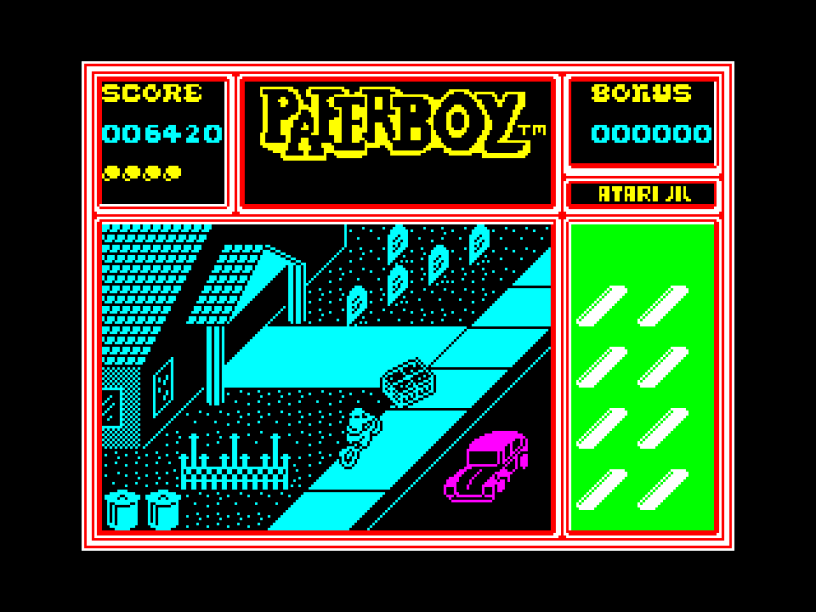
From the outset, I’ve got to admit, this is destroying me! I know I just said we’ll come back to honourable mentions, but I can’t believe I’ve had to sacrifice Paperboy! It did mean it got the headline pic at the top of the page though. Anyway, this arrived in 1986, a couple of years after the Tehkan (later Tecmo) arcade game, and has your little superhero, Jack, travelling to well-known locations all over the world, where he needs to frantically jump and glide around, trying to defuse all the bombs all over each single-screen level, ideally in the order their fuses are sparking away for the serious bonus points. Obviously, there’s also all manner of meanies out to stop you but who or what or why or anything else isn’t really further explained anywhere, and that’s just fine! From one of gaming’s most iconic sights, as you start out in front of the Sphinx and the Pyramids of Giza in Egypt, this conversion is incredible (and among the best of them anywhere), a bit more monochrome but with all the personality, as well as the authenticity of every location, which undoubtedly goes for the gameplay too, with that exaggerated jump and tap-to-glide mechanic making all the difference, providing hidden depth and precision to your movement but also encouraging risk as you become more skilled and decide you can just above squeeze through that gap between enemies and get at the lit bomb! Not for the last time here, sound is dumbed down, but I reckon what’s there is perfectly authentic too, if a little hard on the ear, and adds up to a brilliant adaptation with all the high-scoring addictiveness I love in the arcade game, and more or less everything else too!
9. Commando
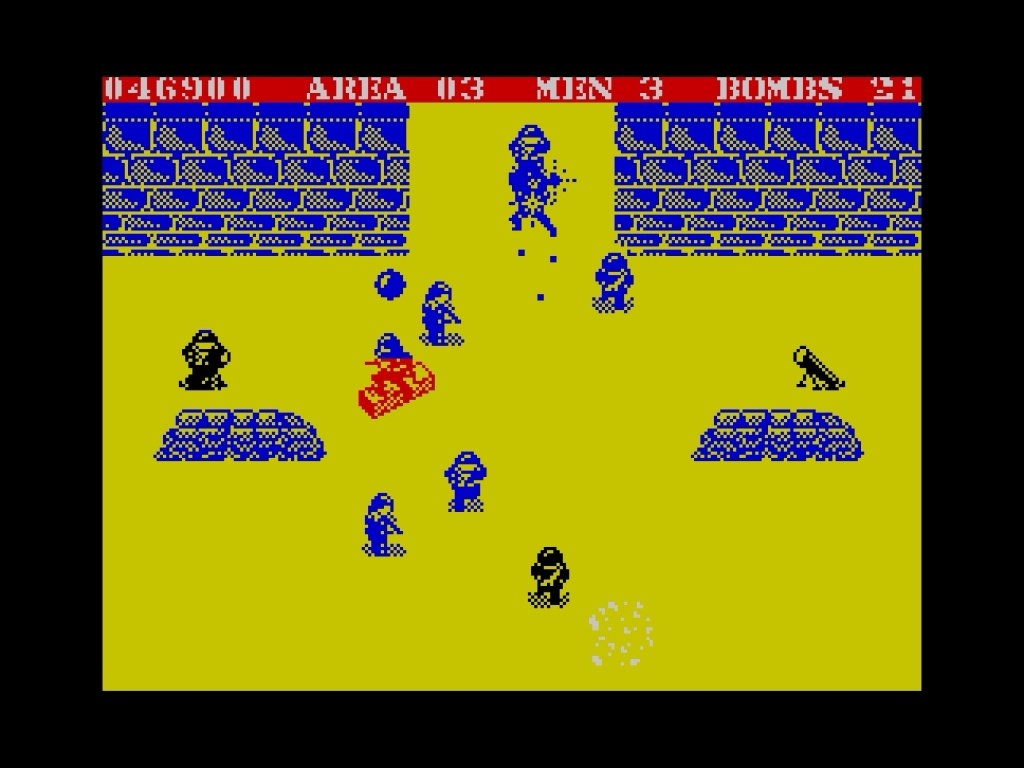
It was number one on my C64 countdown but was there ever a bad port of Commando? I guess the Atari 7800 version was a bit functional, and I wasn’t keen on some of the additions in the NES one, but no, I don’t think so, and yes, I’m a sucker for the Atari 2600 and won’t hear a word said against that version either! As for the Spectrum, its take on this top-down, run and gun masterpiece is very yellow and blue and red and all the colours of its unique rainbow, and there’s not a hint of one of gaming’s great (if not greatest) soundtracks during gameplay, but it does move incredibly smoothly, and it’s all so responsive and generally fast and frantic too, and is everything that’s great about the 1985 arcade game! This arrived from Elite very soon after, in time for Christmas the same year, and really is a bit of a miracle, considering the Spectrum wasn’t exactly proficient at most of those things I just mentioned! Your little soldier, Super Joe, was proficient with a machine gun and a box of hand grenades though, as you travel as far as possible behind enemy lines, going Rambo (which it went head-to-head with for your pocket money at the time) against rebel enemy forces across various terrains, which I always thought were like a World War II movie set. Weird colours aside, they’re right at home here too, full of detail and atmosphere with most of the set pieces of the original, and simply crawling with character-filled sprites. The sound is functional, but you’ll soon be focussed on spraying bullets like a boss and staying alive as long as possible, and then doing it all over again and again! Just brilliant, and we’re still only at number nine…
8. Out-Run

I don’t care what anyone says nowadays about this port of Out Run – I still play it and I still think it’s great, just like I did on Christmas morning 1987, when I also still couldn’t quite believe what I was seeing… Which was also the case for pretty much everyone else at the time, magazine reviews included, and that’s all the justification I’m giving for this being here, born-again framerate fascists be damned! Sega’s sun-drenched 1986 original isn’t just my favourite racer but is a top ten game of all time for me too, taking you through your choice of exotic routes to one of five destinations, all against the clock and relentless traffic, as one of gaming’s most memorable soundtracks carries you through one of its most exhilarating experiences to this day! As usual, the Spectrum version took a hit on colours, going for a mostly monochrome look on simplified but boldly authentic and perfectly atmospheric backgrounds, and your Ferrari looked just like you wanted it to – big and convertible with your girl by your side – and everything else looked more than fine and where it should be. You had all the tracks from the arcade version too, and while there was a bit of multi-load going on to drive on a new one, it stayed in memory if you were doing the same route again, and on my 128K machine at least, you had great versions of two of those wonderful pieces of music. Again, usual compromises and more than acceptable for having this unbelievable arcade game in your own home. And like everyone else, I didn’t even notice it wasn’t quite as fast as the arcade version, so there!
7. Hyper Sports

Hyper Sports was the sequel to 1983’s Track & Field, which interestingly didn’t get a Spectrum port until 1988 when it was released for the first time on the Game, Set and Match compilation. And it stank big time! Anyway, back in the arcades, Hyper Sports arrived a year later, in time to get an official 1984 Summer Olympics license in Japan (only) and featured seven events that mixed button-mashing and timing, meaning your poor fingers generally got a break between beatings! Plenty of variety too, with swimming, skeet-shooting, long-horse gymnastics, archery, triple jump, weightlifting and pole vault, with the latter being the only one that didn’t make it to the Spectrum when it got there in 1985. Each event came with a qualifying time or score, depending on its mechanics, and apart from swimming, you’d get three goes at each one to make the cut for the next. And wherever you’re playing, some are going to take a lot more perseverance than others to be able to do that! My brother and I co-owned this on Konami Arcade Classics, and as the game that sold us on the collection, we couldn’t have been happier with it, and while there wasn’t a single game on there we didn’t play all the time, we absolutely played this one to death, looping all the events multiple times until our hands (or joystick) just couldn’t keep up with the weightlifting anymore, and being able to get a perfect score on the skeet-shooting literally with our eyes closed, playing by sound alone! And when I eventually got to the arcade version – which I still also play regularly – that translated right back again, which I think is a pretty good indication of how good the Spectrum port was! It takes a few hilarious, seventies pornstar-like liberties with the presentation but that’s all good too, with every event perfectly recognisable and controlling like the joystick-killer it needed to! Proper all-time favourite right here that I still really need to do a proper deep-dive into sometime as well.
6. Operation Wolf
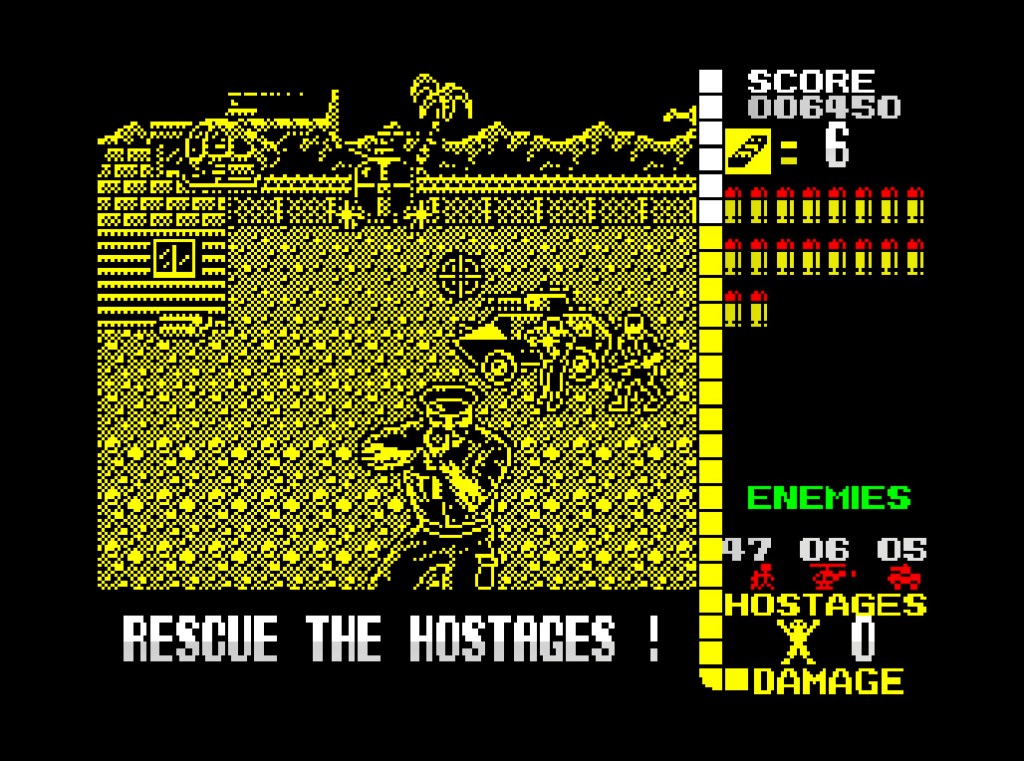
When I was talking about Out Run just now, I was thinking about other arcade games whose presence on 8-bit systems in particular simply defied belief, and I realised how many of them also seemed to originate from Sega, like Afterburner, Space Harrier, Thunder Blade, Power Drift… The arrival of Taito’s Operation Wolf in time for another Christmas, 1988, was something else again though, which is especially interesting because just a year later, Christmas 1989, I’d be fawning over the Atari ST version, which introduced the whole new phenomena of the “arcade perfect” conversion, but that’s a story for another time! For now, the story here (such as it was) was true to the 1987 lightgun-toting arcade original – travel on-rails through six military-themed levels including jungles, prison camps, airports and various bases to rescue the hostages. Each one was a bit more than just shooting everything in sight though, with you also tasked with stuff like cutting off the enemy communications or getting information out of them, even if it did all just involve shooting everything that moved, unless it was one of the fleeing civilians or nurses carrying some unfortunate in a stretcher who shouted “NO!” if you shot them! It might not have had the uzi, but the Spectrum version simply nailed everything else about the arcade game, with outrageously good-looking graphics that perfectly captured the feel of the original. So much going on all at once too, with enemies relentlessly coming out of the distance and in the foreground (including the one that looked like something out of The Village People) all over the place, then there were those nurses and madcap animals and stuff you could shoot for bonuses, and the huge tanks and choppers and all sorts, all without any kind of slowdown or mess. The 128K version sounded good too, with a suitably testosterone-juiced theme tune! And it played just fine on a joystick, and is still a literal blast, and I’m really wondering how it’s only at number six in this list!
5. 1942
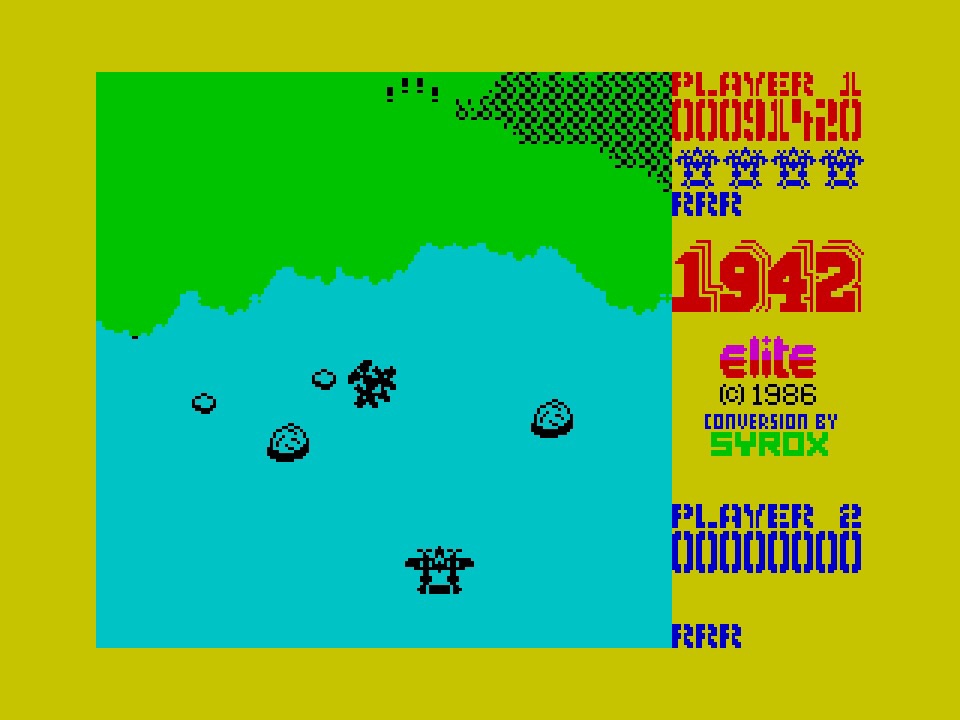
I first played Capcom’s pioneering World War II shooter on a ferry to Ireland not long after its 1984 arcade release, and it was love at first sight! Not much has changed since either, with it getting all the way to number three in my far more recent Top Ten Favourite Vertically-Scrolling Shoot ‘Em Ups countdown! The 1986 Spectrum version was everything I hoped for at the time, with that unique loop-the-loop dodge mechanic as mesmerising as I remembered, and although the environments had been toned-down a lot by practical necessity (at least until a few levels in), it did little to harm the feeling of absolute vulnerability in the middle of nowhere, and all those power-ups and huge boss planes like we’d never seen before were right where they were supposed to be! Hard as nails too, with its Battle of Midway-era Pacific Theatre setting (which would feature more directly in its erroneously-set 1943 sequel) serving up wave after wave of historically accurate Japanese air forces to shoot down en-route to Tokyo thirty-two stages later! Some fantastic attention to detail in the various animations here as well, with a hint of pseudo-3D in regular flight allowing for some lovely authentic wing-tipping, turning and rolling. Cool, colour-clashing explosions too, but thankfully missing some of the strangely shrill accompaniments that came out of the arcade cabinet’s speakers! Whatever the version though, 1942 has always been simple, undiluted fun over everything else, all about getting a bit further for the highest possible score, and that’s all this port ever needed to offer, which it does and a lot more besides. I’ve also done a deep-dive on this one if you fancy a bit more, and if I remember rightly, there’s even a photo of me on that very ferry in there too!
4. Enduro Racer

With its ride-on bike controls between your legs and rip-roaring spectacle right in your face, Sega’s Enduro Racer from 1986 was a total showstopper in the arcades! It was also another seemingly impossible conversion, yet here we are again, circa mid-1987, with not just something borderline miraculous, but probably the definitive home version (including 16-bit variants) and, once the high-speed 3D bells and whistles are removed from the original, maybe even the definitive version of the game overall! Unlike Out Run though, that’s not a hill I’m going to die on, even if the Spectrum’s dirt bike racing feels way tighter and less floaty than the original! It has plenty of spectacle of its own too, moving at pace with a convincing amount of 3D going on, and plenty of detail in the environments and trackside obstacles, the animations and little dusty flourishes, and not least those wonderful foot-down turns and borderline suicidal jumps, which are almost worth screwing up for, with your big rider sprite coming adrift of the big bike sprite and hanging on to the handlebars for dear life! Once again, everything is monochrome on colourfully atmospheric backgrounds, and it works brilliantly, to the point that in my mind at least, this is how it’s supposed to look, and on the 128K version at least, it sounds pretty good too! Another brutal game though, demanding you go hell for leather to beat the clock while punishing every mistake, however good they look. I did do a deep-dive of sorts on this too, right back in 2018, although like elsewhere I’ve linked to here, my format was still evolving then. All the same, I was interested to read just now that I reckoned this was the best of the Spectrum’s conversions at the time of writing, which again, isn’t really a hill I’d die on if I had to argue otherwise today! Oh yeah, one more thing, the Commodore 64 version of this is a proper stinker that lives up to every bad, blocky, brown stereotype you’ll ever come across on there!!!
3. Gauntlet

When we looked at Out Run earlier, I mentioned how the arcade version is a top ten game ever for me, and likewise, so is Gauntlet. However, this time, I’m talking specifically about the 1986 ZX Spectrum port and not the original from the previous year! Not because I’m going to argue it’s better though, like I maybe could have done for our last game and definitely will do for another game still to come, but just because it’s where I spent dozens if not hundreds of hours multiplayer dungeon-crawling with my brothers, and there’s a whole backstory to all of that in a deep-dive I’m far less self-conscious about than the last one here! Actually, the reduction from four to two players is one of the few concessions in this version, but you’ve still got the choice of four fantasy tropes to play as, as you try to survive ungodly swarms of ungodly monsters for as long as possible in these more or less top-down mazes while competing for food, magic potions and treasure, and also looking for keys to get you through the exit to the next level, of which there are equally dozens if not the total one hundred found in other versions here! Honestly, I couldn’t tell you because I’ve never seen an end or looped around or whatever, but whether you’re four, two or playing solo (which has its own unique rhythm), the deceptively simple depth, strategy and variety of gameplay, combined with the irresistible urge to look out for yourself, still hasn’t got old to this day, however far you get, and likewise the incredible number of ghosts, demons and otherwise waiting to overwhelm you the second you put a key in a lock! Non-stop digitised speech aside, the original was hardly spectacular on release, and that obviously suits all the home versions no end, with this one full of cleverly assigned colour and textures, a few nice tunes, and performance that never lets up, just like some very impressive scrolling in all directions. And apart from that, it’s Gauntlet, and that’s all I could ask for!
2. Shao-Lin’s Road
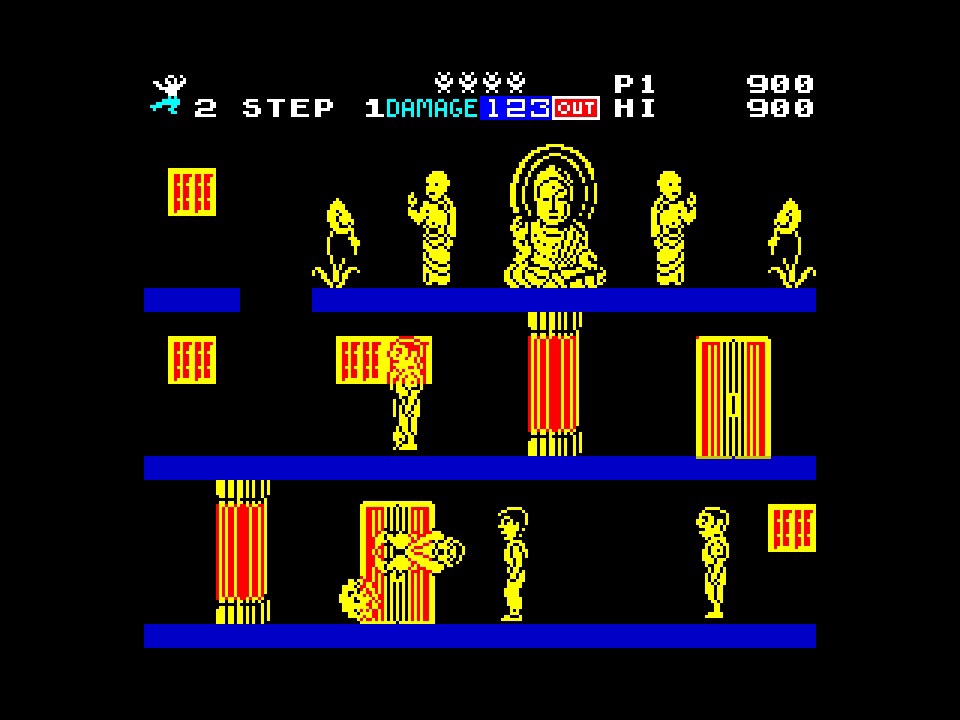
Although I might sometimes give a different impression, I was more aware of arcade games back in the mid-eighties through things like Computer & Video Games magazine or the more ride-focussed visits to the twice-yearly travelling funfair than I was actually playing them… But I played Shao-Lin’s Road to death! It was one of three machines that hung around the local leisure centre my brothers and me hung around in for years, so whenever we were done with kung-fu or five-a-side football or roller-disco or whatever, we were on that! It’s a kind of platforming beat ‘em up that does scroll a bit either way but is pretty much single-screen in spirit, with you taking on a gang of meanies over five very martial arts movie locations, each of which is split into three brilliantly designed “floors” to move between and punch and kick your way through two waves of a certain amount of enemies, with the second ending in a boss. It then loops but gets way harder, and unlike the last game, this time I can say that from experience! You can pull off a variety of simple moves, and there are power-ups and bonuses to try and intercept, but we’re mostly talking fast-paced and very immediate arcade fun, despite the 1986 Spectrum version taking forever to load… Count yourself lucky if it did at all though because it was the most hit and miss game I ever owned on there! It was also the arcade conversion I looked forward to on there more than anything else here, and it translated beautifully! Some of the later levels are just gorgeous too, with wild colour choices bringing so much personality to these immaculately detailed temples and canyons and forests, more than compensating for the unavoidable loss of colour in the wacky cast of characters. No loss of sound though – it’s just right, and so is the gameplay, which was never the most refined but just works so well and will forever be a joy to me!
1. Renegade
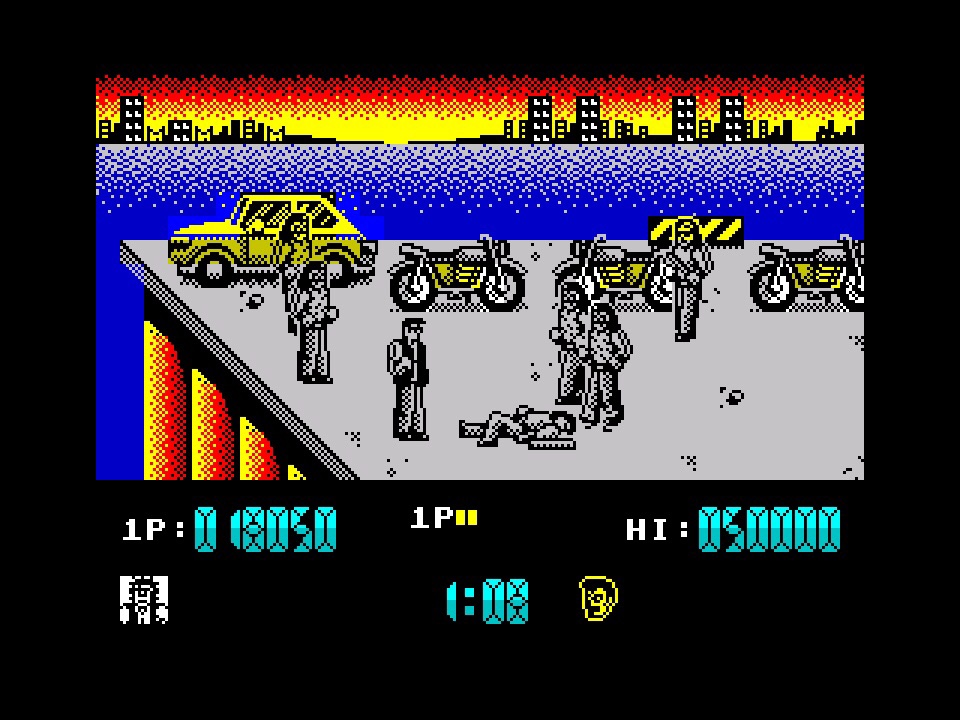
Right, arcade ports that are objectively better than the original… Apart from this, obviously, I was about to suggest the NES version of Contra but while it looks better, sounds better, controls better and is better paced, now I’ve written it down it’s all sounding a bit subjective to me! Same probably goes for R-Type on PC-Engine, Master System Double Dragon, SNES Street Fighter II and Mega Drive or Genesis Ghouls ‘n Ghosts, so I’m just going to stick with Renegade on the Spectrum as the only example I’ve got! And that’s simply down to controls – the original’s directional attack stinks to the point it kills the game for me, which also goes for all the home ports that bizarrely followed suit, rather than replicating the glaringly obvious method that’s crafted to perfection here! And that’s why this version sits at number four, no less, in my top ten favourite games of all time, sandwiched between Resident Evil 4 and Silent Hill 2 if you’re interested! The original came from Taito in 1986, and controls aside, is undoubtedly a pioneer of the side-scrolling beat ‘em up, where “…Night falls swiftly as you make your way through the most sinister part of town to collect your girl.” That’s five gloriously seedy locations, including subways, piers and red light zones, once again scrolling a little way in each direction as you try to make your way through all manner of miscreants and their bosses up to no good in them. The Spectrum port came in the autumn of 1987, which I very distinctly remember thanks to a trip to London thanks to a Your Sinclair magazine competition (which I covered in my deep-dive here), and it’s nothing short of a masterpiece, especially when you throw in all the lovely multilayered sounds of the 128K version too! It’s as good as a Spectrum game ever looked too, so carefully detailed and coloured and lit in every area, and there is so much character in both your cool dude and The Warriors-inspired enemies, and that’s before they start moving super-smoothly en-masse. And those reworked controls just elevate the game to new heights, with every kick, punch, weapon swing, knee, grab and throw so effortlessly intuitive on a single-buttoned joystick, and those ground-pounds are a whole new level of vicious on top! This game still means everything to me, and I still play it almost as much as I do the Arcade Archives release of the original on PlayStation 4, in the hope that one day I’ll realise I was just wrong about the controls and they’ll click, but honestly I don’t need them to because this is all I ever dreamed of in a conversion and pretty much a video game full-stop.

They might not have everything you’ll find in the originals but in conclusion, I think everything here has got the best of them, and that’s all you could ever have asked for from a home conversion on any system around the time period we’re talking here… Well, apart from the sheer miracle of being able to play these things at home in the first place! Anyway, I’m going to conclude with those honourable mentions as promised at the start, but first I’ve got a dishonourable one for you! Kung-Fu Master was another of those three arcade games I used to play at the leisure centre I mentioned when we covered Shao-Lin’s Road above, and I’ve done a couple of features on that, the most recent of which was a deep-dive you can find here. I love the thing, which is why the Spectrum conversion (pictured above) still stings – everything about it is dreadful, and I spent all my pocket money on the stupid thing, and it’s the most disappointing game I’ve ever played! And yeah, I know there’s a recent homebrew version that put everything right, but tell that to 13-year old me in 1986!

On a more positive note, the following were part of what was the original top fifteen I shortlisted, so from the aforementioned Paperboy at eleven, I’ve got Spy Hunter, Rampage, Indiana Jones and The Temple of Doom, and Ping-Pong in that order. Then I’ve got Pac-Land and Elevator Action (pictured above), which weren’t necessarily great conversions but I adored the arcade games and they were the best I had, and made me very happy for being so! There’s also Super Sprint, Super Hang-on and Bubble Bobble, which were excellent conversions but the Atari ST was where my favourite ones were. And then, in no particular order, Green Beret, Combat School, Flying Shark, Space Harrier, Ghosts ‘n Goblins, Tapper, Cabal, P-47, Arkanoid and Rainbow Islands (the last two of which I’ve also heard argued play better than the originals). I could probably go on forever but for completeness (meaning to avoid all the comments…), I’ll honourably mention Chase H.Q. and Midnight Resistance, which are clearly amazing conversions but just not my thing. And on that bombshell, that’s your lot!
As always, I’ll never expect anything for what I do here but if you’d like to buy me a Ko-fi and help towards increasingly expensive hosting and storage costs then it will always be really appreciated! And be sure to follow me on Instagram, X (formerly Twitter) or Threads for my latest retro-gaming nonsense, and also on Bluesky, which is under my real name but most of it ends up there too if you prefer!

