The problem with reaching your fifties and finally having the money to get the toys you wanted as a kid is that you’re not a kid anymore, and you might not really want them after all… Who’d have believed it!?!? No harm in making sure when the opportunity arises though.Case in point, Tomy’s Atomic Pinball, which honestly was never really up there with stuff I always wanted but never got like the yellow Lego castle, or Big Trak, or the flip-screen Donkey Kong Game & Watch, but you’d never have been disappointed if you got one for your birthday or Christmas back in the eighties. Unfortunately, (unlike that Game & Watch!) the reality was a bit underwhelming when I got hold of one on eBay a couple of years back, and as we’re in the process of getting the house ready for sale at the time of writing, and trying to clear a bit of shelf space to make things more presentable, I reckon it can go back on there again, so here I am, part-celebrating getting hold of the thing at last, but also part-documenting it before I let it go again! But what’s the betting I’ll have talked myself out of it by the time we’re done here…
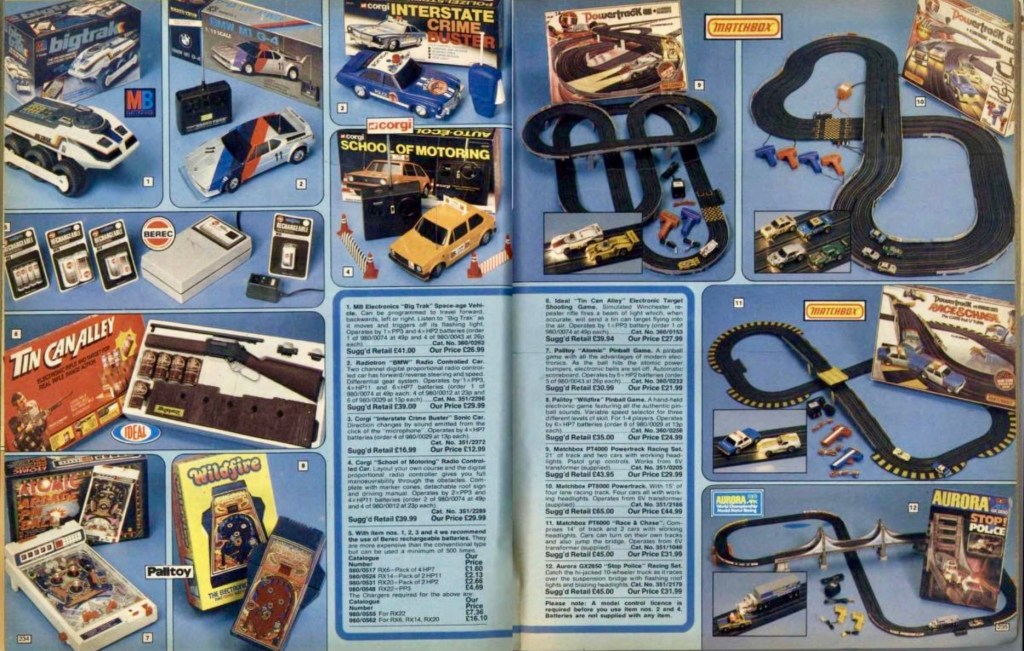
Anyway, onto the game itself, it first appeared as “Atomic Arcade Pinball” in 1979, then for as long as I can remember, would be a mainstay of what would soon becoming the burgeoning “electronic games” section of the Argos catalogue, or my Mum’s Marshall Ward and Littlewoods catalogues, throughout the whole of my childhood and seemingly well beyond! By the way, the picture above is from the Argos Autumn/Winter 1980/81 catalogue, and credit to the Department Store Catalogs Collection on Internet Archive for the original scans. I’m not sure how long it actually hung around, but it did get a new grey and black revision (which is what I’ve now got) during the late eighties, at which point I was probably less interested in toys and more interested in, er, more exotic categories in those near-biblical home-shopping experiences, although a quick look around on the internet does seems to suggest it was still available into the next century. Its heyday was undoubtedly the early to mid-eighties though, capturing the contemporary imagination (and the relentless terror of nuclear annihilation!) with its atomic-age sci-fi looks, and all those colours and flashing lights and sounds and tech, as well as bringing that arcade experience into your living room, which, just a few short years down the line, was first going to become the dream with the emergence of the 8-bit home computers, and increasingly the reality as the 16-bit era arrived close behind!
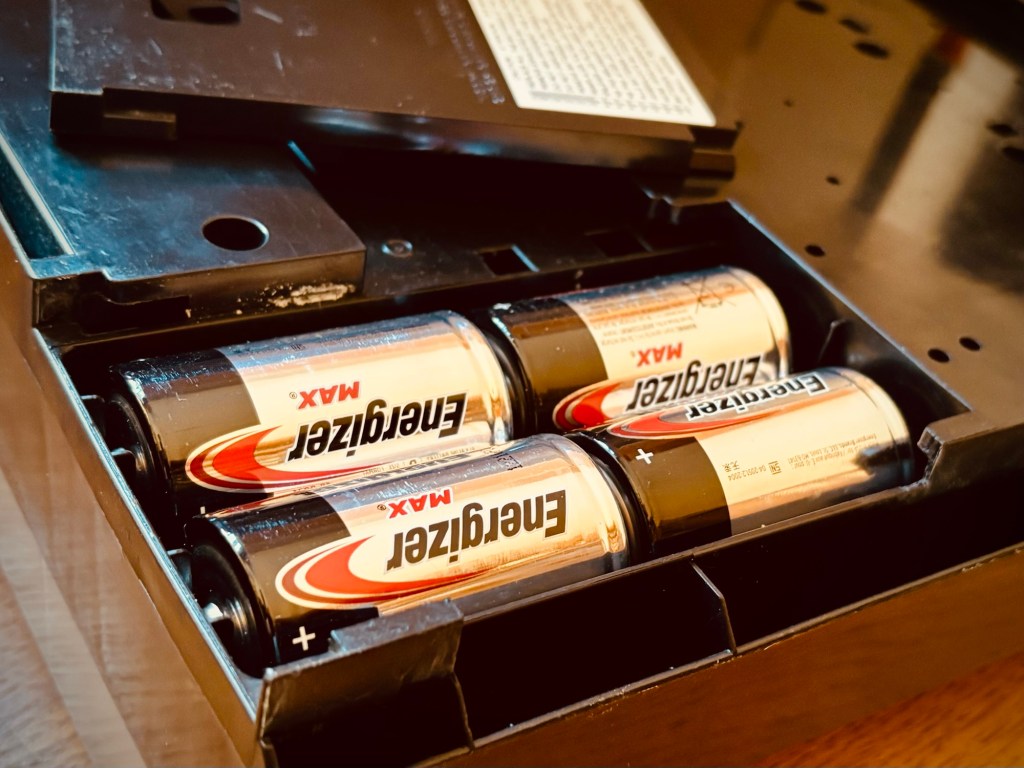
I don’t think any of that would have been on my radar when I first saw this though – we’d have got our Interstate 1160 “Pong” console more or less around the same time, then my auntie got a Fire Game & Watch, and a bit later my best friend got an Atari VCS (or 2600), and my next door neighbour a ZX81, but I wouldn’t have seen any of that coming, hence the ongoing attraction of this beast of a battery-guzzling tabletop game… Originally took five of the huge D-type batteries! Fortunately, subsequent versions including mine only take four of them, but it’s still a beast, weighing in at around 2.5kg and measuring a whopping 43cm long by 26cm wide by 10cm high. Sadly, it didn’t come with any instructions, and I can’t see any dates on the box, but another quick and dirty bit of research seems to suggest 1987-1988 for this model. Interestingly, what you do get on the box is a “Product Upgrade Notice” stating “The product livery has been re-designed, so colours and appearance vary from those shown” – meaning old box with the original white design on, which is certainly more reflective of its time, and likewise the new version, but as far as I can tell, the table mechanics and features are more or less the same.
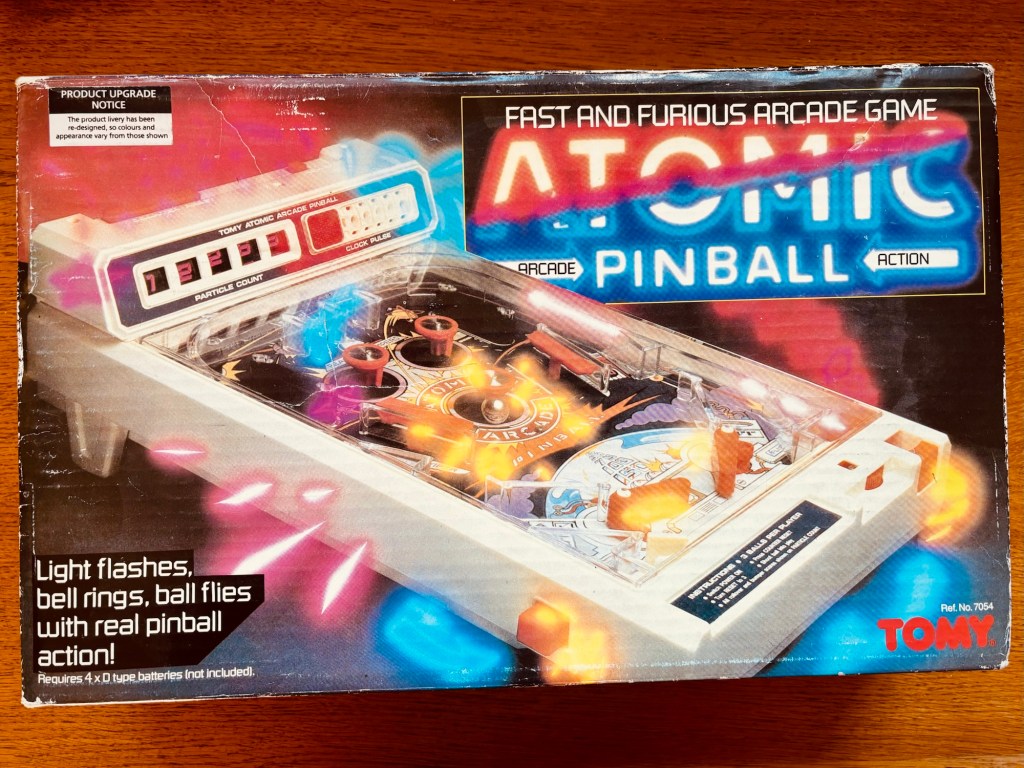
Which reminds me, before we get into all that, although I’ve covered a few pinball games, as well as a few standalone electronic games – both handheld and tabletop – in a few deep-dives, I don’t think I’ve ever covered anything quite so “mechanical” before. Not even any “graphics” on the scoreboard – just lots of lights, lots of noise, and a big metal ball bashing into stuff, just like the real thing! Before we get into that, I’m going to stick with the box for a second though… “Light flashes, bell rings, ball flies with real pinball action!” is what you get on the front in English, but switch to the French version on the side and it’s a bit more descriptive, more or less telling us to introduce the ball and keep it in circulation for as long possible, then every time it touches a bumper, the bell rings, and the longer the ball rolls, the higher your score on the board. If I’m reading it right, the German, on the other hand, is a bit more prosaic, with it buzzing and flashing and ringing as the steel ball rolls into power bumpers and the pinball bell sounds, then there’s more buzzing and rattling and flashing lights and mechanisms! Outdated or not, the big picture on the box (which you can see above) was doing most of the selling though, and the weird neon lights applied to illustrate it in action are so gloriously of their time!
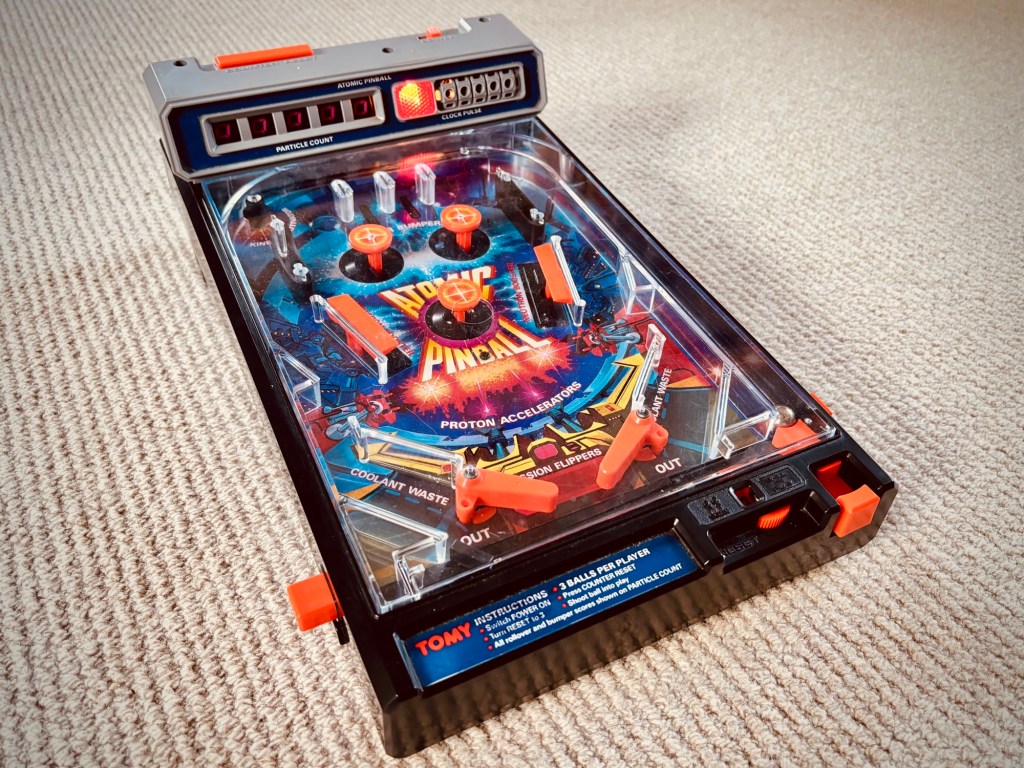
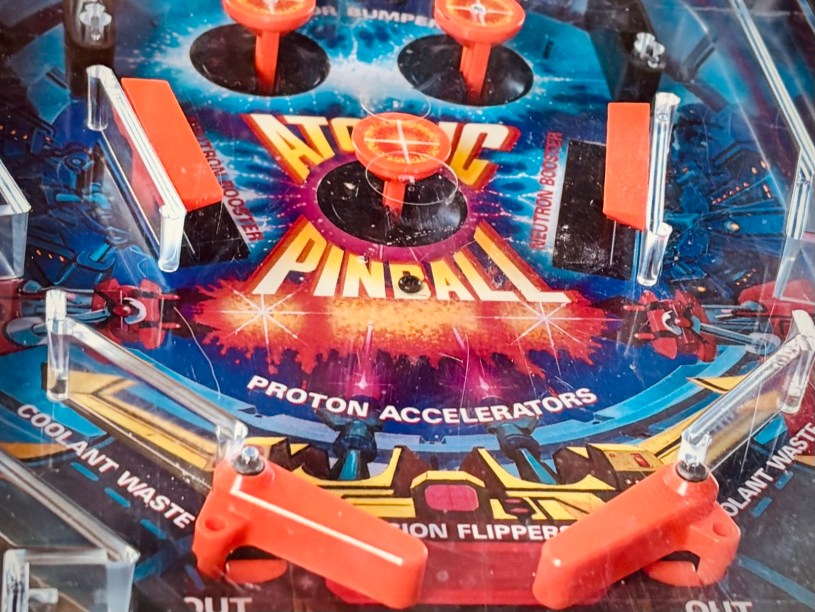
Right, onto the thing itself. The layout is a simple but familiar one, designed to recreate a real electromechanical table within the constraints of what’s effectively a battery-operated toy, so let’s have a look at what we’ve got, then if I can, I’ll see if I can work out what’s changed in this later revision we’re looking at versus what’s still pictured on the box. Most important we’ve got the two Fission Flippers, located where you’d expect them in the bottom-centre, and controlled by a pair of buttons similarly positioned on either edge; I think there’s a bit of assistance from the table’s motor and gear system too. On the right side, we’ve got the plunger lane, where you pull back the spring-loaded mechanism and let fly with the little steel ball, and how fast that flies out is on you. The motor and gears really come back into play back in the middle of the table though, where you’ve got the two long Neutron Booster bumpers and three circular Reactor Bumpers that all really pack a punch when the ball makes contact, and I think more than anything gives Atomic Pinball it of authenticity, as well as being where the big scores come from!
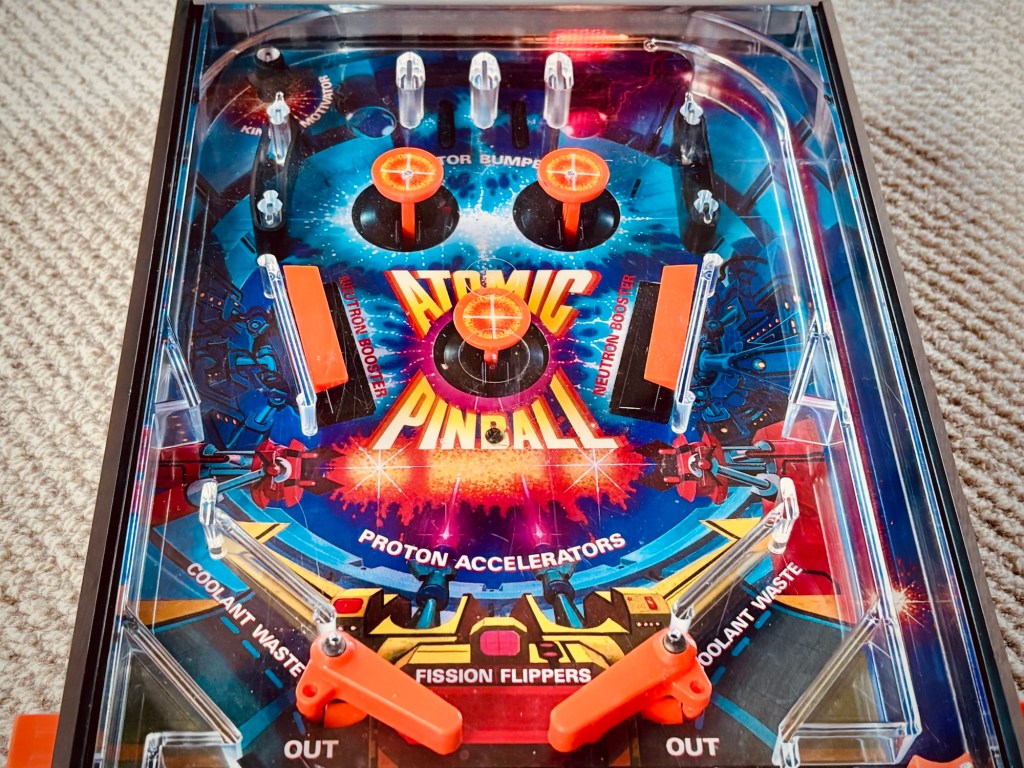
Above them, right at the top of the table, you’ve then got three pillars creating four lanes, with the Kinetic Motivator on their left, opposite where the ball exits the plunger lane on the right. This is simply a rubber bounce-back into play rather than anything electromechanical or affecting score, and likewise two big rubber band things either side, simply acting to keep the ball where the action is as much as possible. You do have two out-lanes running down each edge though, both of which have Coolant Waste gates leading straight into the drain if you’re unlucky, which you’ll inevitably end up in through the gap between the flippers otherwise. Keeping tally of your lives is manual but very elegantly done, whereby once you’re down the drain, the ball rolls to this little “Ball in Play” dial on the bottom edge next to the plunger, which it’s connected to, and as you turn it to feed the ball back into place for another go, the dial counts 1, 2, 3 for number of lives lost, but once you’re at three, there’s nowhere to go, so game over, and you have to reset to start again.
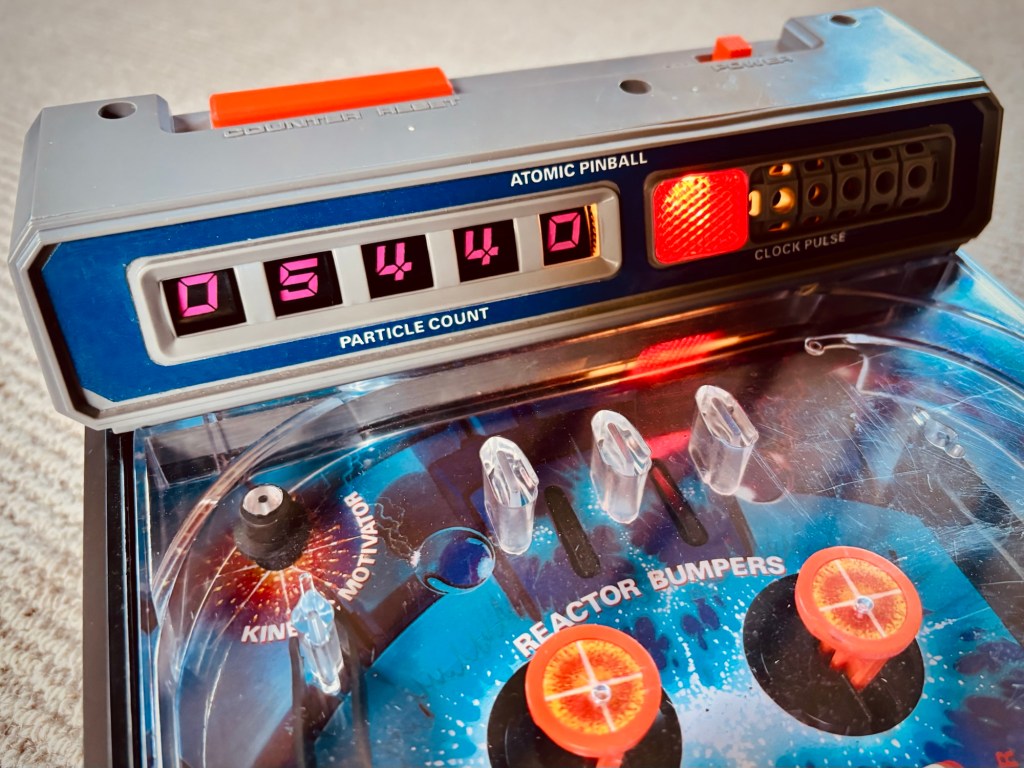
You also need to remember to press the big reset button for your score (or “Particle Count”) when you start again, which will go up to 99,000 maximum and is handled by electromechanical reels, once again connected to that big motor as well as all the scoring items on the table, pushing your score forwards with a really nice physicality… And now those four giant batteries are starting to make sense! Next to the score counter, which sits where it should above the opposite end to the flippers, you’ve got some simple strobe and LED-type lighting effects that react to you scoring too, which is also the case for a very loud bell sound – needs to be too, given how loud the non-stop whirring of that motor is behind it! Now I’m studying the table itself next to the box, I can’t really see much mechanically different to the original version, with all the parts described previously seemingly in the same place, although there seem to be a lot more fake lighting effects illustrated than reflected in the reality I’m seeing, so I’ll put that down to artistic license! Which, apart from the move from creamy white to black and grey exterior, seems to be the only real difference, with the graphical overlay on top of the table itself a bit more detailed and a bit more “nuclear sci-fi” than the more simplistic, more pinball-like original. The colours appear to be more vibrant and contrasting too, and all the weird feature names I just mentioned (such as Kinetic Motivators!) are now labelled on the overlay, where it looks like they weren’t before.
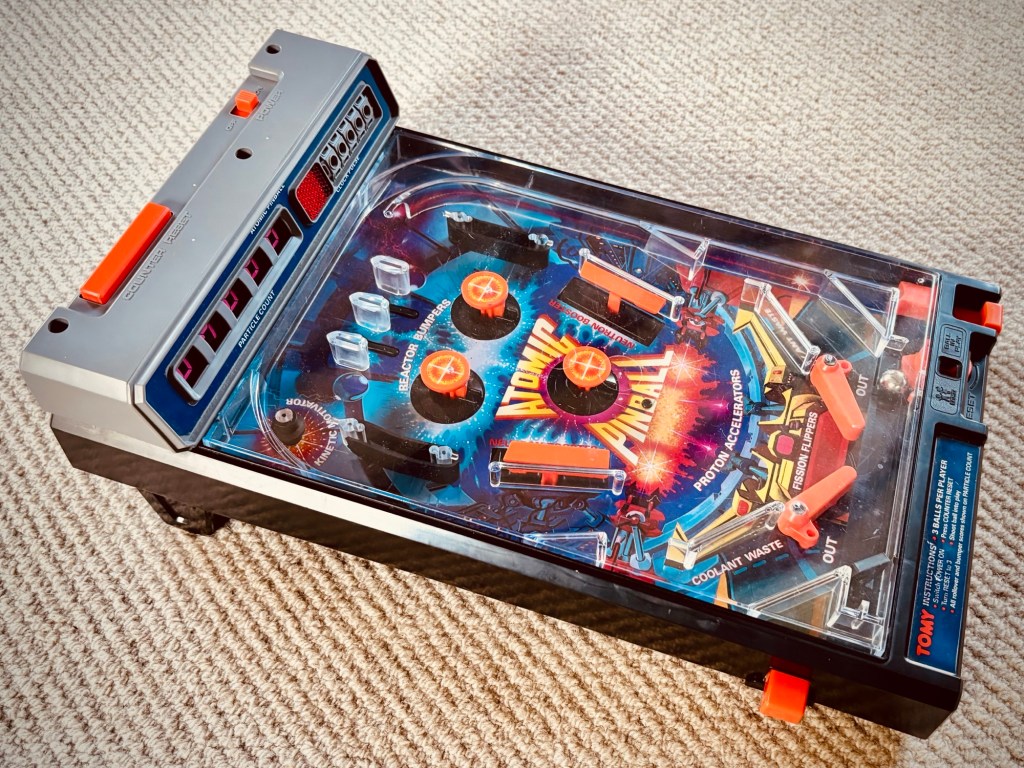
From what I’ve seen of the original in action during my research (such as it was), it does seem like this version’s motor runs slightly faster than that one’s too, which might explain quite how frantic things get once the ball’s entrenched in the middle of the play-field! As alluded to before, the bumpers have real impact, and are where the pinball experience comes most alive, as the lights light and the bells ring in non-stop quick succession, and that cacophony is compounded by the sound of the bumper kicks and the switches doing the hit-detection, and for a moment it feels great… At least until your wife comes in and asks what the hell’s all that bloody noise! The trouble is though, that’s as close as this gets to pinball, and feels great or not, it doesn’t really feel like pinball – plays like it yes, but rarely feels like it. And I’m putting that squarely on the ball not being heavy enough! I know, it’s probably as heavy as it can be, otherwise all of these would have had smashed flippers and knackered switches and cracked tops decades ago, and we certainly wouldn’t be talking about them like this now. It just can’t behave like a real pinball though – too light, too fast, and can’t carry enough momentum.
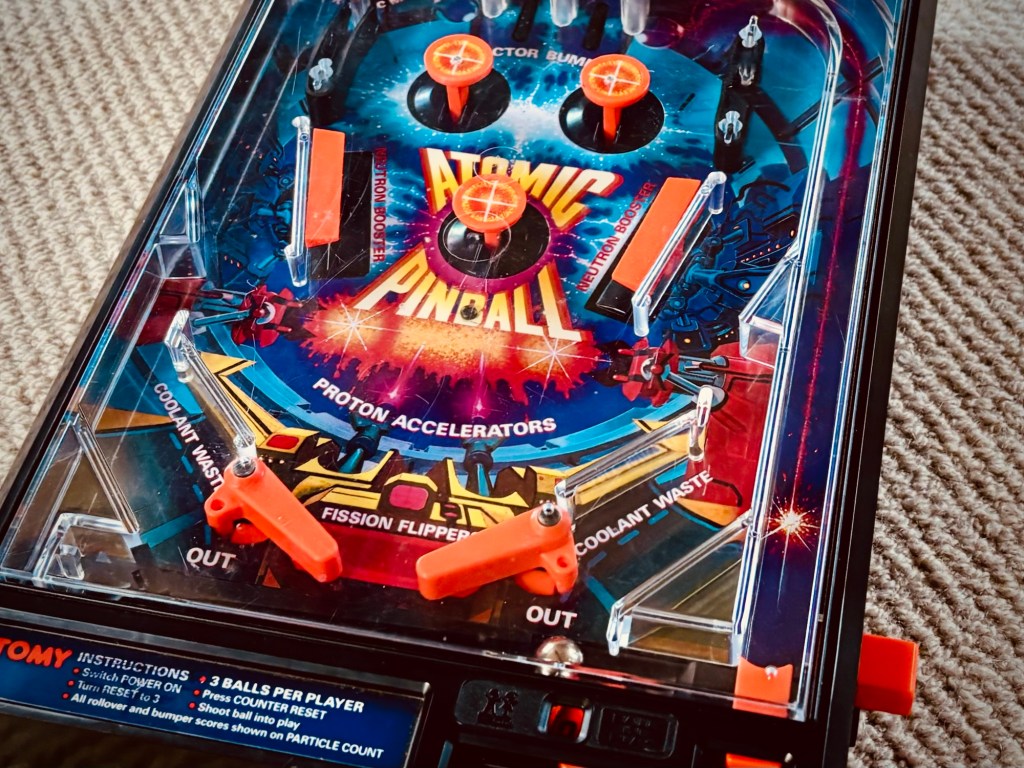
While I’m being down on things that probably couldn’t be any better than they are, the flippers can’t give you much precision either. That said, there is nuance that emerges the more you play, just like real pinball, and they’re more than capable of letting you point the ball in the right direction, and the plunger spring has enough give in it to let you gently drop the ball into the upper right or left lanes, or just go all out and take your chances at hitting all the bumpers in the middle at full speed! There’s even a rhythm to hitting those bumpers so you can keep the ball looping around them to maximise your score. Really easy to redirect the ball away from the drains by picking up the table too… Yeah, no nudge either! But for what it lacks in features, strategy, progression, ball control and general physics, it’s undeniably a game of pinball, and arguably more so than any video game versions ever created either. As much as I love them! (And you can see the ones I really love in a countdown of my top ten here). It’s fun for what it is too, full of personality and noise and lights and excitement, rewarding timing and quick reflexes with a score you’ll want to keep trying to beat, which sounds like a pretty good basis for any kind of game to me! And maybe it’s not for me anymore as an old fart, but it’s still everything about that wonderful period of innovation I was lucky enough to be around for as a kid!
As always, I’ll never expect anything for what I do here but if you’d like to buy me a Ko-fi and help towards increasingly expensive hosting and storage costs then it will always be really appreciated! And be sure to follow me on Instagram, X (formerly Twitter) or Threads for my latest retro-gaming nonsense, and also on Bluesky, which is under my regular name but most of it ends up there too if you prefer!
 Retro Arcadia