
I regularly come up with stuff here I say I’ll come back to and look at it more detail sometime later, and do you know what? Sooner or later I generally do! Either a man of my word or it just saves me thinking what’s next, take your pick! Let me give you a couple of examples… Discovering Splatterhouse 2 on Sega Mega Drive one Halloween led to the same treatment for A Nightmare on Elm Street on the NES the following year because I enjoyed the favourite Friday the 13th movie tangent it went off on. Slightly more inexplicably – on the surface at least – my Top Ten ZX Spectrum Loading Screens feature spawned Rediscovering Repton 3 on the BBC Micro! More often than not though, it’s less esoteric, like when I looked at Syvalion on the Taito Egret II Mini after I first came across it when I reviewed the system’s Paddle & Trackball Expansion. While many of these will be opportunistic, with one thing simply leading to another, there’s occasionally method to my madness too, and in particular when I’m doing one one of my always-popular book reviews! I like to give a flavour of what you’ll find in these, which are more often than not some kind of coffee-table compendium full of games, so I’ll talk around a couple I’m familiar with, one I’m not at all, something that jumps out at me and something I’d like to play… There’s been a load now, but a recent one was a huge deep-dive into Lovecraftian MS-DOS point-and-click adventure Call of Cthulhu: Shadow of the Comet, which had first piqued my interest with an absolutely stunning pixel art double-page screenshot while I was reviewing the equally stunning The Art of Point-and-Click Adventure Games by Bitmap Books.
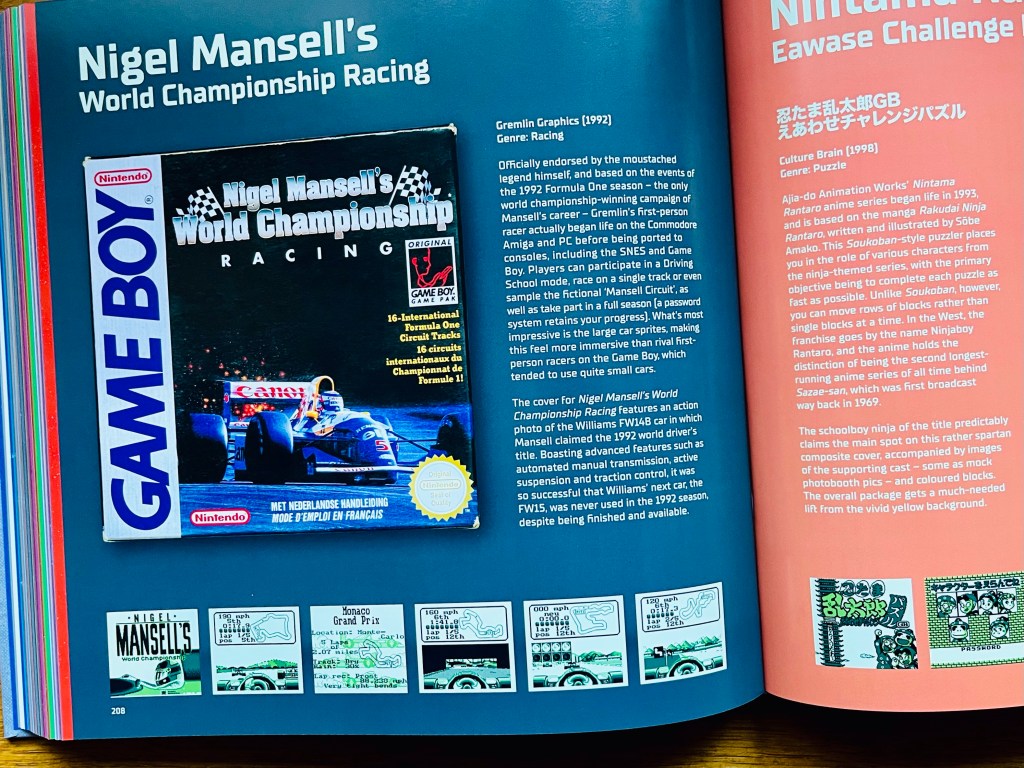
As I write, an even more recent example of this kind I haven’t got to yet but will very soon is desperate-to-be-X-rated ZX Spectrum text adventure Jack the Ripper, featured in ZX Nightmares by Graeme Mason, even if honestly I’d have got to that sooner or later anyway! It was another Bitmap Books review that eventually got us to today’s feature presentation though, albeit far more indirectly, but with a far more unique outcome… When I reviewed Game Boy: The Box Art Collection, it was supposed to be Nigel Mansell’s World Championship Racing that got the same treatment, but as much as I had a good time getting to know it as planned afterwards, it just wasn’t a Formula 1 game I wanted to write about… I might save that for F1 Racing Championship on PlayStation 2, and you heard that one here first! Back on the Game Boy though, there was literally hundreds of pages of inspiration for other stuff to cover instead, and I ended up with Namco Gallery Vol. 2, which I enjoyed doing so much that in turn it will also eventually lead to covering a similar Taito collection on the Game Boy, followed by one of the other Namco volumes! On this volume from 1997 though, we’ve got four Namco arcade games recreated for the Game Boy – Galaxian, Dig Dug and The Tower of Druaga, all of which have been available elsewhere in some form on the Game Boy previously, and last but not least Famista 4, which only ever appeared on this compilation. And that’s how we’re about to end up at R.B.I. Baseball, in relatively dramatic fashion!

“I know as much about Famista 4 as I do the sport it’s based on” is how I started talking about that game, which it turned out was part of the Famista, or, in English, Pro Baseball: Family Stadium series, that to date has sold more than fifteen million copies across its almost forty game roster! For this entry, in terms of gameplay – despite everything being in Japanese – it was clear there was enormous depth here, which unfortunately I couldn’t fathom, but all the same, it was easy enough to get into a game, work out how to bat or pitch or control a fielder, and have a load of fun doing so – especially fielding, where you’ve got so much control out of two buttons and four directions, which we’ll come back to again! I thought the presentation was brilliant too, with a larger scale third-person view for batting and pitching that gives you everything you need to see, and thereby feel and react to, then it switches to a view of the full pitch with some very Game Boy smaller sprites, which again, do their job admirably. I found it to be full of character, full of energy (in no small part thanks to the sound design) and while it was hard to take in everything that’s going on in-game – and more so the team stuff outside it – because there’s no escaping all the Japanese text – there was no reason you couldn’t still enjoy what’s here. And I did a lot, and in turn was more than enough to draw my attention to a game I’d at least heard the name of before, R.B.I. Baseball, which, during my research into the Game Boy game, I also learned was the name of the North American NES version of the first Famista game so I thought I’d have a look at that instead and see what I could fathom out there.

Destination confirmed, the last stage of our journey to that game begins by quickly working back to that deep-dive into Namco Gallery Vol. 2 again, which went live on 10 May 2023, meaning I probably wrote it around the start of April but, for the sake of convenience, let’s just say two months before my first live MLB game, the London Series featuring Chicago Cubs against St Louis Cardinals, by which point I’d gone from genuinely knowing nothing about baseball to absolutely loving it! Okay, in retrospect it was only a matter of time and would inevitably have happened sooner, had several trips to New York and Boston over recent years with our sporty son been better timed (although no complaints about all the NFL, NBA and NHL games we’ve seen instead), although the amount of money I’ve spent on baseball merch for him regardless probably already makes me a Yankees fan by default! Anyway, between then and going to that game, I’d already gone from zero to religiously recording every single live game on TV (as they tend to be at midnight here), watching all three or so hours of each and every one, absorbing everything, learning what’s what, who’s who, where’s where and a bit of history on top. In other words, a totally unexpected, all-new, all-consuming (non-gaming) interest, arriving out of the blue aged fifty-one, and all down to a Game Boy game I couldn’t understand that I only came across because I didn’t fancy covering Nigel Mansell. It’s a funny old game!

Just before we get to looking at R.B.I. Baseball, it would be remiss of me not to fill in a couple of gaps in our journey before we get there! The first one was pretty obvious from the moment I fired up Famista 4, and it wasn’t that not speaking Japanese was a fundamental obstacle to fully enjoying the game, but something confirmed by the very opening sentence in the R.B.I. Baseball manual… “R.B.I. Baseball conforms to most of the rules of big league baseball. You will be required to have a basic understanding of these rules.” Apart from three strikes and you’re out, I didn’t, so I decided to hit YouTube before I even carried on reading, let alone firing up the game, and here was the very rabbit hole that was about to properly suck me in once it had given me a taster, which I have to credit The School of Sports channel for, and their Baseball Rules for Beginners video – fifteen minutes of absolute basics in layman’s terms, including something I had no idea was going to be so key to enjoying a game wherever it’s being played, which is reading the scoreboard! I’m not going into any of that here though but don’t worry because I’m not going to require you to have a basic understanding of anything! Oh yeah, credit to NESHQ.com too for the pics of the manual scan, and thanks for sharing it with us!

Obviously, it’s no replacement for a lifetime of fandom, but fifteen minutes turns out to be all it takes to equip you to start enjoying watching a game – as the R.B.I. Baseball manual also states, “any rules you are not familiar with will become obvious through play.” And with that I was full onboard a very slippery slope! The second gap in our journey I wanted to mention begins with the admission that R.B.I. Baseball wasn’t actually the first baseball game I turned to either… Instead, I turned to my own games library first because I knew there was stuff I’d been sitting on with no previous interest in playing that had suddenly become relevant! I’m still not sure I haven’t missed anything, but the one that’s definitely been hanging around the longest is Baseball Stars 2, a Neo Geo arcade take on baseball from 1992, and sequel to Baseball Stars Professional from 1990, which was actually a follow-up to another NES game, Baseball Stars, from the year before. This is on the 2008 compilation SNK Arcade Classics Vol.1 for the PlayStation Portable, which I really should cover in its own right sometime (and there’s another one!) because apart from the golf game, Neo Turf Masters, and a bit of Metal Slug, I’ve barely ever touched this thing and it’s full of absolute classics – Samurai Shodown, King of Fighters ’94, Super Sidekicks 3…

Anyway, Baseball Stars 2, and I’m not sure I’ve seen a more visually appealing baseball game than this – not that I’m exactly a connoisseur yet – but I can tell you it’s gorgeous, full of vibrant cartoon detail, madcap animation and comedic pop-outs for key plays, with music and sound effects (including a ton of over-excited speech) to match. It’s loads of fun to play too, with fast and frantic one or two player gameplay across two leagues – Exciting (beginner) and Fighting (expert) – with various team types, power-ups, button mashing for speed, finesse plays and other very non-simulation stuff! I actually put this to one side to come back to though because it was a bit too full-on and in your face as opposed to where you want to be when you’re learning the ropes, so I then moved to Street Sports Baseball on the Commodore 64, which has been hanging around for a lot less time on The C64 Collection 1 for Evercade, which I got for Christmas 2022. This is from 1987, and was part of the Street Sports series by Epyx, where you took the regular game out of the stadium and onto the streets, with gangs of teenagers using dustbin lids for home plates, jumpers for goal posts and so on. It’s very C64 in its presentation but full of character and atmosphere, with plenty of depth to team selection from the local oiks if you want it and just the right amount of automation to support the one-button plus direction controls. It does take a bit of getting used to all the same, but once it clicks it’s a great time for one player and really comes alive with two! Again, it’s something I’d like to come back to here in a year or two (just to avoid sounding even more like a broken record than usual) and look at in its own right.

Now all that’s out of the way, I think it’s safe to fire up R.B.I. Baseball. And unless you own a Game Boy and speak Japanese, I’m really not sure that in 2023 you could have a better entry point (with the exception of actually playing) into either baseball as a whole, or just baseball video games if you prefer, than R.B.I. Baseball, which was launched in North America in 1987 as a localised version of Pro Yakyū: Family Stadium, released on the Famicom in Japan at the end of the previous year. The story goes that Namco programmer Yoshihiro Kishimoto was filling time waiting for colleagues playing Nintendo’s Baseball for the Famicom, which disappointed him with its lack of named players, player characteristics and playable fielders, so he got the green light to see if he could do better while he had time on his hands! It was actually first brought to the West by Atari on the Famicom-based Nintendo VS. System arcade machine, where it was known as Atari R.B.I. Baseball, before their offshoot Tengen published it as R.B.I. Baseball on the NES.

Once the title screen has scrolled in from the right behind a big baseball, beneath the big R.B.I. Baseball logo you’ve then got a choice of one or two player play and also a watch option, which lets you pick your teams and watch the computer play out a full match between them, just like watching on TV! And as bizarre as it sounds, it’s very watchable! Leave it a few seconds and you get a very impressive attract mode too, introducing the teams you can play as and a load of gameplay highlights you’ll encounter, assuming you actually want to play at some point, so let’s do that now! Picking one player mode, you’re going to play against a computer opponent for a regular nine inning game, but at the end of each game you can also choose to continue and play out a nine game season against the other nine teams. I’ll come back to them in a sec, but by necessity I’ll focus on one player here so let me quickly mention two-player, where you’re competing against a friend for either a single nine inning game or you can also continue on to a best of seven series.

The game was the first to get a Major League Baseball Players Association license, meaning it’s using actual contemporary Major League Baseball player names throughout, but what it didn’t have was the MLB license, meaning the teams they represented, as well as their nicknames and logos, could not be used, so what you’ve got instead are team locations rather than names. There’s California, Boston, Detroit, Minnesota, Houston, New York, St Louis and San Francisco, then you’ve got an all-star team from both American and National leagues that form Major League Baseball. In the game, the all-stars contain a mix of veterans as well as up and coming stars that aren’t represented in the other teams here, so people like George Brett, who’d been at the Kansas City Royals for decades, or Mark McGwire from the Oakland Athletics, who’d go on to get the fifth most home runs in MLB history by the time he retired in 2001. On the whole, the teams are simplified but seemingly pretty accurate, consisting of eight starting batters, four bench players, two starting pitchers and two relief pitchers, which I’ll come back to shortly.

One thing I’ve learnt about baseball is that it loves its stats! Which reminds me, I haven’t even said yet that R.B.I. stands for run(s) batted in, a statistic that credits a batter for making a play that leads to a run, for example if there’s another player on third base, and he hits the ball, while he’s running to first base, the other runs home, so he gets an RBI. Back in the instruction manual – and I should say this is all very optional – you’ve got all the stats you could ever hope for, presented in the “Official R.B.I. Baseball Player Program” containing crazy levels individual detail based on the 1986-7 rosters and line-ups for all ten teams included here, so you can use it for both your own team management as well as getting the inside scoop on your competition. For batters, for example, you’ve got CT ratings for contact, so the higher the CT, the more chance they have of making decent contact with the ball, or there’s SP ratings for speed, so here you’ll be able to identify the speedsters who can stretch singles into doubles and steal bases. On the pitching side, stamina comes into play, which determines how effective they’ll be short or long term, and there’s other ratings covering speed, curve and so on. You’ve also got those starting and relief pitchers, and while you can happily ignore all of this realism, if you’re playing a one or two player series you do need to make sure you’re not overworking your starting pitcher, who will typically give you the best speed and accuracy, but if they run out of steam you’ll start to lose control and the opposition will start raining runs down on you! In fact, it’s mandatory to rest starting pitchers between games, where relief pitchers can perform in every game but their stamina per game is also far less.

I do wonder how typical my experience of this game is – I’m not sure many people with no previous experience of baseball would have splashed out on a baseball game when, if their reality was anything like mine, you got one new game in a blue moon at the time. On the other hand, as we already saw, the instructions do tell you from the outset that an understanding of the basics is needed to enjoy the game so maybe I’m not in such an exclusive club, but the point is that from then on in, they’re constantly reminding you that while the depth is there if you want it, it’s not necessary to your enjoyment, and initially it certainly isn’t – you pick your mode, you pick your team, you press fire on the default starting pitcher, you’re sent in to bat first as the default visiting team and within seconds you’re playing ball! You take control of your player in the batter’s box, which you can move around in any direction, then when the ball gets to you it’s hold A for a complete swing, or press and quickly release for a bunt, hitting the ball without a swing for really weak tap that can force the fielding team into an uncomfortable defence – which honestly I found way too hard to pull off consistently and gave up ever using it again!

Hitting the ball is pretty intuitive and pretty forgiving too – you want to hit the button as it reaches your home plate, and if you make contact then there’s all kinds of factors that seem to come into play to decide where it’s going to end up, just like in real life – ball speed, direction of approach, angle of approach, curve, where you connect, how hard you connect and so on, as well as all those other lovely player stats in the manual! I don’t think it’s actually possible to score a home run is Street Sports Baseball on the C64, but here it seems a bit more regular – possibly slightly too regular – which is greeted with a nice fanfare from the crowd and a firework display. There’s a few other cool flourishes around the park as you’re playing too, like the runners sliding at the base when getting there is a bit tight, the umpires waving their arms about or the brief dazed look on a fielder’s face if they get hit by the ball before they snap-out of it and get on with throwing it. These do elevate what are otherwise pretty basic graphics which, outside of plenty of character in the close-up pitching and batting animations, move in a very primitive way and there’s not a huge amount of detail to anything – the teams have their own colours, but everything is then made up of those two colours, including the bat and the two dots for eyes that make up each player’s features. The ballpark is very functional too, and while it does its job – just like the rest of the graphics, I guess – I was a bit disappointed once you got to the stands; now, I know even the latest MLB: The Show will still find a realistic crowd a challenge but there were plenty of games around at this time that managed to represent a crowd better than a pattern of tiny white dots on dark turquoise that occasionally flash when something good happens!

The graphics are absolutely fine on the whole though, and I think in this kind of game in 1987 they’re there to support the action rather than define it. While we’re on presentation, I’d love to say the same of the sound too but there’s a non-stop chiptune that’s constantly repeating the same basic two-channel melody the whole time that I really wish you could turn off because it’s not only annoying but I think the sound effects – as basic as they also are – are dense enough to hold their own just fine with only the occasional musical interlude, just like at a real game. Anyway, we were talking batting, so let’s head back there where you can also choose not to swing for a misdirected pitch to collect a ball, take a walk to the first base if you’re hit by it or take a walk back to the dugout after three strikes, but as said earlier, there’s also a reasonable chance you’re going to hit it somewhere too! In this case, you’ll automatically advance to the first base, while any players already on other bases are going to also move forward of their own accord, and like most other plays in the game, you can just carry on like this and enjoy a perfectly realistic game with plenty of tension as the innings progress, and all the thrills and frustrations as you get there. However, of all the additional depth available to you if you want it, this is probably where you’ll dip your toe in first because it’s pretty easy to pick up manual control here too, meaning you can start overriding player decisions and taking risks, or doing hit and run or squeeze plays. With a press of B and one of the four directions, representing each base, you can easily hold players when a ball’s in the air or advance to the next base, have a go at stealing a base during a pitch or, if it all starts to go wrong, a press of A and a direction will send them back where they started.
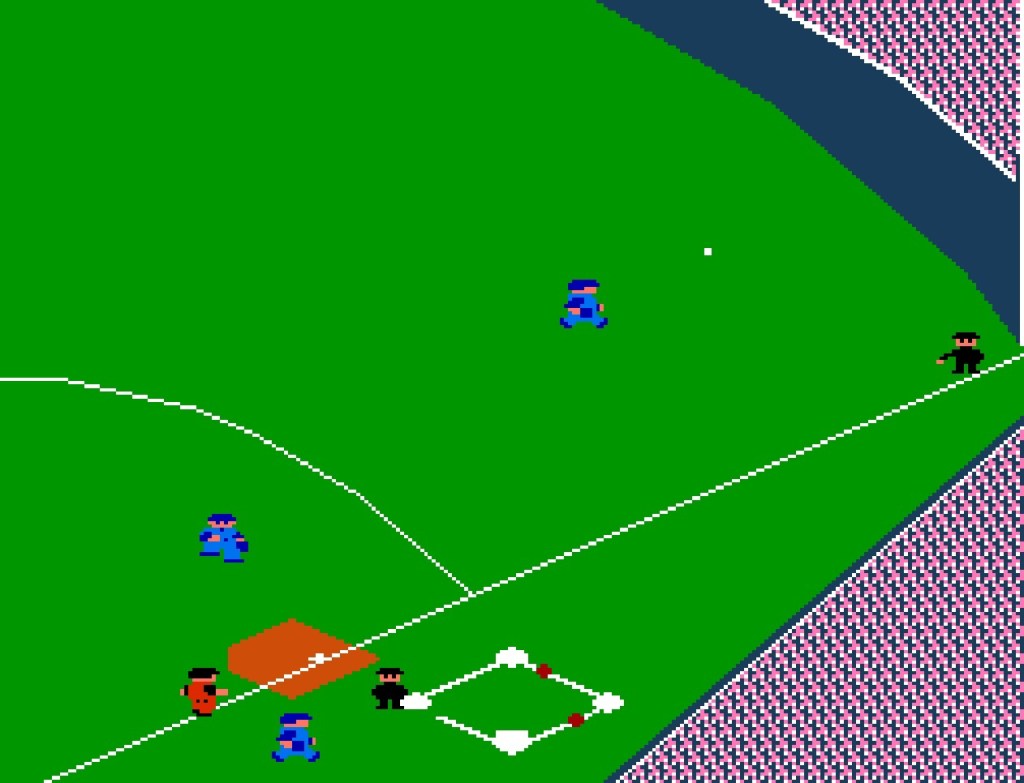
Going even deeper, depending on what’s happening on the field you might also want to make a substitution in the batting line-up, so if you find your bases loaded or just need to make a desperate attempt at a comeback you might decide to use a pinch-hitter, which you can position to stay in your line-up after an innings or for as long as you’re at bat, where a substitute pitcher must then be chosen to bat in that (ninth) position instead. This is just about a level beyond where I am currently though, and while I’ve taken an interest in some of those playing stats at the back of the manual, I’ve really not felt the need to particularly use them as yet. Fielding, on the other hand, does offer slightly more “useful” depth to me, but let’s start with the basics. Firstly, once you’re where you want to be on the pitching mound, you press A to pitch the ball, with an up direction throwing it slow, neutral (middle) throwing at normal speed and down throwing it fast. You can also use left and right after it’s left your hand to throw a curveball or screwball, and, like batting, it all becomes pretty intuitive pretty quickly, with you mixing up different types of ball depending on your pitcher’s strengths and weaknesses, as well as the current batter’s. Once the ball is hit, control automatically switches to the nearest fielder, and you’re controlling them with regular directional controls to get to the ball then throw it back to one of the bases, with the directional controls then further representing each one like before, or positioning them using the ball’s shadow to catch it if it’s in the air.

Each pitcher is unique in his abilities to curve the ball, wobble it in flight and throw it at pace, as well as in their stamina ratings, and, as said earlier, you’re going to need to keep an eye on that one sooner or later and jump into the menu behind the start button (same for those batting changes from before) so you can grab one of those relief pitchers. The pitcher can also pull off a “pick-off” move, where you first hold the ball by pressing B then press A and a direction to throw to a specific base in a bid to try and get an over-eager runner trying to steal a base out. On the fielding side, I think all things are more or less equal and you don’t ever have to worry about team management here, but they are prone to a few errors, like the occasional rubbish throw or bobbling the ball. You can get them to run to a base (or to tag-out a runner) as well as throw to it, or run then throw, again using B to run then A to throw if you want to, with the directions dictating which base you’re headed to as usual. Of everything, this is probably where your skills are going to develop the most as you play, juggling the player fielding the ball at the same time as working out where the runners are in relation to the different bases, and what to do as a result, although likewise you’ll do similar once you’re directing wider batting plays over just controlling the guy with the bat.
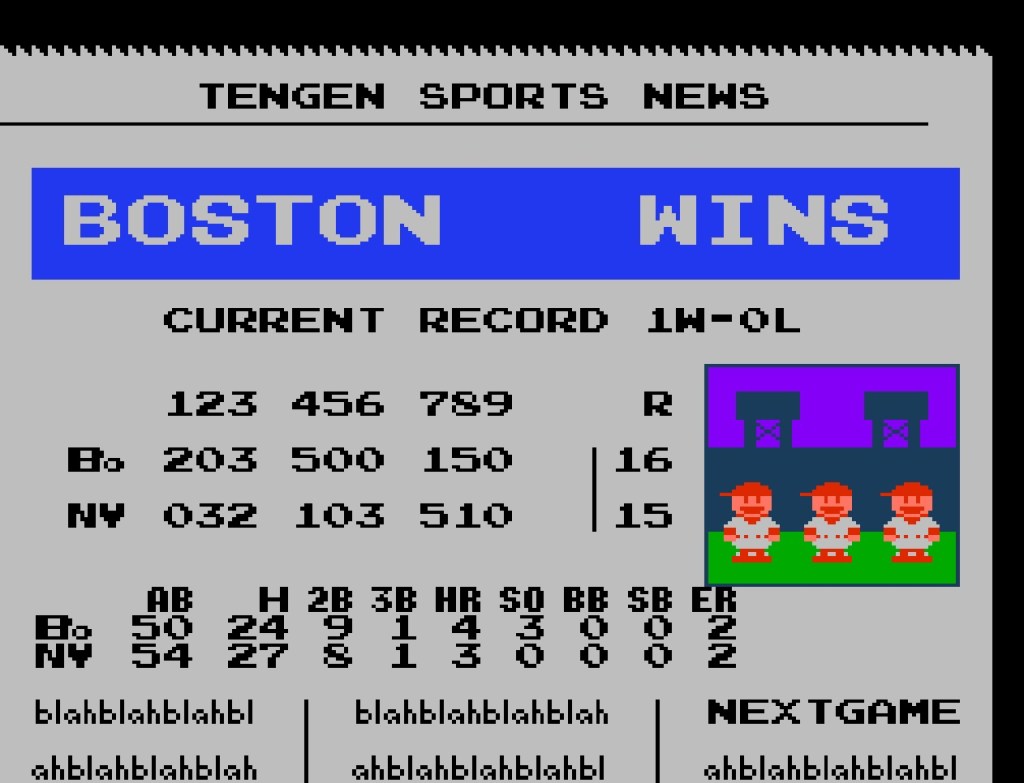
For a game grounded in realism, to a newcomer like me I think this is precisely where its realism – and thereby its real success – lies, where the gameplay is growing with you at the pace you want it to. Yes, just like the real thing, the overall experience is enhanced the more you learn and know and generally grow, but you’re also going to have a great time getting there from the very outset, although actually winning a season is a whole different ballpark! The AI seems mostly fair, and that’s reflected by mostly realistic outcomes to games, but there’s a lot of variables at play and they’re not all under your control, so while winning always seems achievable, it’s very easily snatched away too, and that’s what keeps you coming back. Having also now played a bit of the original Nintendo Baseball game it set out to improve upon, that’s also where it wins out because as fun as that also is (once you accept not being able to control the fielders, which is jarring after playing this) you’re getting the same game whether it’s your first go or your hundredth. However deep you decide to go here though, a typical game is going to last you about fifteen minutes, meaning a full season is going to take a good two hours, while best case a best of seven against a friend is going to take an hour or so but could easily go nearer two. And the problem with that is there’s no password system or any other way to save, so if you’re going the distance you need to slog it out all in one go. Thank goodness for modern save states! As I’ve gone really long (and also haven’t played them yet), I won’t go into R.B.I. Baseball’s sequels except to say there was a password save system introduced in the second game, along with all twenty-six pro teams, each with twenty-four real players, based on the 1989 season, and while gameplay was much the same there was a bit more to the presentation, and you got instant replays, and it came out on all the 8- and 16-bit computers as well as the NES… Maybe I’ll get to one of the 16-bits some other time because they look really nice and I might have just bought the Atari ST version! In the meantime, I’ve still got plenty of unfinished business with the original, as well as about 150 years of the game itself to catch up on!


These games were a common rental for a friend and me!
LikeLiked by 1 person
I can understand why. Wish I could have got to play with a friend.
LikeLiked by 1 person
My cousin and I used to play the crap out of RBI baseball!
LikeLiked by 1 person
I can imagine! Must have been great. Would love to have played with someone else!
LikeLiked by 1 person
where can we play RBI baseball 1987 now?
LikeLike