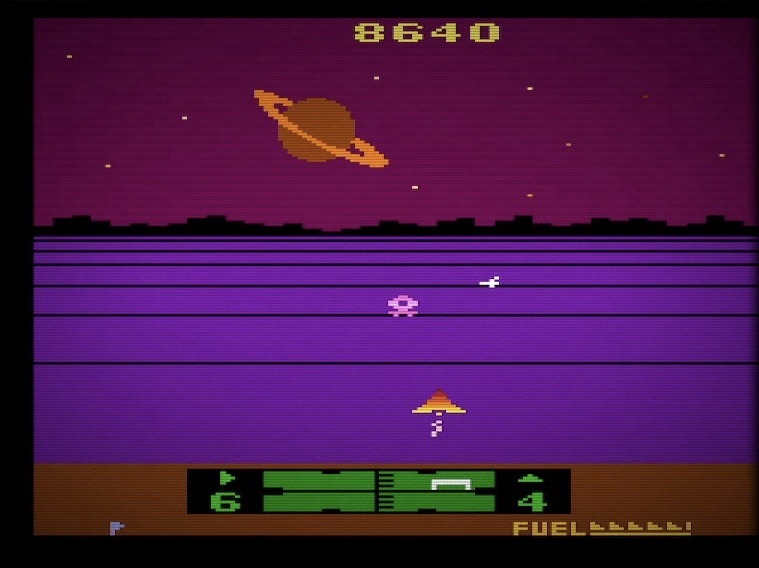
As relatively simple as they may be, and as much of a fan as I’ve been since its early eighties heyday, there are certain games in the Atari 2600 library that I’ve always found to be just too intimidating, almost to this day! Almost… They’re mainly very much celebrated ones too, as well as E.T. (although read the instructions goes a very long way in that case), although I’m not really sure about how Raiders of the Lost Ark and Space Shuttle are regarded – no question they’re both outrageously ambitious in their own way but still too intimidating, and the instructions only make it worse! Actually, I think Atari’s obsession with overly verbose instructions for even the simplest of arcade games was a big part of any intimidation. I’ve one other example I want to quickly highlight in slightly more depth before we get into the main course, and I’m mainly doing that because it was actually what I was originally planning to cover here today, had Solaris not done exactly the same thing but with an even bigger impact in the meantime…

Adventure was released way back in 1980, and just like a couple of other games we saw just now, its scope is staggering for the time, with you trying to find an enchanted chalice stolen by an evil magician and return it to the Golden Castle. Along the way, you’ll need to find the keys to open the gates to this and two other castles holding other items you’ll also need to progress your quest, from swords to deal with the magician’s three dragons to bridges to navigate some hard to reach places. Then there are big mazes and blind mazes to negotiate, secret rooms to find (and the first ever gaming Easter egg) and a stupid bat that regularly steals whatever single item you’re trying to carry somewhere and takes it somewhere else, and is far more likely to ruin your chances than any dragon! Three skill levels too, where the first is straightforward and there to ease you in to the second, which I guess is regular but way more expansive and challenging, then the third drops all the items randomly every time, and is where you’ll play forever! Its real genius is how quickly it grabs you and lets your imagination take over though, leaving you totally immersed in this first-of-a-kind action-adventure, totally oblivious to the fact that you are playing as a square, and everything else is made up of a handful more squares, all accompanied by some harsh beeps and blips, rather than the brilliantly varied and atmospheric fantasy kingdom you’ve convinced yourself you’re suddenly spending an entire weekend obsessing over again! Has to be seen to not be believed, and it’s an absolute masterpiece I’m so glad I finally found the courage to work out what’s going on in, the best part of half a century later or not!

And then there was Solaris… My favourite Atari 2600 game ever! To say I was late to this party would be beyond understatement though, and you really don’t need to go back very far into my previous Atari 2600 features to see that for several decades (and seemingly until as late as January 2025 according to dates on some of the screenshots here), that honour went to single-screen, multidirectional shoot ‘em up Seaquest (more here). Unlike Adventure though, which always looked like my cup of tea but I simply hadn’t learned how to play, this wasn’t a game that ever really appealed at all. Just another ancient space shooter I missed out on at the time and wasn’t fussed about when compilations then emulation (then more compilations!) opened up the system for proper exploration. And then there was Star Raiders! Right, long story short now because I did a whole deep-dive on that here – I got The [Atari] 400 Mini for my birthday in 2024, and having never really experienced anything on there before, lapped up every single game that came on it, including a strategic space combat sim called Star Raiders II. It was love at first sight, to the point that I decided I should check out its 1980 predecessor (also on Atari 8-bit and pictured above) first, and almost two years later as I write, I still haven’t been back to its sequel! It’s not just one of the most influential games of all time, but to this day one of the most immersive too, and despite what is probably now hundreds of hours trying to clear its galactic map of a dynamically-invading alien fleet over and over again across multiple difficulty levels, I’m no way ready to move on yet!
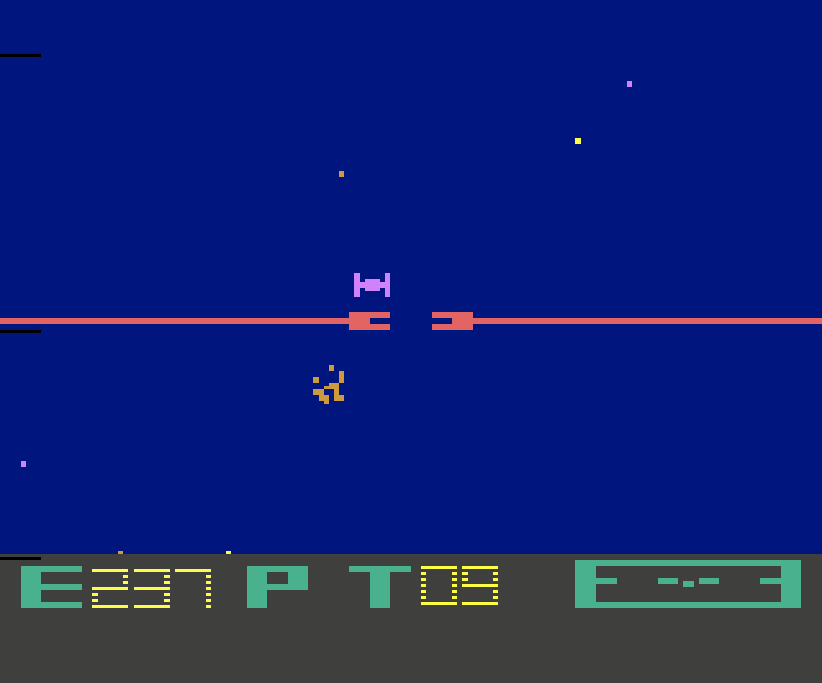
At this point, it’s worth briefly recapping the basics of the game to give us some context for Solaris shortly… The treaty between the Atarian Federation and the Zylons (which is just the start of the Battlestar Galactica comparisons!) has broken down into a state of war, with the Zylons now threatening to eliminate humanity as we know it, right across the galaxy, which is about to become your battleground! You’re part of the elite unit of the Atarian Starship Fleet known as The Star Raiders, and your primary mission is to destroy all Zylon starships without getting destroyed yourself. On top of that, you also want to complete your mission in as little time as possible, using as little energy as possible, and without allowing any friendly starbases to be destroyed, and all of this contributes to your end of mission rating. We might return to some of that later, but it plays out as simple real-time strategy on various galactic maps followed by 3D cockpit-view space flight and combat. Star Raiders went on to be adapted for various Atari systems over the next decade or so, including the 2600 in 1982, where it’s unquestionably a remarkable achievement but unfortunately isn’t really where you want to be playing it – another example of too ambitious for its own good, with a dedicated controller (that makes it a nightmare to emulate or run on something like an Atari 2600+ today) providing fully-featured and perfectly intuitive and immersive control, but it’s also so stripped back that most of that all-important immersion gets lost as soon as you start playing. That said, if it was the only place to play it I don’t think you’d be that disappointed, but before we get to its “official” follow-up, I want one more stop-off at another 2600 game called Starmaster…
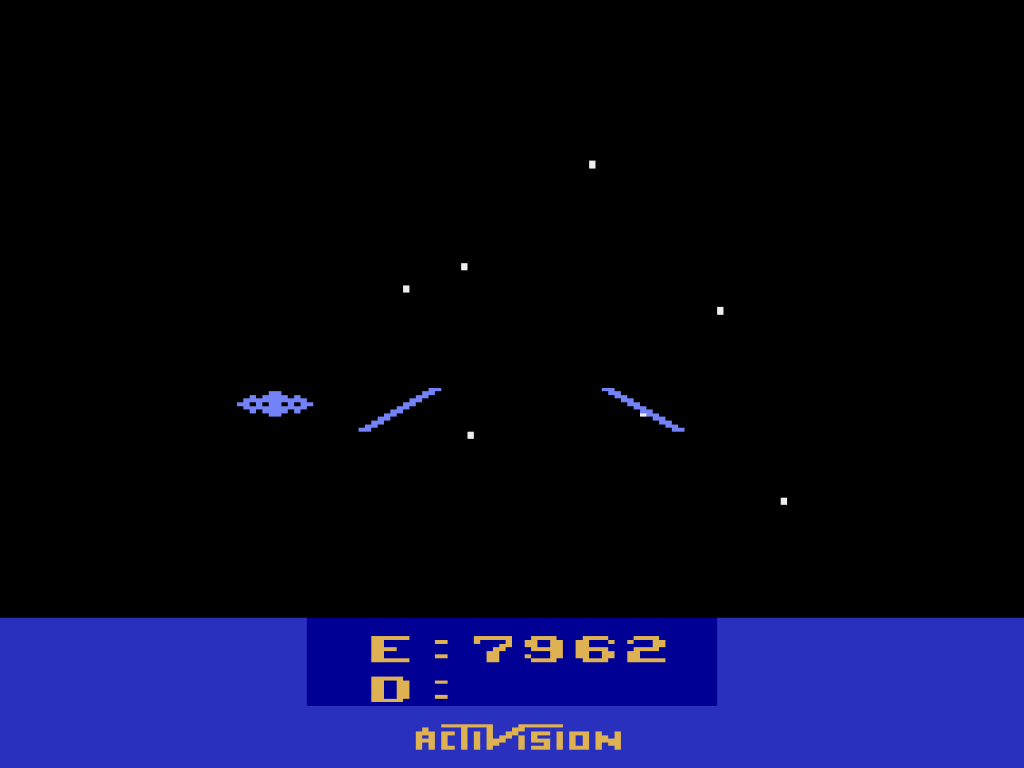
To get the best possible Star Raiders experience on the 2600 in 1982 – and for a good while afterwards come to that – you wanted Activision’s Starmaster, pictured above, which was completely built for purpose, and as such, as intuitive and as immersive as you could hope for from a primitive 3D star-field, a few simple shapes, a couple of beeps and blips, and the whole galaxy within easy reach! That galaxy is also being invaded, so it’s your job to strategically warp around the map, protecting your star bases from invading aliens by tracking them down and blasting them to smithereens, while also looking out for meteors and the like, all of which want to damage your energy and shields, which you can replenish from those star bases, assuming you’ve stopped any immediate threat in time and managed to limp there one way or another! It’s a big-scale, risk-reward game of cat and mouse as you try to anticipate the alien fleet’s next move so you can work out if yours is even feasible! The balance between simple strategy, combat and ship management is just right, and everything controls equally simply, on a standard Atari joystick or a modern controller or whatever, and it’s just a joy, especially when you get to the third and fourth of the (four) difficulty levels, where there’s way more aliens who move way faster than you do too! If I had to name a single hidden-gem on the Atari 2600, it’s this, and actually, I don’t think it ranks too far behind Solaris overall either, which sounds like a good place to finally get into that!
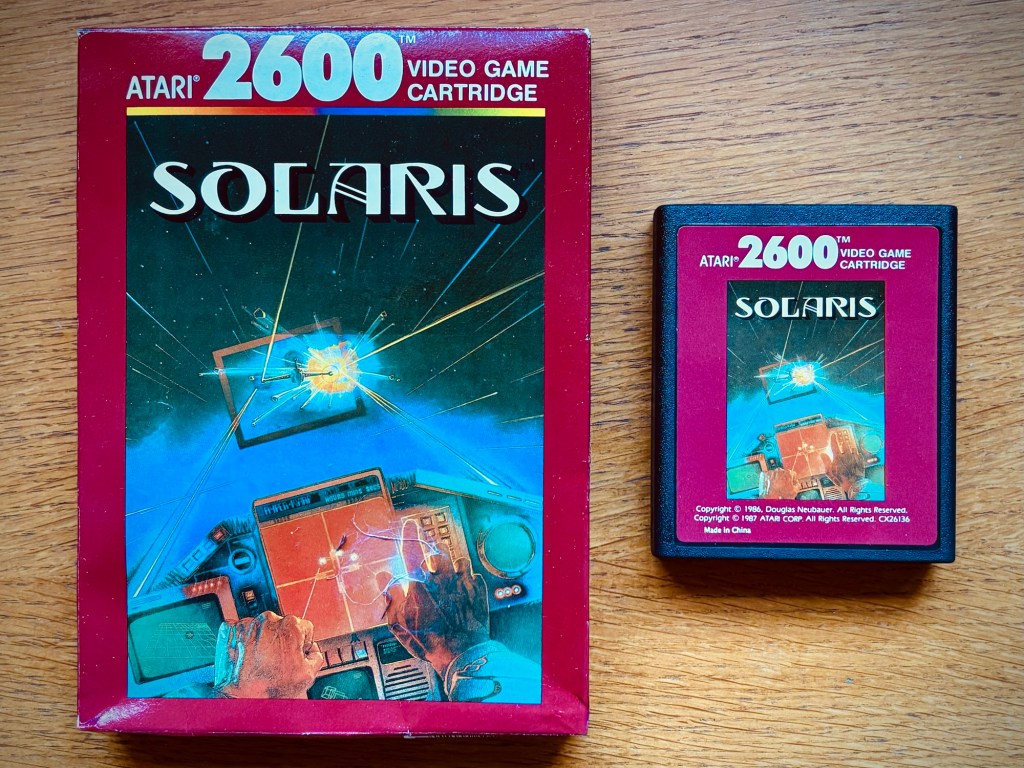
And just like the aforementioned Adventure, the place I finally got into it was 2022’s incredible Atari 50: The Anniversary Celebration on Nintendo Switch, which I should point out also includes the excellent, controller-friendly Atari 5200 port of Star Raiders… As well as those intimidating original instruction manuals for everything on there, and a whole lot more besides, including histories, developer goodies, video features, artwork, packaging renders and all sorts of other stuff, although I’m pleased to announce that I’ve since got my own original boxed copy all the way from 1986 as well, and although most of the screenshots you see here are from the Switch version for convenience, that’s where we’re predominantly going to be drawing from otherwise. Although we’ve already talked a lot about Star Raiders, and Solaris is set in the same universe, so to speak, it’s not actually an official sequel; more of an official spiritual successor by its author, Doug Neubauer, that was once again published by Atari, albeit in a different form… It was first pitched to them a couple of years earlier, when they were looking for a tie-in to The Last Starfighter movie, but that was also around the time Atari was bought by Jack Tramiel and, like the rest of their home console output, it subsequently got shelved until he decided to resurrect the now-creaking 2600 in 1986, and they got back in touch with Neubauer. The game now known as Solaris was showcased at CES that summer alongside the “new” console (together with the backwards-compatible Atari 7800), and got a release in November that year, complete with promotional artwork lifted from Star Raiders several years earlier, even though it definitely wasn’t a sequel!
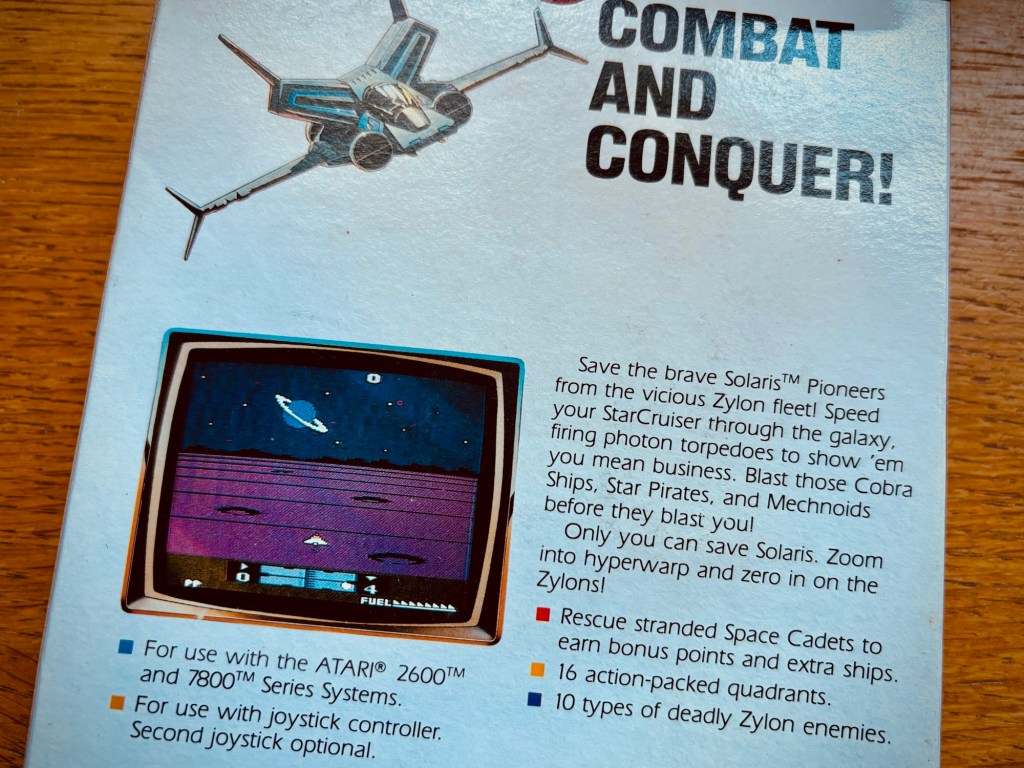
“Save the brave Solaris™ Pioneers from the vicious Zylon fleet! Speed your StarCruiser through the galaxy, firing photon torpedoes to show ’em you mean business. Blast those Cobra Ships, Star Pirates, and Mechnoids before they blast you! Only you can save Solaris. Zoom into hyperwarp and zero in on the Zylons!” Yes, they’re back, and once again swarming all over the even bigger galaxy in even bigger numbers attempting another takeover, which is all spelled once you get beyond the back of the box and into the instruction manual, but that’s essentially it – if you didn’t know the lore behind Star Raiders, then you’d be none the wiser that this is following-on from that. And it wouldn’t matter in the slightest, especially when there’s more to the mission than meets the eye… I’ll be honest, until I studied the manual just now, I thought I was looking for the titular planet Solaris to rescue the Atarian Federation Pioneers (another link to Star Raiders) stranded there, obviously taking out those pesky Zylons along the way. However, it turns out that’s just the official version to throw them off the scent, should they guess you’re onto them – your real mission is simply to wipe them out! Confusingly though, the game ends when either all your ships (three of them) are destroyed, or you actually reach Solaris before the Zylons get there and blow it up. Whatever, the ruse clearly had me fooled!
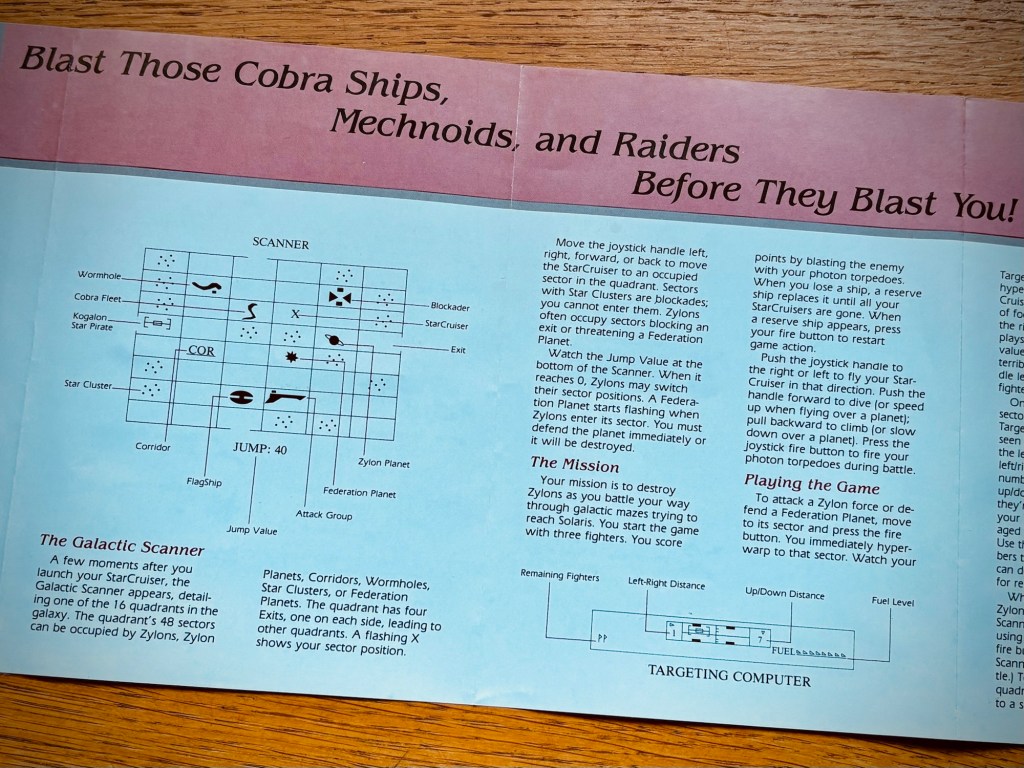
What is clear though is that you need to jump into your fully-equipped StarCruiser and hyperwarp from quadrant to quadrant, facing-off against threats such as Kogalan Star Pirates, Cobra Fleets and the always ominous-sounding Planet Destroyers! There are no game variations or difficulty switches to worry about with this one, so a press of Reset on the title screen is going to put you in the cockpit, then a press of the (single) fire button on your joystick will launch you across the spectacular 3D planet surface and into hyperspace to get you underway, with a few seconds to acclimatise yourself to even more very pretty space flight before things get serious. Aside from the view of vibrantly coloured planets whizzing by, it’s worth noting the simplified cockpit controls, more like those found in Starmaster than Star Raiders, and far more suited to the platform, with remaining fighters (lives) on the left, your Targeting Computer in the middle, and your fuel level on the right, and I’ll come back to all of that shortly. In the meantime, after a moment or two the Galactic Scanner is going to appear, and exactly like Starmaster again, it’s the same again with this – apart from your forward cockpit view, this is the only other screen either you or the poor old 2600 needs to worry about here!
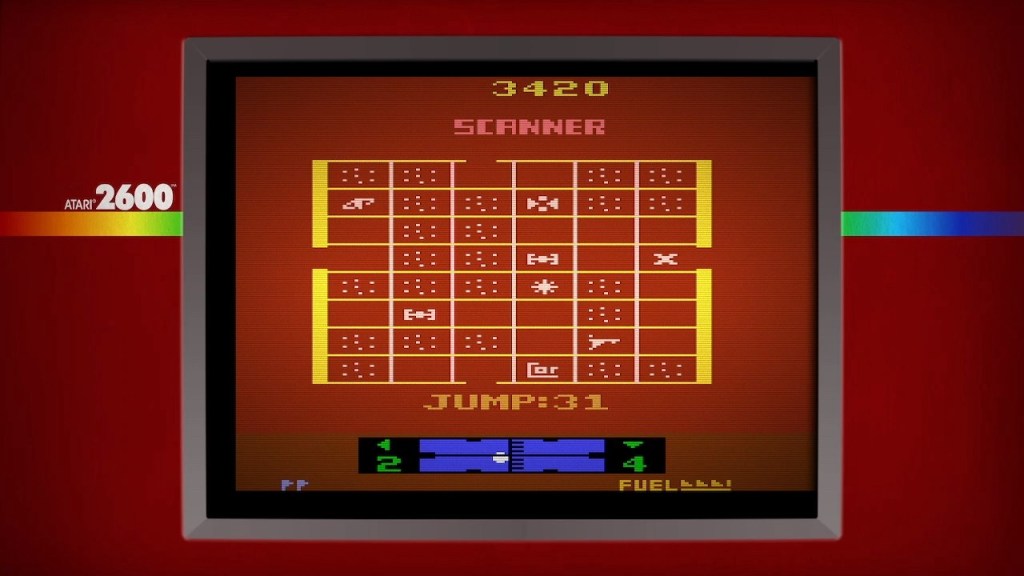
Right, Galactic Scanners! What we’re looking at (on the Atari 50 version pictured here with its disappointingly not very exciting wallpaper) is one of sixteen quadrants making up the galaxy. In turn, it’s a grid made up of forty-eight sectors, and each of those can be occupied by you (shown as a flashing X), various types of Zylon menace, planets they’ve occupied, corridors, wormholes, star clusters or Federation planets, and I’ll try and remember to come back to those too. On each of the quadrant’s four sides, you’ll also see an exit, which leads to its neighbouring quadrants, and you’ll probably want to start mapping those out once you’re ready to make a serious attempt at getting to Solaris as quickly and efficiently as possible! Actual traversal is like getting around a maze, simply moving your ship around the clear routes between impassable star clusters to wherever or whatever it is you want to get to. Just keep in mind that goes for the Zylons too, and when the Jump value at the bottom of the screens counts down to zero, they’ll be on the move, mostly likely to take up a strategic post near the exit you were heading for, or to attack one of the Federation planets, and once the alarm bells start ringing for that, you need to get there quick and defend it before it’s overrun and turns into what’s called a Red Zone, which definitely reverses your controls if you get caught in one but I’m not really sure of any longer term consequences… I am sure that happens just forty seconds after the alarm sounds and the planet starts flashing though, so you really can’t hang around or miss too many of the blighters first time of asking!
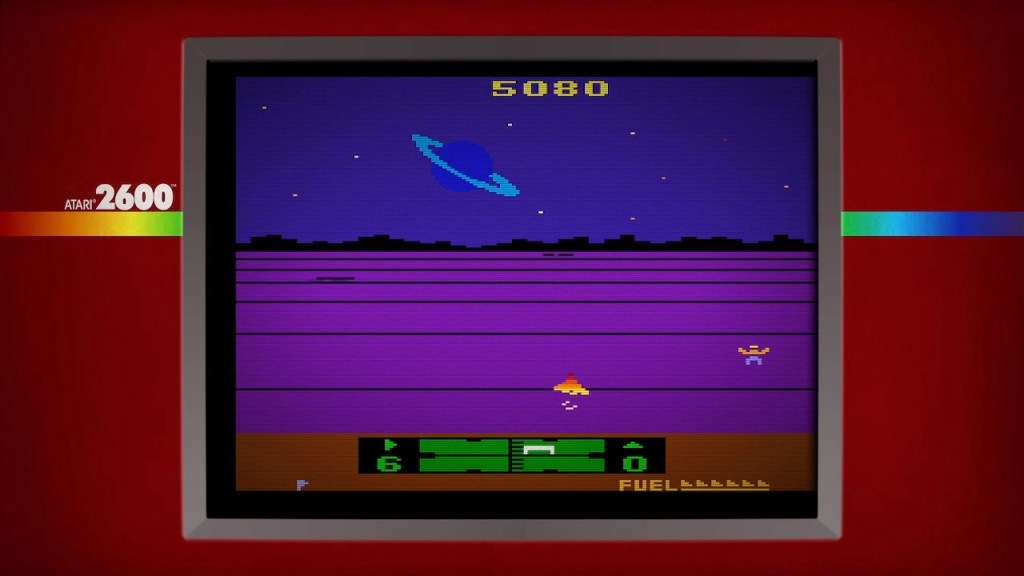
Defending a planet under threat on its surface, or, indeed, attacking a Zylon force in outer space, involves moving your icon to its sector and hitting fire to hyperwarp there. You have to keep an eye on your Targeting Computer on the way, which will show your ship moving in and out of focus, together with a numerical display from 0 to 3, and you need to move left and right to maintain hyperwarp focus and keep it as close to zero as possible, which will both use fuel more efficiently and take you out of hyperwarp closer to your final destination. Once you arrive in hostile territory, one way or another you’re about to start shooting stuff, but unless you arrived precisely on top of them, it’s the targeting computer again, first to line up the enemy, once more using a new set of numbers on the left of it to show horizontal distance away and on the right to show vertical, the idea being you want both at zero so they’re right in front of you. It’s way easier than I’m probably making it sound, and that’s the real genius of this game… Well, apart from wrenching miraculous levels of performance out of the machine and the general absolute mastery of it! Anyway, a significant part of the genius of this game is just how easily it plays once you’ve got a basic handle on it. I relish the original Star Raiders’ immersion for its relative complexity – like you’re flying a real spaceship, with all those keyboard commands for all those things you do in all those different directions, whereas this gives you exactly the same immersive experience while stripping all of that stuff away entirely.
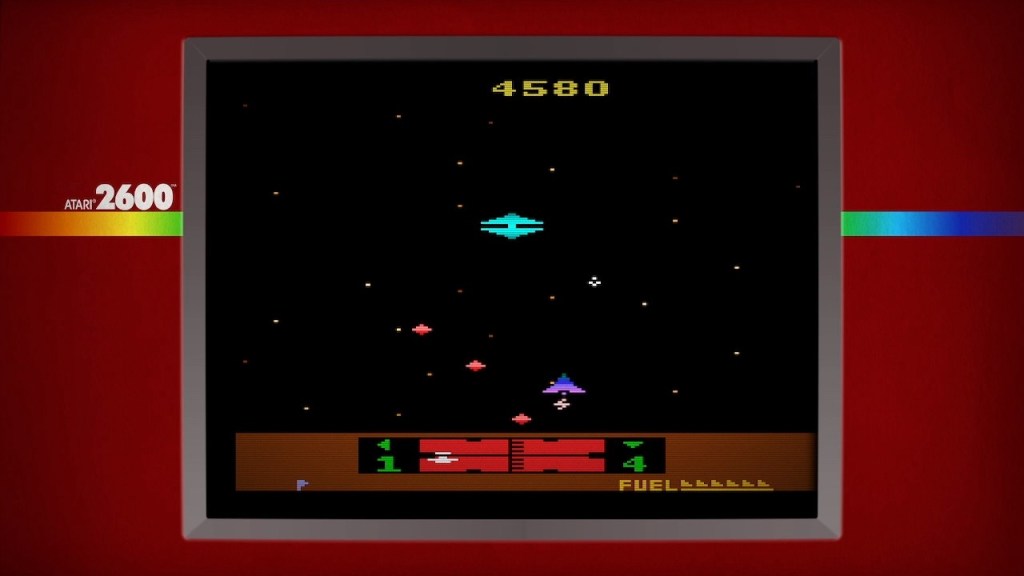
Back to shooting the bad guys, there are loads of different ones, all made up from menacing geometric shapes, and inevitably, at least one resembles a Star Wars TIE-Fighter! Actually, that one is those Kogalan Star Pirates from earlier, who just attack everything in sight, whether Zylon or Federation, and aren’t just averse to ramming you either! The Zylons also have the Cobra Ships, which come out in numbers to defend their sector, and Mechnoids, which are big and clumsy but pack a serious punch if you get in their way, and likewise the Flagships, who send out Distractors en masse to suicide attack you, draining your fuel with every hit, which is also the case for everything else that hits you – run out and you explode! Also out for a bit of that action are homing attacks, space minefields, Gliders that dart around as you shoot, and Raiders, which is what will attack a Federation planet and are a good idea to prioritise getting rid of. All of these might be alone in a sector, or part of an attack group, which can contain Flagships, Mechnoids and a bunch of Pirates on top, so you really need to pick your moments when you see them on the Galactic Chart, especially if you’re low on fuel. When that happens (indicated by a different alarm), you want to warp to a Federation planet as soon as you can and look out for the Docking Bay on your Targeting Computer, which you want to fly into to get yourself filled up and fixed up, but just don’t shoot it, or it becomes one of those Red Zones too!
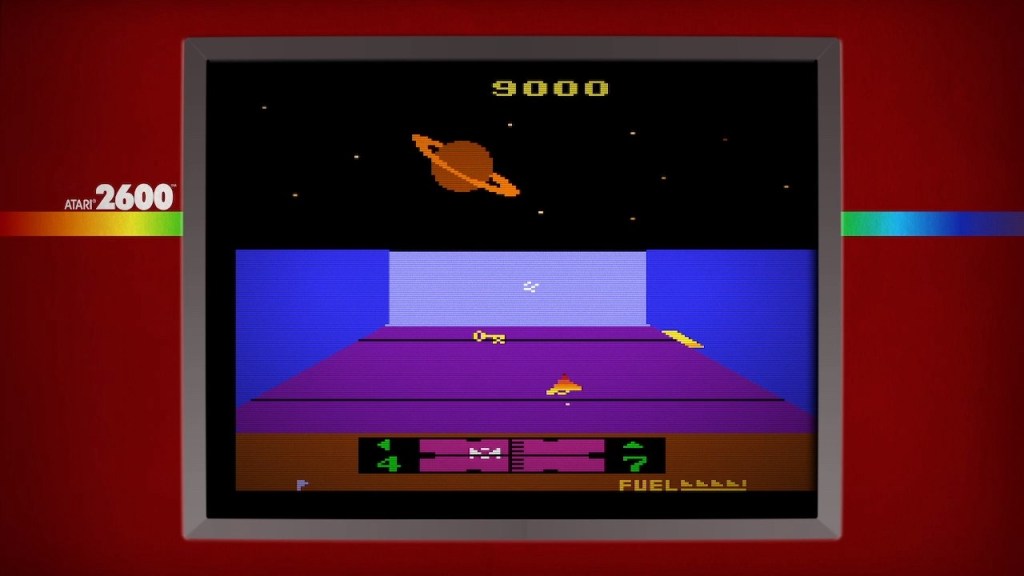
While you’re on a planet, you might also notice a few Space Cadets waving frantically at you, or at least holding their arms in the air while your imagination sorts out the animation! If they’re on a Federation planet, just ignore them. Apparently just saying hello! However, if they’re stranded on Zylon planets, then that’s another matter! Rescue them all there then it’s a huge points bonus, an extra life, and the planet mysteriously blows up on top! The other way of collecting really big scores is to negotiate a Corridor in space, which kind of act like a risky shortcut through a quadrant. Guardians protect their entrance, and once you’re past them, you need to track down a key and fly directly over it to grab it while also negotiating more Guardians, before trying to gain safe passage through the Ion Doors it opens at the end; get through that, and as well as the bonus points, another nearby Zylon planet will mysteriously explode! All the regular enemies are worth more or less points too, and although this is one of those games where it’s easy to ignore them entirely, for context, those little kamikaze Distractors are worth 20 points, Guardians 60 points, Cobras 80 points, then varying values up to Flagships at 500 points, while the Space Cadet rescues and Corridors are worth 8,000 points each. And apart from looking out for Solaris while you’re wiping out the entire Zylon race, I think that’s the game!
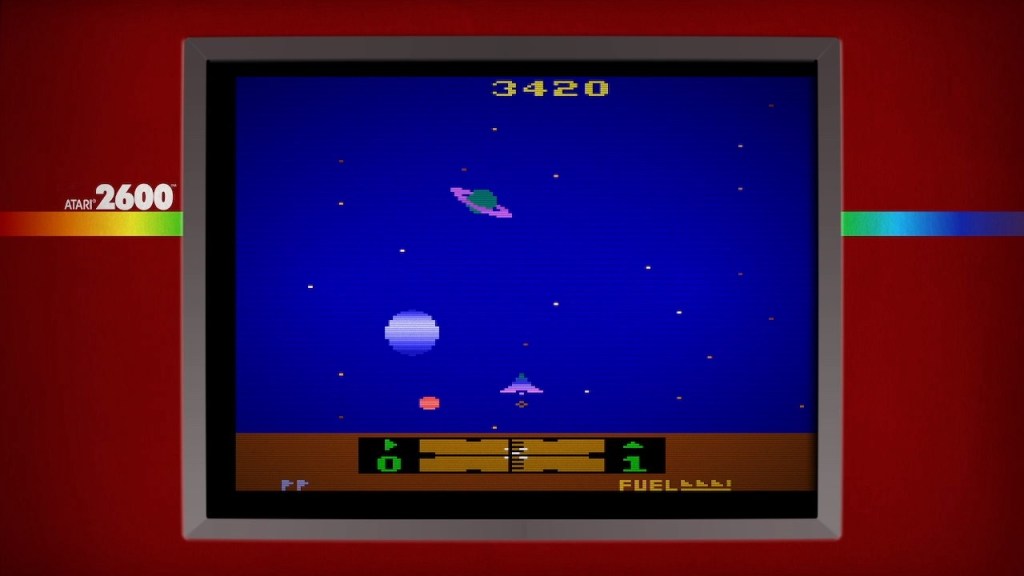
You’ll know Solaris when you find it because it’s the only planet blinking away on your Galactic Chart, although you’ll have also noticed the gameplay becoming more and more frantic the closer you get! In fact, just making your way around a couple of quadrants with your three lives intact and a few rescued Space Cadets onboard is going to be quite the achievement for some time when you first start playing. But that’s just fine too! Okay, a map made up of a big grid filled with a bunch of simple icons might not sound that exciting but the Galactic Chart is a technical marvel for the old 2600 in itself, with you plotting away against an entire fleet of alien intelligence in this giant cosmic game of chess… And then it switches to 3D space combat, with loads of stars and planets flying by at incredible speed, and then you’re hurtling across their textured surfaces, all distinctly and vibrantly coloured, and with mountains and craters and gorgeously detailed distant other planets, and again, everything is moving so fast and so smoothly (including the transitions between all this stuff), and with barely a trademark flicker too! The use of different colours in the little sprites also adds way more than it probably should, in no small part thanks to some clever scaling effects, and likewise the multicoloured explosions and animated flames coming from the back of your ship. I might have been late to Solaris, but I’ve been playing on the 2600 (or VCS as we knew it back then) since the early eighties, and I’m really struggling to think of anything that looks better in motion than this! The only thing I will note (in the interests of balance because I could gush about this all day) is that in some of the outer space combat encounters, the game’s pseudo-3D effect can trip over itself, and your brain suddenly stops seeing it so it ends up feeling like a single-screen shoot ‘em up like Galaga or something instead.
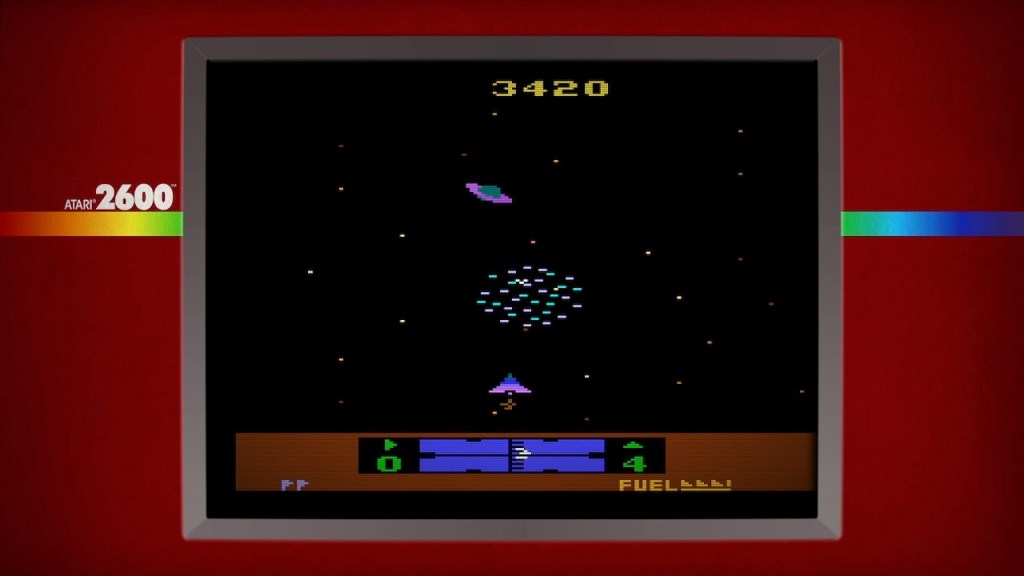
Doesn’t happen much though, and not for long when it does, and until I almost deliberately started noticing it while writing this, I’m not sure I noticed it at all, if that makes any sense! I really like the sound effects too, and although they’re typically limited by what the 2600 can physically achieve, the kind of intimacy with system we’ve just seen elsewhere is audible here too. There are the regular beeps and blips and simple sirens and melodies and stuff for enough things like damage taken and dished out, alarms, confirmations and so on to keep the noise relentless, but your laser cannon has real punch, and any subsequent explosions are very nicely loud and impactful, while the warp sound hits you with this brief psychedelic whoosh, complemented by a similarly psychedelic graphical tunnel effect. No music but it’s more than atmospheric enough without it, and realistically probably better off without it too! I reckon there’s more than enough going on elsewhere too, with all that plotting and strategic depth, and the multiple objectives, and the shooting, warping, landing, rescuing, docking, navigating space corridors to find space keys, fuel management, all the different enemy types with all their different behaviours… I just mentioned struggling to think of anything else that looked like this on the 2600, but that lot’s sounding like something I wouldn’t experience until I got my 16-bit Atari ST as well! We covered a couple of overly ambitious games on here at the start, and this is undeniably another, but unlike the others, it nails every single element of that ambition and more besides! Yes, there were pioneers everywhere you looked on this remarkable system, but there was nothing else like Solaris on there, and a lot of other places besides!
As always, I’ll never expect anything for what I do here but if you’d like to buy me a Ko-fi and help towards increasingly expensive hosting and storage costs then it will always be really appreciated! And be sure to follow me on Instagram, X (formerly Twitter) or Threads for my latest retro-gaming nonsense, and also on Bluesky, which is under my real name but most of it ends up there too if you prefer!


Solaris is soooo good. Like you, I was a late convert, though not due to intimidation. I grew up with Star Raiders and its sequel on Atari 8-bit computers, and had no idea of Solaris’ existence until the release of the Evercade in 2020. I was enraptured immediately, though, and strongly believe it’s one of the best 2600 games of all time.
LikeLiked by 1 person
Nothing better than finding an ancient game you didn’t know you loved!
LikeLiked by 1 person