
Before The Spectrum arrived at the end of November 2024, I put together a list of the stuff I wanted to check out on there before I got sucked into its built-in games carousel, as well as everything else I’d ever bought for it first time around, and, inevitably, the infinite distraction of an entire library of thousands of titles to pore through again on top! Obviously, top ten all-time favourites such as Feud, Renegade, Olli & Lissa: The Ghost of Shilmoore Castle and Gauntlet were the first order of business. Then there were a handful of text adventures I’ve been meaning to catch up on for ages, such as The Hobbit (which came with it), Dracula and Jack the Ripper; might seem strange but with the replica machine’s replica keyboard, it was a nice way of experiencing the genre again! And that was partly true of the final batch of games on my initial to-do list, which were the ones I remember playing on those iconic rubber keys when my best friend got his ZX Spectrum back around 1984…
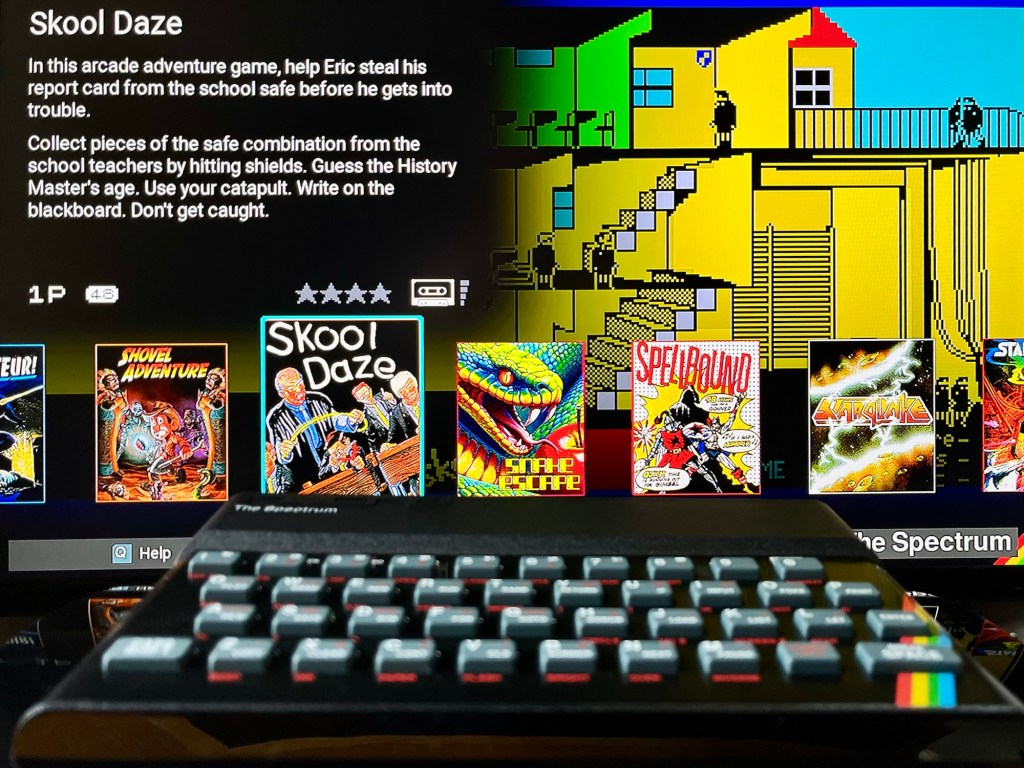
Now, I’m sure I’ve mentioned it at least several time before here, but while I can remember the very first games I ever played on the Spectrum, I can’t remember which one precisely was the first, but it was one of the following: Chequered Flag, Horace Goes Skiing, Daley Thompson’s Decathlon or Alcatraz Harry. While it would be romantic to try and establish the latter as the first in the very feature where I’m covering it, my head says it was actually Chequered Flag or Horace Goes Skiing because I reckon they’d have come with it – he wasn’t into car racing or skiing so I’m not sure he’d have ever picked them out above anything else in Boots or WHSmith or wherever and bought them for his new computer! He’d have been all over Decathlon though, and that was certainly the game we played more than any other on his Spectrum, so to further extend my theory, I’m not sure anything else would have got much of a look in after he got that, and we did play a lot of the other two I just mentioned too! Finally, Alcatraz Harry was a budget game, so it kind of makes sense he went for that next, after he’d blown all the pocket money he’d previously saved up on Decathlon!

All conjecture though, but one thing’s for certain, and that’s Alcatraz Harry was definitely the first game I ever completed on the Spectrum, sitting next to him on his bedroom floor, where the portable TV was also sitting alongside the demure little computer and its tape deck. And one thing I do also distinctly remember is the tension of its final section (which I’ll come back to), and I can also confirm that tension is still there, having beaten it for the second time ever about ten minutes ago as I write these words, and possibly more so now, because I really didn’t fancy going through it all over again… I’ll come back to that too, but for the time being, I’ve had Alcatraz Harry on my list of stuff to write about for years, and while I do still have unfinished business with Chequered Flag on The Spectrum as well, I thought there’s no time like the present to finally do it, so here we are! By the way, credit to Spectrum Computing for the inlay pic above – unfortunately I can’t for the life of me find my original copy, which is annoying me no end!

Alcatraz Harry (on the box) or Alcatrazz Harry (in-game) was created by a chap called Barry Jones, who came up with tons of early Spectrum games, including the likes of C5 Clive and The Greatest Show on Earth. It was released by Mastertronic, exclusively on the Spectrum, somewhere around October 1984, when the £1.99 games it would soon become famous for were still something of a wonderful, just about accessible novelty! In retrospect, it’s got all the hallmarks of an early budget game too – not far beyond a high-end type-in but on a larger scale. Plenty of fun type-in games though, and just being able to get the occasional game in-between Christmas and your birthday always made stuff like this far greater than the sum of its admittedly primitive parts! Which we’ll also come back to, but first let’s set the scene… “A unique blend of arcade strategy and adventure where the player must escape from a prison camp. In order to do so he must steal secret files and escape equipment, then negotiate a mine field, avoid the patrolling guards, use the escape tunnels, cut the wire fence and reach the car which you can steal to help you get to the escape compound where you can deposit the equipment you have accumulated a finally escape via a hole in the fence. Avoid the obvious and think carefully before you decide where to make your move.”
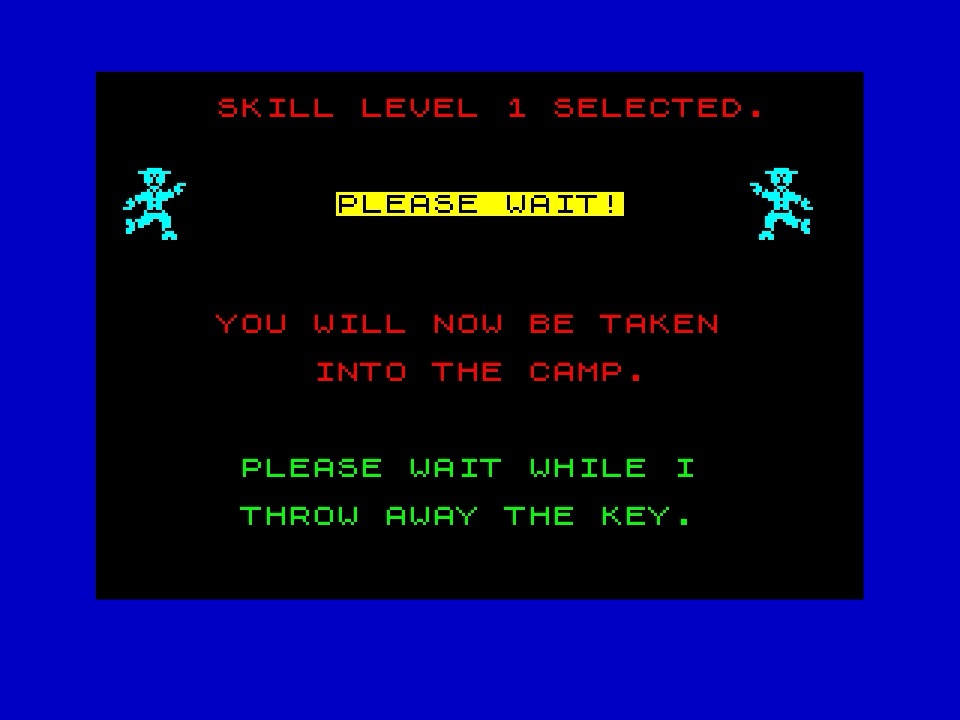
Some of those things do happen as well, but in general, this back of the box narrative is really stretching the reality of the gameplay! Luckily the optional in-game instructions do fill in quite a few gaps, although not necessarily all of them… Right, first up, our prison consists of eighteen screens across by eight screens down, making a grand total of one hundred and forty-four of them to make our way around, initially looking for thirty items of escape equipment scattered around some of them, which we then need to deposit back at our start point, a nice little fenced-off compound in the middle of the bottom of the map. Along the way, we also need to find those secret files, which are apparently most important to our allies… We don’t know why or even who they are but maybe that’s the secret! Anyway, before we get going, a kindly prison guard is going to let slip which “sector” the secret files are hidden in, which will be a random screen number, and if you bring up the status screen at any time, that’s going to tell you the number of the screen you’re currently on, and those increase sequentially as you go up and across.
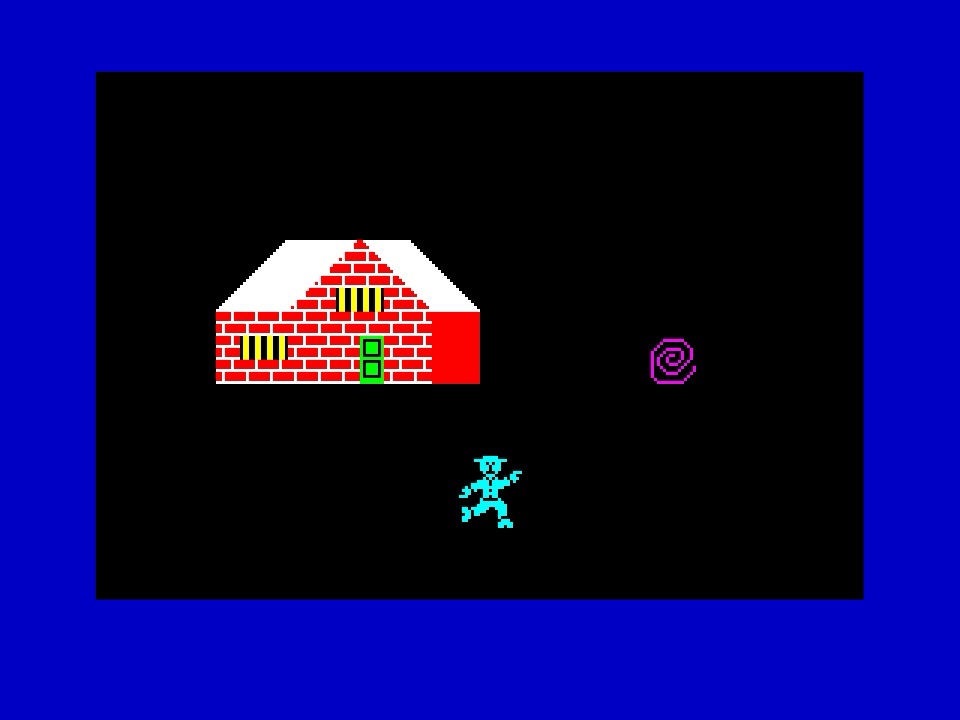
Getting around is as easy as it gets – you’ve got four directions on four keys (but no joystick option), and to pick up any equipment you find, you just place yourself above it and press the down key. That status screen will also keep track of what you’ve picked up so far, which is going to consist of guns, pliers, rope, ladders, spades and some kind of bomb things. I think! Now, you might have noticed I mentioned all of those in the plural, because inexplicably, you’re going to need multiples of everything to make up the thirty, and you ain’t going nowhere until you’ve found all thirty either! Of course, it’s all there to extend the lifetime of a game that can easily be beaten in fifteen minutes regardless, and despite everything being placed in different positions every game, but all the same, that makes no difference when you have to go almost everywhere anyway! I’d have much preferred something like Adventure on the Atari 2600 had done several years before even this, where one of the game modes would place the handful of items you need to find at random across the same map, rather than tell you to explore every inch of it every time to find a dozen swords, keys and chalices before you can get anywhere, thereby making an even shorter game (in theory!) literally last a lifetime, which I can certainly vouch for, still playing it through at least once a month!
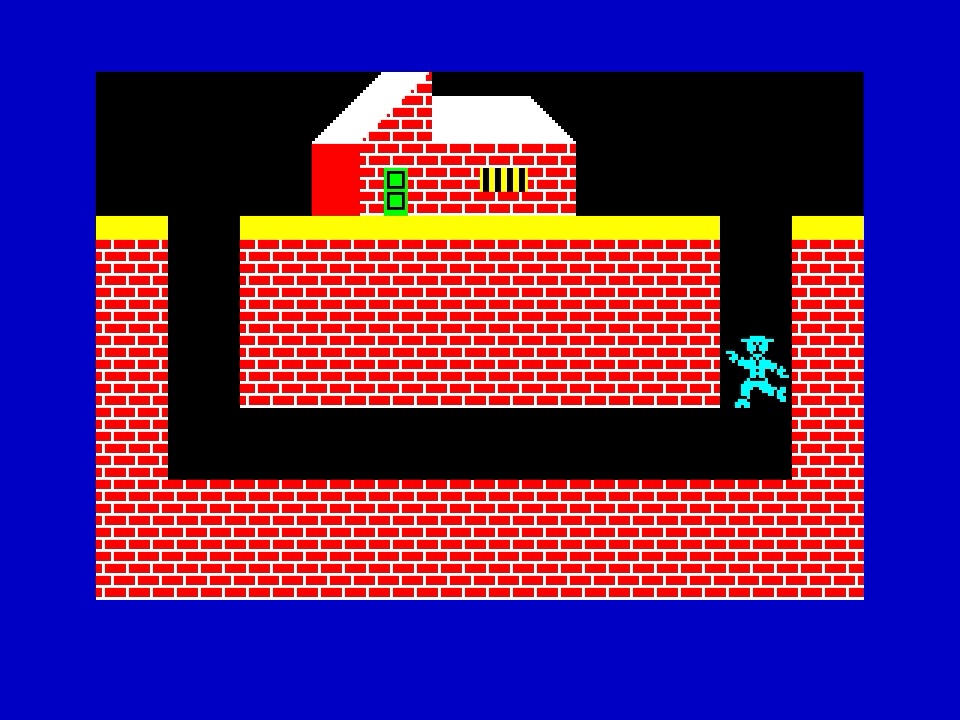
Back on Alcatraz Island though, you won’t necessarily have to explore every inch of the map (if you’re lucky) every time, and there are a few things to also look out for that will help you get around too. Firstly, you’ve got tunnels, which you can climb into and you’ll be whisked to somewhere else in the camp, which is supported by one of the game’s little “flourishes” where you see your little man travelling side-on through the tunnel in a cutscene of sorts. Likewise, if you come across an old-fashioned convertible car, you can drive straight back to the compound at the bottom of the map, and let me tell you, remembering you’ve seen one of those a couple of screens to the left of where you’ve just found your thirtieth piece of escape equipment (and ninth ladder!) is such a relief… The thing is, as well as handily abandoned bits of escape equipment, and tunnels and cars, you’ll also be coming across the prison’s guards, and sometimes their dogs, and if you come across them a second time, you’re in for it… And I really mean in for it, as first they surround you, and then you’re put in front of a firing squad to get your head literally blown off! Seems a bit harsh for what the instructions describe as being caught “loitering” but that’s what’s going to happen if you so much as return to any screen you’ve previously entered where there’s a guard present, and this is where the main challenge of the game lies – remembering where the buggers are, because by the time you’re into the twenties of equipment found, you’ll have probably come across just as many guards to avoid as you progress around the grid, and suddenly you’re not just going up, across and down a screen to avoid one, but up, up, across twice, down one, across one and so on!
And with a sense of direction like mine, that really is quite the challenge! It’s fun all the same though, and there’s a nice, increasing sense of jeopardy the further in you get. Which is more than can be said for the other supposed main source of danger… Those hidden secret files you’re also on the hunt for are down a grid thing in the ground – like a drain cover. However, if you go down the wrong grid, you won’t be able to get out again because there’s only a ladder out of the correct hiding place, regardless of whether or not you’ve already collected seven ladders from elsewhere! In reality though, even if you’ve totally forgotten the sector number you were given at the start, then a simple press of S for status screen is going to tell you if it’s the right one or not without you even getting within touching distance of it, so no danger whatsoever. Probably best not to overthink any of this though because it get’s worse! Once you’ve been down a grid with a ladder and got the files, as well as all your escape gear, and made it all the way back to the compound you started in, you then need to escape via a hole, somewhere along the fence at the top of the camp… Meaning you didn’t need any of that stuff whatsoever!

That’s now the least of your problems though, because to get to the top of the camp to locate the hole, you need to negotiate the minefield it’s suddenly become while you were messing around with stuff you didn’t actually need in your little compound! To help you out, you’re given a second map, which shows where the mines are, and conversely, any safe paths through them from where you’re highlighted at the bottom, but you’re only able to see it for twenty-five seconds. Like the placement of the objects you’ve been hunting for up to now, I believe their positions are randomly generated each game, but even the first time of playing, once you’ve stopped panicking for the first five seconds, you’ll quickly work out “left one then straight up” or similar, and then you just need to do it for real! No more guards to worry about either, and once you’re at the top (assuming you weren’t “blown into microparticles by a deadly mine”), you can freely wander back and forth until you come across your exit point in the fence. Game successfully over! You’re then awarded points for the items you found, the cars you stole, the tunnels you went through, plus some bonus points for still having your head on top of your neck, and you’re ready to try the next skill level! Honestly, I can’t see any difference between any of the four skill levels, although I guess there might be more mines, for example, the higher you go, or maybe there’s less doubles of items scattered around the map. I don’t know, I don’t need to know – I’ll take my freedom however it comes!

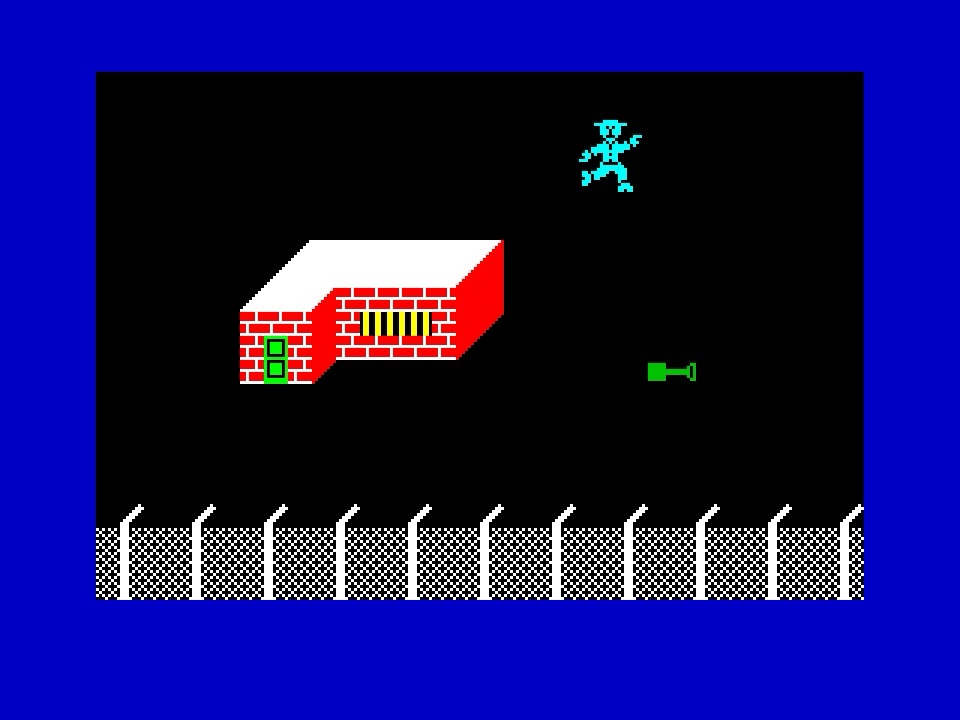
Alcatraz Harry might well have been written in BASIC. Something else I don’t know but it certainly plods along at that rate, and the presentation doesn’t really do much to convince you otherwise! That’s not to say it doesn’t work fine though, and forty-plus years ago as I write (and long before I actually visited Alcatraz for real), it also did a pretty good job of creating a pretty atmospheric prison setting. It’s suitably sparse and bleak, which is enhanced by the consistently black background, and the uniform placement of very minimal objects, whether the ropes and guns and other kit you’re after, or the three or four different prison building types, conveyed as very simple (and totally out of scale) but perfectly recognisable brickwork blocks with little doors and barred windows and a childlike 3D perspective. Just tell me that machine gun tower at the top of the page isn’t as cool as hell though! Harry himself is an odd little fellow, looking more like a flamenco dancer than a convict, totally white and with a total of two frames of animation flip-flopping as you move, while the armed guards do look a bit more sinister, but are likewise solid green and don’t move at all! The fences are very nicely put together, which is always a positive, and I mentioned those cutscenes earlier too, and while “cutscenes” might be pushing it, the little flickery green car trundling across the screen, and the tunnel bits, and the gruesome death scene, all add character and a level of polish that elevates the rest of the game way beyond its asking price back in 1984…

Don’t get excited about the sound doing the same though. Most of the time there isn’t any, and when there is, you’ll be thankful there wasn’t before! I’m being harsh. There’s the occasional (and I mean occasional) beep or blip, and some of those cutscenes get a shrill (and I really mean shrill) little melody to accompany them. Exactly what you imagine from an early Spectrum budget game. And that goes for the rest of the game too because you really couldn’t get a better example of one! It’s primitive, it’s basic (and possibly BASIC), and for an afternoon or two at least, it’s going to give you way more than £1.99’s worth of fun. Even if those afternoons are four decades apart! I was originally going to circle back to some of those memories of the first of them now but I reckon that’s a pretty nice way to close on Alcatraz Harry. It turns out we’re not quite done with him though because while I was looking for my missing cassette inlay earlier, I learned for the very first time he got a sequel! I genuinely had no idea, and was so pleasantly surprised that that’s all I’m going to say about it because I decided I didn’t want to know any more! Instead, I thought it would be nice to look at it with completely fresh eyes some other time soon, which isn’t something I get to do with old Spectrum games very often anymore, so I’m going to take full advantage!
As always, I’ll never expect anything for what I do here but if you’d like to buy me a Ko-fi and help towards increasingly expensive hosting and storage costs then it will always be really appreciated! And be sure to follow me on Instagram, X (formerly Twitter) or Threads for my latest retro-gaming nonsense, and also on Bluesky, which is under my real name but most it ends up there too if you prefer!
 Retro Arcadia