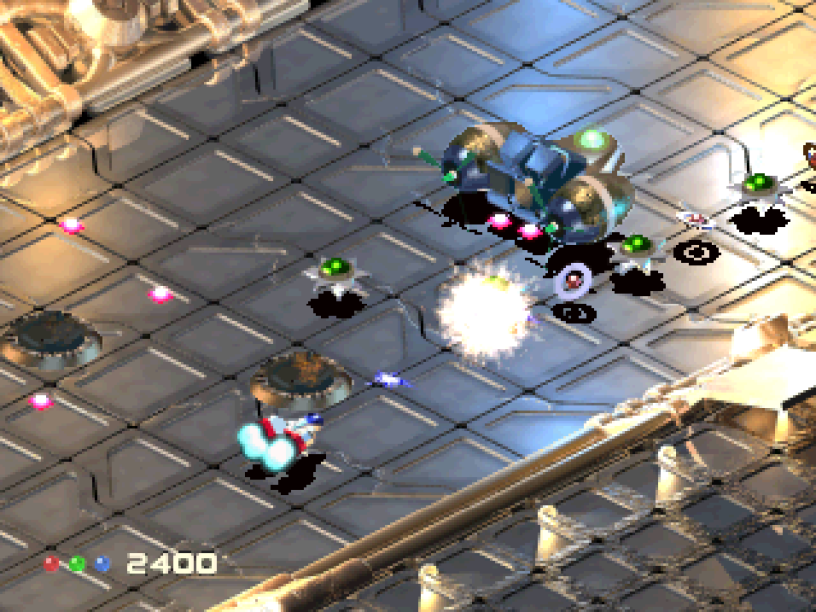
I’ve been spoilt for choice so far when putting together previous instalments of this ongoing series of shoot ‘em up sub-genre countdowns, with no problems at all coming up with literally dozens of candidates for each of the fixed-screen, horizontally- and vertically-scrolling top tens that preceded this one! From what I can tell, that’s also going be the case when we start rounding out the series with multidirectional and finally 3D shoot ‘em ups, before combining everything and getting to the final countdown… By the way, I think I’ve decided I won’t be including rail or light-gun shooters as originally planned because they’re really not in the spirit of everything else, although I will still give them their own countdown at some point too. Anyway, back to the here and now, and in the case of isometric shoot ‘em ups, unlike the others, there really isn’t much choice! That’s not to say my top ten didn’t pretty much write itself like all the others did too though, but if it was even a top eleven, I’d honestly be struggling, assuming you don’t want to read a top ten versions of Zaxxon countdown instead! We’ll come back to all that as we go through what I have got though, so let’s jump straight in, starting at ten, counting down to one, a paragraph on each, then one or two (maybe!) vaguely honourable mentions to finish…
10. Motherbase (Sega 32X)
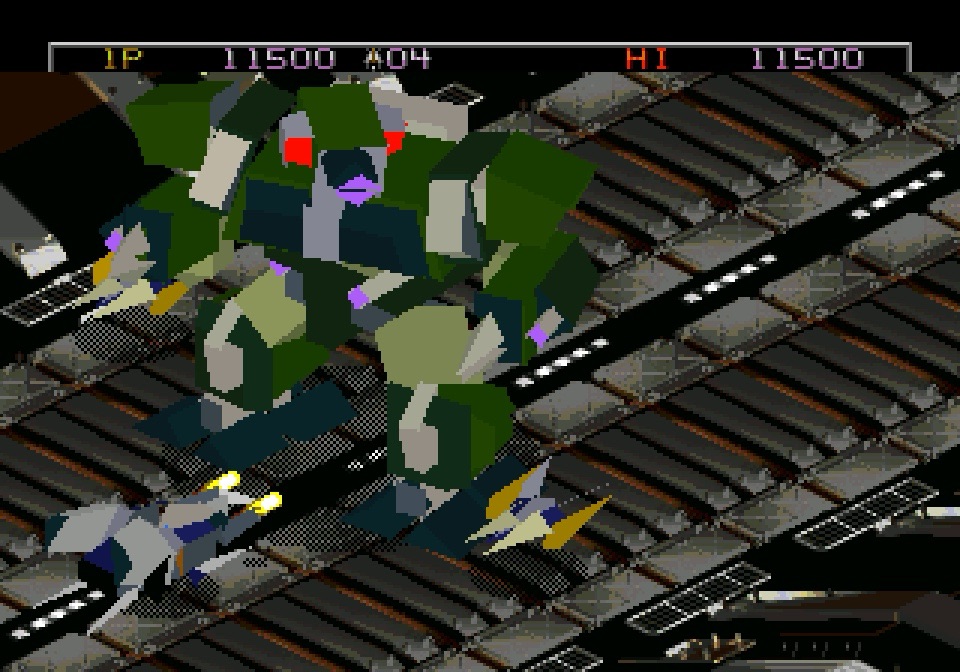
We’re starting in 1995, which I think is as far into the future as this top ten is going to get, so combined with what we’ve just discussed, gives us a pretty clear picture of this corner of the genre already! Anyway, this was also known as Parasquad in Japan and Zaxxon’s Motherbase 2000 in the US, which was a pretty cheap rebrand on Sega’s part considering it’s further away from being Zaxxon than almost anything else we’re going to see here (that isn’t Zaxxon)! I guess they did what they had to for this ailing add-on though… I came across it far more recently, when I was properly exploring the 32x library for the first time, and while it was no Star Wars Arcade or NBA Jam, I really liked it from the off! You’re flying a spaceship called Stinger, taking the fight back to an evil computer who’s overrun a load of hapless planets with the most polygonal bunch of enemies you’ll ever come across! Some very atmospheric backdrops though, and the huge, haphazard robot bosses can be impressive in their own way too. As for gameplay, it’s just a very straightforward shooter, with less in-your-face polygon enemies and some imaginative obstacles putting up plenty of resistance along the way, and it’s all at a single height (weird jump mechanic aside) so you can focus on where you’re shooting very naturally. It stutters a bit but you soon acclimatise, and there’s of variety to everything you’re shooting and where you’re shooting it to keep you otherwise engaged anyway, which also goes for the bombastic electronic soundtrack. A lot better than it gets credit for!
9. Isolated Warrior (NES)

I always assumed this was a funnelled run and gun game in the style of something like Gun.Smoke (which I also associate with the NES) when it first arrived back in 1991 but once again, it was a lot later when I finally got my hands on it and realised it was more akin to, er, Zaxxon, than anything else! The thing is, your little isolated warrior – an alien-fighting army captain called Max Maverick – looks like he’s on foot (because he often is!) but grab a controller and you soon realise it’s auto-scrolling and you’re moving like you would in, er, Zaxxon, and it’s very quickly a very unforgiving slice of proper shoot ‘em up! You’ll soon start powering-up your weapon to compensate though, and there’ll be some sci-fi vehicles to get it before long too, and you can always jump in the meantime to get at those flying enemies! You can get overwhelmed all the same, with narrow corridors between decaying buildings, holes in the ground and so on often giving you very little room for manoeuvre when you’ve got waves of enemies not only coming at you one after the other, but also tagging up with things like electric ropes between them, making it easy to panic and die a cheap death, and equally a real thrill when you make it through! Some cool bosses too, and everything being thrown at look looks great, full of detail and variety, which also goes for the backgrounds (at the cost of sometimes stuttering), and it’s all so full of wildly contrasting colour. Good tunes too, and overall a real hidden-gem!
8. Turboat (MSX)
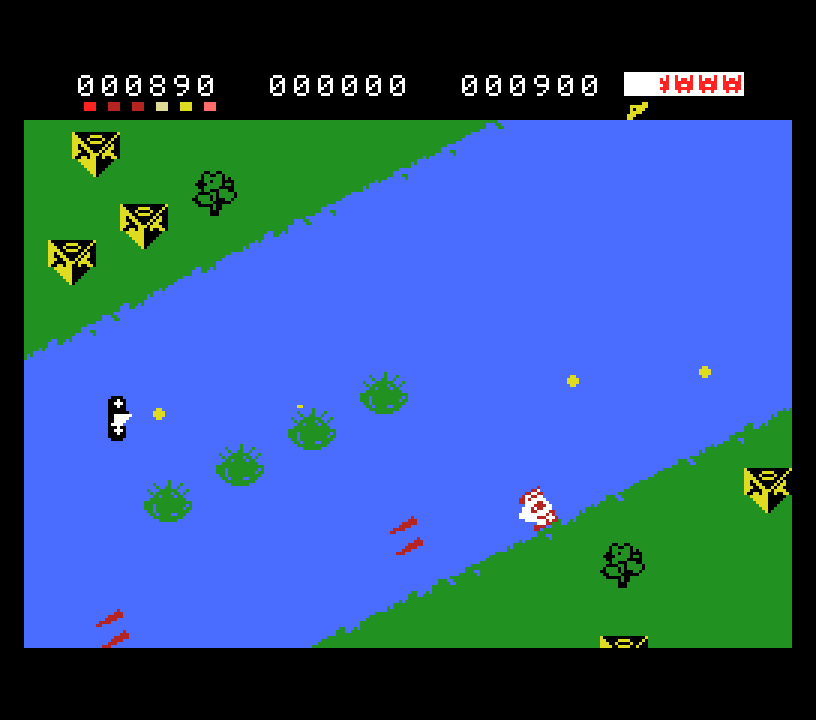
Like the machine it’s running on, Turboat is a curious thing! “As commander of Turboat, you have an important job for the protection of our free world” by entering enemy territory, shooting your way to their “central lake” and then grabbing their secret radar buoys so the good guy scientists can figure out how they work and plan a counterattack.” Not sure why they didn’t just send in more Turboats, which obviously don’t have a problem getting past these radars, though I don’t suppose that would have left us with much of a game, which would have been a shame because it’s another good ‘un! It plays out across three separate stages, starting on a river, with enemy boats and gun emplacements on the shore shooting at you, and you just need to survive until a simple chiptune ditty tells you you’ve got to the lake, where it opens up and now you’ve got planes dropping bombs and streams of missiles to contend with as you try to fly into the radar buoys when they appear – usually exactly where the most danger is and you don’t want to even try and get at them! Collect enough and another tune will transport you back onto the river, where you now need to stay ahead of three particularly vindictive missiles while also avoiding the regular ones coming at you from the other direction before it loops. It’s very 1984, looking and sounding like a diagonal River Raid, although the unintentionally authentic lightsabre noise that accompanies your movement is way ahead of its time! And speaking of time, while you can see everything the game has to offer in less than five minutes, it’s got plenty going for it, and not least that your ship controls like the one in Asteroids, with a left, right and thrust, which take some getting used to but offers some unique strategy and is really fun to boot!
7. Panther (Commodore 64)
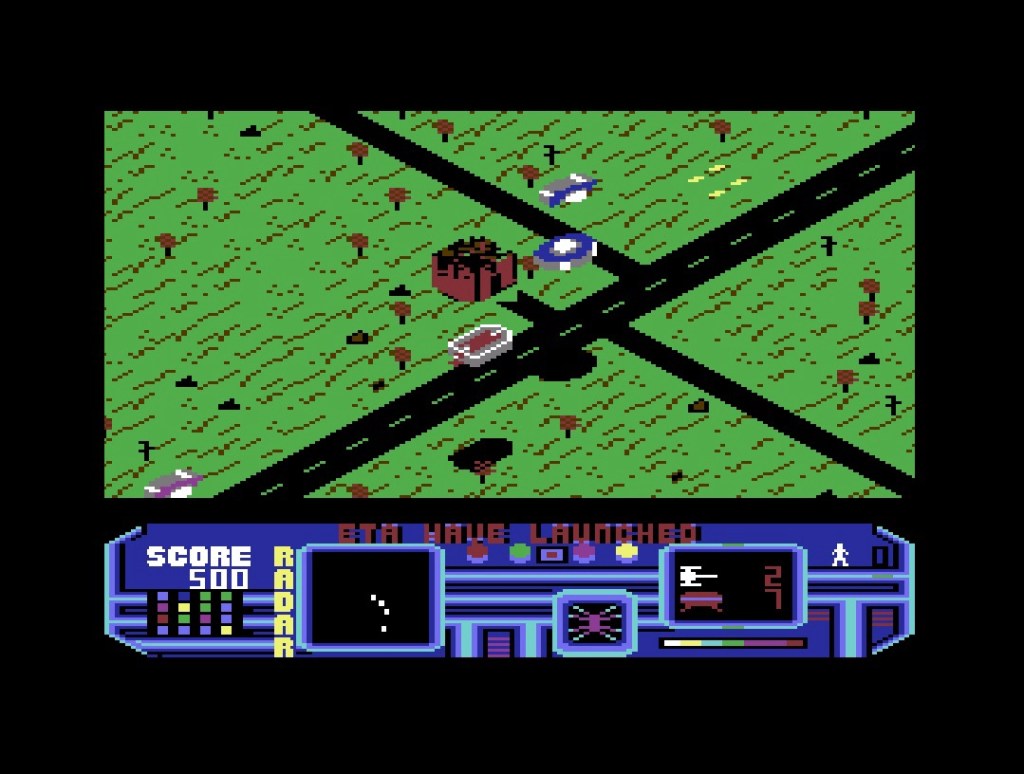
This is going to be the first of several games here where I could feasibly have gone for any one of several versions but while I’ve also enjoyed Panther on the ZX Spectrum and Atari 8-bit over the years, I’ve got to choose the C64 version for the incredible David Whittaker music alone – all the colours of the SID chip, all multi-layered and atmospheric and wonderful! Don’t worry though because it’s not the last we’ll see of the other pair yet, and possibly not the last time we’ll see a budget game here either… Incredible to think this thing cost £1.99 and can still be providing entertainment almost forty years on, wherever you’re playing! That was Mastertronic in 1986 though, and if the last game was diagonal River Raid then this is diagonal Choplifter! You need to fly high and low over various simple but still interesting post-apocalyptic landscapes, looking out for survivors to pick up while fending off waves of enemy fighters that look a lot like rotating poker chips (versus your ship that resembles a motorised bathtub), as well as deciding how long you can risk landing and just sitting helplessly when both inevitably appear at once! Fighting back is a cool game of cat and mouse too, more like a dogfight with a handful of enemies at once than relentlessly mowing down dozens of them, as you methodically try to get into position in and around and above and below to get a precise shot in. A thoughtful instrument panel keeps you further engaged with status messages from base, and a radar and lots of pretty lights, and overall it’s just everything you could want from a budget release, and probably a lot more!
6. H.A.T.E. (ZX Spectrum)
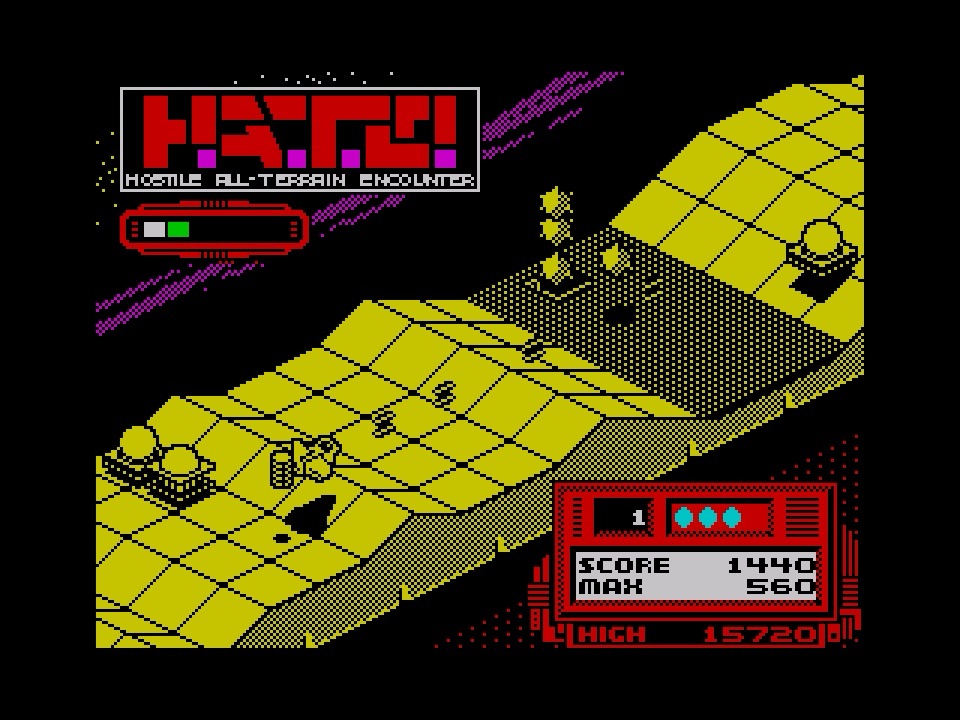
It’s my beloved Spectrum’s turn next, and this time a full-price release from Gremlin Graphics in 1988 which also had releases elsewhere but this time I can’t really recommend any of them – C64 just doesn’t run well (and you only get one life), while Amiga doesn’t play particularly well and Atari ST looks a bit public-domain. No such problems here though (if you’re okay with 48K Spectrum beeps and blips), as you begin your career as a trainee pilot through ten levels of simulated alien defences, including guns, missiles, star fighters and mine barriers, before hitting the a real-life alien invasion for the next ten as a fighter pilot, then the final ten as a commander, with the game helpfully remembering how far you got so you can continue at your current rank next time. Oh yeah, H.A.T.E. stands for Hostile All-Terrain Encounter, and to help you with all terrains, you’ll be doing one level in a star fighter before switching to tanks, hovercrafts and back again, all done seamlessly as you transition from one to the other on little runways. And that covers the two stars of the show for me… Firstly, the terrains look fantastic, predominantly made up of what could pass as solid vector grids with non-stop, stylishly angular undulations and cut away valleys, interspersed with those runways and trenches and sandy or watery areas, or enemy installations, all monochrome but nicely textured and very nicely detailed, and also changing colour between levels. Impressive scrolling too, but the second thing I actually wanted to come back to was that transition, which is representative of so much care and attention given to bringing every element on the screen to life, from opening and closing hatches throwing up carefully choreographed enemy formations, to the multi-stage explosions when you take them down, and those exquisite shadows that not only realistically reflect the sprite they’re beneath but also move and change shape across whatever surface they’re crossing. And it’s a real treat to play too, controlling easily and predictably with a well-set level of increasing challenge. Possibly the only time a Spectrum game will appear on any of these shoot ‘em up countdowns but this one deserves its place!
5. Desert Falcon (Atari 7800)

Ancient Egypt is our next location, and a game developed in 1984 and released in 1986 that I only came across in 2021, in the wonderful Atari 2600/7800: a visual compendium by Bitmap Books, where this huge 8-bit, pseudo-3D Sphinx boss fight was spread across a whole double-page, and I was immediately captivated (so much so I then wrote a deep-dive here)! That said, I think the real star turned out to be the falcon itself that you’re flying across all these vibrant desert (and otherwise) landscapes, and specifically the crazy amounts of animation it has for everything – taking off and flying, turning and stalling, diving and landing, and then when you’re on the ground too, hunting down the big points or magical power-up combinations, where you’ll be either hopping or swimming, and not to mention all the dying too! You’re on the hunt for the Pharoah’s stolen treasures, scattered in the sand among the pyramids and obelisks, and guarded by swarms of scarabs that mean you need to make quick work of getting any booty and getting airborne again, where you’ll also be facing all sorts of vultures, flying fish and other weird aerial beasts. And then a big Sphinx! The ground-work adds a real extra dimension to the gameplay, and there are bonus rounds and some nice psychedelic attempts to disguise the mostly repeating environments on each level, which do have some lovely details and special effects about them, although sound, on the other hand, is very arcade-generic throughout. Which reminds me, there’s also an Atari 2600 version of this that’s more bare-bones but amazingly still has the big Sphinxes, and has a madcap take on a familiar “Egyptian” tune on top! They both scroll very impressively too, and offer a frantic and sometimes unique take on the formula either way!
4. Return of the Jedi (Arcade)
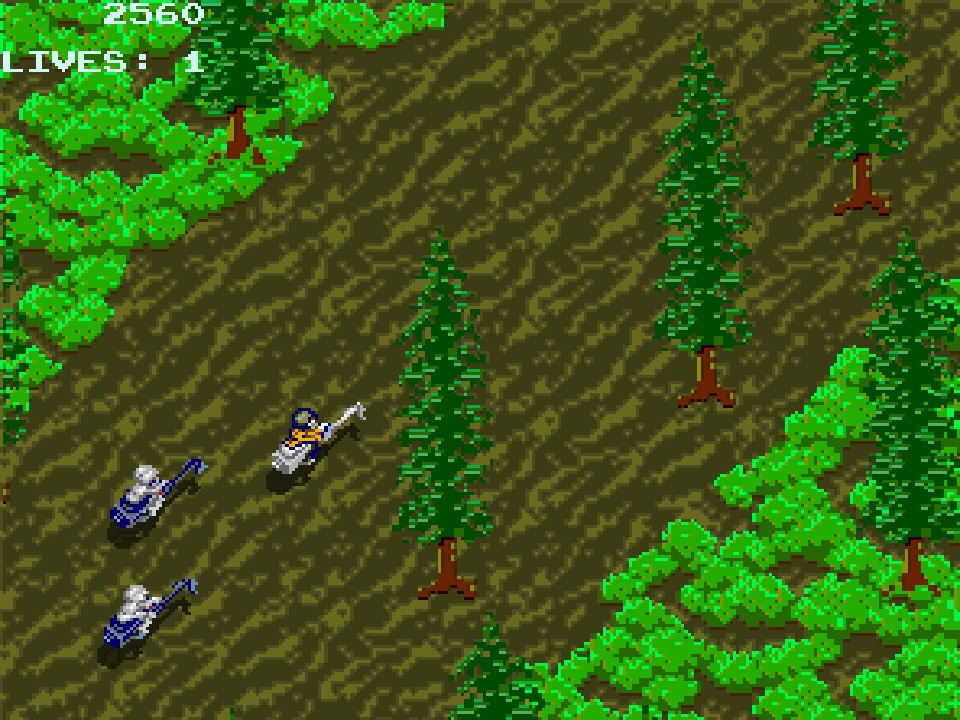
The original Atari Star Wars arcade game from 1983 is an all-time favourite of mine, so still fresh from the exhilaration of its sit-down cabinet, I was more than hesitant when I first laid eyes on Return of the Jedi in Computer & Video Games magazine’s Arcade Action section at some point a year later, replacing the timeless 3D vector graphic action of its predecessor (but not predecessors because Empire Strikes Back came a year later again) with a raster-based isometric style! Not that it mattered – I don’t think I ever laid eyes on it in the wild, and while I reckon it’s a decent port nowadays, I didn’t bother with the Atari ST version at the time either… In fact, it wasn’t until 2003, when I picked up Star Wars Rogue Squadron III: Rebel Strike on the Nintendo GameCube, where all three original arcade games are included as secret bonuses, that I played it at all. Turned out to be pretty good too, even with a GameCube controller! It plays out like Zaxxon meets Spy Hunter, picking up some of the movie’s landmark set-pieces, starting with a speeder bike chase through the forests of Endor, before switching to the Millenium Falcon on its way to taking down the Death Star’s reactor, then back to a speeder bike, then alternating between an AT-ST and the Millenium Falcon trying to take down an Imperial cruiser. It’s very bold and cartoon-like to look at, with plenty of detail providing a totally authentic experience, and the sound design and all the sampled speech from the movie is awesome. And while the gameplay can occasionally be a bit clumsy, seeing how many times you can loop it (because it’s not the toughest game ever) is such a blast. And it’s definitely Star Wars too, vector graphics or not!
3. Blue Max (Atari 400/800)
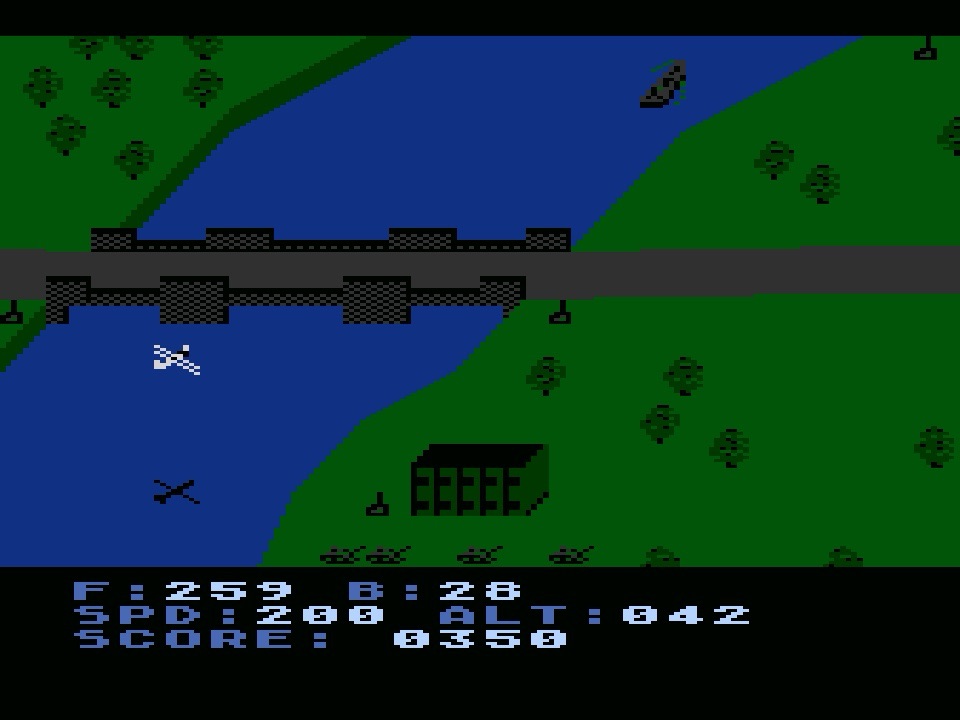
Another toss-up between this and the C64 version of Blue Max, which is actually the one I was most familiar with at the time but the Atari 8-bit version is the one that stuck with me since the first time I played it – same game, same style, just plays like a dream! It’s possibly inspired by a true story too, of a British World War I flying ace called Max Chatsworth, who caused so much mayhem that the Axis forces offered their highest decoration – the Blue Max – to anyone who shot him down, from which point on he was nicknamed The Blue Max! You’re in his shoes here, and once your plane reaches 100mph (or you’ll be in for a very short game!) you can take off from the runway and head for the three marked targets, while also shooting down enemy buildings, planes, cars, boats and anti-aircraft guns you come across on the way. Get them all and you’ll hear a tone to signify you can drop your landing gear, attempt a landing, refuel then head off on the next mission. While it is pure action, this stuff also does a good impression of some light simulation mechanics, as do separate displays for controls (fuel, bombs left, altitude, speed and wind factor) and damage to fuel lines, aircraft integrity, bomb gear and machine guns, all of which also affect manoeuvrability or weapon usage. There’s a command bar too, which gives you coloured indications of things like being at strafing altitude or various warnings, but I’m now making it sound way more complicated than it is, which is a typically 1983 game with more emphasis on being a really good time than how it looks or sounds, both of which are clean and functional all the same, and it certainly moves well, although I’ll never be keen on that chiptune Rule Britannia on the title screen!
2. Viewpoint (Neo Geo CD)
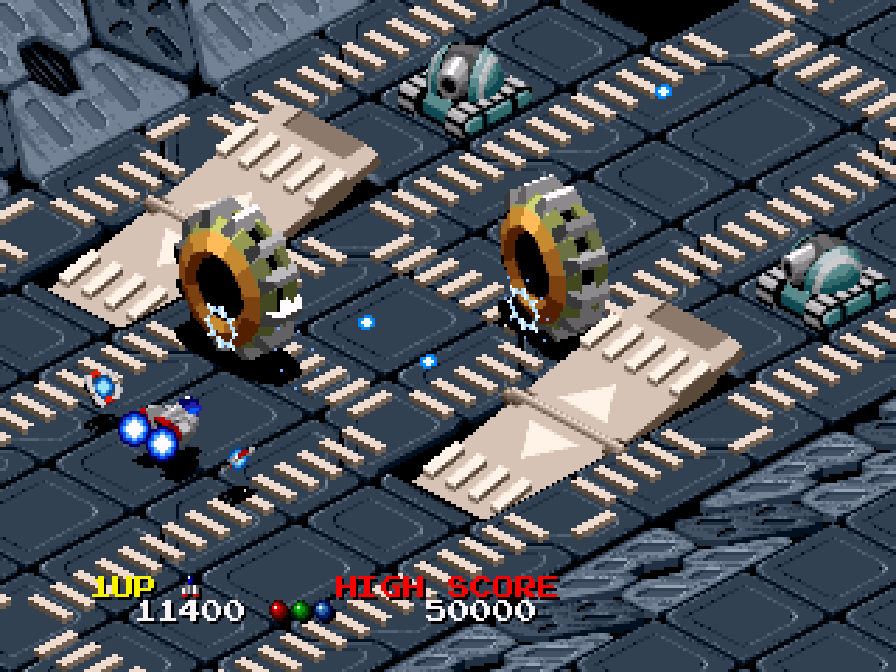
I was never that fussed about the original 1992 Viewpoint arcade (or Neo Geo) game by SNK, but sometime much later, I had a go on the Mega Drive port and it had something about it, which then led me to the PlayStation, which had a lot more about it, including insane difficulty unfortunately… You won’t find a better-looking example of the genre anywhere else though – see the top of this page! Anyway, that in turn led me back to the Neo Geo CD release of the original and it turned out to excellent after all! Well, apart from the funky techno soundtrack, which really isn’t my thing, but the crunchy sound effects do their job, and while it doesn’t quite reach the metallic sheen of the PS1 game, it’s a real sci-fi stunner, and totally hand-drawn too, with this big and dynamic play-field that soon ends up as much an obstacle course as a kill-zone, with trapdoors to avoid and screen-spanning gates to open as you frantically fend off immediately big and bullet-heavy mechanical enemies flanked by a mass of smaller ones. The action is relentless, and I suppose not unlike a diagonal take on R-Type, including your powered-up shot by holding down fire, and a couple of those obstacles will look familiar too. Plenty of its own ideas as well though, with all sorts of wild-looking and uniquely colourful stuff coming at you, whether flying, rolling or even flouncing along like a slinky, and then you’ll hit a boss that’s all the more intimidating for the angle it’s spewing bullets at you from! Nice difficulty curve all the same and one for the long haul!
1. Zaxxon (Atari 400/800)
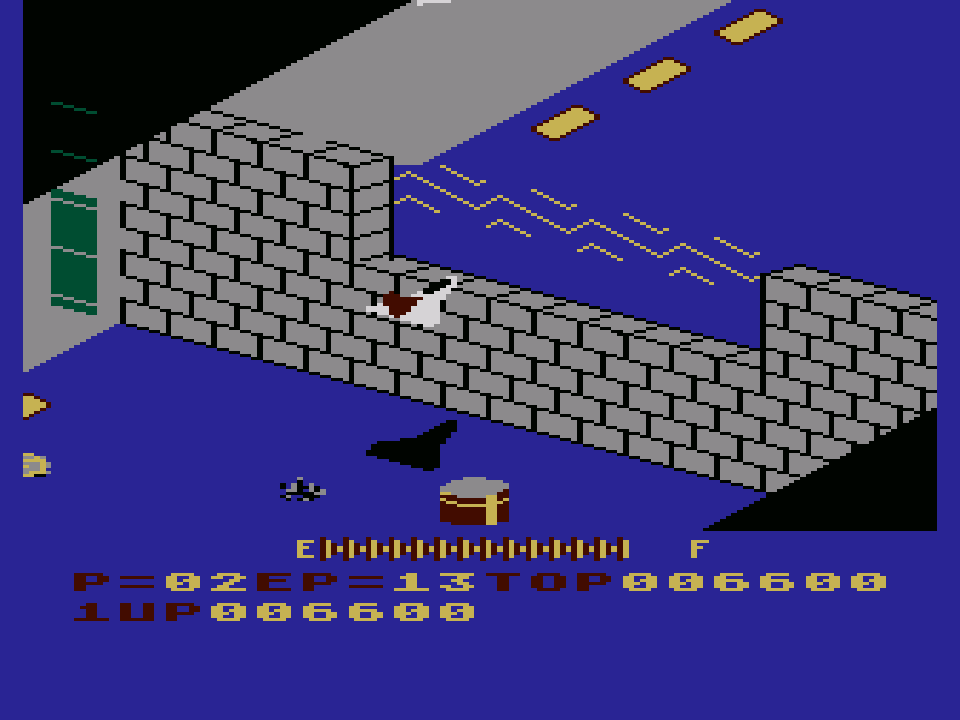
I know, I know, totally predictable… Well, not entirely! As impressive as it always was and is to this day, I wasn’t a fan of Sega’s groundbreaking, genre-defining, technical marvel of an arcade game when it came out in 1982, nor its Super Zaxxon reworking shortly after, nor its spiritual sequel Future Spy a couple of years later again! I just didn’t gel with the perspective, and it would take several of the other games you’ve just read about over several more years to start bringing me around to it, although the ship had long-since sailed by then, and I eventually turned to other official home ports instead – which I’ll come back to in a sec – before finding this one, where everything finally clicked and then some! I’m not sure there’s much of a plot to Zaxxon – you fly across an enemy floating fortress, shooting as much as possible and replenishing your fuel when you can, while also avoiding walls (or finding gaps in them), electrified beams, anti-aircraft fire, enemy ships and concealed missiles (as long as you’re rocking 32K or 48K of memory on your Atari home computer)! You’ve then got a fight against a fleet of fighters (as well as your altitude gauge!) before hitting another fortress, where you’ll find the armoured robot boss, Zaxxon, waiting at the end before you do it all again but a bit harder this time! Not that the first loop is a walk in the park, especially when you’re still working out judging heights and distances from gauges and shadows, but that comes quickly, and when it does it’s just the most addictive, risk-reward score-chaser, as you effortlessly swoop and strafe ground targets, then glide back up and side-to-side hunting down enemy fighters, or just brushing past missiles so you can line up your next shot. And the big boss guy with his big glassy helmet… Absolute joy! And it all moves along fast and smooth and totally authentic, and while it’s lacking the fancy colouring and decoration and density of on-screen objects of the original, as well as its iconic explosions, it feels so good to play that what are fine but functional looks and sounds become secondary anyway, and I just love it!
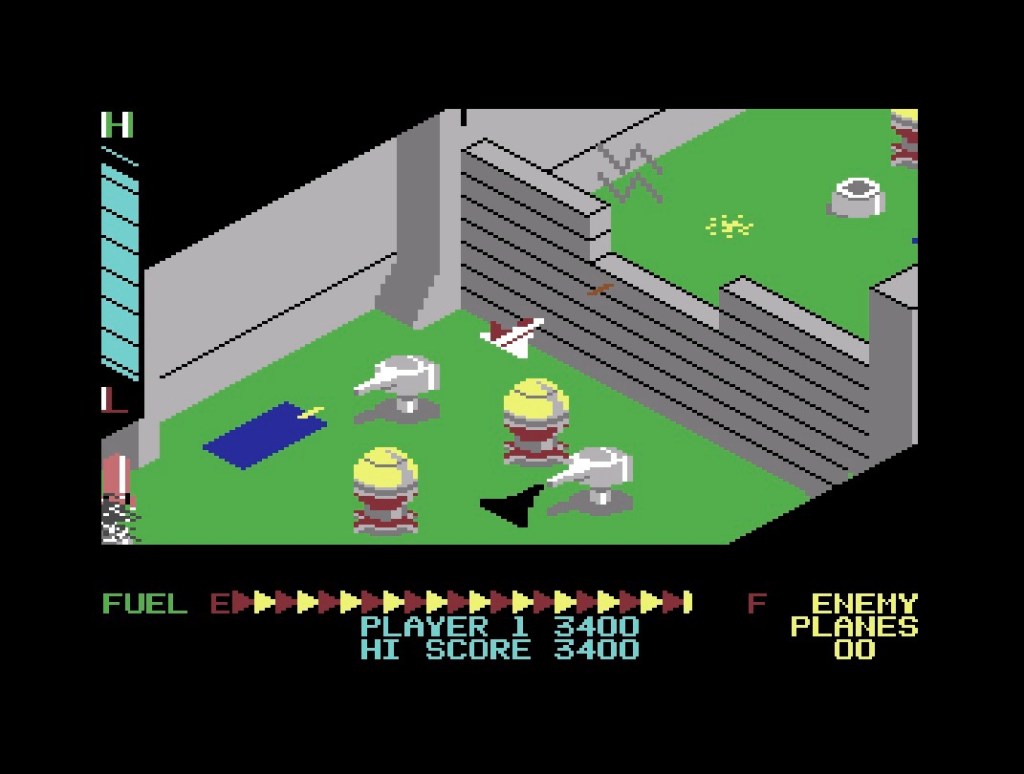
Sorry, we’re not quite done with Zaxxon yet but you’ll be pleased to hear that my list of honourable mentions is limited to a couple of those other ports of it I just talked about, albeit because, as I said at the start, I’m about out of any other ideas anyway, unless you count that dreadful Commodore 64 3-D Skramble thing that really doesn’t deserve any more spotlight than I’ve just given it! I will stick with the C64 though, and its port of Super Zaxxon (pictured above) which does everything just about right, in much the same way the Atari 8-bit port of the original did, to the point it was a bit of a toss-up between the two here. And as for the original, I also want to mention the ZX Spectrum conversion of that, not because it’s great or anything (and it’s anything but!) but because it’s the version I spent all my pocket money on, and as such had no choice but to play to death, and it did have one of those really nice oversized soft-plastic cases too. So there! And on that bombshell, that’s all I’ve got for this instalment but do check out the fixed-screen, horizontally- and vertically-scrolling top tens already published, and if future me remembers, I’ll come back and add the next instalment too, where as said earlier, we’ll be looking at multidirectional shoot ‘em ups, and that will be on the way relatively quickly after you’ve read this if it’s not here already. In the meantime, I hope you’ve enjoyed this one because I certainly enjoyed putting it together!
As always, I’ll never expect anything for what I do here but if you’d like to buy me a Ko-fi and help towards increasingly expensive hosting and storage costs then it will always be really appreciated! And be sure to follow me on Instagram, X (formerly Twitter) or Threads for my latest retro-gaming nonsense!
 Retro Arcadia
Fine picks. I remember seeing reviews of Panther in Atari mags back in the day and thinking it looked neat, but I’ve never actually tried it. Will have to correct that!
Return of the Jedi’s Atari ST port was actually pretty good, as I recall. I remember playing it a fair bit back in the day, at least.
LikeLiked by 1 person
Thanks! Definitely give Panther a go and let me know what you think!
LikeLike
I ended up here whilst Googling for a game I used to play on my Amstrad. It’s not on your list, but it was an isometric game. I think it was made by Gremlin, sure it was on a compilation from them. You controlled a character that reminded me of a Dalek (although almost 40 years later my memory may be hazy on that one) and you were navigating your way up a long road. Can’t for the life of me remember what it was called. Sure the graphics were kind of monochrome too.
LikeLiked by 1 person
Reckon it’s Alien Highway or Highway Encounter. I had both on the Spectrum and I liked them a lot but decided they didn’t really fit here as shoot ‘em ups in the end.
LikeLike
Hot damn you’re right, Highway Encounter! Thanks! I am sure it came on a compilation with loads of really great games like Trailblazer and Footballer Of The Year.
LikeLiked by 1 person
Excellent! That’s where I had it too. Cant remember which came first but have a look at Alien Highway too if you liked that.
LikeLike