
Welcome to the fourth instalment in what seems to have become an annual look at some of the cool sights that have stuck with me over the past four or five decades of gaming! The format is simple, and it’s one I really enjoy pondering throughout the year, which is why it keeps coming back… Somewhere around fifteen screenshots (depending on how verbose I get), in no particular order, with an explanation of where they’re from and why I think they’re cool, or, if that all sounds like too much reading, you can just enjoy some pretty pictures! And before I get into them without too much further ado for a change, I’ll include links to the three previous ones at the end so you can complete the set! By the way, in case you were wondering, the one at the top of the page here is from the PC-Engine CD version of Altered Beast. Okay, “wonderful” is particularly subjective in this case but I couldn’t resist!
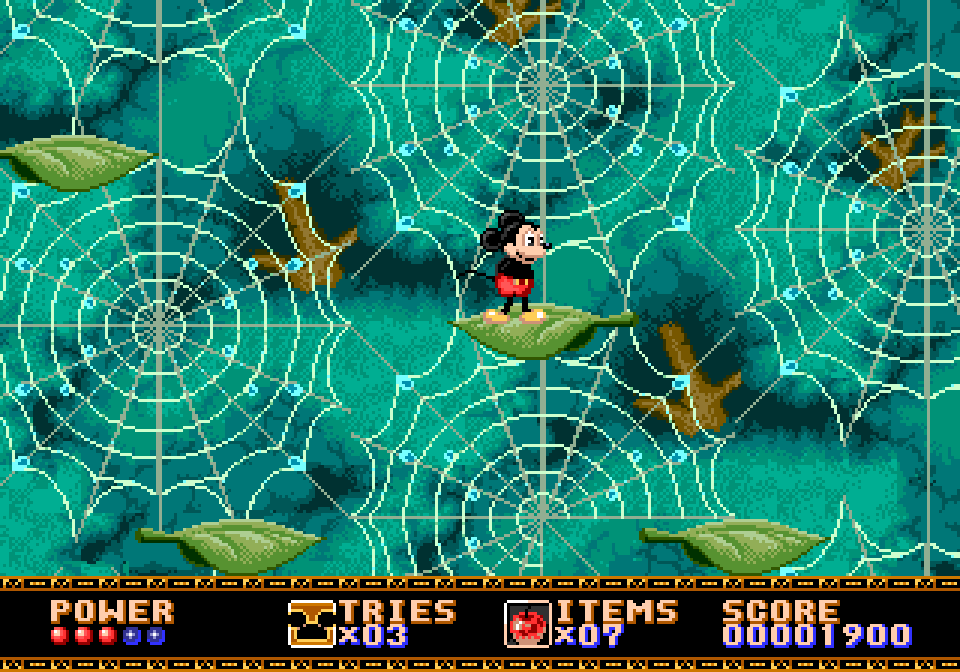
Right, having just said I’m doing this in no particular order, I’m actually going to start where I ran out of self-imposed space last time, with Castle of Illusion Starring Mickey Mouse on the Sega Mega Drive or Genesis from 1990! You’re at the castle to rescue Minnie Mouse from an evil witch, and to defeat her, you need the Seven Gems of the Rainbow, scattered across five and a bit illusion-filled levels, each guarded by the witch’s minions and a Master of Illusion boss, waiting at the other end of a load of very well put together platforms and other such obstacles to overcome first. Each level has its own distinct theme and set of challenges, starting with The Enchanted Forest, then Toyland, The Storm, The Dessert Factory and The Library, which should then open up The Castle and a final fight with the witch herself. And what a really enjoyable time on all counts! Controls are so focussed and tight, and whether you’re battling baddies in jelly, swimming in a teacup or trying to resist the urge to eat everything in that gorgeous dessert level, it’s all immediately intuitive. And it’s not just the food that looks good enough to eat! This game really is gorgeous throughout, so richly decorated and filled with perfectly-set enemies and hazards, and Mickey’s animation is just spot-on. As is the happy-go-lucky music and slapstick sound design. Always worth a play-through however the opportunity presents itself, and not least for this first sight, which you’ll get to within just a couple of minutes of starting as you emerge from the first part of the forest into the windy, spiderweb-covered treetops, using leaves for precarious transport as you admire the delicately realistic dew-dropped patterns hanging en-masse from the stylised, pixel-splatter tree shapes. And with such an authentic Mickey front and centre, it’s a real piece of old-school Disney art that you could easily imagine hanging in a kid’s bedroom!

I’ve always loved a golf game (despite little interest in the sport itself), and if I fancy a round hosted by SNK, I generally veer towards Neo Turf Masters from 1996, partly because it’s the best game of arcade golf ever, but also because I now own it all over the place, from SNK Arcade Classics Vol. 1 on PlayStation Portable onwards! Top Player’s Golf first arrived in 1990, although I’m really hazy on whether or not I ever played it back then, or if its inclusion on SNK’s 40th anniversary NEOGEO Mini console from 2018 was the first time, which probably reflects me not being such a big fan of this one! There’s nothing particularly wrong with it though, and actually, there’s loads going on, with four different golfers to choose from, two courses and three game modes, including stroke play for one player, match play for two, and Nassau Game for either way, which throws challenges like closest to the hole or longest shot on top of regular play. I just don’t find the understandably simple gameplay mechanics to be particularly remarkable or rewarding, and there’s no easy indication of how far is left to reach the hole, or how that relates to hitting your selected club. You get used to it though, and I guess you could say that adds a bit of realism, and everything else is great, with a good level of challenge in the course designs and really nice presentation, with tons of sampled speech and easy-going music to set a suitably jolly mood, while the visuals are very much golf game of the time but also very dynamic, with tons of pixelated detail in the carefully lit, animated scenery, where clouds float overhead and waves lap against rocks and bridges, alongside all kinds of trees and types of grass. This all sweeps in and out with some great camera motion, and then you’ve got some simple but stylish animations showing your shot, or your caddy giving you advice, and spectacular views of lakes and forests between holes, but none as spectacular as the very opening seconds, right before the title screen! This really is a sight, so full of natural drama as you strike your ball from the clifftop tee across wild seas towards the distant hole! And there’s so much texture and physicality to everything that you almost feel like you’re there but are probably glad you aren’t! Not necessarily my golf game of choice but this is unsurpassed in any of them!
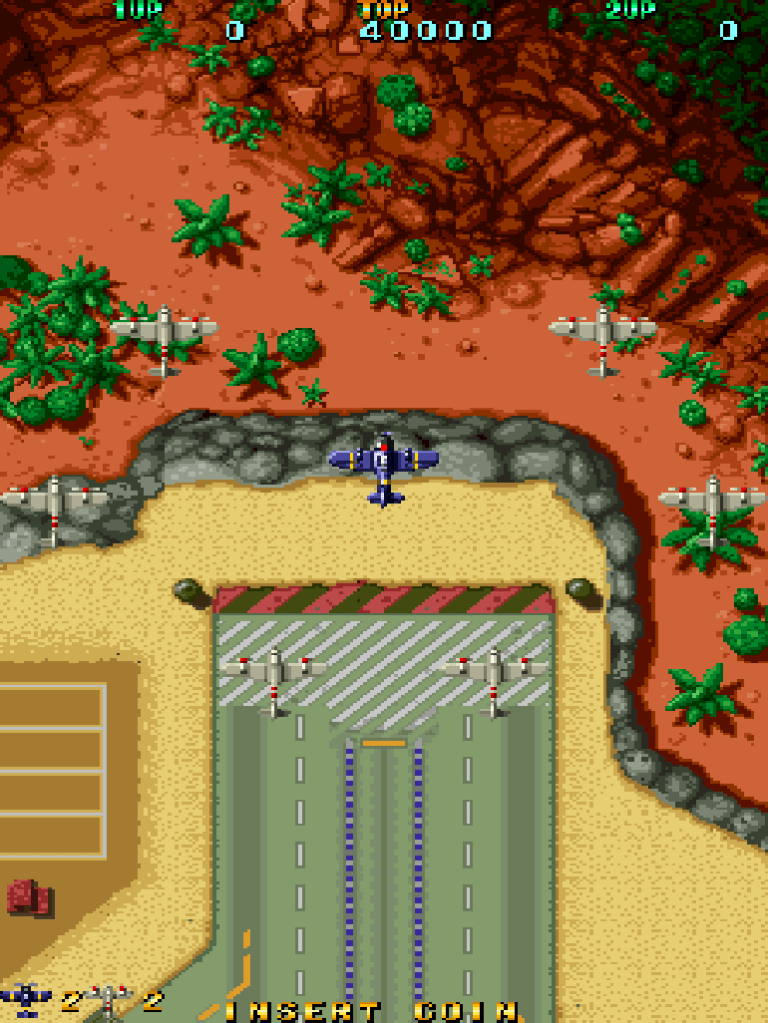
Always one TATE mode game to spoil your carefully landscaped flow, though I suppose if I was that bothered I’d have done something about it, or just used the picture I already had of it running on my Evercade EXP instead! Right, Twin Hawk, a vertically-scrolling shoot ‘em up developed by Toaplan and published by Taito in 1989, that sees us in an alternate World War II timeline, although specifics seem to be dependent on which version you’re playing, as well as where you’re playing it! Can safely say it will be a load of nonsense regardless, and, if you’ve ever played stuff like Flying Shark, Twin Cobra, or any other Toaplan stuff from around then, it’s going to start out familiar too – fighter plane flying over a surprisingly tropical landscape, considering it’s supposed to be set in Europe, with lots of other planes, gun emplacements and increasingly large tanks to shoot before they shoot you, with the latter the more likely scenario until you learn where they’re coming from! All the usual power-ups too, but the bomb button is where it starts to do it’s own thing, with it calling in six support planes to fight alongside you until they’re shot down, at which point they’ll go kamikaze on the nearest enemy! Disturbingly, you can also command the whole lot to do exactly that before they get a shot away, or you can replace them with a regular bomb instead before they get into formation. It’s set over four seamless levels separated by bosses and a change in background music, which starts out like nothing you’ve heard in one of these games before – like an even more mellow take on the Out Run high score table tune, and that’s also where we join the game for this sight, as your plane and its helpers take off across its stunning, almost volcanic (but definitely tropical!) landscape, full of burnt reds and oranges that soon give way to sparkling seas and beaches and militarised zones. It’s so fleeting but isn’t a bad last thing to see before you’re inevitably obliterated mere seconds later! Beautiful location, and the best of Toaplan in all respects, I reckon!

Fairlight was the quintessential ZX Spectrum isometric action adventure, filled with ambition and created with love, with weird keyboard (only) controls, and was beatable in under fifteen minutes if you had any idea what was going on! In reality though, you didn’t have a clue, so spent a lifetime wandering around looking for somewhere you hadn’t been before, and like most such games, it was all the better for it! It was first released by The Edge (who I assume is the same bloke out of U2) in 1985, and has you exploring a castle to find a magic book to free a wizard, if my understanding of the the longest, most convoluted piece of fantasy nonsense ever seen in a game at that point is correct! Doesn’t really make any difference either way though, as you move between some impressively realistic rooms, moving and picking up objects to solve puzzles while avoiding getting killed by the local trolls and the like. There’s a forward-thinking inventory management system too, where you can carry five items maximum but that will depend on their weight, so you could, for example, fill your pockets with three bits of food and a big stick but if you want to grab a barrel for something later then you’ll have to ditch everything else first. So much attention to detail, and a stunner too, from the personality-filled character sprites to the lavishly designed, vividly monochrome 3D castle and cave environments they’re moving around in, but once the equally impressive bit of 48K Spectrum title screen music ends, you’re playing in total silence, and that’s as awkward as the controls! While the 128K version that came a year later couldn’t do much about the latter, it did add in-game music and sound effects, making all the difference, as well as some static cutscenes, which is what we’re looking at here. Now, on the one hand, I don’t like this! The richly detailed, black and white pixel-meets-pointillism styling is in such contrast to the rest of the game that it looks out of place, and that’s before it’s just carelessly dumped on the screen with questionable context. However, that’s also the best-looking skull I’ve ever seen on a Spectrum, straight out of some early eighties Italian horror flick, and I love it too!
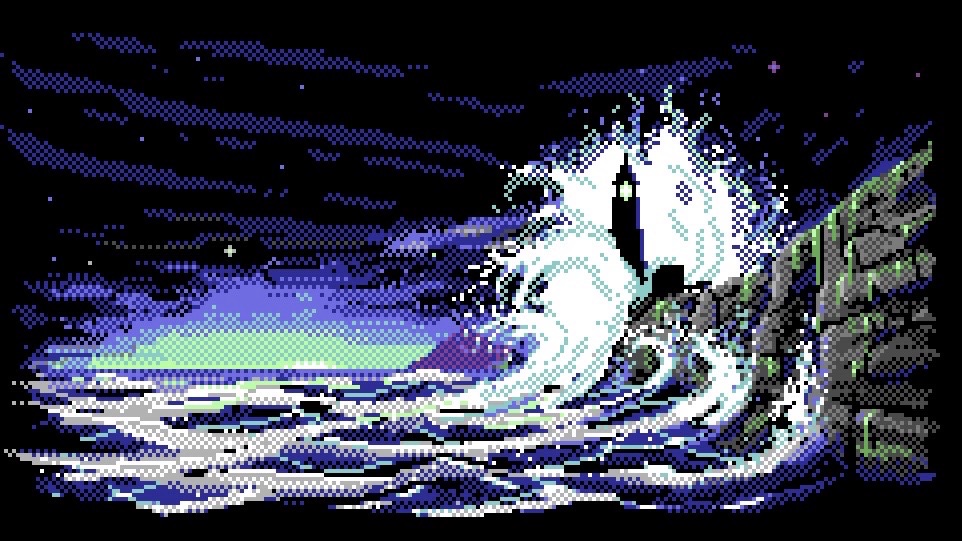
I just realised this sight is from the only game here that isn’t ancient! It’s an RPG called Skald: Against the Black Priory, and at the time of writing in 2024, only recently made its debut on PC via Steam… And without spoiling too much, it might even make the game of the year list I’ll be turning my attention to when I’m done with this! And this lovely drenched lighthouse you can see here was one of four pictures that sold me on the game several years before release, simply jumping out at me as I scrolled through my Twitter / X feed! I could have picked a bunch more to use here too but I love a lighthouse, and this is such a beautifully crafted, exquisitely coloured, dramatic piece of modern pixel art, which I’ve cropped from its little in-game window to let it shine properly (but is also how I first saw it). Amazingly, it doesn’t even take up half the screen when you get to it, and it’s just one of hundreds of locations you’ll pass through, so it really is a fleeting glimpse too! Real man versus nature stuff, which is also a nice relief when you get there, considering the Lovecraftian narrative running through this new take on Ultima or similar, as you end up shipwrecked on an island full of unimaginable mysteries, unnameable horrors and, if you’re lucky, some clues on the whereabouts of the missing childhood friend that brought you there. Tentacled, oozing horrors aside, it’s all familiar, fast-paced swords and sorcery stuff, with the turn-based combat and other interactions subject to on-screen dice rolls, and lots of character creation, inventory management, attributes and skills to manage to your nerdy heart’s content on easy-to-use menu screens. The overall presentation is great, with so many of these superbly illustrated static scenes that are so full of character and atmosphere and really add to the immersion, as do the crunchy sound effects and the surprisingly rich soundtrack. Overall it’s a joy to play – especially if you have nostalgia for such things, so check it out if you can!

The Game Boy Advance library included in the Nintendo Switch Online Expansion Pass was been a bit underwhelming after its equally underwhelming launch a little while back as I write – a lot of what was on there is fantastic but there’s really not a lot of it. That’s where find ourselves next though, and while I’m not exactly the born-again fan I am for the likes of Sonic the Hedgehog, I have developed more of an appreciation for Kirby too of late, so was keen to give Kirby & The Amazing Mirror a go when it first appeared on the service. It originally came out in 2004, and sees Kirby out to save the day after The Mirror World, which exists in the skies over the more familiar Dream Land, was invaded by an evil shadow. He’s not alone though because he’s conveniently been split into four Kirbys of different colours, who you can summon to help solve puzzles, distract enemies or team-up against bosses. Usual Kirby sub-games too, but not the usual Kirby format because this is a kind of metroidvania, with a maze of branching paths you can have a go at in any order, assuming you’ve found the right power beforehand. That’s where it falls down for me too – terrible sense of direction and I soon didn’t know where to go next, often because I also couldn’t remember where I’d been already! I had some fun with it before that got too frustrating though, with Kirby never feeling better to control, plenty of tricks up his sleeve, and some of what could be hand-painted backgrounds that are absolutely stunning, like the gothic melodrama we’re looking at here, which might be more Scooby Doo than Kirby, but contrasts so beautifully with his wobbly pink form. Much like the subject matter of this early area, the colours are pure Hammer Horror, minimal and dark but vibrant all at once, and the way both forest and castle all deform inwards is really disconcerting once you notice it, again, in complete contrast to the typical Kirby ethos. All of which is all present and correct elsewhere though, and is as polished as you’d expect too, even if it’s a bit less mindless than I was hoping for!

Here’s another one I ran out of space for last time, which I remember being a tough call because it’s totally insane! Speaking of which, it’s from Konami ‘s 1996 horizontally- and vertically-scrolling shoot ‘em up Salamander 2, which is, of course, the third in the Salamander series, itself a spin-off of Gradius! Up to two players flying Vic Viper and Super Cobra spaceships, fighting an alien race called Doom to save the planet Gradius is all the background you need, and this takes place across six levels that alternate between horizontal and vertical planes. As usual with these things, you can destroy certain enemies to get power-up tokens to upgrade your weapons as you see fit, and then you need to stay alive as long as possible because if you subsequently lose them you’ll be screwed! It had all been seen before (and arguably done better) at this point, but Konami reckoned some mid-nineties polish on a familiar formula would have its fans from ten years earlier rushing back to the arcades. Well, I think they might have been busy with Street Fighter Alpha 2 and The House of the Dead but I’ve always been fond of it! It has a very oppressive, almost watercolour-like art style, with big moving parts all over the place, and then even bigger bosses, drenched in creativity and colour, and that’s what we’re looking at here… The first stage has such a cool mid-boss, which appears out of a darkened screen full of eyes that turn out to be mini versions of it, leaving this big brain thing, also covered in eyes, with two long, clawed arms grabbing at you. You’ll deal with it soon enough, then it’s business as usual for a while, until it reappears as the end of level boss but before you can even get a shot away, the real end of level boss – this huge, mutated eel-thing – makes its entrance, gobbles up the first one, and then turns its attention to you! The theatre, the spectacle and the colours here are incredible, especially the first time you see it! I’ve never been much into the music, although the gameplay is more than fine, but for me this is the centrepiece of the game’s whole gooey, cartoon-Geiger vibe, and definitely worth the 1996 equivalent of 10p!

I love finding an old new favourite (or vice versa), and there’s a couple of them represented on this very page, but I don’t think any were as new to me as Zap’t’balls by Elmsoft on the Amstrad CPC! While things get way more frantic than the seemingly serene sight here suggests, this was the moment I totally fell for its bonkers, Pang-like premise from very late in the underdog system’s life in 1992. There’s an enormous, very Germanic backstory and an extremely convoluted level-select password system you need to navigate around the game’s dozens of levels, all spread over four distinct worlds, not to mention its two-player mode (with some downright bizarre controls so you can still experience these levels if you don’t have a player two to hand!), as well as a further eighty levels of “Advanced Edition.” Once you’re in though, it’s very simple, however and wherever you choose to play – fire your zapper at the balls (or t’balls), which might then split or shrink until they’re all gone, and you move to the next level. If any of them hit you, you lose a life, and to hit some of the balls you might have to overcome some obstacles first. Whatever, it’s Pang, and it’s loads of fun! It might have the most atmospheric 8-bit sunset ever too, summoning up every possible shade of red and orange and throwing these lifelike but distinctly primitive pixel-art trees into shadow, and is everything I love about what the CPC could produce at its best, but then you’ve also got this detailed, cute character and the nicely lit simplicity of the balls and his zapper in total contrast, and against all the odds, it not only works but it works great! Don’t get too comfortable here though because the colours will soon be testing your sanity way more than the increasingly surreal and occasionally dynamic environments do. Some of the best music on the system too, and I reckon one of its real hidden gems!
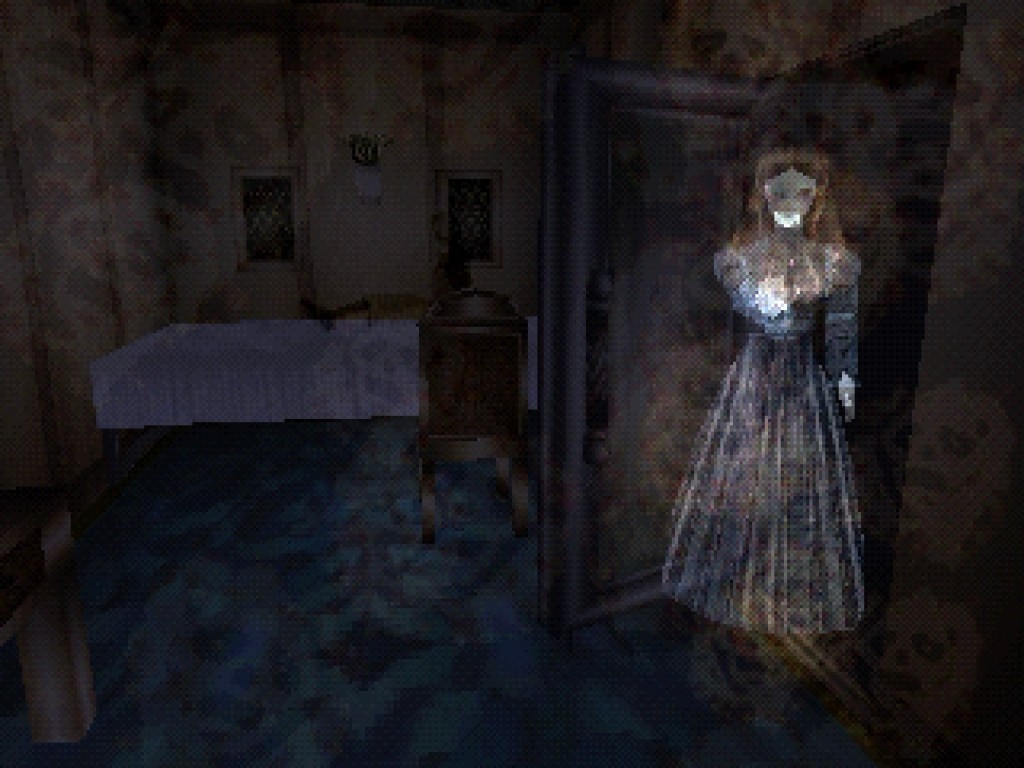
I fell in love with Echo Night the moment I saw its glorious, none-more-PS1 double-page screenshot in From Ants to Zombies, the history of horror in video games from Bitmap Books, and actually playing it did nothing to change my shallow little mind! It’s by none other than FromSoftware in 1998 but it’s certainly no Dark Souls; instead, we have a vaguely-Lovecraftian supernatural mystery, mostly set on an opulent old Titanic-inspired (with a dash of Mary Celeste) cruise liner, where you end up trying to move on the ghosts who are its only remaining occupants by learning what’s still tying them to the ship then fixing whatever that problem is, which generally involves being transported back to their past lives to do some digging. Having now finished it twice and written a deep-dive, I still can’t put it better than the book’s assessment that it plays like what we’d call a walking simulator nowadays, with a bit of back and forth exploring and puzzling at a nice, measured pace, plus the occasional mortal threat and a load of spooks that look like Silent Hill’s more glamourous cousins! The past-life sections offer variety but it’s being onboard the ship that I absolutely adore, with this incredible sense of melancholy and atmosphere like you only got on the original PlayStation, where jagged edges and dimly lit locations seem more like a design decision to me today than any “limitation” – not that it ever was at the time! And that can’t be better exemplified than that image here that attracted me to the game in the first place. I just wish I’d seen it when it looked as state-of-the-art and, no doubt, as scary as it must have been back then, with that mournful, part-transparent, waif-like outline forever chained to the dismal, decaying luxury of the room she died in. Beautiful, and of everything here this time out, it’s without doubt my favourite sight!

Until very recently, I mainly knew Chaos Field as the pretty much simultaneous GameCube conversion of a 2004 vertically-scrolling arcade shoot ‘em up by MileStone, and in fact, the image you see here from its opening sequence was originally pencilled in to be from that version. Then, back at the end of 2024, I stumbled upon the Dreamcast port, and while there’s not a lot in it, it does just edge it for image quality and depth, so that’s what you’re now seeing here instead! Actually, for gameplay alone, the GameCube does offer some additional modes, although honestly it’s hardly the greatest shooter of them all so take your pick! Awesome attract mode regardless, echoing the classic opening of any decent Star Wars movie, where the vastness of space is eclipsed by some dirty great Imperial Star Destroyer ominously emerging across it. This sight is a bit smaller scale but no less dramatic, with something far more like a meticulously illustrated and sublimely lit Coruscant Guard Gunship from The Clone Wars (note my nerd credentials!), flying over a view like you get out of a plane on a clear night, with the brilliantly illuminated density of a city far, far beneath you in the distance, its outskirts and motorways like pinpricks in the darkness closer below. In-game, I think we’re actually looking at a carrier transporting the choice of fighters you’ll be flying, which you’ll emerge out of towards that big moon in another cutscene once you’ve selected your character. From there, it’s five levels of non-stop boss fights, three on each, which makes for a pretty slow-paced bullet-hell experience that’s not exactly big on exhilaration but the weapon loadouts are fun to experiment with, as is the “order field” and “chaos field” environmental switch, with the latter giving both you and the enemy more firepower. It’s by ex-Compile guys so it’s supremely competent but also very generic everywhere you look (and listen), and little more than nice for a change once you’ve pressed Start for the first time!

I’m not sure how I ever ended up here because it’s definitely not my usual thing but once I did, I got properly hooked on Arabian Nights on the Amiga… Well, once I ditched the original two-disk release from 1993 for the CD32 version, which loads far less painfully slowly, and even has a button for jump… What have I turned into??? Anyway, you play as Sinbad Junior, a voyeuristic royal gardener who sees the princess being abducted by a dragon. He tries to save her, ends up unconscious, then wakes up in prison, accused of sorcery and being involved in the kidnap, which is where we pick up the tale. It’s a no holds barred platformer in the main, and once you’re out of the prison you’ll be working your way through another nine danger-filled levels, with enemies to fight and puzzles to solve, but as well as leaping about, you’ll also occasionally end up racing mine carts and flying magic carpets… There’s loads of power-ups and secret places to find too, with these usually resulting in money you can use to buy stuff from the folk you’ll come across to aid your quest to clear your name and save the princess. I can’t think of many better platformers on the Amiga (where it was an exclusive), with the challenge becoming more balanced as you become more proficient, and it actually reminded me of Dizzy more than anything… Which is my thing, so might explain me sticking with this for so long! Fantastic cartoon graphics and a lovely soundtrack to boot but eventually getting to that magic carpet bit (insane difficulty aside) was a real visual highlight for me! Now, I know I’m a sucker for a gaming sunset but that borderline too-bold colour gradient soaring up above the clouds and into the starry sky above is just stunning! So 16-bit too, and with a great sense of scale thanks to the tiny sprites, which I’m sure was their intention all along! Just wish this stupid bit wasn’t so stupid hard!

I don’t like stealth games so I was never interested in Metal Gear Solid at the time but very, very recently as I write, a Retro Gamer article convinced me to have a quick go on the PlayStation Classic, then before I knew it, I’d very belatedly found a genuine top-fifteen all-time favourite! Obviously, we’re talking action-stealth by Hideo Kojima in 1998, where you play super-soldier Solid Snake, trying to get into a nuclear weapons facility, rescue the hostages, neutralise the terrorist threat and save the world. It’s an incredible, seamless mix of 2D and 3D, top-down, third-person, first-person and in-engine cutscenes, making for this totally cinematic experience unlike anything else I can think of from the time or much else since! Still looks great too, with the PS1 once again more than holding up today, it’s polygonal textures adding their own distinctive and surprisingly distinguished character. While we’re taking graphics, and before I get too born-again Metal Gear fanboy, let’s have a look at the sight I’ve picked from the game here! It’s captured from a full-motion cutscene from right near the beginning, where Snake is being briefed on why he’s found himself in these frozen waters with nothing more than the scuba gear you can see in silhouette here and an entire world to save! The danger and bleakness of the environment you’re about to experience, as well as the gravity and isolation of his predicament, are captured perfectly, with the console pulling out its very best tricks to convey a glimmer of hope through these icy reflections. Nice indication of the adventure to come too, which takes you to so many different places, full of believable detail, enhanced no end by some really effective lighting, as well as decent voice acting, some very atmospheric sound effects (those wolves!) and an excellent original soundtrack that all really adds to the drama. Proper James Bond stuff too, with some great gadgets by the end, where you feel totally in command, although the last couple of bosses took some working out! Elsewhere, puzzles are logical, the action well-balanced, there’s some wild fourth-wall curveballs, and I even enjoyed the massive talking bits, the prolonged back and forth, and that cone of vision stealth nonsense! I’ve always known it’s considered one of the greats so better late than never but I’m not embarrassed to say this is one of those holy grail discoveries I live for with this hobby!
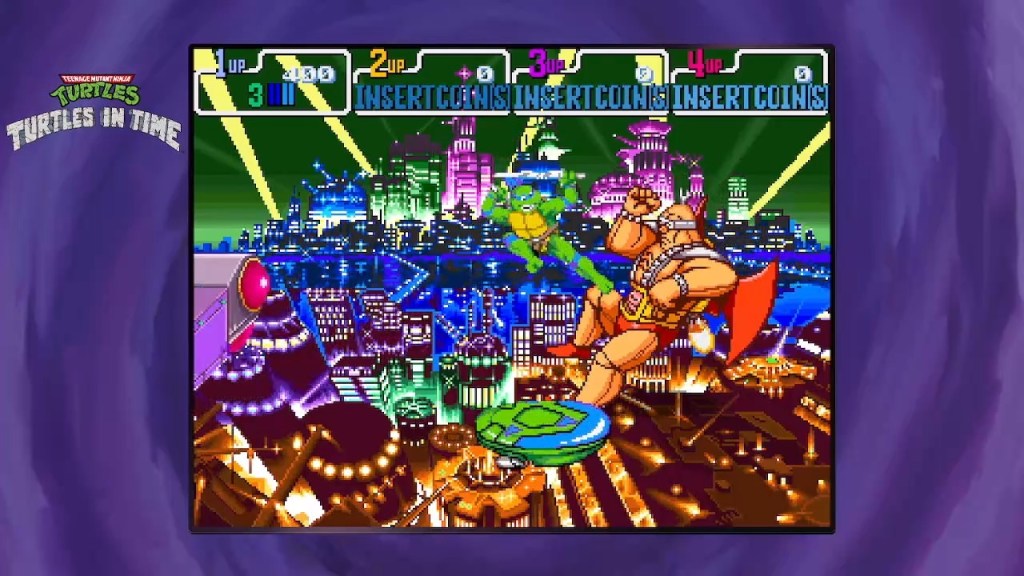
Right, I think we’re close to the end now, and it’s another literal big hitter, and it’s none other than Teenage Mutant Ninja Turtles: Turtles in Time! Lucky I enjoyed the sight we’re seeing here so much too, considering how many times it takes me to get past this Super Krang fight over yet another gorgeous, vibrantly lit cityscape! It really is all about the lighting too, so dynamic and varied, with searchlights and reflections and all those illuminated buildings, giving the impression of so much life despite there not actually being that much else going on if you look closely, far below this completely authentic, over-the-top aerial battle between these cartoon heavyweights! This 1991 Konami arcade game is undoubtedly one of my all-time favourite beat ‘em ups, sitting right alongside the god-tier (in my eyes) Alien vs. Predator and Growl. It’s just wonderful! This time out, the action begins with the Turtles’ news-pal April O’Neil being interrupted live on air by series bad guy Krang turning up in an exosuit and stealing the Statue of Liberty before his pal and born-again Timelord Shredder joins in too. Enter your choice of Turtle(s), setting out through ten stages, first on the streets of New York then across time as they’re sent back to prehistory and on to the age of pirates, the Wild West and the sci-fi future, fighting everything that moves, which makes for a fantastic array of appropriately-equipped familiar as well as new enemies and bosses! The combat is exquisite with animation to match, including some great use of sprite-scaling as you throw your unfortunate victims at the screen! It’s full of visual and audio slapstick throughout, and the whole package couldn’t be more Ninja Turtles, looking exactly the part and sounding like it too, with just the right amount of wacky sampled speech interspersed with a ton of crunchy and often level-specific sound effects, which is also true of the themed and always high-energy synth-rock soundtrack. The odds do get stacked against you later on if you’re playing solo but adding a credit any time will add a few more lives so you can carry on as seamlessly as you wish regardless, and you really should! Which sounds like a good place to close for this time and give you some closing thoughts…

At the end of the last one of these features, when I was talking about running out of room for any more, I did also mention a lovely example of an Amiga graveyard we’d try and get to this time, but honestly as I write I’ve not played it yet, and we’re running long, so I reckon that’s a good place to end and a good place to pick up again in Part 5! I will tell you it was Curse of Enchantia though, and I first came across it in the wonderful Commodore Amiga: a visual compendium, once again from Bitmap Books, and I’ll definitely do my best to get it done for next time, so look out for my Weekly Spotlights for more on that! And finally, earlier on I promised to direct you to the first three parts of this series so do also have a look at those…
Wonderful Sights in Gaming – Part One
Wonderful Sights in Gaming – Part Two
Wonderful Sights in Gaming – Part Three
Hope you enjoy having a look at them, and I really hope you’ve enjoyed our little journey through another set of wonderful sights in gaming here! And with that, I will see you here for part five next year, and everything else in-between too!
As always, I’ll never expect anything for what I do here but if you’d like to buy me a Ko-fi and help towards increasingly expensive hosting and storage costs then it will always be really appreciated! And be sure to follow me on Instagram, X (formerly Twitter) or Threads for my latest retro-gaming nonsense!
 Retro Arcadia