There once was a game called Bomb Jack. It took me a while to get to Tehkan’s 1984 arcade original but I was quickly all over the ZX Spectrum port of this legendary single-screen platformer of sorts that takes you all around the world, jumping and gliding about, frantically trying to avoid enemies while you defuse all the bombs in some well-known locations, including a particularly wonderful rendition of Egypt’s Pyramids of Giza… Rather than Pyramids of Death, as my autocomplete just helpfully suggested! Anyway, it turned out this was the port to own too, although the Atari ST version was alright, and I’d eventually pick up the definitive Arcade Archives release on Nintendo Switch as well. Doesn’t matter where you play though because as soon as you realise you want to be defusing those bombs in the order their fuses are sparking away then everything changes. Forever! Still an incredibly fun and addictive game whether you’re sightseeing or playing for high scores though, and in reality, one is a progression of the other anyway; it’s not like the game isn’t signposting exactly what’s going on either, and sooner or later you’ll grab enough of them one after the other for it it to spell out the effect… And if you’re anything like me, you’ll then end up starting out with big intentions then reverting back to form as soon as it all goes wrong so it makes little difference regardless!

Aside from sequels to the game we’re gradually getting to that did it better and bigger and for longer than everything else combined, I was trying to think of other games where “advanced play” might not only affect how you approach them but also how much you enjoy them! And honestly I’m struggling… Road Rash II came to mind first but actually that’s for doing the total opposite because I know how to play it properly but generally (and very regularly) choose to just start a new game, have a blast through a few courses, and ignore all the progression stuff. And that then put me in mind of the old 8-bit racing games where you realise it’s the road you’re controlling and not your car, and you will never, ever unsee that, which equally totally changes the way you play, and often kills whatever fun was there in the first place. If you were lucky! Which I know is not what I’m after at all but gives me a chance to mention that I was watching exotic late seventies and early eighties motorcycle cops TV show CHiPs the other day, and that’s been similarly impacted by finding out they could only film on location at the literal crack of dawn, which is why the California highways they like to patrol are always virtually empty! Again, you can’t unsee that but there are some things you can’t spoil, and that show will forever be one of my all-time favourites!

Right, let’s get back on track! While I didn’t necessarily set up this stream of consciousness just so I could talk about CHiPs, all I’ve really come up with on top of Bomb Jack is The New Zealand Story… Somethihg about super-cute arcade platformers from Taito! This one came in 1988, and on the surface is a simple but fiendish multi-directional scrolling affair that has you taking your little kiwi from one end of the level to the other, where there’ll either be one of your kidnapped friends waiting to be rescued or a boss fight. Despite being pretty big and having a time limit, those levels encourage exploration too, with loads of hidden secrets that are almost impossible to ignore once you know they’re in there somewhere, from warp gates to entire post-death levels, if you die the right way… I know we haven’t got there yet but while it plays out a bit differently, the lineage from Bubble Bobble is obvious as you play, and there’s even direct links, like picking up letters to spell EXTEND for an extra life. EXTEND letters are a good example of some of those early secrets too, where in the very first level, you’ll see three platforms near the end that seem a bit excessive, but that’s because if you climb to the top one and stand on its left edge then jump and shoot five times, a warp gate will appear, and there’s E, X and T waiting to be collected. Find the next warp gate from there and you’ll end up in a room you’ve seen but couldn’t access under the first boss (the whale you fight from the inside!), with E, N and D. And the rest of the game is full of this stuff, to the point you might even forget all about your poor caged compatriots and obsess over all that instead!
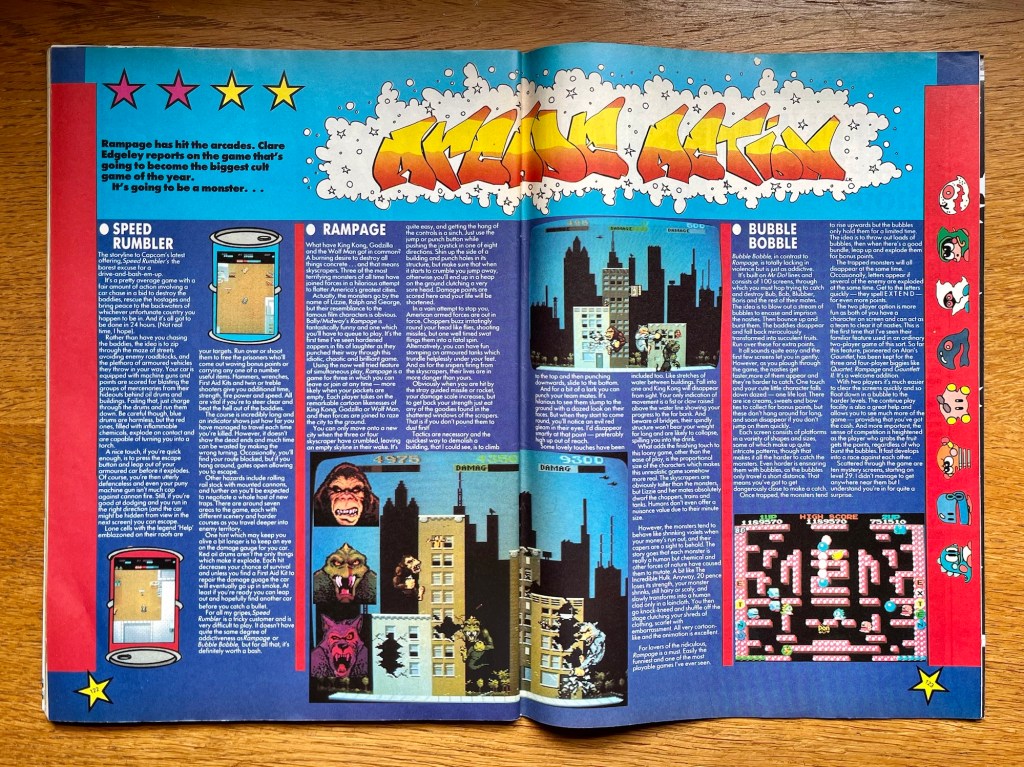
I will come back to the similarly secret-infused Rainbow Islands later but in the meantime, I reckon we got there in the end and found some context for gaming’s equivalent of the iceberg that sunk the Titanic, Bubble Bobble! Just like Bomb Jack earlier, Taito’s 1986 arcade original wasn’t my first experience of playing the game but I do distinctly remember the first time I came across it, in the Arcade Action bit of the November 1986 issue of Computer & Video Games magazine, and one of those eye-watering, exotic revelations you’d regularly get in that section back then… Not that it involved Bubble Bobble at all! That would come a bit later but in the meantime, I was totally smitten by my first introduction to Bally-Midway’s Rampage, spanning both pages with glorious screenshots of fully destructible cities and these three huge monsters on the, er, rampage! And, in the absence of access to pretty much any arcades full-stop, let alone with that machine in, I read and reread that page so many times over the coming months, and by association, Bubble Bobble would worm its way into my consciousness too, which would then be totally ready and waiting by the time the home computer versions came along! Didn’t hurt that they gushed about it almost as much as they did Rampage either but, reading through it again just now, I was most interested to see how they saw it as being along the same lines as Universal’s 1982 maze-tunneller Mr. Do! which in turn could be seen as being along the same lines as Namco’s Dig- Dug from the same year. However, Taito did publish Mr. Do! in Japan, and it’s got cute dinosaurs, and you chuck balls at them, and there’s fruit to collect, and you spell out words for bonuses, so in retrospect, there is definitely some association I’d never even thought about before!
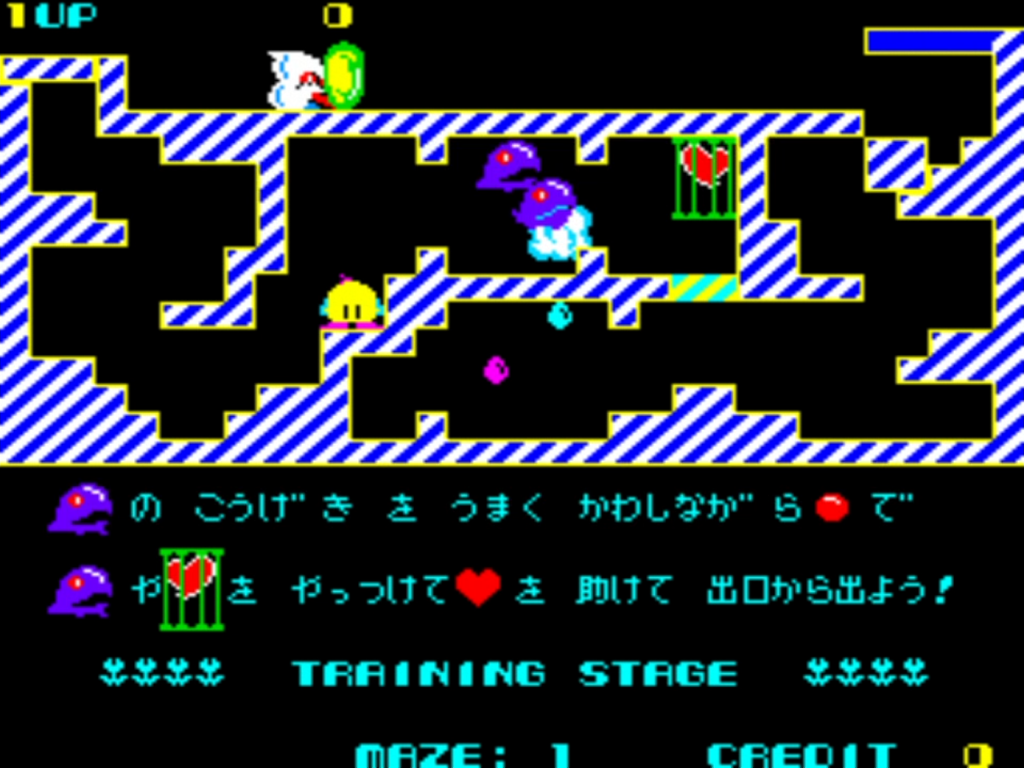
If we’re really talking spiritual predecessors though, we need to talk about Taito’s Chack’n Pop! Looking at the screenshot here, it’s a bit more direct than that too, as your little yellow blob platforms his way to free caged hearts that will open up the single-screen level’s exit while avoiding monsters hatching from eggs, or just lobbing bombs to destroy them, though that’s always a risky business when their explosions spread Bomberman-style and can easily take you out too! As familiar as it seemed when I finally got to it, I knew nothing about this game until 2006, when it appeared on the Taito Legends 2 compilation for PlayStation 2 but even then, I imagine I played it once and didn’t come back until it reappeared on the first Taito Milestones collection for Nintendo Switch in 2022, and again a few months later on the Taito Egret II Mini tabletop cabinet. But wherever I’ve played it since, I’ve always been put off by what I think are some very awkward movement mechanics, involving stretching rather than jumping, and no matter how much I’ve tried that never got intuitive, and instead always managed to suck most of the fun out of the experience as soon as you’ve got a monster on your tail. Thank goodness they sorted that out in time for Bubble Bobble! It is interesting to see the evolution of its audio and visual style here regardless though. And with the foundations in place, let’s jump back to Bubble Bobble itself now, and the home computer ports that I first became aware of when the adverts started appearing in the September 1987 issue of C&VG, almost a year after we were introduced to the original just now.
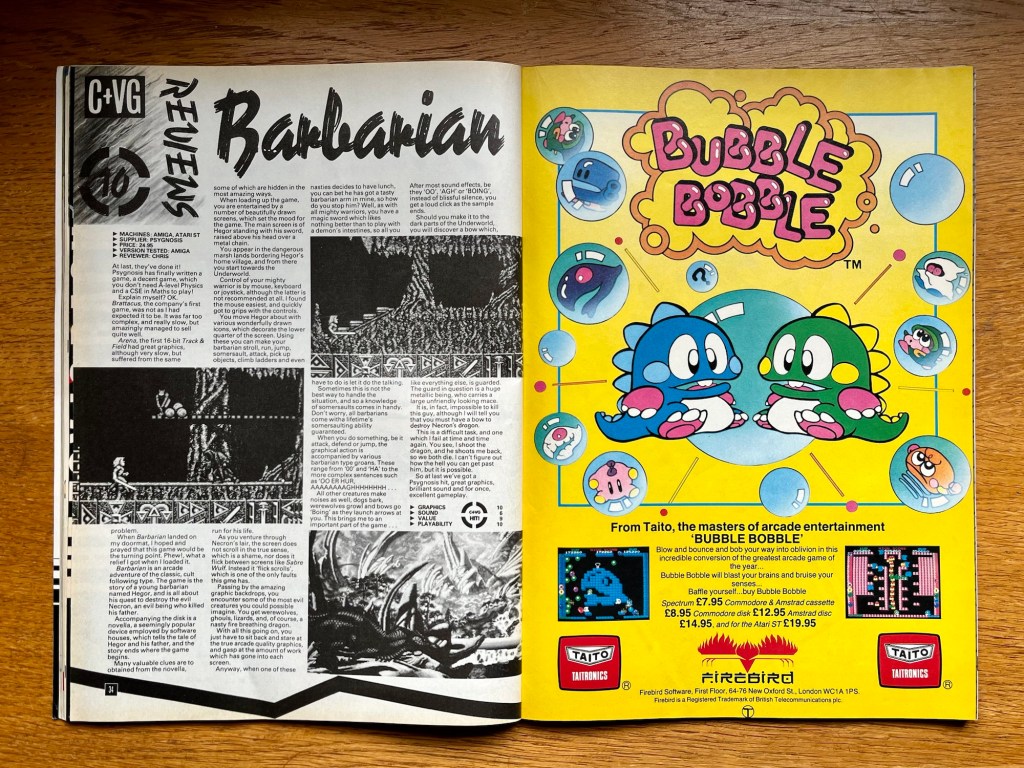
As a quick aside, as much as I enjoyed a game of Psygnosis’ Barbarian (rather than the fighting game with the big-boobed cover art you just thought of!), those black and white screenshots here – in such stark contrast to what’s going on across the page – really don’t do it any favours, no matter how much they’re giving it ten out of ten for graphics! And that poor thing bottom-right, which you’d never know is part of one of the most stunning intro sequences of the entire 16-bit generation!!! Anyway, did an advert (apart from the aforementioned big-boob Barbarian) ever capture everything you needed to know about a game than Bubble Bobble’s? It certainly had me sold, and my brother too, just like the glowing review of the Commodore 64 version did a month later, and if it could do a decent job on there, then you could be sure the Spectrum port we’d already made up our minds we’d have to get certainly would! Bias aside, that is one of the great C64 conversions too, but I’ll come back to that and the rest later because while the advert does indeed tell you all you need to know, there’s a story too… There were two boys called Bubby and Bobby, and they had girlfriends called Betty and Patty, who decided to venture outside of their peaceful village and have a look around the local woods, where they got lost and ended up going deeper and deeper until they stumbled into the Cave of Monsters. Here they met an evil magician called Super Drunk, who kidnapped them and locked them away on the top floor of the cave. Enter our two heroes but, unfortunately for them, they also bumped into Super Drunk on the way, and (for better or worse!) he turned them into Bubble Dragons, which is where we join them in their new bubble-blowing, dinosaur state, ready to make their way through the hundred floors (levels) of the cave to rescue the girls. Oh yeah, they’re now called Bub and Bob too!

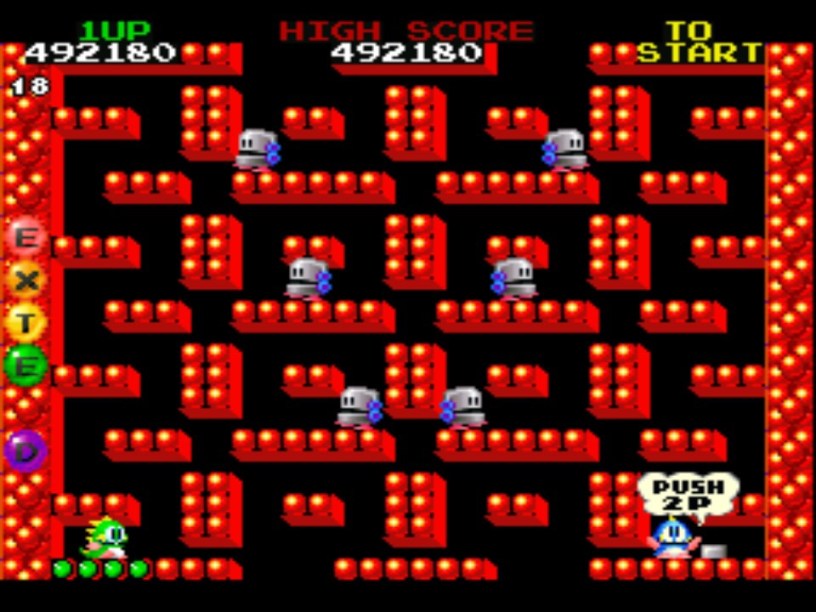
Each level begins with you at the bottom corner(s) of a single-screen filled with platforms and a bunch of monsters, which you need to get rid of to move to the next, which will then offer a new layout and, soon enough, new monsters too. You can jump up the platforms but need to come back down by dropping off the ends, and you can also drop down holes at the bottom of the screen to fall back through holes at the top. All those bubbles floating around can be used for getting to high places too! The monsters will patrol the platforms and generally make their way towards you without being too relentless in their pursuit to avoid it feeling unfair. The slightest touch is a life lost, so you need to blow bubbles at them before they get too close, and once they’re trapped in one of your bubbles, it’s going to float away so you then need to get after it and burst it with either your spine or your horn (depending on which character you are) although in reality it’s simply jump at them or onto them with a bit of momentum on your side! Once it’s burst, it will zoom off in all directions before landing somewhere and leaving a bonus item but take too long to grab it and they’ll disappear, and that’s the case for the bubbles as well, which the monsters will escape from if you don’t pop them in time! The level itself is also against the clock, and if you’re too slow then the terrifying Skel-Monsta (aka Baron von Blubba) is going to turn up, and his pursuit is going to be slow but will be relentless from the outset, and he’s invincible too, so the only way to escape is to complete the level before he hunts you down, like a cute version of Jason Vorhees from Friday the 13th! There’s about ten regular enemies in the arcade game plus the big boss, while the number seems to vary between the home versions, but you’ll come across a mix of ground-based stalkers, some that fly, some that bounce, some that breathe fireballs, and a really cool one that looks like a Space Invader and shoots lasers down at you! And they’ve got no qualms with teaming-up and all piling in on you at once either, so you want to try and get as many as you can in the brief respite before they start moving when each level begins! That said, trapping them all then bursting the lot in one go after they’ve come at you en-masse is one of the game’s chaotic highlights for me!

As you progress, you’ll also come across special bubbles on some levels that contain fire, thunder or water, and you can set them off by hitting them from the opposite direction you want their effect to be produced, which is often easier said than done! Fire will cause flames to engulf the ground around the bubble and any monsters with it; thunder shoots a lighting bolt across the platform to similar effect; and water is the best of all, flowing down the platforms below and taking anything in the way with it, including you, which can also be a handy way of getting into some harder to reach places! Get caught by the fire or thunder, on the other hand, and you’ll be frozen for a second or two. There is also – so I’ve heard – a special bubble that only appears about one in four thousand times, and that will allow you to breathe fire for the next five rounds! More often than not though, you’ll be chasing after bonus items, like different kinds of fruit that award you points, from five hundred for a lowly banana to sixteen thousand for a juicy pineapple. Clearing a stage quickly will also reward you with jewels, crowns and other treasures that will appear in the next stage, and then there are magic targets that, according to my Atari ST instructions, “mysteriously appear” and will reward you with things like bubble power, speed-ups, extra lives and various other unspecified lucky dip items which I’ll get into a bit more later! Finally for now though, you’ll also see letters appearing, which I think do so after you’ve destroyed a bunch of enemies at once, and if you collect all the letters in the word “EXTEND” you’ll also get an extra life. And that’s all there is to it…

I’m not sure I’ve ever owned so many versions of a single game on so many systems as I do Bubble Bobble, and as much as it would have sounded like science-fiction to 14-year old me at the time, a good chunk of those are now the original version, on several generations of consoles, that wonderful Egret II Mini, and the absolute miracle of having it handheld, care of the Super Pocket spin-off from the Evercade folk! As said though, like most good things in life, it all began on the ZX Spectrum… Now, while I will return to the original, there are certain things any version of this game needs to get right regardless of technical limitations, namely the effortless simplicity of playing the game (ideally with a second player in tow), the flawlessly cute characterisation, and a decent rendition of one of gaming’s most iconic soundtracks! And as I was saying, ZX Spectrum… If you ever wanted to demonstrate how important music can be to a game, then play the 48K version of this port back-to-back with the 128K version! Same game, same gameplay, but one is interspersed by occasional white noise blips, while the other is literally brought to life by a continuous, gloriously authentic rendition of the theme tune. There’s so much energy in that 128K version I was fortunate enough to be able to play at the time, and it genuinely makes all the difference, although the base game is all there too. Visually, it’s part-monochrome, displaying see-through characters on colourful platforms on black backgrounds, and those characters are brilliantly rendered in tiny detail with all the original’s slapstick animation, and just the odd bit of slowdown when things get frantic. It plays just right too, especially when you throw in a second player to part-cooperate and part-compete. Like its Commodore 64 counterpart, it’s one of the system’s essential arcade conversions.
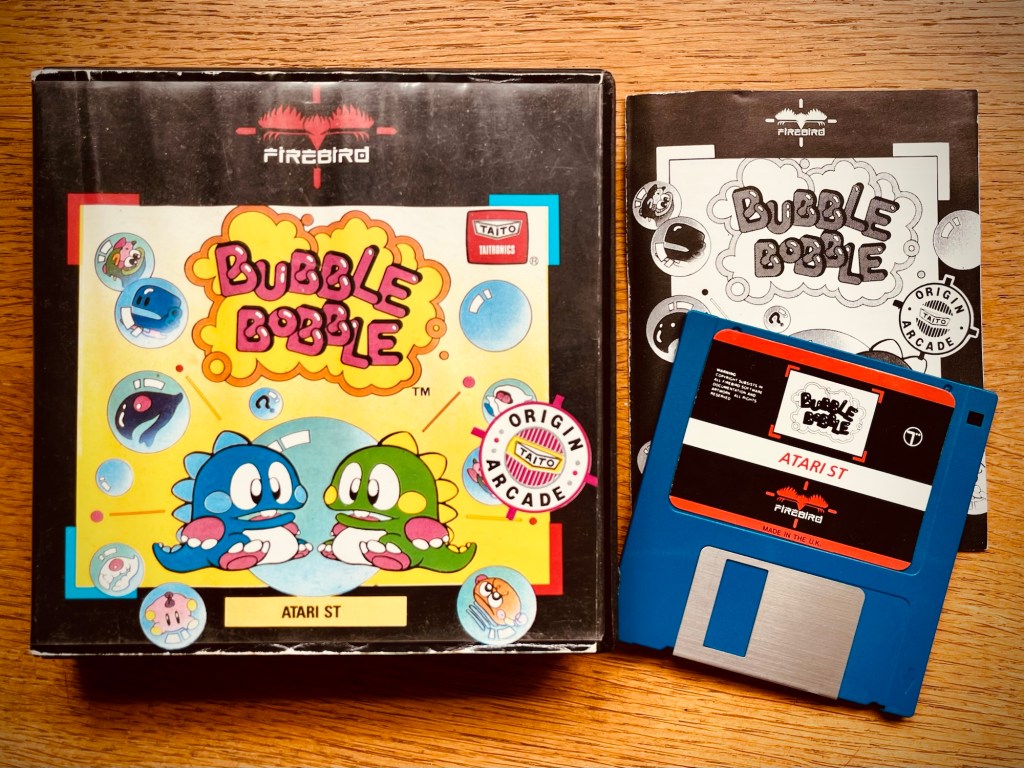
I don’t think I ever played the C64 game when it first came out but where I went next was the 1987 Atari ST version, and to this day, for me that’s the definitive way to play – Quickshot II joystick, two players, arcade perfect… Which is easy to say when you’ve never played the arcade version but while it wasn’t quite, on the surface it wasn’t far off either, especially compared to the Amiga version, which had more sound but played too fast and just seemed to lack effort – not sure but it seems like a port of the ST port, as was often the case over there. Anyway, while I’m not much of a social gamer, to me this moment in gaming – and we’re talking 1989 into the early-ninteties – is where my fondest multiplayer memories lie, playing against my two brothers on this, and the ST ports of the aforementioned Rampage and Super Sprint, and, of course, Kick Off, with two sitting on the bed, one on the stool at the desk in front of the tiny (but now colour!) portable TV in my tiny bedroom! And by this time, as much as we’d loved the Spectrum version, that was now a distant memory as these beautifully coloured and fully-featured little dinosaurs leapt around the increasingly intricate platforms that looked good enough to eat, and it was all so smooth and there was no slowdown, and that soundtrack wouldn’t have been out of place in one of those rave things the tabloids loved to overly dramatise at the time! I will come back to how close to arcade perfect it was but for now, let’s just say there’s things going on under the hood that were unlikely to have made the cut, and, more obviously, a flourish to the original that’s understandably missing here. In fact, of all those original ports, I think the Sharp X68000 maybe comes closest when it comes to “flourish” before things like the Sega Saturn and Xbox 360 went a step further and somehow lost something in the process…

The last time I played Pacmania, that fantastic, isometric spin on the classic, I was thinking to myself I don’t think it ever got a bad conversion, even though, of course, some are better than others. And I was thinking the same about Bubble Bobble too… Then I remembered the Game Boy port! It made its way there in 1991 (as well as the Game Boy Color in 1996) and kind of did its own thing to try and make the best of what the machine could offer, albeit to varying degrees of success. The first thing that jumps out at you is the iconic theme music that’s not only perfectly intact, but really pops here, all multi-layered and melodic from this understated but frequently remarkable little sound chip! The gameplay itself is also intact… in theory! The thing is, it’s compensating for the tiny screen by only showing a portion of the level and scrolling around (nice and smoothly) for the rest, and while the levels themselves have clearly been redesigned to this end, the monsters roaming them haven’t. This means you’ll constantly be moving up or down beyond the current view of the screen, and there’ll be one waiting there, going about its business exactly where the jump or fall is now unavoidably taking you. And while you do get a feel for the layouts, which does in turn make it better, you’ll still mostly be dying cheap deaths in this way. Likewise, you’ll also lose track of all the bonus goodies, and often lose track of the level itself if you’re dropping down through the bottom then back into the top! They’re on the bland side too, although they do really nail the various characters and overall arcade aesthetic. Still tough to love this game as much as I thought I would at the time though – it’s fun while it lasts but I’m not sure that’s ever for long enough to outweigh all the frustrations, and having now played loads of that Super Pocket handheld arcade version, I can’t help but wonder if – resolution allowing – a simplified version of the full level on the screen at once might have still worked better.
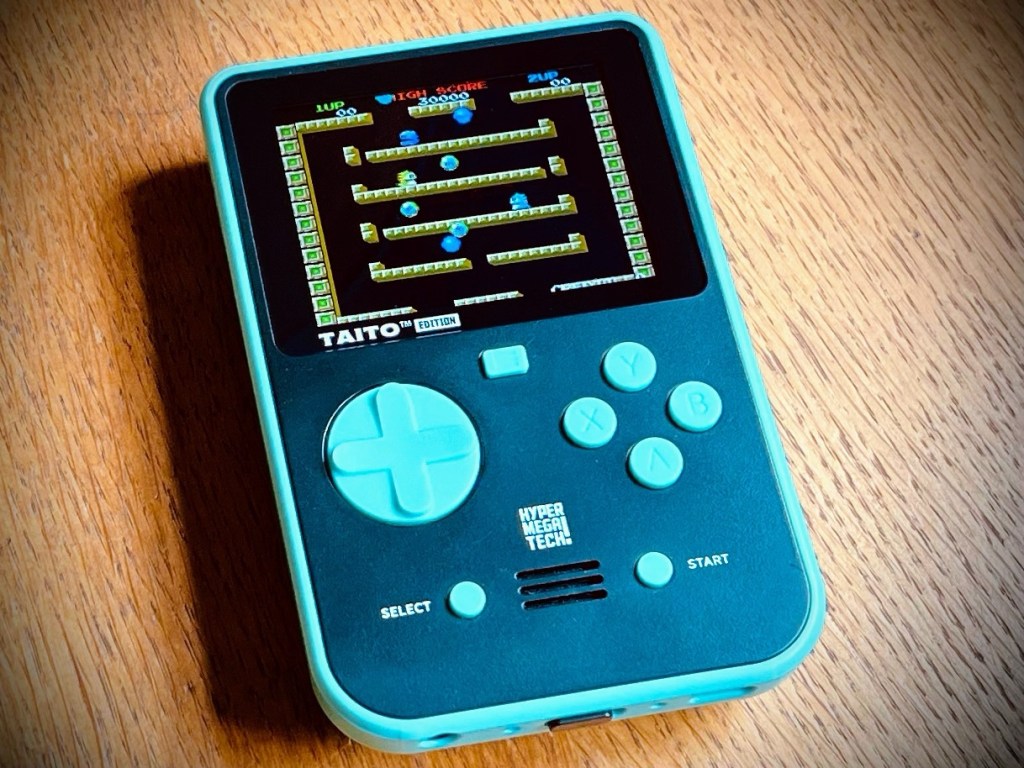
Which is a good place to hook back up with the original, and where I’ve mostly been playing as I put this together. I will just mention the NES, Master System and shrunk-down Game Gear ports as other places I’ve enjoyed the game though, admittedly without ever really going beyond dabbling, and I really want to give a shoutout to the virtually completed but then unreleased 1989 BBC version, which I think just came too late for Firebird to think it worth putting out, but fortunately it’s now playable and worth checking out for the music alone. Outrageous! And the same might well be said for the Super Pocket handheld version, where the arcade original is baked-in with seventeen other Taito (mostly) classics, from Space Invaders to Growl to Operation Wolf! I’ve had this thing on the go all the time since it arrived for Christmas 2023, mixing up that lot with whatever Evercade cartridge I’m in the mood for via the slot at the back. And ignore my badly-lit photography because colourful stuff like Bubble Bobble really look the part on there too! Not that it’s exactly a visual feast anywhere but it is very colourful, despite the blackness behind it all, and there are times that use of colour, in combination with the density or complexity of the current level layout, as well as the textures on its platforms, is nothing short of stunning, like an impossibly tasty sweet shop! And all the tiny little sprites could not have had any more personality crammed into them, with that determined sadness on the faces of Bub and Bob’s big-eyed, tail-swishing cartoon-dinosaur transformations, while the monsters you face are as consistently mischievous-looking as they are imaginative, with little whale things and ghost things and wind-up mechanical things and little aliens that are clearly ready to make your life hell however innocent they might seem. Those bonus items are good enough to eat too, especially when they become giant versions of themselves! And yes, it’s all sickeningly cute, and none more so then when it’s all in motion, with madcap animations everywhere, as toothy mouths are opened, bubbles are blown, creatures are trapped, bubbles are poppped, and each level gradually fills with all kinds of vibrant mayhem as you progress further into it!

There’s no denying the singular star of the show though – that unmistakable, insanely catchy piece music you’re playing along to! It was composed by Tadashi Kimijima, of Taito’s house band Zuntata, which in turn means it’s not easy to track down what else she’s done but is identified as Kimi in the credits here. If only I could see more arcade game credits… Anyway, this thing might well be gaming’s ultimate earworm, built on variations of a simple melody over a few chords, and the scariest tempo change ever as you’re told to hurry up as Skela-Monsta appears when you’re taking too long over a level! The instrumentation really takes it to a new level too, with layers of bell-like chimes looking after that winding tune, while a squelchy synth-bass provides all the rhythm you need! And although that might also be all the game needs, things like EXTEND, Super Drunk and game over get their own quick burst of music too, and then there’s also suitably ominous backing tracks for some of those “mysterious” elements I mentioned before! I think this is probably where the original has the edge over any of its conversions too, however arcade-perfect, with a kind of shimmer to those chiming melodies, as well as a few little dynamic, literal bells and whistles to them which aren’t present elsewhere, but stick a pair of headphones on for this version and you won’t miss them! That “shimmer” also applies to the sound effects, many of which share that chiming quality, while others are more cartoon-like to match the visuals and increasingly chaotic action. And just to close on presentation, those musical flourishes found in the original but not elsewhere also extend (not EXTEND) to the visuals too, from basics like the number of colours available to how many of them can be displayed at once to create things like reflections on a bubble’s multicoloured surface, or little explosions of light in things like the thunder effect, and the bubble-starburst effect in the opening sequence.

It’s all minor though, as is the final difference between arcade and conversion I wanted to quickly mention, and that brings us back to gameplay, and the slight physical resistance from the pressure inside the bubble as you make contact with it, providing subtle but noticeable feedback about the equally subtle change in motion required to burst one rather than push it. Pretty good indicator of how well it was ported when these things are the best I’ve got to level at them though! While we’re talking gameplay, Bubble Bobble couldn’t be more accessible but it doesn’t taken many levels for those more aggressive monsters to start appearing, then getting mixed-up in different combinations, while the platform layouts also quickly become more complex and challenging to negotiate, sometimes even bordering on puzzling, as you wonder how to get into tight spaces the monsters don’t want to leave. They’re always in the same place too, and there’s also only so many ways you can place them, so you’ll work them out with practice, and while it does get very tough, clearing them is obviously easier with a second player, although the better you both get, the more you’re both going to want all those lovely points and bonus items on offer, and there’s plenty of ways to try and scupper your partner getting at them! Two other things I want to quickly mention on difficulty – first, the time you’ve got to pop bubbles after trapping a monster in them will significantly decrease as you progress, which in turn will significantly change the way you approach them in the first place, often demanding you get way closer before you shoot, which is a much riskier business! Not sure but the bubble behaviour when a monster is inside seems to get increasingly erratic later too, although that could also be because there’s way more going on by now to knock the bubbles around. And this is also true of monster activity itself, so those platforms might always be in the same place but they could end up anywhere with all the random chaos on-screen directing them! Second point is the difficulty itself, which is kind of dynamic, although I think it’s as simple as the more lives you’re not losing, the more everything gets a bit quicker, so while it’s not something I’ll ever need to worry about, if you get good you might want to reconsider those EXTEND letters!

Despite all of this, while things are never quite the same from game to game, they mostly are though, and I guess if you’re playing solo in particular, that repetition we just talked about could lead to things getting a bit stale forty levels in but if you’re getting to the point it is, then that’s probably not going to bother you anyway! And you could always skip a few levels… At this time, I’m going to issue something akin to a spoiler warning! So far, we’ve enjoyed blowing bubbles at monsters then popping them to make fruit to get points and clear levels, and if that’s what Bubble Bobble means to you then please consider jumping ahead to the end! It’s certainly what it meant to me until just a couple of years ago as I write, and probably when I really got back into it again on the Egret II Mini, to the point I started thinking I should put together what you’re now reading sometime, as well as working out how to get a bit better than I was now I was playing it seriously but on my own for the first time ever, so I started doing some digging… And it was the number of footsteps on level one trick that changed everything! The remarkable thing is that what was going on with a lot of these esoteric things I’m about to describe took years and years to emerge as not being random at all but carefully plotted out because it turned out the game wasn’t just watching you – it was also watching everyone else who played any particular cabinet! You see, Bubble Bobble likes counting things. It counts everything, from the number of steps you take or how many bubbles you pop to how frequently you drop out of the bottom of the screen and back into the top. And as said, not just you, but the player before and the player before and every player since the machine was last turned on, so however you’re playing nowadays, always save your game! And in parallel, it’s got a big list of trigger levels for a whole raft of items that can be unleashed when these counters reach them, so if you’re not saving (or playing the Arcade Archives release that looks after all that for you), or, at the time, were the first players on a cab when the arcade opened in the morning, you’re never ever going to see half of those items, especially the best ones!

I’m not going to go too wild on these but let me give you a couple of examples, starting with that footsteps one which is actually counting movement frames, and once you’ve moved enough, is going to reward you with a shoe that gives you a life-long speed boost a few seconds into the next level. Likewise, fire fifty or so bubbles and you’ll get a pink candy that will increase your bubble fire distances, while popping them or jumping the same number of times will give you different coloured ones for fire rate and speed, meaning get all of that done in those easier early levels and you’re already set for unlocking some bigger secrets! One of those – and one of the few I’ve experienced – involves getting to level twenty with one player not losing a life, which opens up this secret room full of massive score diamonds. Keep going without dying though, and every ten levels will not only offer up more treasure rooms but also parts of a code that you’ll need to decipher to trigger a specific end-game scenario. Then get to level fifty and you’ll get a level-skip all the way to seventy. And good luck with that! By my reckoning there’s over fifty items that can appear, with effects ranging from bonus points to some mega-scores for the ones that take a bit more stamina, and from various (smaller) level-skips and bonus round triggers to special powers. Some of those will also stack of sorts to create new events and new triggers for new items. There’s even ways to trigger items that mean you won’t need to reach trigger points to get other items! And it’s all as totally insane as that sounds! The benefit of there being so much of this, though, is that it’s all way too much for my tiny little mind to take in, so while I now can’t help but walk up and down platforms blowing bubbles like a lunatic on level one, where doing so is totally superfluous to completing it, I’m not going to count out a hundred and fifty bubbles to get three pink candies to get a pink ring to get me five hundred points for every subsequent jump. That’s real, by the way!

I haven’t even got into the different lanterns, crosses, time stops and bouncing balls from too many hurry up messages but I reckon you get the picture so I’ll leave that can of worms there, and return instead to the sheer joy of being the happiest little dinosaur catching monsters in bubbles so he can save his girlfriend ever… Who I’m sure will be thrilled by his new look when she next lays eyes on him! However you get there though, make it through a hundred levels to the hundredth floor of the cave where the girls are at, and you’re going to come face-to-face with the disturbingly large Super Drunk, and the game’s singular boss fight! For this, you’ll get a special lightning shot ability, which you need to fire at him repeatedly while avoiding his attacks, until eventually you get to pop a bubble one last time. Maybe… You’ve now reached the end, ready to free the girls from their bubble prisons, but – unusually for the time – you’ll get one of three endings. The first ending, for sad old gits like me (assuming I was remotely capable of getting there), is reserved for single players, who will get their own girl but will then be reprimanded for coming alone before being sent back to try again! Better get a friend this time then (or shove in a player two credit just in time for the boss fight!), which will give you a better ending where you rescue the two girls. However, I mentioned earlier some codes you might find along the way, and you’ll need to combine them with some more you’ll get here to unlock Super Bubble Bobble mode (complete with custom title screen) which will not only free the girls if you finish it but also make a giant bubble-dragon appear that isn’t quite what it seems, although from what I understand it makes very little sense anyway! You could always just jump to the aforementioned 1987 sequel, Rainbow Islands, instead, where Bub and Bob are back to fight The Boss of Shadow (best evil villain name ever!) who’s turned all the inhabitants of said islands into bubble dragons, so you need to free them by shooting rainbows from your now-human form, which will kill the monsters, collect bonuses and act as platforms as you move up towards the top of ten vertically-scrolling islands. Which also happen to be the brightest and breeziest places you’ll ever see in a video game! There’s now an enormous cast of enemies to deal with too (and I reckon it’s in the hundreds), as well as bosses, three more possible endings, and an even bigger list of returning and new (and often equally obscure) bonus items!

I’ve gone way, way longer than I originally intended here but Bubble Bobble – in multiple forms – was already one of my all-time favourite games before I even knew half of it existed, so I reckon it was justified! However, I think I’ll leave the rest of the sequels and spin-offs and sequels of spin-offs (of which I’m currently counting forty-plus) for another time – I will get to a deep-dive into Rainbow Islands at some point soon though, and I imagine Puzzle Bobble 2 won’t be far behind either! In the meantime, I could also keep going on about the original, and find all sorts of stuff I forgot to say, like how the enemy monsters get angry and more aggressive when they escape an unpopped bubble, or how the Master System port has a hundred extra levels, but equally I don’t think I’ve got much more I really want to say! It’s got everything going for it and more besides, most of which most of us had no inkling about for years or even decades to come, and everything it’s got is so mechanically and aesthetically and perfectly simple that it could be translated pretty much intact to almost anything in a way that almost no other contemporary arcade games could even dream of. Just remember when you play it that Big Brother is watching your every step though! Literally!
As always, I’ll never expect anything for what I do here but if you’d like to buy me a Ko-fi and help towards increasingly expensive hosting and storage costs then it will always be really appreciated! And be sure to follow me on Instagram, X (formerly Twitter) or Threads for my latest retro-gaming nonsense!
 Retro Arcadia
Nice article! The Speccy port of Bomb Jack is top notch. I played that a lot back in the day. I’m actually playing a lot of Rainbow Islands (arcade) at the moment. It’s good but very evil at the same time!
LikeLiked by 1 person
Thanks! I’m terrible at Rainbow Islands but I keep trying!
LikeLiked by 1 person