
Normally, when we’re “rediscovering” something here, it’s a game I’ve played at some point in the past but haven’t for ages; often it’s something I bought and had a go but then got sidetracked and never went back too, or something I never gave a proper chance to for whatever reason, or simply something I just forgot all about. None of which really apply to Road Rash II, so you might be wondering what we’re actually rediscovering here! I play Road Rash II all the time, and while I do have previous form with various entries in the series, which I’ll briefly recap in a sec, in the case of Road Rash II, my history only really goes back as far as the Mega Drive Mini in 2019, which, despite what I just said about playing it all the time, is probably the last time I played it properly, meaning for any kind of saved progression. And just about five years on as I write, I thought it was about time I “rediscovered” it and sank some time into learning the tracks and upgrading my bike and going through the ranks again, like you’re probably supposed to!
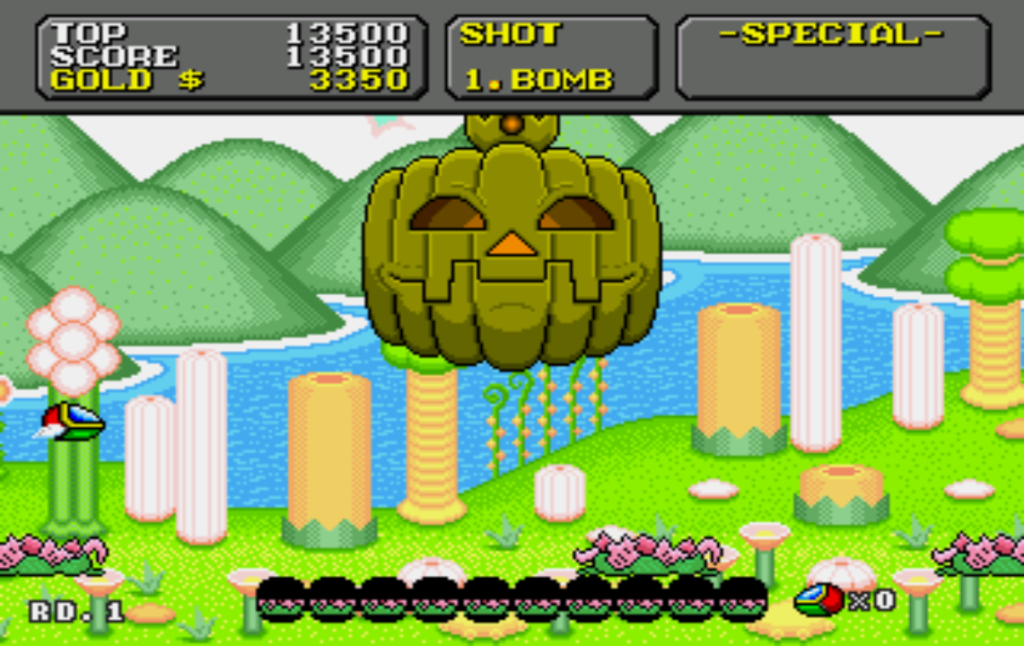
Which brings me to your next question, and the answer is gaming comfort food! Road Rash II tops my list of five games in particular that I think of as my football halftime games, where I’ve got fifteen minutes or so, several times a week, to get something in while all the adverts and ex-players talking crap are playing out on TV… Stuff I can just turn on in an instant and enjoy with zero thought and zero effort before turning it off again and turning my attention back to the match! That Mega Drive Mini is generally connected in the room next to the one with the big TV in, meaning a nice change of sofa too, as well as the option of Super Fantasy Zone, one of my top ten favourite horizontally scrolling shoot ‘em ups and an absolutely gorgeous one at that, playing a bit like Defender but with all the 1992 cutesy flair! Which is in stark contrast to the next on my list of five, occult pinball masterpiece Demon’s Tilt, my all-time favourite pinball video game, which I like to play on the Switch or Xbox, both of which mean I don’t need to move a muscle! That’s the only modern game here, although it is a spiritual successor to Alien Crush, which would be on this list too if I didn’t get about forty-five minutes out of a single game, but does brings us nicely to the PC-Engine Mini I also like to play it on, together with next game, Dragon Spirit. This one features in my top ten favourite vertically scrolling shoot ‘em ups, offering a way more balanced version of the 1987 Namco fantasy-themed arcade game it’s based on. I’m noticing another theme here, what with all these favourite something or others, and that certainly applies to my last game here, Sega’s iconic 1986 none more exotic and exhilarating arcade racer Out-Run, which is most accessible to me on the Switch, and isn’t just my favourite racing game ever but also my number eight favourite game of any kind!
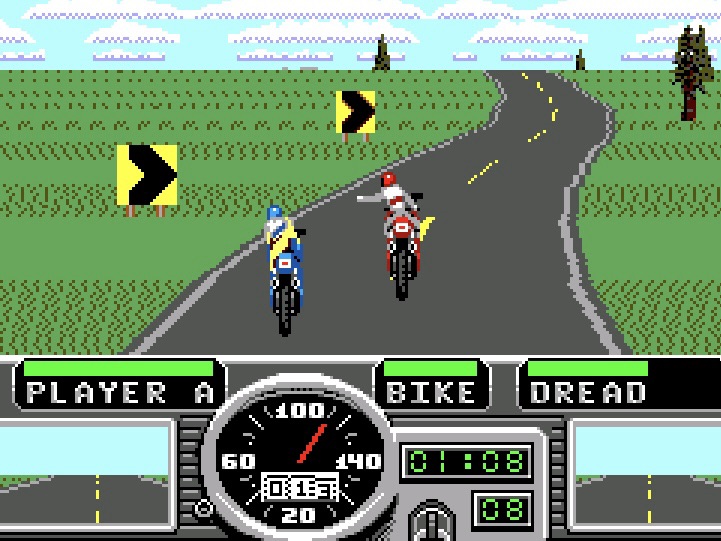
Road Rash II isn’t far behind though, so let’s start making our way over to that now! Electronic Arts’ original Road Rash first appeared on the Sega Genesis in North America towards the end of 1991, pitting you against fourteen other racers (or a player two) across five levels of five races set in various locations around California, with the unique twist that you could fight with your opponents if you got your bike close enough to theirs! Some had weapons too, which you could grab if you timed it right, or take a bigger beating if not! You’ve also got a stamina meter to keep an eye on, a bike damage meter that means you’re out of the race if it depletes, as well as sporadic police officers who can also kick you out then fine you, meaning that cash you’ve spent so long earning can’t be used for essential bike upgrades – which, incidentally, is what I was mostly talking about when I said I wasn’t playing the sequel properly just now! I didn’t get to play that version of first game until the EA Replay compilation on the PlayStation Portable in 2006, which also included the next two Genesis (or Mega Drive) games, although I don’t think I ever really played much of anything on there. Which I need to fix! However, going back to 1992, I did play a bit of the Amiga version when it turned up in time for Christmas that year, and I’m sure I thought it was all fine and dandy at the time but in reality it’s slow and the bike feels cumbersome and the music ain’t great and it’s just a bit boring… In stark contrast to the Sega Master System port (pictured above), which is the exact opposite on all counts and is nothing short of a miracle! Not sure when I first played that but I still play it a lot!
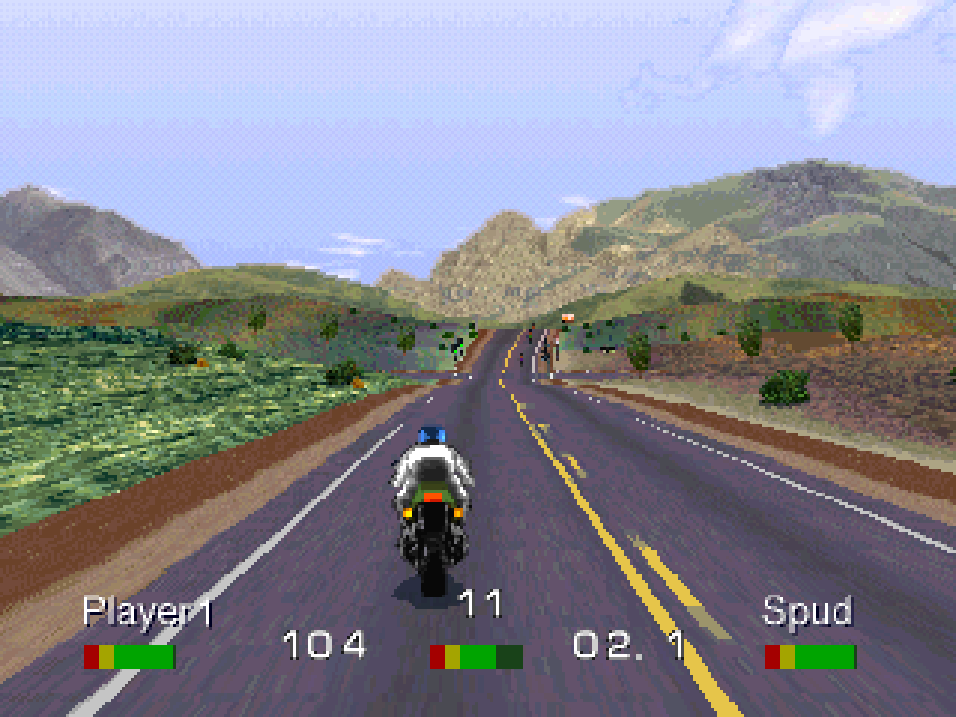
There’s loads more ports of most of these games but I’ll just quickly mention the ones I’ve played, which I think just about covers the whole series on one format or another anyway, except the 2009 Java mobile thing, but I’m sure we’ll survive without that! The 1994 original PlayStation port of 3DO Road Rash (pictured here) has one feature I go back for, and is probably also why I got it at the time – there’s a full Swervedriver music video in it, and the rest of the licensed indie rock and grunge soundtrack is pretty great as well! The game itself is fine too, I guess, but it just doesn’t feel special – like the machine isn’t trying and riding with no hands to prove the point, in complete contrast to that Master System game just now. Its 1998 follow-up on there, Road Rash 3D, is an odd concept, considering they’re all 3D, but anyway, let’s say in principle that a total overhaul with state of the art graphics and proper studio music is a decent idea. Unfortunately, it’s not that at all, and the bike is floaty, and the controls are as twitchy as hell, and it seems to want to be an old Sega arcade racer like Super Hang-On more than whatever take on Road Rash it’s supposed to be. Didn’t get any better a year later with Road Rash 64 for the Nintendo 64, which Electronic Arts licensed to THQ then farmed out elsewhere again. It looks like it’s been put through a soft-focus filter but that doesn’t disguise how sparse, lazy and generally crap the visuals are, and that also applies to the clunky gameplay. And to close out my history with the series, 2000’s Road Rash Jailbreak on PS1 is sluggish and more interested in being “extreme” than much fun, but don’t despair because we can finish on a high with its 2003 Game Boy Advance Port, which thankfully does its own thing, and while it’s inevitably scaled-back a bit, it really gets being a Road Rash game!
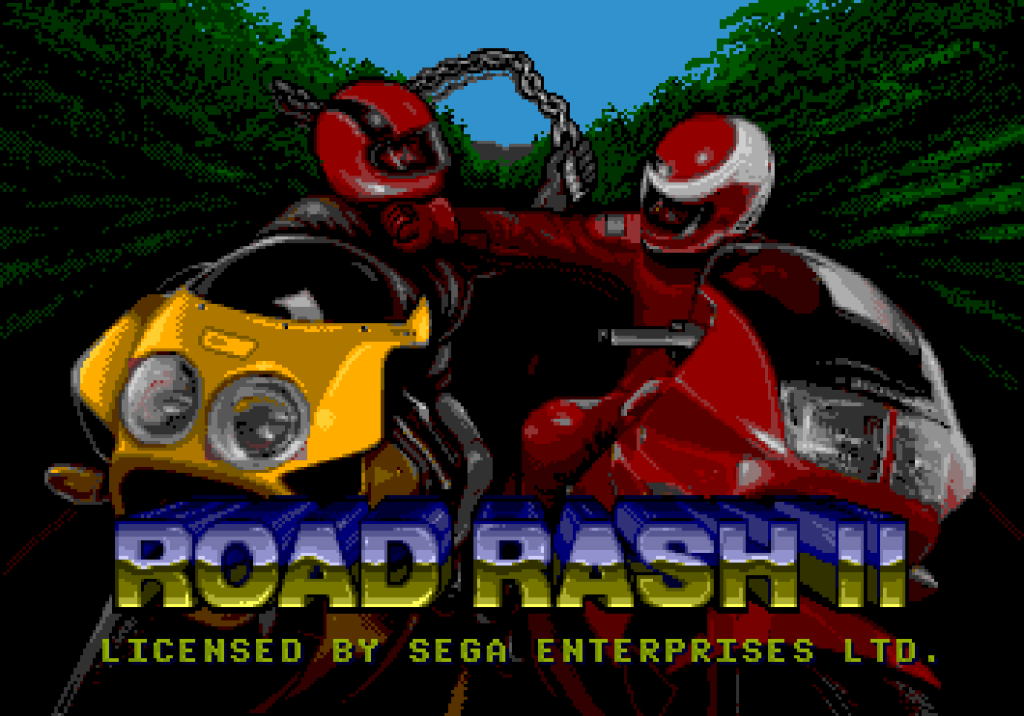
And that’s a good place to jump to Road Rash II, which came to the Sega Genesis or Mega Drive in 1992, bringing with it the original’s vehicular combat but now it was five levels of five races that spanned the whole of the USA, which is another good place to also say that’s precisely why I’d choose this over the third game – Road Rash is none-more-American to me, so the worldwide settings that offered (and little else new besides) don’t appeal so much. As good as it still is! Anyway, as well as going inter-state, Road Rash II also brought chains to the fight, nitro-boosts on some of the bigger-boy bikes and split-screen multiplayer, which you can play one-on-one or part of a regular race with all the usual computer riders. And from what I can tell with my limited play-time with it, it’s a very good extra mode to have here! In the absence of a player two for more than mere seconds just to humour me though, I’m all about the solo game as usual, starting out at level one (or the Squid Tank) with the default Shuriken 400 bike between my legs and $1000 in my pocket. To make the way through each level and progress to the next, you need to come third or better in each of the five races, which you can follow the default order of or choose as you please – which has been precisely the extent of my regular play sessions since it arrived with the Mega Drive Mini! Play it as nature intended though, and you’ll eventually make your way through the ranks, earning more money from longer but higher value races to use on better equipment against more aggressive opponents and even more cops on patrol to take you down (and dish out even bigger fines). Do it on level five and you’ll reach the legendary Rashmaster status, but screw it up and lose all your money and you’ll be going back down the ranks instead and starting from scratch!
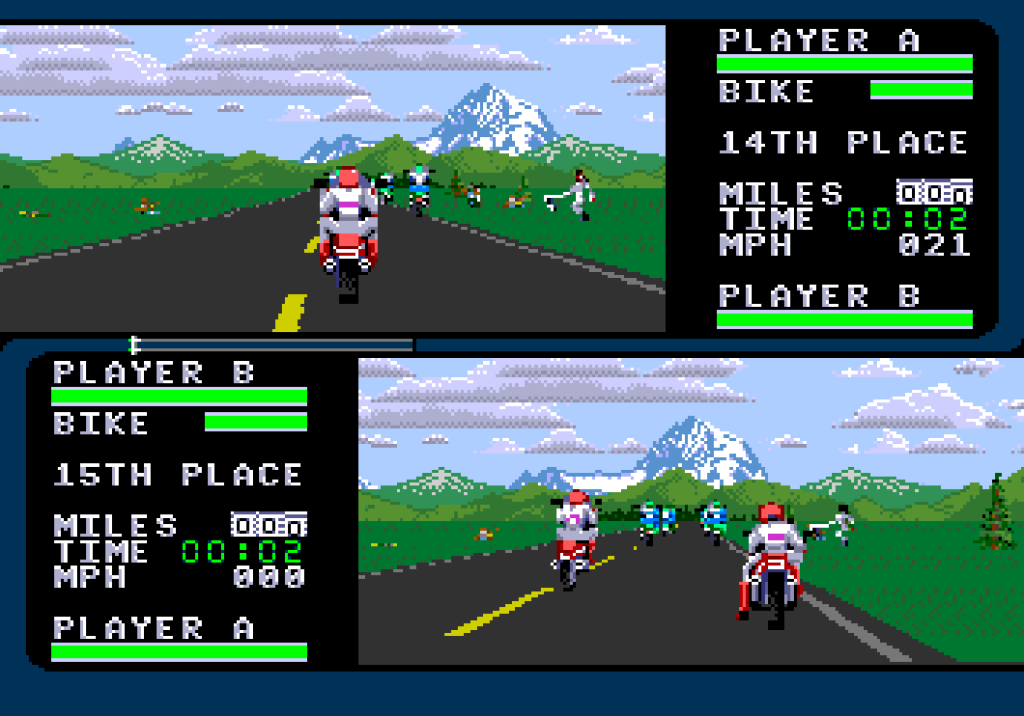
The five tracks here are just so perfectly set, not only bringing as much geographic variety as you could wish for from a single continent, but each bringing their own environmental hazards and local wildlife, in one form or another! And I’ll come back to the music for each later! Molokai Express in Hawaii is named after the treacherous currents off the volcanic Diamond Head, and is one of the trickier courses here, full of hairpin turns and wild undulations. Hoodoo’s Revenge brings us to Arizona, where you need to stay out of the sand, away from the ghostly rock formations along the side of the road, and avoid oil and abandoned cars in the middle of it. The misty heights of Tennessee next with Smokin’ Mountain, a long and winding road with lots of gradual turns and steep hills with deer and cows to look out for as well as the locals who couldn’t care less what flavour of roadkill they take home with them! The police seem particularly vindictive in these parts too. A total change of weather now as we head to the rugged, snowy terrains of Gold Rush in Alaska, with much sharper ups and downs and some nasty blind turns with pine trees too close to the side of the road for comfort, making this race another tough ask, especially when you throw in the oil derricks, caribou and mule deer all over the place on top! The last track on our tour, Maple Run in Vermont, is probably the fastest of the lot, with the rolling countryside playing home to long straights and nice gradual turns, ideal for giving your traction a hell of a workout!
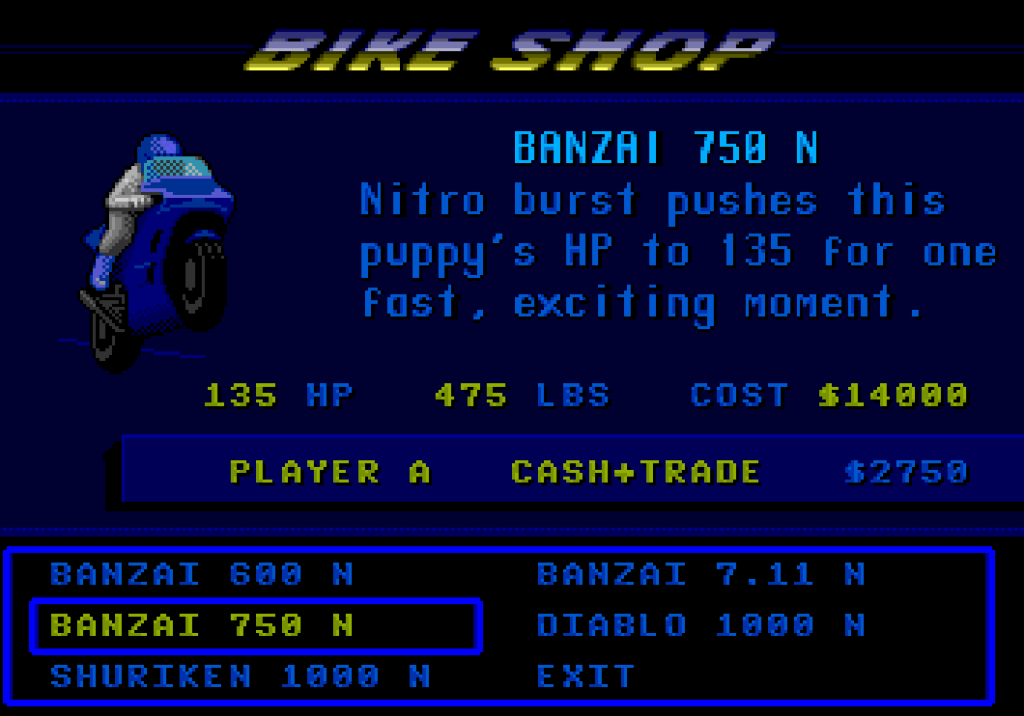
As such, some of these tracks are also more suited to some bikes more than others – Maple Run, for example, is great for something big and fast, while you’re better off with something light to flick into those hairpins in Molokai Express. You’ll need to work your way up to those though, and it’s not a quick process because even on level one, you won’t just breeze your way through in first place every time, and you certainly won’t avoid repairs and the occasional fine (meaning also not placing) if you happen to end up on your backside while the police are nearby, waiting to drag you to jail! Its not so bad though because the deliberately fast and loose controls on your lower power but very functional first bike take some acclimatising to in their own right, and you’ll want to spend a good amount of time on something light with quick steering to begin with, evolving to more power, more weight and more speed as your handling prowess allows. You can see what’s on offer in the Bike Shop any time you like though, and when you’re ready, there’s a choice of five increasingly powerful and decreasingly heavy Ultra Lights, five increasingly fast but harder to handle Super Bikes, then five increasingly dangerous Nitro bikes, with a nitrous-oxide boost that can make for some wild, edge of control and utterly exhilarating high-powered racing! Every lineup offers a good mix of entry-level, compromised and all-out luxury though, and whatever level you reach and however much you win, you’ll have plenty to spend your winnings on for a very long time, but just be sure to have enough on the side for those repairs and fines!
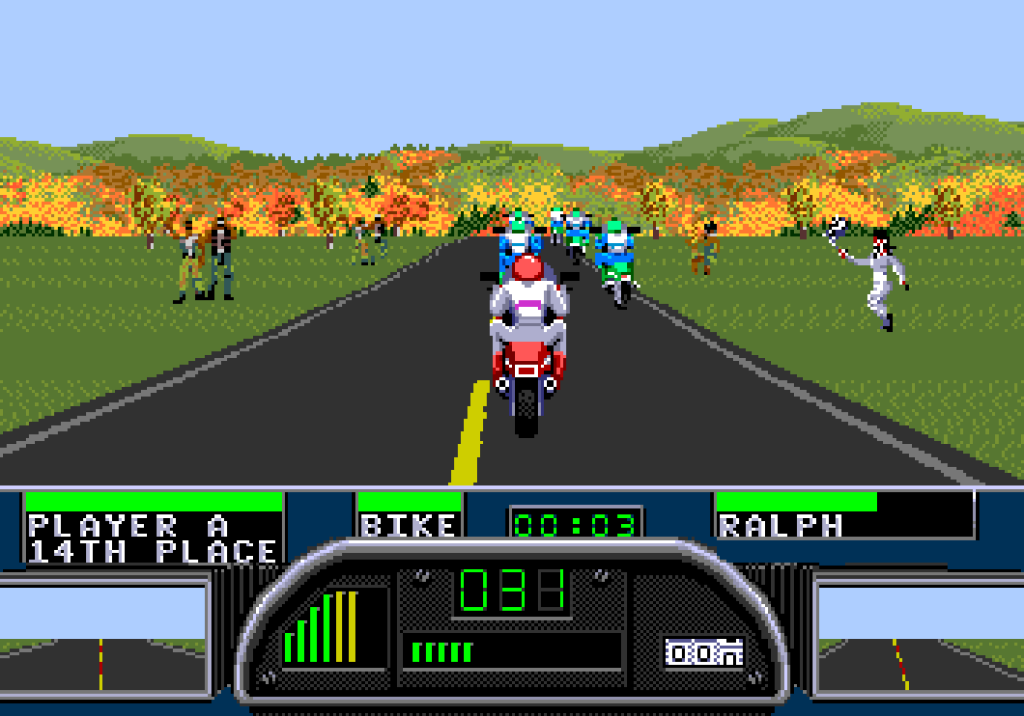
Each race plays out from a behind the bike view, with about two-thirds of the screen taken up by the play area while the bottom bit takes you behind the handlebars for all your instruments and race information. As well as regular stuff like speed, RPM and race time, there’s the stamina meter for your physical condition, as well as your nearest opponent’s, which can influence which fights you pick, and a similar one for the bike condition, and if that goes red then it’s race over and a hefty repair bill on top, which is the same, to a greater or lesser extent, for all damage taken in a race, wherever you end up. No stamina, on the other hand, will cause you to fall off your bike – the same as crashing into an oncoming car or obstacle, which means you need to run back to wherever your bike ended up, get back on and head off again having lost all sorts of time as well as race position. You’ve also got rearview mirrors, and there are some bike- or race-specific displays too, like nitro level or two-player race positions. One bugbear I do have though is the odometer, annoyingly showing race distance completed rather than race distance left, which might add more realism but this is Road Rash, and even the manual acknowledges it’s not ideal by suggesting your memorise the race distance from the track select screen then work it out as you go! It’s not the end of the world but is the one thing I’d change about Road Rash II!
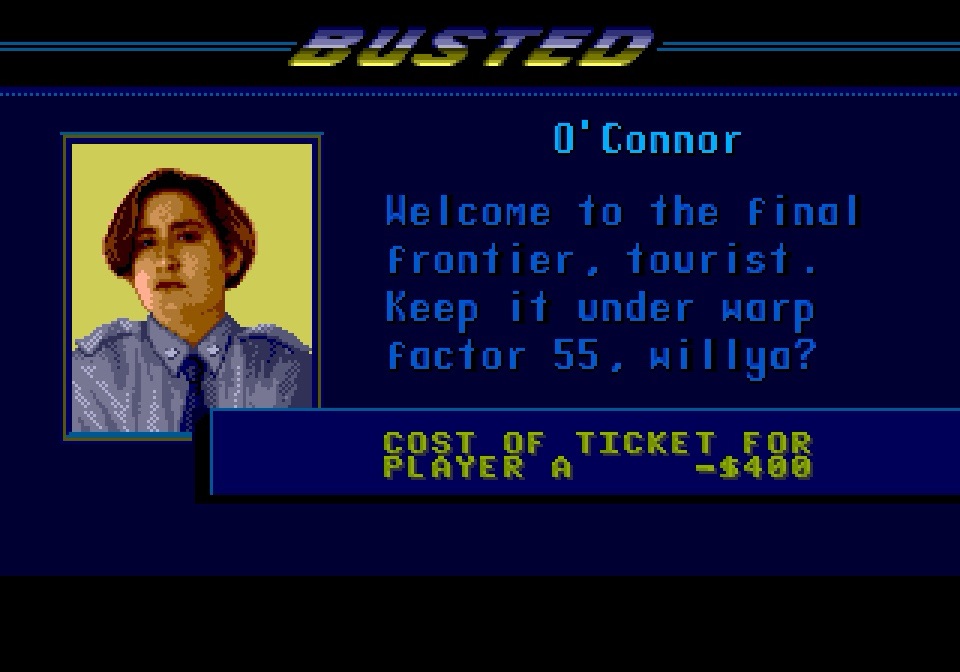
Speaking of the manual, as always with Sega’s Mini console games, they’ve also scanned and provided the original game manuals on a dedicated website, and I was amazed at how much this particular one went into biographical detail on not only all your fellow “Rashers” but also five of the cops you’ll come across! Here’s a single example of one of sixteen such entries, which come complete with photos, and I’ve gone for Chino… “Born to ride a chopper, this crusty, stinking facecrusher turned to sport bikes so he could compete in road rash events. The most seasoned rider of the bunch, he’ll do anything for you if you befriend him; but he’ll make life short if you get on his bad side. Legend tells that when he busted out of San Quentin, he hot-wired a police bike and roared into the desert. A one-car chase ensued; and when the cruiser flipped off the road, Chino circled back to the wreckage and put his fist through the windshield. Through the haze of radiator steam, he looked into the blank eyes of the trooper and whispered, “Brother, I’ll see you in hell.”” And so it also goes for the Elvis guy, the punk, the rocker, the Voodoo girl, Ortega the policeman and the rest. And as you can probably tell from Chino, depending on both their character and how well (but mainly how badly!) you treat them, your opponents will either let you get on with racing or make a beeline to beating you down whenever you come close! In the earlier levels it’s certainly best to mind your own business then they’ll mostly do likewise, but sooner or later combat becomes unavoidable, and let’s face it, it’s what you’re here for! It’s all on a single button, with punching the default action, and it will automatically aim in the right direction for you. Tapping up at the same time will deliver a lovely backhand, while pressing down then releasing the button will kick. When the opportunity arises, you really want to grab a club or a chain if you spot an opponent carrying one, and this is done the same way as punching but with better timing, and once you’ve got hold of either you’ll be dishing out some serious damage!
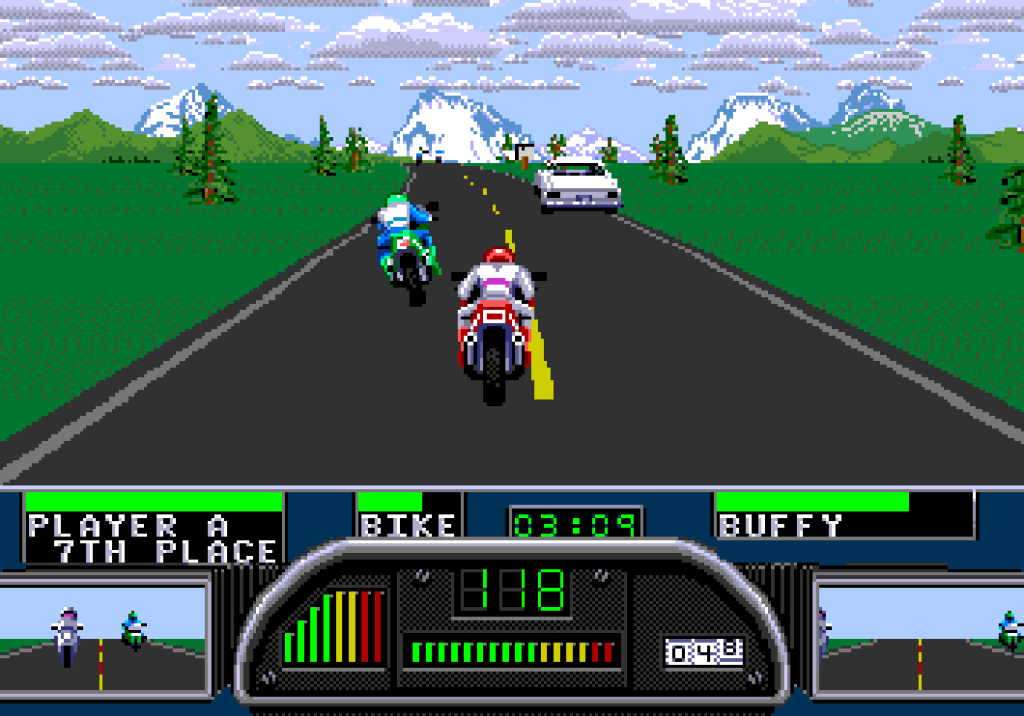
Opponent AI is unpredictable but knows how to hold a grudge, so if you get tied up with someone, sorting that out will then immediately need to take priority over gaining further places because they’ll keep coming at you until one of you can’t come anymore! There’s plenty of time for regular racing too, even if the bike physics are similarly built for arcade fun over any semblance of realism! Regardless of which bike you’re on, which will be directly reflected in how it handles, I’d say they’re intentionally “sloppy” to keep you in control but only just, and when you factor in all the hazards on the road, and the humps and bumps and crazy turns, that results in non-stop adjustment, to a greater or lesser degree, as well as a relentless feeling of panic meets edge-of-your-seat helplessness! And this couldn’t be more suited to the game, or its unique track designs, which are both diverse and totally built to be reckless on, simply making it fun to fight your way around!
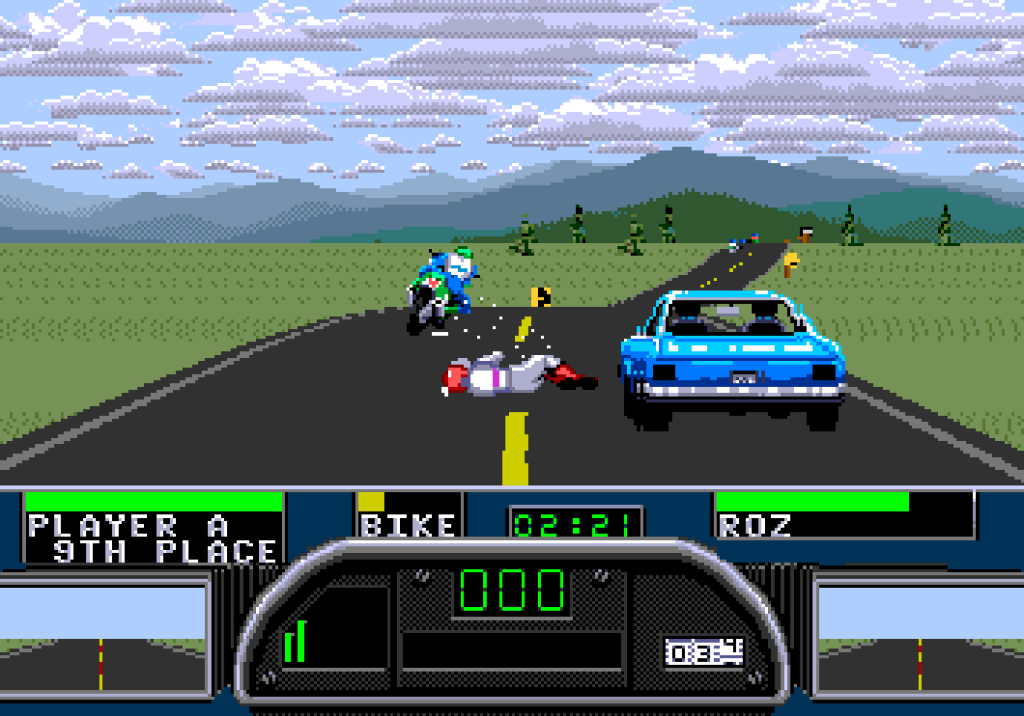
While not quite as grounded in chaos as something like Destruction Derby (and even more so its sequel) on the original PlayStation, Road Rash II will often come close, as random things come together against you out of nowhere, and you find yourself snatching defeat from the jaws of victory as one second you’re desperately vying for third place before the checkered flag guy appears any time now, then suddenly you get knocked into a passing car and on your backside wondering where you bike ended up, as fifth and sixth and seventh pass right by! Or you’re mid-flight jumping over a hill, only to find a crossroads on the other side, which some idiot car has decided to drive through exactly when and where you don’t want it, and right when you’re totally out of control! Or maybe you can’t avoid an oil patch on a bend because there’s a bear taking up the rest of the road, and you slide off the track and into a cactus, all in front of the police guy in your rearview mirror, then you’re busted and all that effort was for nothing! Equally though, there’s such a sense of relief when that police siren starts to fade into the distance behind you, or the sheer exhilaration as you weave impossibly between two cars while the guy who’s been attacking you with the chain for the last mile has nowhere to go except right into the back of one!
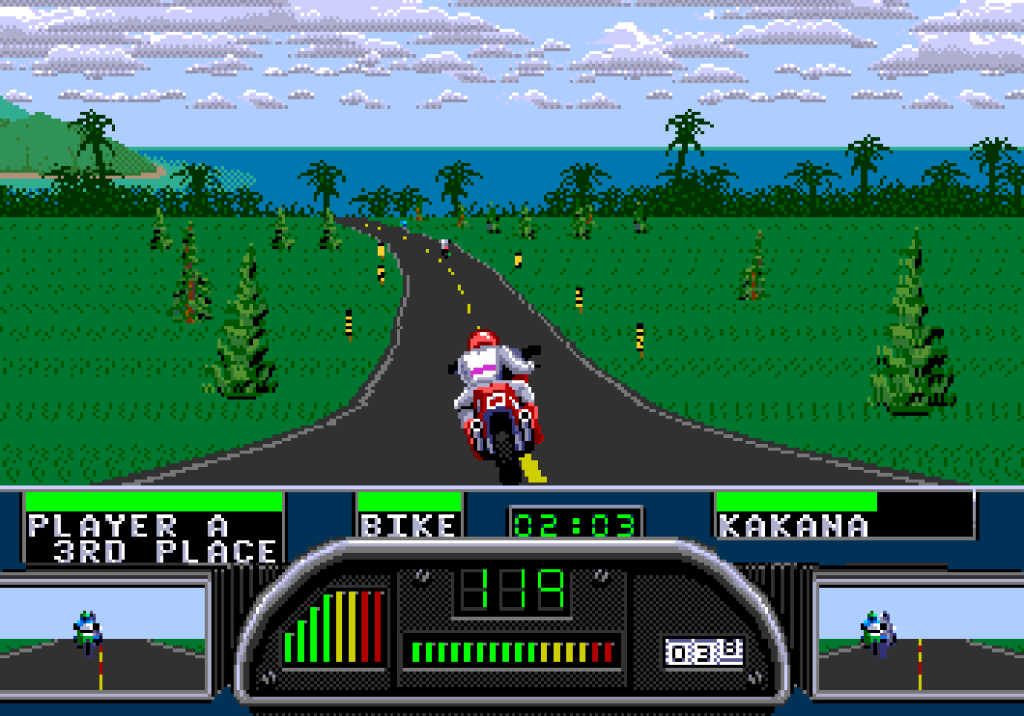
I decided to do a quick experiment when I was thinking about the soundtrack just now but let me preface that by saying it’s an absolute highlight of Road Rash II for me, and if I were to delve further into why I prefer this one over its successor, it would be next on the list after the setting… I love it! The legendary Rob Hubbard being involved or not though, I don’t think many would argue it’s as memorable or enduring as something like Out-Run’s or Super Hang-On’s iconic soundtracks, but it does something they don’t that I couldn’t quite put my finger on, so I decided to play each game one after the other, with my attention on the music as I was playing, just to try and nail down my thoughts. By the way, Mega Drive versions only, to keep it fair! Now, there’s also no denying something like Out Run’s Magical Sound Shower enhances the gaming (or any other!) experience, and likewise Winning Road, for example, in Super Hang-On, but they’re not intrinsic to the game’s immersion even if they do exponentially add to it, as evidenced by the choice of musical tracks at the start of each of those. Every single piece of music on Road Rash II, though, is as important to the level design as the course layout or any set-dressing around it, defining the location (which in turn defines the game) way more than just setting a mood… Which it also does very well! Every location has its own local theme, built out of traditional folk instruments in Hawaii and banjos in Tennessee, bass-driven rock in Vermont while we get slower, more bluesy and more percussion-heavy (and totally Hell’s Angels dive bar!) in Arizona, then a bit more groovy and keyboard-driven in Alaska. It is very Megadrive though, and all made out of chiptune-synth approximations of the above, which I’m also not sure are as individually strong as some of the instrumentation in the first game, but they couldn’t be a better fit here all the same. I should mention the music does come at the expense of the race sound though, which is consigned to spot effects of varying quality, where, for example, punching someone is hefty but skidding is a damp squib of hissy white noise. Plenty of different noise scenarios all the same, including sampled speech (albeit mostly anguished cries!), but no engine noise, which is something else I’d change if I could and takes a bit of time to adjust to every time you notice, like when you occasionally realise your nose is permanently in your eyeline… You’re welcome!
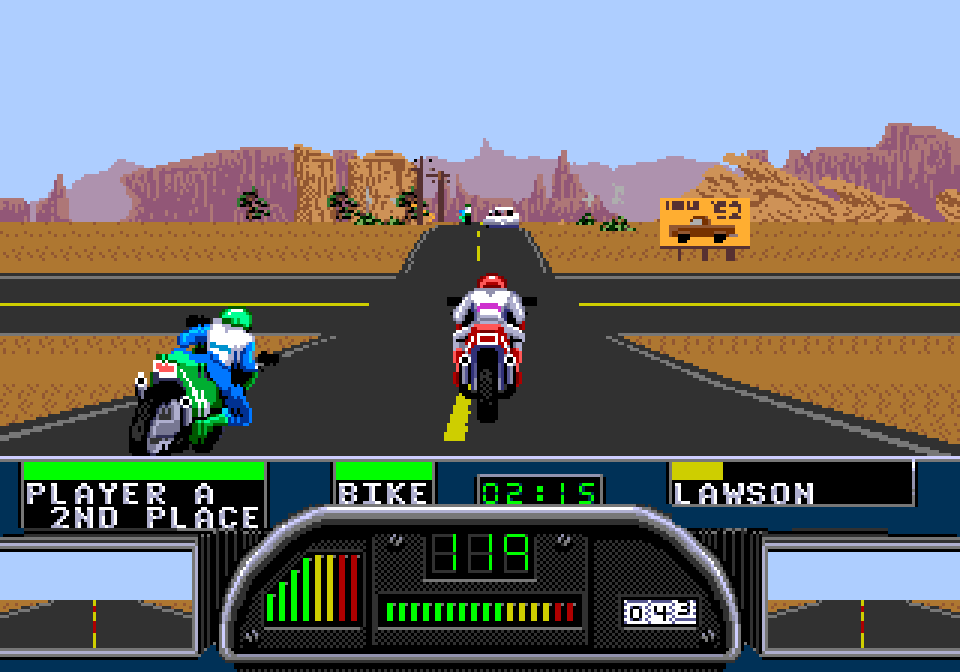
As always when I’m playing on something that only outputs to a TV, I’ve spared you any crappy phone pictures from the Mega Drive Mini and switched to emulation to grab a few screenshots instead. Not that they’re anything special, but at least they’re not wonky! Anyway, I wanted one of each track, then a couple of menus, and maybe a cutscene to choose from, plus a few spares in case I got carried away writing, which was all pretty straightforward for once. But when I was deciding which to use, I was thinking stuff like various Hawaiian landscapes heading down towards the sea looked nice, and the Arizona desert colours were atmospheric, and there were a couple of authentic looking buildings (and very prettt countryside) in Vermont, and it was all fine and put me in the place the game intended, but I noticed nothing was blowing me away! Which might be unfair because it’s a whole different ballpark in motion, where it couldn’t be any faster or whizz by more smoothly, or from a greater visible distance, and going up and down those hills is a stomach-churning something else! But it’s a very earthy game all the same, with a colour palette that wouldn’t look out of place on a Commodore 64, and although the backgrounds and skylines are picturesque, and there’s plenty of detail and bits of animation where it matters a bit closer – and in particular some impressive 3D models for other road users – things like roadside buildings or the wildlife are little more than recognisable at best. As said, it’s fine, but going back to that Master System port of the first game, that went above and beyond while this is more functional than glorious.
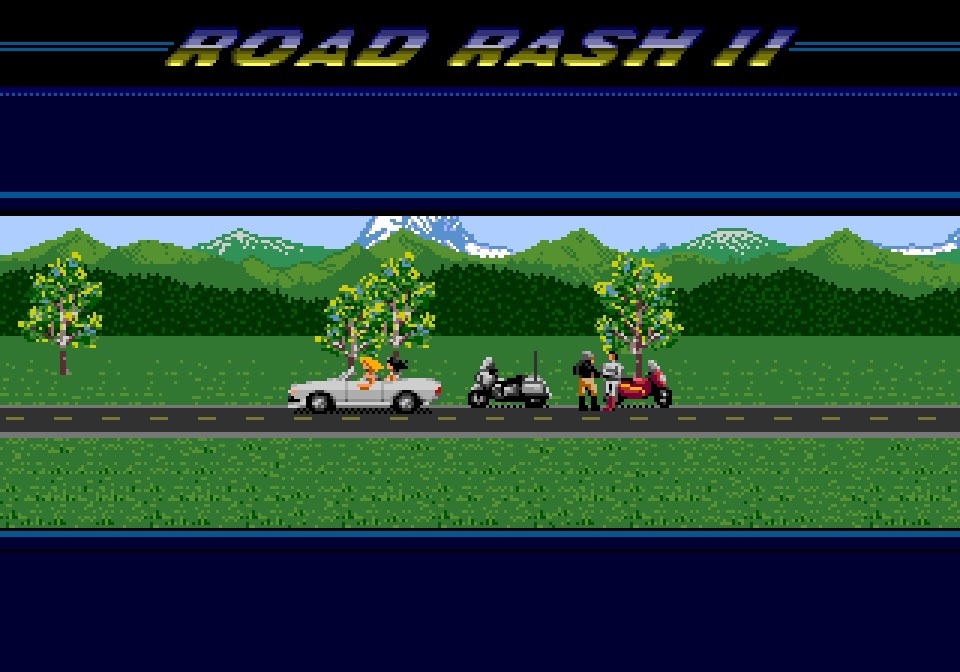
That said, everything still looks exactly how it needs to, just like the soundtrack sounds like it needs to, and the bike controls like it needs to, and while you could certainly say none of those things are perfect, you could also say they’re all absolutely perfect for Road Rash II! Throw in the near-enough perfectly balanced combat-racing gameplay and you’ve got something you’ll be perfectly happy playing in short bursts with no consequence (other than being perfectly happy!) or as part of a longer-term campaign to become a Rashmaster… Meaning it turns out I was probably playing it properly all along after all!
As always, I’ll never expect anything for what I do here but if you’d like to buy me a Ko-fi and help towards increasingly expensive hosting and storage costs then it will always be really appreciated! And be sure to follow me on Instagram, X (formerly Twitter) or Threads for my latest retro-gaming nonsense!
 Retro Arcadia