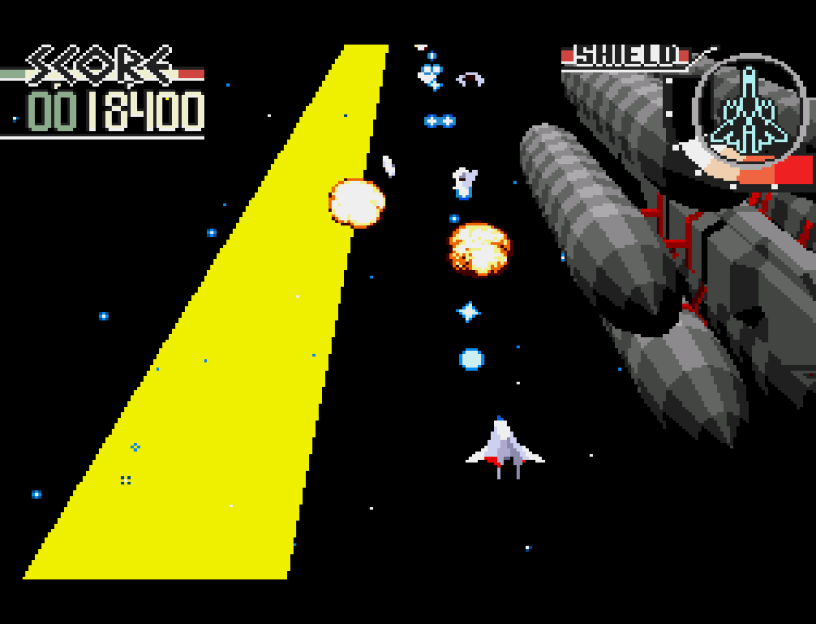
With this instalment, I do believe we are now on the home straight with this epic series covering every type of shoot ‘em up you could ever think of (and seemingly more besides)! And I’m particularly relieved to get it this one out of the way because, as mentioned last time out when we looked at the multidirectional variety (here), it’s been getting harder and harder to define these sub-genres and pigeonhole everything the further we’ve gone, and I’m pretty sure this was the hardest of the lot! As I said last time, the horizontally- and vertically-scrolling ones were easy, even though things didn’t always go in the same direction, but when we got onto the fixed or single-screen countdown, along came the caveats and concessions… For example, “fixed” implies on a single horizontal or vertical axis – think Space Invaders – while “single-screen” implies no scrolling – also think Space Invaders! What about Centipede though, which allows for mostly horizontal movement but a very limited bit of up and down too? Or Moon Cresta, and that shimmering starfield moving down the screen behind all its brutal action? To cut a long story short, I decided to go with “in spirit” where necessary for stuff like this, which has worked out fine, and while it wasn’t really a factor when we then got into isometric shoot ‘em ups, it certainly was again for those multidirectional games, which ended-up including stuff where you can be shooting in different directions on a single-screen, or where you’re doing so by scrolling across multiple screens in different directions, but specifically from one directional controller. And now there is 3D, and the question of where you draw the line between a 3D shoot ‘em up and a rail-shooter, which then needs breaking down into first-person (or gallery or light-gun) varieties, such as Operation Wolf, or third-person ones like Space Harrier… Which honestly was the first game I wrote down when I was shortlisting this lot! Anyway, I’ve decided we’ll do two further top ten countdowns covering those for completeness, even if they are slightly outside this series’ original remit. And for this countdown, I’m simply trying to include games coming at you in 3D, where you are in control of your ship’s or character’s or whatever’s movement – as opposed to the computer (generally!) controlling it in a rail-shooter – while you take care of where to shoot, one way or another. That’s the theory at least, so let’s see how it goes!
10. Space Raiders (GameCube)
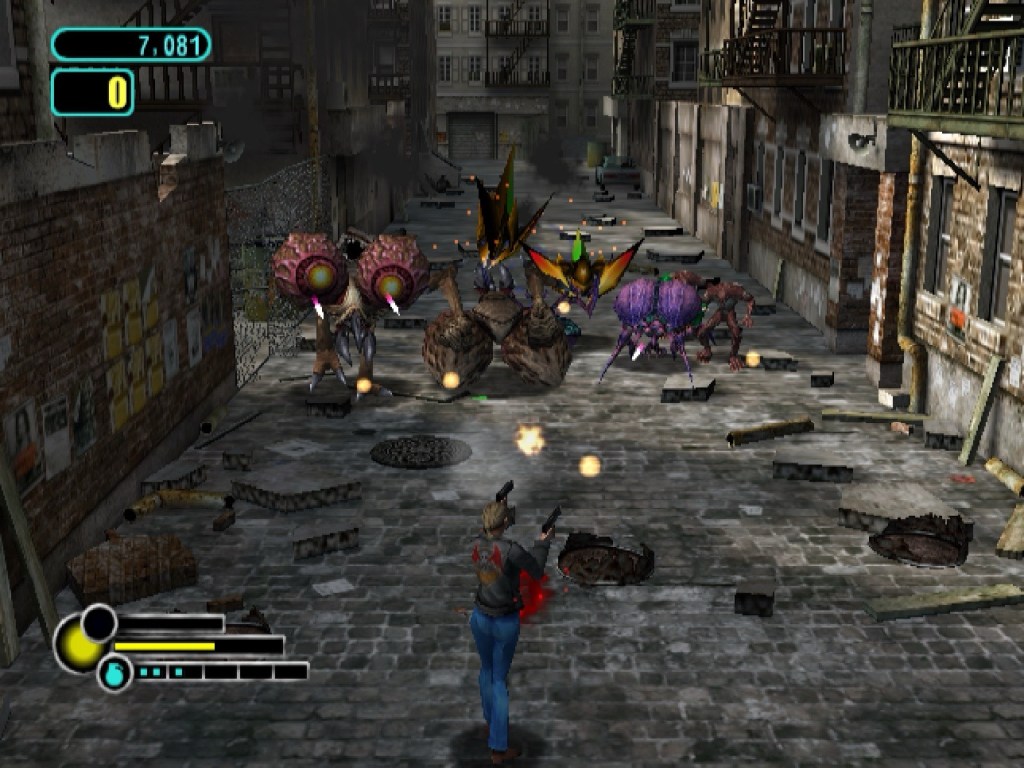
After all that, maybe I was worrying about nothing… If only everything here was Space Invaders from a different perspective! This really is that too, released by Taito in 2004 to mark the 25th anniversary of the game that started everything we’re looking at! You’d be forgiven for not knowing any of that from the screenshot here though, where ground-to-air combat has seemingly been replaced by this sleazy post-apocalyptic urban shootout! The gameplay is very familiar though, as is the surprisingly fleshed-out narrative, played-out through cinematic cutscenes between levels, and involving a full-on alien invasion of Earth by these nasty (and ultimately very gooey!) insectoid things in their flying saucers! Humanity’s last hope lies in your choice of three playable survivors, made up of a desperate woman searching for her missing fiancée, a cop out for vengeance after his squad was wiped out, and a kid who had a similar experience when all his friends were slaughtered in front of him. Whoever you go for, you’re in for wave after wave of invaders that are maybe more Galaxian than Space Invaders in their tactics, quickly getting right in your face, while others will hang back to spew all kinds of bullets, and as fast as you kill them, more keep coming! Speaking of Galaxian, some of them have a properly terrifying shriek too, which does make up for a pretty generic orchestral soundtrack, while visually it’s kind of Mars Attacks in various war-torn backstreets. They’re atmospheric and with a nice sense of perspective though, and make an ideal backdrop for a fast-paced but otherwise surprisingly authentic (for better or worse in 2004) take on the granddaddy of them all!
9. Beamrider (Atari 2600)

Our next game might not be one of Activision’s best-known Atari 2600 titles, but if you want super-smooth 3D motion on there then you won’t get much better, although if you’re one of those sensitive to flashing-types, then you probably won’t get much worse either! Fortunately, no one was that sensitive about all kinds of things when this came out back in 1984, and visual tricks like that every time you shoot an alien, combined with some really meaty sound effects, really elevate the immersion. Plenty of action to keep you on your toes too, as you patrol the Earth’s Restrictor Shield, which seems to have backfired because the pesky aliens are now travelling across its protective beams to attack you! You need to clear a certain number of them from each sector before facing-off against a bigger and more aggressive mothership, taking it down with one of your limited special missiles before it crosses the play area for big bonus points, then moving on to the next one. The gameplay itself doesn’t shy away from its influences, with increasingly erratic aliens and new types of danger being introduced as you progress, and things soon get very frantic (not to mention “flashy”), especially when you start messing with the various difficulty settings! And that 3D effect is so impressive for the time, even if does serve to mask some otherwise simplistic (for the time!) visuals. Simplistic never hurt though, and this is living proof of that!
8. Buck Rogers: Planet of Zoom (Colecovision)
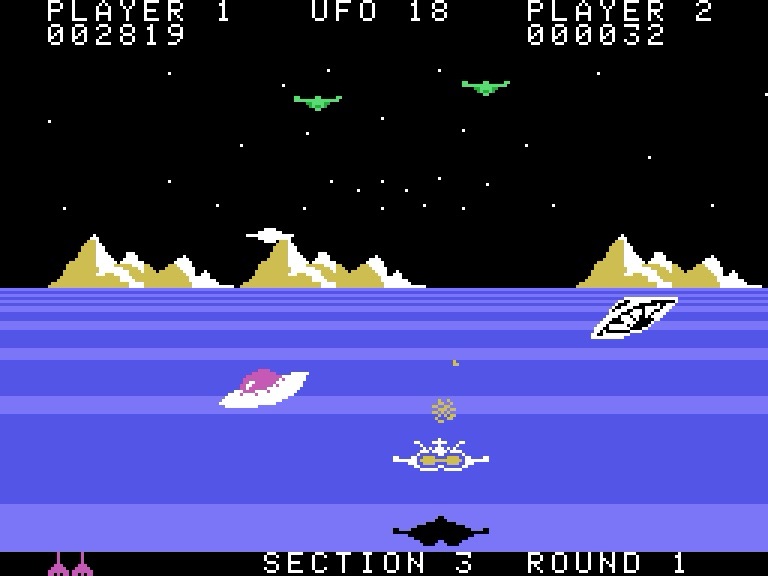
Not for the last time in this countdown, I could have gone for any of several versions of this game, and in particular, the Atari 8-bit and 2600 versions, but to this day I’ve never played the arcade original, so not that one! And yes, I could have stuck it in a rail-shooter top ten too – it’s borderline, but the Centipede-like movement of your ship and generally similar feel to the gameplay just about made the decision for me… Even if this was a big influence on Space Harrier, which, as we’ve already established, you’re definitely not going to find here! Anyway, I believe this is a 1984 port of what I know is a 1982 Sega arcade game, which in turn was an adaptation of their pioneering 3D racer, Turbo, from 1981 (which I have played). Came out on everything too because that Buck Rogers license was a big deal back then, tenuous as any in-game association is – you’re Buck, it’s the 25th century, and you’re fighting aliens who’ve invaded the Planet of Zoom! This plays out across increasingly difficult rounds made up of multiple stages featuring variations of Death Star trench run type things, outer space, planet surface then a mothership battle, and in each you need to take down a certain number of approaching UFOs while avoiding missiles, asteroids and other hazards, although the unpredictable and reckless enemy pilots themselves are the biggest danger! The different flavours of 3D motion are very impressive, as are the varied and detailed visuals, especially the traditional flying-saucer UFOs, and also the creepy sci-fi soundscape playing over the action, which soon gets frantic but never stops being fun.
7. Zaxxon (Atari 2600)
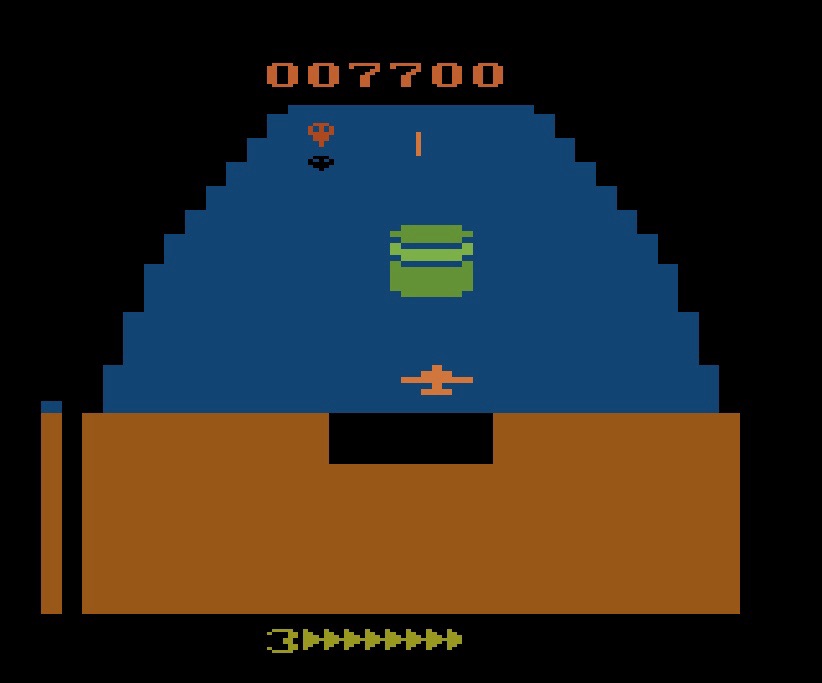
Yeah, I know, I know, it’s not even Zaxxon, and it gets worse when I tell you this pushed the grandaddy of all of these, Radar Scope by Nintendo in 1980, out of my top ten! Whatever, this is the 1983 “interpretation” of Sega’s iconic isometric arcade shoot ‘em up from the previous year, but while Coleco just about managed to squeeze that groundbreaking graphical perspective out of their own system, they couldn’t on both their 2600 and Intellivision versions, so went behind the ship, pseudo-3D instead. And while stuff like Desert Falcon would eventually prove it was possible, in reality this was the best possible option at the time, and actually plays like a surprisingly authentic game of Zaxxon too! As usual, you’re flying left and right and up and down across a floating enemy fortress, shooting as much as possible (including fuel tanks to replenish your dwindling supply), while avoiding walls and what’s admittedly a very simplified and scaled-back take on the original’s ground defences, but get through it all and you’ll still find the armoured robot boss, Zaxxon, waiting for you before you do it all again but a bit harder this time! Judging your height versus the enemy’s takes a few goes but once that clicks you discover a compelling scoring versus survival risk-reward mechanic, and you’ve got four skill levels once it really clicks, although the last is too fast for my liking, even if that seems to be where the 2600 performs best, as jagged-edge as the visuals remain throughout, and white-noisy the sound! And you can argue it’s not really Zaxxon but I’ll still take this over most of the more “faithful” conversions.
6. Moonsweeper (Atari 2600)
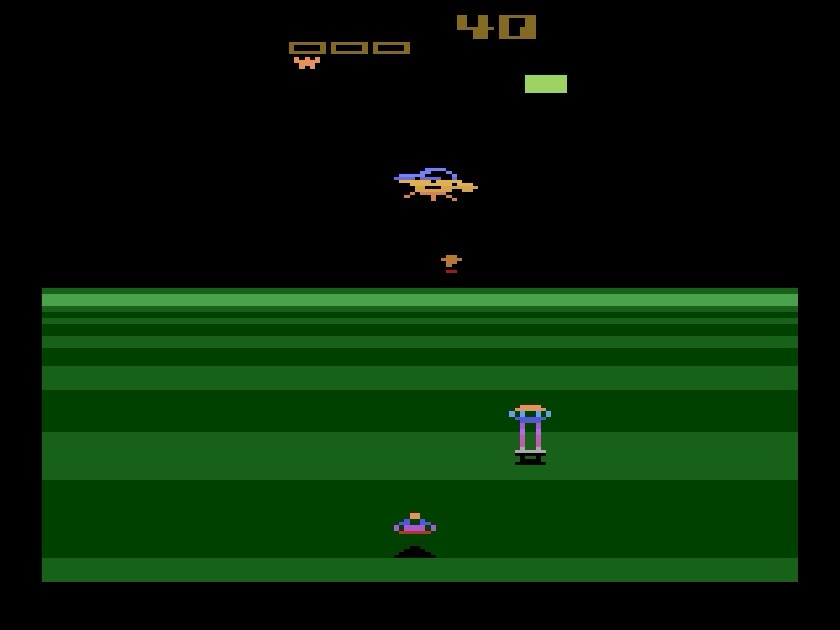
I think we’ve reached our highest entry for the old 2600 with this one, an ambitious multi-stage shooter by Imagic in 1983. The first bit finds you in your rescue ship, seemingly flying towards a sun, dodging and shooting comets, solar flares and bullet showers as you wait for an orbiting moon to appear, which you then need to try and fly into (easier said than done) to trigger the second bit. In this one, you’re hurtling across its hostile surface, dodging and shooting defence towers, aliens, UFOs and stuff as you search for the six stranded miners you’re rescuing, before getting out of there on some accelerator rings and on to the next moon. It’s not unlike Beamrider from earlier, but the variety really takes it to another level, and I don’t just mean the two different stages and the different shooting and rescue mechanics (which was always a big deal at the time), but also how each moon feels different, albeit through little more than clever use of colour, where each colour also represents different levels of challenge. They all scroll equally great though, and handle your changes in speed perfectly, which, as odd as it might sound, really adds to the immersion. It gets tense too, and you’ll soon be feeling terrible when you can’t quite rescue someone (or worse blow them to smithereens!) as you come under too much fire. The nice use of colour also extends to the enemy sprites and star-fields, and likewise, the aforementioned variety extends to sound effects too, which are simple but very effectively combined. You’ll really get a sense of progression the more you play too, and that’s before you try out the different skill levels, with things like score-sapping shields and weapon variations allowing you to take down bonus enemies for big points, adding a level of strategy that makes this hard to put down!
5. Juno First (Arcade)
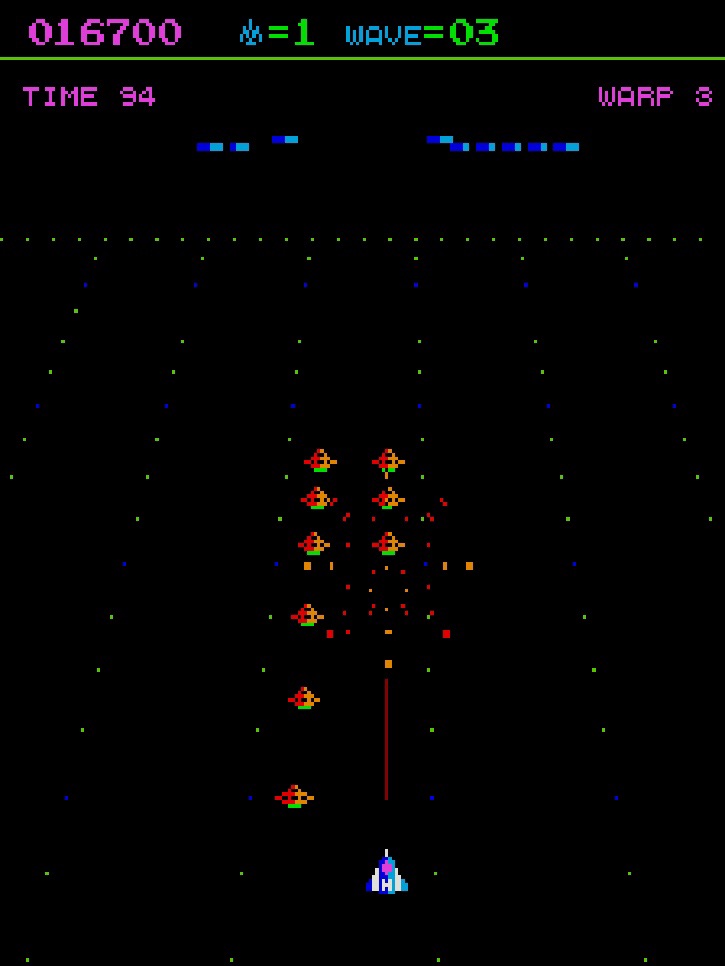
According to one of my very earliest Weekly Spotlight features, the first time I ever played Juno First was just before Christmas 2021, but in the five years or so that have passed since then, I’ve definitely made up for lost time! This one came from Konami in 1983, and owes a great deal to Nintendo’s Radar Scope that we came across earlier, while Beamrider from earlier also owes a great deal to both! There’s a fair bit of Galaxian or Galaga meets Centipede on the go here too, and more than anything else we’ll look at, gives this a very single-screen, fixed-shooter vibe as waves of aliens emerge from the far distance to get you. Apart from them sometimes working individually rather than in formation, there’s not much more to it either – you’ve got to navigate your way up and down and across a shimmering, scrolling and tilting grid, hitting a certain number to get to the next level. You’ve got limited Asteroids-style warps to (hopefully) get you out of sticky situations, some-big scoring enemies to look out for, and one that has a mystery humanoid inside, who’ll reward subsequent kills with serious points if you can grab them! It’s got all the classic Golden Age arcade hooks that will not want to let go once you get going, but despite that, I don’t think the presentation does it many favours, and may well be why it’s a relative obscurity – some very cool colours and particle effects but there’s no personality in either your ship or the enemy’s; in fact, they’re just different geometric shapes, while sound effects aren’t much more than we’ve already encountered here on the Atari 2600. The way everything moves is impressive though, and there’s intelligence and nuance mixed into the raw fun of the gameplay that elevates it, but I get the impression maybe not enough for the suddenly-sophisticated tastes of 1983 to elevate it across the decades like it deserved!
4. Xevious 3D/G+ (PlayStation)

I don’t think I’ve ever admitted this before, but I’ve grown to like this loads more than the original. Sorry! All the same, I’ll also admit that back in 1997, no amount of “modernising” was realistically going to get me to buy a fourteen-year old arcade game over other new releases like Grand Theft Auto, Final Fantasy VII or Tomb Raider II on my PS1… As was also the case for that creaking old 2D platformer, Castlevania: Symphony of the Night, but that’s another sorry story! Nice idea for another countdown though – biggest gaming regrets, with that, and deciding I didn’t like the sound of Resident Evil 4, or abandoning Silent Hill after fifteen minutes, and so on! Back with Xevious 3D/G, it originally got an arcade release in 1996, no doubt trying to capitalise on what was a mild resurgence of the shoot ‘em up genre in the mid-nineties, but as was the style at the time, the perspective was changed, everything was built out of 3D polygons, and of course, it got a dreadful techno soundtrack on top! It certainly contributed to what resulted in a new energy that was never present in the somewhat stuffy original though, together with faster movement and more responsive controls, more varied enemies and environments, power-ups and visual effects, even if the visuals overall are still often nothing to write home about. I should say, the core mechanics are more or less the same as the original too – save mankind from the Xevious air and ground forces with your missiles and bombs over seven stages, complete with bosses, including a really cool take on the original first level mothership. Loads of nice Namco Easter eggs to look out for too! To put the “+” in in the subsequent PlayStation 3D/G+ release, you also got the original 1983 arcade game, it’s 1984 Super Xevious update, and Xevious Arrangement, which I think had been created for a Namco compilation around the same time, and is another update and remaster of sorts, with a fantastic, ominous soundtrack that’s straight out of Metal Gear, but honestly, I struggle with that one due to my colourblindness, so no further comments. Regardless, retrospectively it’s a decent package, and the new game itself is excellent, and while maybe not as polished as some of its genre contemporaries, it’s more accessible than most and really knows how to give you a good time, if only you’ll give it the chance!
3. Silpheed (Sega Mega-CD)
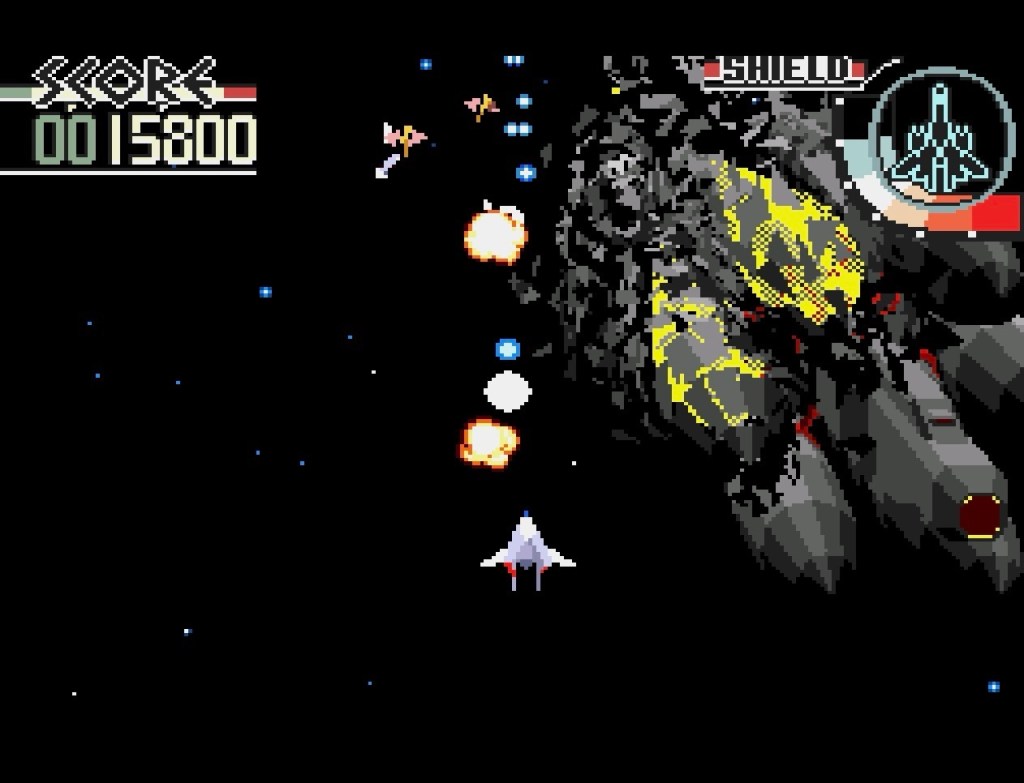
This is another game I’d never played until relatively recently, although given the platform it was originally released on, it’s hardly a surprise! The Sega Mega Drive Mini 2 was where I first encountered it back at the end of 2022, when it was one of a dozen Mega-CD (or Sega-CD) games included. Turned out to be quite the springboard into discovering its wider library too, including what have become several real favourites, as well as an obsession with Sonic the Hedgehog and completing everyone one of his 2D adventures (more in another top ten covering those here)! As for Silpheed, this was love at first sight, and today is generally the reason I fire up that Mini again. While it’s very much vertically scrolling shooter in spirit, like Xevious just now, it’s been tilted to a 3D perspective, but in this case, its original incarnation on the obscure NEC PC-8801 computer all the way back in 1986 also pulled-off an impressive pseudo-3D approach, as well as the use of 3D polygons. The Mega-CD port came in 1993, adding these stunning pre-rendered video backgrounds, together with some excellent polygonal-anime cutscenes, relentless in-game talking and some very high energy electro-synth-rock music. It’s high energy everywhere you look though, with light and colour and special effects all over the place – there’s just so much spectacle and so many memorable, large-scale set-pieces; in fact, you can see one progressing in the screenshot at the top of the page and the one just above, and if I’d added a third, there’d be this huge, screen-filling particle-effect explosion to admire too! It does all disguise a wafer-thin plot though – something nonsense about galactic terrorism – and the gameplay itself is pretty generic, and the feel of it had fundamentally already been perfected a decade or so earlier in the next game we’ll look at… Some good power-ups and scoring stuff to grab though, and there’s also a pretty unique repair pick-up system that creates some really tense moments, as you constantly and inevitably approach death when things quickly start to get frantic from the second of the eleven levels onwards! It’s an exhilarating ride all the way though, and as wonderfully in-your-face as any game here!
2. Gyruss (Commodore 64)
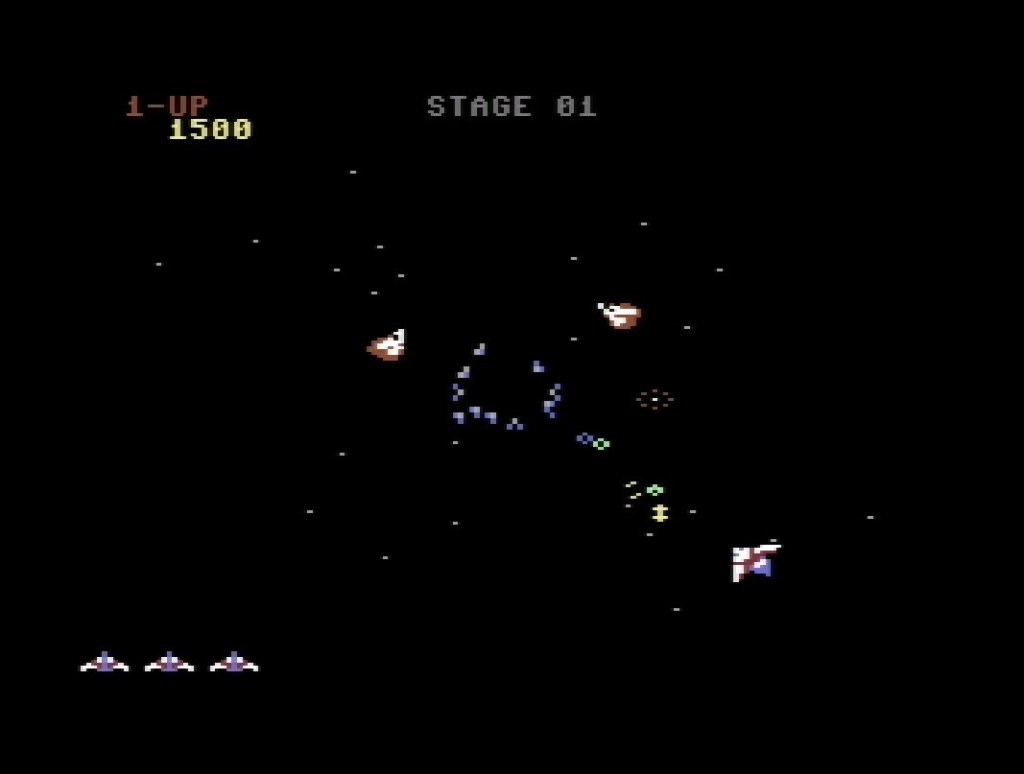
Unlike the previous game, “3 WARPS TO URANUS” is about as in-your-face as any version of Gyruss gets, but as also just alluded to, if you want the perfect example of substance over style, then this is it! Not that it wasn’t also perfectly stylish when Konami first unleashed it into arcades in 1983, with the possible exception of its tinny, Bach-infused proto-techno soundtrack, although I’m likely in the minority there! A smattering of conversions soon followed, and that (together with some far less irritating music!) is where nostalgia is driving me for the purposes of this countdown, although it’s been a real conundrum about which one to include here – I always loved the ambition of the Atari 2600 version and the energy of the Atari 8-it version but the C64 port’s presentation just edges it. I really could justify choosing any of them though! As you might expect, there’s no great narrative and there doesn’t need to be – you’re travelling from planet to planet across the solar system, fighting off yet another alien threat until you make it all the way to Earth. Each planet takes a certain number of warps to get to, and before each one you need to wipe out all the Galaga-type enemy formations lurking in the far distance of what’s effectively a tubular star-field that your ship rotates around the near-circumference of. As such, the joystick controls take a bit of getting used to, working in kind of quarter circles on each direction, but it soon feels natural, and in no time you’re effortlessly dancing around the swirling patterns of enemy spaceships, satellites, laser generators and asteroids, and having a total blast! It’s another case of raw Golden Age arcade fun, and this conversion captures it perfectly, with score items, power-ups and bonus stages all present and correct. The initial difficulty has maybe been toned-down a bit but not particularly noticeably, which fortunately isn’t the case for the toned-down music! It’s certainly not the best of the SID-chip but this interpretation of Toccata and Fugue in D Minor adds all the cosmic drama to proceedings it needs to. The graphics are a bit chunkier than the original’s too, but they’re as colourful and detailed and authentic as you could hope for, which is more or less the overall experience here – brilliant conversion of a brilliant and hopelessly addictive arcade classic!
1. Tempest 2000 (Atari Jaguar)
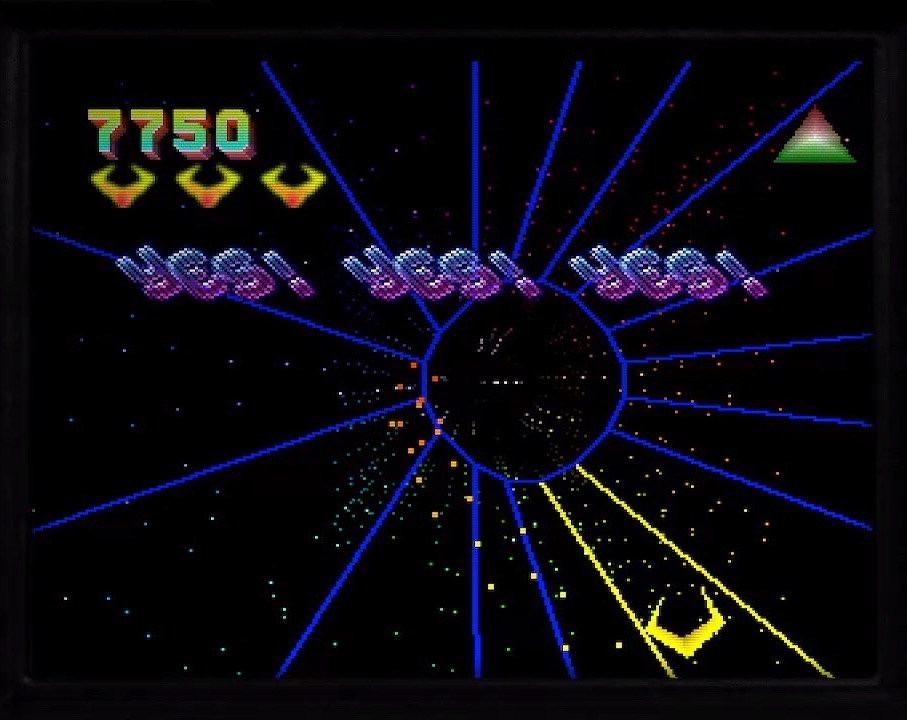
I wonder how many times any top ten countdown ever has featured Mega-CD and Atari Jaguar games so prominently… Not to mention a Commodore 64 arcade conversion! Anyway, here we finally are at number one, where I’ve just noticed another thread running through this list of games, which is the “modern” remake of ancient arcade classics! As we’ve already established though, it’s a formula you can’t beat, although in this case, it’s one that never really grabbed me until this variant came along! That’s not to say I never enjoyed a game of the original 1981 Atari arcade game, with its 3D vector graphics creating various geometries that had your ship rotating under your control (like we just saw with Gyruss) at one end, and the inevitable alien invasion coming at you from the distant other. The same feeling applies to the various Atari console ports from around the same time, as well as the Tempest X3 remake on the original PlayStation… All good but never a favourite. And then came 2022’s Atari 50: The Anniversary Celebration, which I got on Nintendo Switch, stacked with half a century’s worth of games that included a meagre handful of Atari Jaguar games that, much like with the Mega-CD earlier, set me off on another voyage of discovery into the wider library, but there was nothing that even came close to Tempest 2000! I remember the first time very well too – I wasn’t particularly excited about any of the Jaguar games on that compilation, but dutifully had a go on all of them, and I was just blown away by this 1994 assault on the senses by Jeff Minter, whose games I’d been playing for over a decade by then on the VIC-20, Commodore 64, ZX Spectrum and Atari ST; some all-time favourites in that lot too! Weirdly, the core gameplay is no different to any other versions I’d already played over the years though, so I can only put its belated impact down to these psychedelic extremes, helped along by more levels with some wild designs, and power-ups, and bonus levels and more enemies. As we’ve already established elsewhere, mid-nineties techno isn’t for me but there are times it serves its purpose – the Wipeout games, for example, wouldn’t have half the impact without it, and the same applies here – you just need to let it wash over you, together with the cacophony of sci-fi effects that then provides such a perfect extension to the sound design, while crazy visual effects and huge random words explode into a thousand tiny particles before you’ve even had a chance to digest them, let alone come to terms with the chaos happening on the actual play-field! The controls have translated perfectly to the Jaguar (and beyond) too, with precise rotational movement and all the bells and whistles at your disposal instantly feeling intuitive, which is fortunate because those aliens coming at you up the various lanes making up the “tube” are soon relentless, and so are the goodies they can leave behind, which invariably are not where you want them to be when they eventually reach you! It’s carnage, but in the best possible way! I mentioned substance over style a couple of minutes ago but this gives you the lot, and it shoves it right down your throat, and everywhere else while it’s at it! Just remarkable!
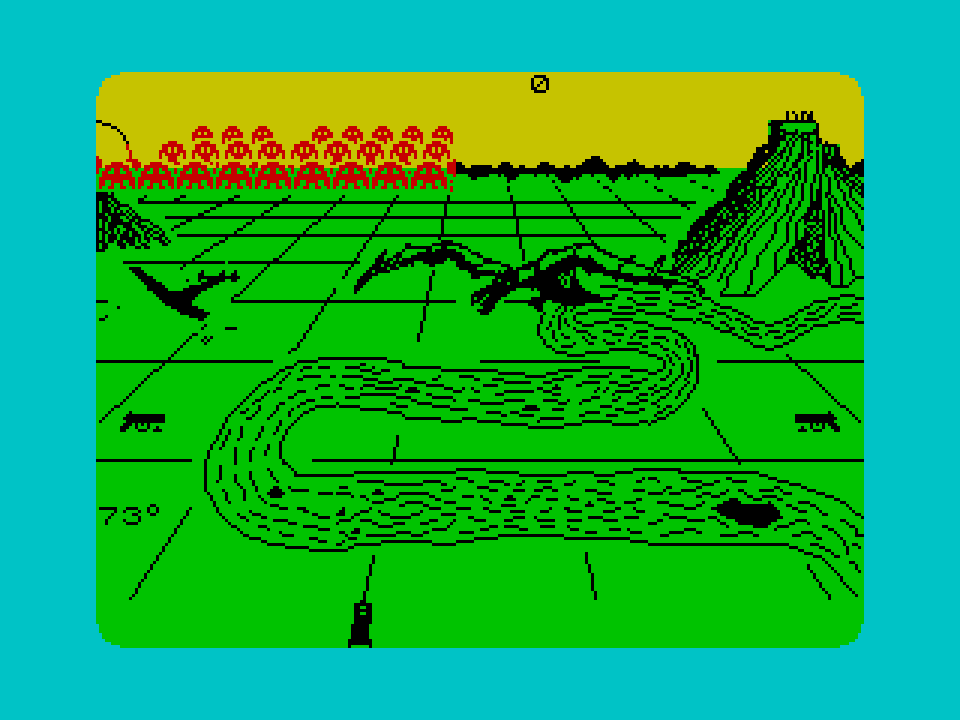
Sorry, I’ve just realised I became increasingly verbose as I went along, but I think my excitement also justifies the order I ended-up putting these things in! I’ve already mentioned the travesty of Radar Scope losing its place in the lineup here, so let me close with a few more honourable mentions… Although Zero Gunner 2, Raystorm and RayCrisis are pretty traditional vertical arcade shooters in spirit as well as in practise most of the time, they do occasionally veer into 3D territory and are absolute stunners for it, so I’ll get all of those out of the way first. Similar for Einhander on PS1, albeit more horizontally-inclined. I am still planning those rail-shooters countdowns to follow this one, just for completeness because, as we’ve seen, there is some subjective overlap, but honestly I haven’t given them much thought yet, so I’m not sure if Stealth on Atari 8-bit will make the cut, but it’s another I could just about argue fits here too, with its limited directional controls, so I’ll also recommend a look at that now, or the C64 version if you prefer. And I also want to mention that 3D level in Gorf that blew my socks off when I first came across it all those years ago! Oh yeah, almost forgot, I’ll close with Terror-Daktil 4D on the Spectrum, which obviously goes way beyond the 3D credentials required to be here, but is also absolutely dreadful, so is only here so I’ve got a new excuse to share the nice screenshot above! And with that, I hope you’ve enjoyed this latest foray into my favourite shoot ‘em ups, and I’ll see you for the next one!
As always, I’ll never expect anything for what I do here but if you’d like to buy me a Ko-fi and help towards increasingly expensive hosting and storage costs then it will always be really appreciated! And be sure to follow me on Instagram, X (formerly Twitter) or Threads for my latest retro-gaming nonsense, and also on Bluesky, which is under my real name but most of it ends up on there too if you prefer!
 Retro Arcadia
I love me some good gaming-related top ten lists. A lot of these games are new to me – and they look awesome! Thanks for sharing.
LikeLiked by 1 person
Awesome! Thanks a lot!
LikeLiked by 1 person