
Welcome to the fifth instalment in what’s evolved into an annual look at some of the cool sights that have stuck with me over the past four or five decades of gaming! That said, it was never really conceived as something I’d keep doing every year, but more of a big list of stuff I’d draw from more or less randomly when the time came again, and that’s why after this one I’ll probably give it a rest for a while, however much I still really enjoying pondering it… A lot of what’s included here and previously (which I’ll link to at the end) was on that list from the outset, but as fluid as it’s been, as I’d remember other things to add or decide to get rid of something else, I’m now down to five or six entries for next year, and I don’t want to force the format, so we’ll let it stew and come back when it’s ready again. Anyway, we’re still more good to cover the regular fifteen or so sights I’ve got for this year (depending on how verbose things get), and they’ll still come at you in no particular order except the one I originally noted them down in, with an explanation of where they’re from and why I think they’re cool, or, if that all sounds like too much reading, you can just enjoy some pretty pictures!
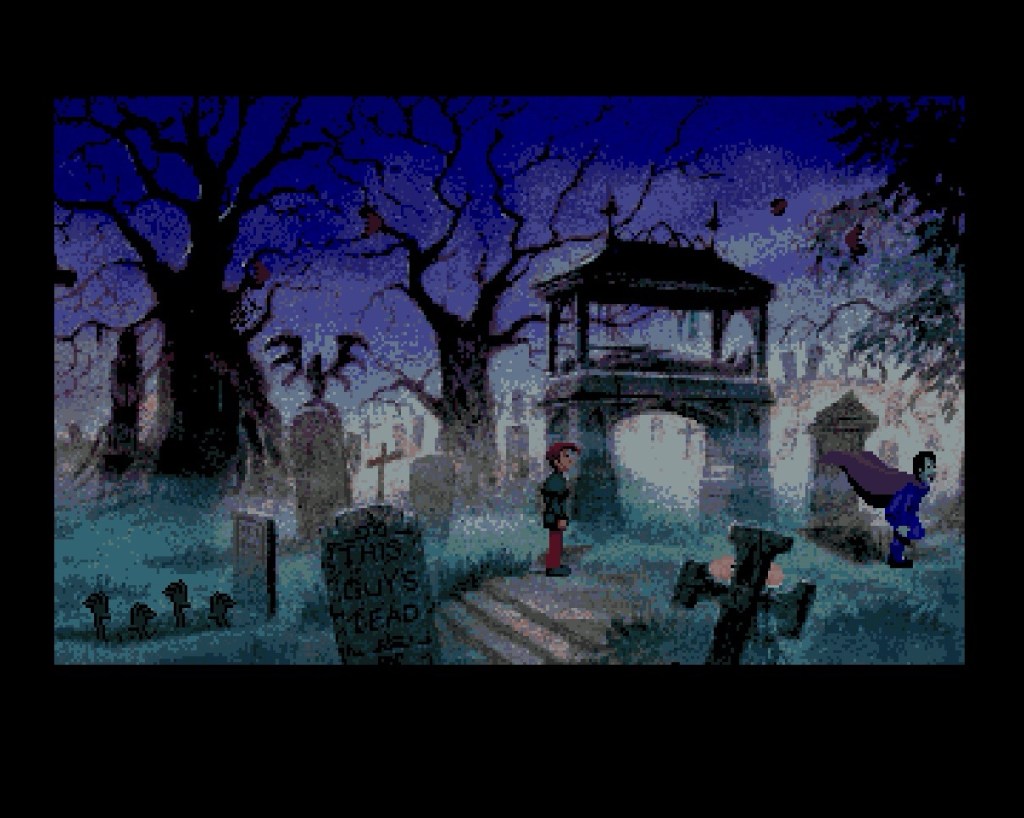
I know I said no particular order but it makes sense to start when I left off in Part 4, where we were looking at a photo of Curse of Enchantia as seen in the wonderful Commodore Amiga: a visual compendium from Bitmap Books… Well, same image here but it’s not a photo anymore because I’ve not only actually now played it and got my own screenshot, but I finished the stupid thing too! Had its moments though, especially the bit in this super-atmospheric old graveyard, crumbling away under a Hammer Horror sky, while its slapstick vampire inhabitant brings a bit of much-needed comic relief to this equally crumbling old point-and-click adventure! It’s by Core Design (the Tomb Raider people) in 1992, and you’re a boy who’s been snatched away to a magical land to be the final ingredient in the titular curse, so you need to put an end to it and get out of there! Although I applaud the attempt to do something different with the interface by removing any words and going wholly visual instead, I couldn’t help but long for a nice LucasArts-style one instead… When you want to do something, you choose a category from the list of ten icons, such as the eye to look or the open hand to use, then choose a specific action in each, like throw or push or give (from another eight possible icons in this example), then you choose what to use from your inventory, then where to use it or who to use it with. This soon becomes very laborious, especially when you’ve got to hand over fifteen individual rocks to some rock-swami, all at the same time! And that’s assuming you’ve found the ones you’re actually allowed to pick up from the thousands you can see but mostly not pick up spread across a whole multi-rock cavern maze, although that’s nothing on picking up a single gold coin from a twenty–foot pile of them later! Puzzles are equally convoluted, such as wearing (yes, wearing!) the sweet you might have found (but more likely missed) in a dreadful “action” sequence, which will then trigger a small rock to fall on your head and stick to the sweet, which you can then chuck at a bigger rock to make it fall and create a bridge! I get it, try everything on everything, but these are just two examples of dozens that get weirder as you go, and the movement controls are clunky, and sound minimal, and it’s all a bit lifeless. Except for our gorgeous undead friend, of course!

I’ll never forget seeing the original Last Ninja for the very first time on my friend’s Commodore 64 back in 1987 – probably the most stunning game I’d ever come across up to that point! We’d go on to sink hours and hours into its cinematic martial arts gameplay, but less so the second game the following year, which never really had the same impact, and by the time Last Ninja 3 came along in 1991, it just seemed like a bit of a relic, with bigger and better “proper” 16-bit titles to spend what very little money I had on, so it took decades… By which time, neither the clunky proto-tank controls, hapless enemy AI, terrible collision detection and even worse precision jumping had improved with age, but throw in some save states to compensate and its C64 incarnation in particular can still be a wonderful thing! This time the game’s set in what seems to be fantasy-medieval-ish Tibet, with each of its five levels reflecting the elements (Earth, Wind, Fire, Water and the mysterious Void) that are the foundation of the very Shaolin temples that give our ninja his power, which some nasty shogun and his four bosses are trying to put a stop to. To put a stop to them though, you need to explore each level, finding items and solving puzzles to get the magic scrolls you need to defeat each one, as well a way of physically getting to them. It’s all isometric flip-screens, with regular enemies to defeat on each one, and while you can just admire the wonderful somersault animation and skip by them, that won’t fill your bushido (or honour) gauge, meaning you won’t be able to beat the final level. Which I wish I’d known before I got there… The puzzles take some thought and the level maps are relatively small but very cunning, combining with the limited action perfectly to keep the pace fast, even while you’re busy scratching your head. Nice variety to it all too, with clever theming and typically gorgeous pixel-art at this point mixing things up every time, especially in the wildly cosmic Void final level we’re looking at here, with outrageous otherworldly detail and brilliant use of colour making up this interplanetary walkway your authentic little ninja and his foe are battling across! Oh yeah, the music on each is as sublime as it ever got on the C64 too – it’s that good! Okay, the gameplay hasn’t aged quite as gracefully but I’m glad I finally got there all the same, even if I couldn’t take that final step beyond its glorious stars!

I don’t know how many times I’d started but never finished Another World over the years – actually, when I say never finished, I mean not got more than three screens in! Anyway, having belatedly also fallen for the not totally dissimilar Ico on PS2, its baked-in icon on the Amiga A500 Mini games carousel jumped out at me again when I was idly scrolling through it trying to get my money’s worth out of the thing, and I thought I might finally be in the right frame of mind to give it a proper go. Which I did, and I finished it, and must have done a dozen times on there and elsewhere since, and now I’m a total convert! (I’ve also done a deep-dive right here). Now, I know it’s already considered by many before me as one of the all-time greats, but I’ll follow convention and quickly describe it anyway… It was originally released on the Amiga and Atari ST at the end of 1991, although there’s not much since it hasn’t been ported to, virtually to this day – in fact, the last place I played it was probably the last place it was released, on Delphine Software Collection 1 for Evercade. It’s a cinematic adventure, almost point-and-click-like in spirit, where you take the role of a nuclear scientist whose latest experiment doesn’t go quite to plan, and ends up travelling through space and time to an alien planet that’s immediately inhospitable, leaving you with the simple goal of surviving… Over and over and over again, as you try to puzzle or fight your way through every single one of its surreal flip-screens that tell this incredible, minimal tale through minimal interactions with this fantastically atmospheric (and minimal) world! The controls are pretty minimal too, and, combined with zero energy bars, scores or anything else intruding on-screen, results in total immersion and singular focus on whatever the immediate problem is you need to solve to progress to the next one. And the next…. And the odd terrifying monster to run away from too! Speaking of which, whatever the flavour, what I’ve picked here is unquestionably one of gaming’s most iconic sights, set at the very beginning of your adventure, as you emerge from the pool you found yourself submerged in after things went weird, and really invokes everything to come, including that monster, as well as the full extent of this desolate alien landscape, and the hints of civilisation or otherwise twinkling away in the mountains, beneath that huge alien moon. So much unknown, and so much isolation behind a handful of exquisitely-set colours and perfectly-set pixels… Incredible scene, incredible game, and even more so now I finally get it! And yes, the lovely pic at the top here, also from this, would have been here if this wasn’t.

I recently decided I don’t particularly like the original Tomb Raider games! Just like my experience with these at the time, the first Tomb Raider on the recent remastered collections started out well, but a few hours in, I slowly started to lose interest and eventually didn’t come back. Never one not to get the most out of my money though, I eventually moved on to 1997’s Tomb Raider II, which, if I had to pick a favourite in the series, would probably be the one. It’s still alright in many respects too, as long as you turn off those weird new controls and horrible, dark remastered graphics! And why wouldn’t you anyway, when we’re talking peak original PlayStation in all its jagged and uniquely textured glory! Seriously though, I love how this looks, especially the Venice canal section we’re looking at here… So vibrant and so full of life and movement, and so cinematic too, with attention to detail like never seen before at the time, presented in a way rarely seen since! By the way, that also goes for the sound design in this one. Lovely animation as well, supporting Lara’s slightly expanded movement repertoire, which also includes vehicles this time, including that exotic thing at her feet here! Gameplay is mostly similar to its predecessor otherwise, as you platform, puzzle and shoot your way around the world to another ancient artefact before some Italian cult gets their hands on it. The controls aren’t much improved either but you’ll soon get to grips with them well enough, while puzzles are well-designed and the action parts mostly lots of fun once you’ve also puzzled out where you’re going and what you’re supposed to be doing there! Just all goes on a bit though, and I think even more so than the first game, which once again was its downfall for me, but no doubt not for the last time!

There are quite a few parallels between the previous game and our next one, which I’ve also been going back and forth with over almost as many years! Alpha Storm was first released by Psygnosis around the same time as Tomb Raider II in 1997, but I wouldn’t get to it until I went a bit FPS-mad when I got my first PC a couple of years later. God, the money I spent on that thing in PC World in Barking… Anyway, it’s another visual showstopper (most of the time!) that just never held my attention for the duration, but I love everything else about it, so I’ll probably keep coming back whenever I think of it until it does! Although I just alluded to it being an FPS, it’s quite a lot more besides, with the action split between that and strategic space sim, as you travel the galaxy in your Eradicator Prototype ship, looking for the six pieces of a Stasis Device that will remove you from time and allow you to escape the Dark Beings’ flagship after your set off your Nova Bomb on it, thus restoring galactic peace… Or some such sci-fi nonsense! It’s so cool though, as you manipulate elegant navigational charts reminiscent of Elite, before engaging in this kind of Battlechess-style ship-to-ship combat on 3D grids, when once the shields are down on your enemy’s ship, you can go first-person, teleport onto it and cause all kinds of mayhem, looting upgrades for your own ship and yourself along the way, as well as essentials to keep everything operational. This dual-edged setup is almost as decadent as its setting – think Jules Verne in space as opposed to 20,000 Leagues Under The Sea! It’s all so luxurious, part-steampunk, part-gothic and totally DOS, where you can almost feel the crushed velvet behind the wild colour schemes and wonderfully blocky environmental detail! As we can see here, that all adds up to the most decadent cockpit ever too, mocking the simple vastness of space behind it with its splendid complexity – it’s a lot of the reason I keep coming back, just to stand there, looking so cool in my own mind! And the slightly out of place music and sampled sound effects are just awesome! There’s really not a huge amount to any aspect of the gameplay though, but the variety keeps it lots of fun for a while, despite some absolutely dreadful enemy graphics, in total contrast to the general splendour elsewhere. Whatever, it’s alright and more people need to know it is!

The 400 Mini has been a real journey of discovery for me over the past couple of years but this old Atari 8-bit graphical text adventure from 1982 called Transylvania is actually something I started but never finished a long time ago on the Commodore 64. With a USB keyboard duly attached to one of the four controller ports, we’re off to save a princess before the sun rises because according to the only in-game direction you come across, “Sabrina dies at dawn!” Despite the presence of werewolves, vampires and even a flying saucer on the loose to hinder your progress, the clock eventually becomes your biggest enemy as you “Go North” and “Read Note” and “Wave Ring” and so on! Really fun adventure though, with an easily manageable number of locations including spooky castles, haunted houses, maze-like forests and graveyards to explore and examine and go back and forth between, and with some trial and error, you’ll work out how to deal with the undead, and with a bit of additional thought you’ll puzzle out most of the rest of what’s going on, although I must admit to needing some help a couple of times when they got really obscure! That said, if I’d been everywhere and tried everything I’d have known… Clever bit of primitive inventory management as well. The accompanying graphics are fantastic too, and for me what we have here isn’t just the best of them, but one of the most atmospheric in any such game ever – primitive but so rustic and – when you first see it in-game – so panic-inducing too! It’s worthy of the Scooby Doo title sequence, as this perfectly demonic presences looms over (or from?) this admittedly weirdly 2D corpse in a weirdly proportioned coffin on a weirdly proportioned cart, but who cares, I’d still hang it on my wall!

I didn’t really know much about Blackthorne until the Blizzard Arcade Collection arrived in 2021, which I then picked up in a Nintendo Switch sale some time later, and I’ve been dabbling with it every once in a while ever since. It’s a cinematic puzzle-platformer, not unlike Flashback in both look and gameplay, and was originally released on the SNES and DOS in 1994, a couple of years after Delphine’s masterpiece, with the Sega 32X version I’ve now come to favour arriving in 1995. Not only does this bring with it the expected graphical overhaul, with bigger rotoscoped sprites and more detailed and colourful pre-rendered environments, but also with an additional level too, which I’ll come back to in a sec… Worth mentioning that it’s not really all that compared with the SNES on the sound front though, but you’d have to do a side-by-side comparison to realise it doesn’t have anything like the heft to the effects. Anyway, you play as Kyle “Blackthorne” Vlaros, heir to the throne of the distant planet Tuul, which has been enslaved by an evil warlord, who you need to take out to regain the throne, liberate your people, avenge your father and so on. It’s all sci-fi-fantasy nonsense, which translates to traversing seventeen levels spread across mines, swampy forests, deserts and a castle, but as just mentioned, this version has fifth area, with four new levels set in snowy mountains, and this area is a real looker! The bit of it we’re looking here is so cold and filled with danger, but also pulls of a real Christmas card vibe, albeit one set in Tolkien’s Mordor! The effective use of limited but perfectly-suited colours is a big part of it, complemented by the seemingly moonlit shading carefully spread across stylishly textured rocks and some really nice piles of snow, not to mention the stuff still dropping in the foreground. The gameplay itself is all very methodical, with you exploring, climbing and jumping back and forth around levels to solve puzzles, open doors and generally progress, with some cool cover and blind-fire mechanics giving combat an extra level of depth, and once it all clicks, it quickly becomes very engaging, also just like Flashback! And while it doesn’t quite reach those lofty heights in terms of spectacle, level design or narrative, it does enough of its own slightly grittier and more action-driven thing to make it worth returning to just as often.
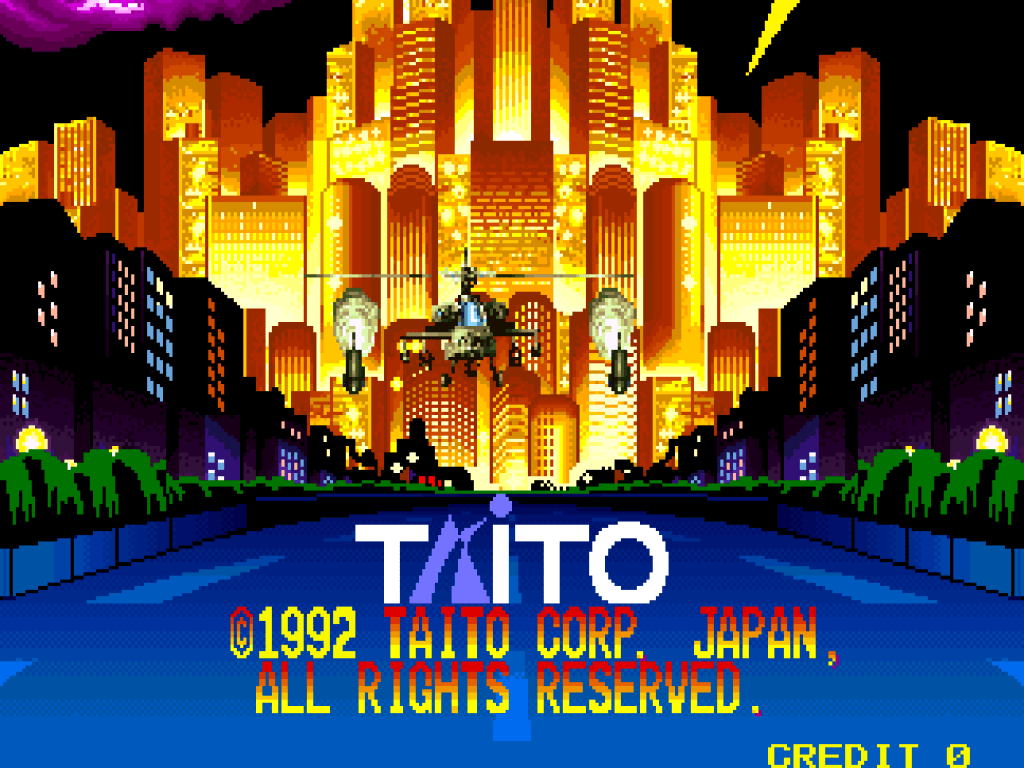
I just looked up and realised I went on way too long about the last sight, so I’m going to very try to get us back on track and properly focus with this something far more mindless, although you’d never know it from one of the most stunning arcade intro sequences ever! That’s what we’re looking at here, as this huge helicopter gunship emerges in full attack mode, with missiles flying everywhere, from this spectacular, Art-Deco-infused, future-Oz-like cartoon-cityscape that’s lit in the most magical fashion! Beyond that though, Silent Dragon is a pretty generic side-scrolling beat ‘em up from Taito in 1990. It was developed by East Technology, the, er, Double Dragon 3 folk, but don’t let that put you off too much, and the same for the generic rescue your kidnapped girlfriend plot, or the four generic martial artists to choose from, because while it’s certainly no Final Fight, it’s competent enough, with accessible and reasonably fluid combat, and there’s a quirkiness about it that’s been bringing me back every once in a while for years! I really like the soundtrack by Taito’s legendary house-band Zuntata too, and the oddball situations you find yourself in, but that’s about all I’ve got to recommend it – hardly a guilty pleasure but those things aside, it really is generic, and even a fantastic (if totally irrelevant) attract mode does little to disguise that!
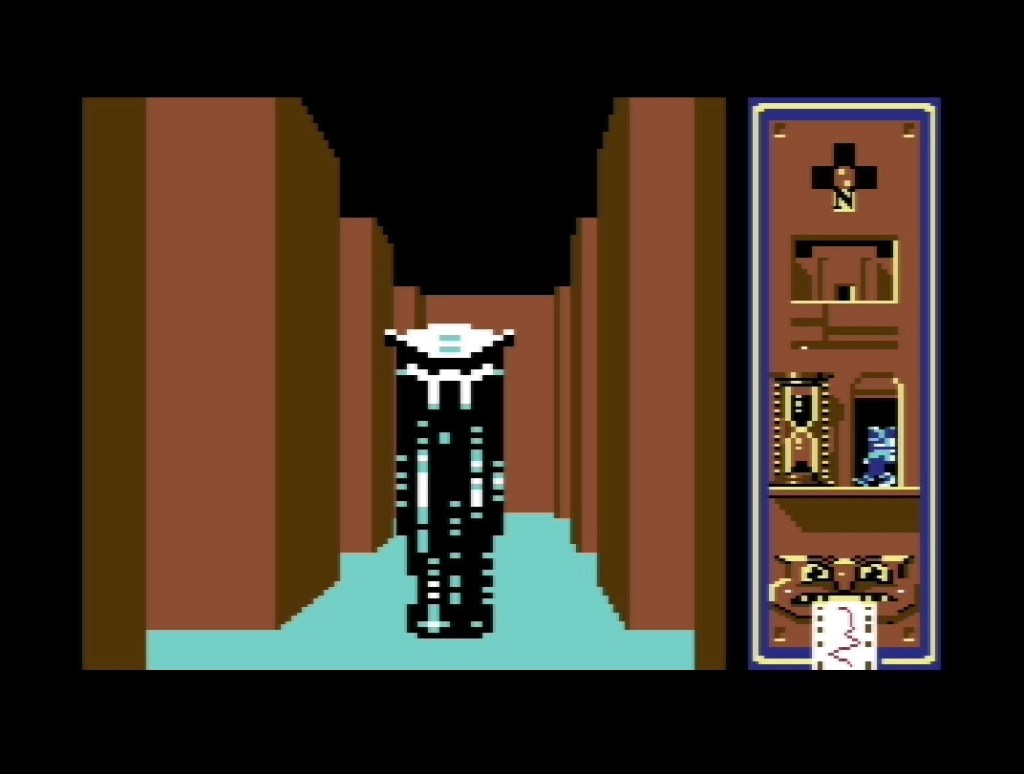
Scarabaeus is one of those games that could only ever have existed on the Commodore 64 in 1985! It’s a bonkers mix of 3D maze and “proper” puzzles, spread over three floors of an Egyptian tomb, which you’ve arrived at in your spaceship in search of the titular treasure, as well as an antidote to the spider bite you got on the way in! The first level involves chasing a mummy (apparently!) around an impressively fast-moving and super-smooth maze, with walls that appear and disappear to cleverly mix it up, and every time you catch the mummy, you’ll be rewarded with a hieroglyph, which will gradually populate a 3×3 grid you’ll need on the next floor. We’ll stick with this floor for a sec though because that’s what we’re looking at here, and even if it doesn’t look like a mummy, I reckon these things are the best-looking meanies on the system! And doesn’t that typically brown maze set them off perfectly, looking like blocky 8-bit Predator prototypes, all menacing in mostly black but using grey and white highlights to provide all the terrifying personality you could ever wish for! Once you’re done staring, that next floor is accessed via an elevator on a winch you wind up and down, but really wasn’t designed for modern d-pads because miss a single direction press as you rotate and you’ll crash to your death! This becomes more of a problem after the very lengthy game of cat and mouse on the next floor, where you first need to lure deadly spiders out of the alcoves, in which you then need to use those hieroglyphs in a kind of graphical wordsearch puzzle, once you’ve led them far enough away so you can run back and do it in peace! Successfully solving each of the thirteen puzzles here will further reward you with a zombie trap and / or a potion, which you’ll collect in the corresponding location on the final floor (where you’ll also need those zombie traps). One of the alcoves also contains a key to unlock that floor, which you get by solving a different and nicely complex block-sliding puzzle. On the third floor, you can now collect those potions but beware of some that aren’t so good for you, as well as those zombies running around trying to drain what’s left of your health! The potions will boost it though, and also reveal a bit more of the final puzzle, involving lining-up symbols in the right order, which then opens the pharaoh’s burial chamber and the treasure. It can be a cruel game but it’s also incredibly rewarding, with a nice mix of puzzles (assuming you’ve been paying careful attention and also read the instructions), some very intuitive maze-action and a great level of tension and atmosphere. Nice learning curve too, and you’ll want to keep coming back to chip away a bit further! And yes, it’s very C64 in 1985 to look at and listen to as well as play but I wouldn’t have it any other way, and those gorgeous meanies running around are worth the asking price alone!

We can’t have a second C64 game in this list and not follow it with a ZX Spectrum one, although like many others at the time, I’d long since moved on when Extreme arrived in 1991, but to this day I’ve never stopped being impressed by any game that breaks all the rules on there, and there are few that break them like this! And yes, predictably I am talking about the impossible number of colours over-filling every inch of the screen with barely a hint of colour-clash, although I will also note it’s a 48K-only game, despite the equally remarkable tune playing on the title screen… Which I believe was lifted from the almost as miraculous at the time Trantor from a few years earlier. And the rest of the game was built using the Dan Dare 3 engine, which will also have jumped out at you almost as much as the wonderfully garish palette if you’ve ever played it! Unfortunately, the game itself is a bit of a mess – not terrible but let’s just say the presentation clearly came first, resulting in little more than a pretty short-lived (and relatively pricey) tech-demo. It’s a multi-directional space shoot ‘em up of sorts, where you’re trying to stop an alien computer’s self-destruct sequence taking out Earth with it, involving three levels that see you retrieving an energy crystal on a little space hover-thing, then swimming through a hazardous fuel tank in a hydronaut suit, before finally strapping on a screen-spanning exo-skeleton for the final showdown. Every single level is a contender for as good as the Spectrum ever looked, and not just for all the colours and the huge sprites, but the density of what’s going on and all the special effects and animations too, and the sound isn’t far off either – it’s very easy to forget we’re not on a 128K machine! The real wonder to me though is a really lovely intro sequence, with this giant alien face dwarfing your tiny, helpless stick-man, hypnotically summoning you into the game as it changes colours in front of this giant rainbow tractor beam, starkly lighting the simple black and white star-scale behind it. It’s all framed by this evocative user interface too, which remain one of the highlights as you play the thing because unfortunately it’s very average at best, but as a bit of a hidden showcase for the system, you should definitely have a look.

We’ve now had more 8-bit games here than in any of the previous entries in this series combined, so before we finish on some new-fangled nineties stuff, I’ve got a couple of really old-school sights for you… We’ll start all the way back in 1983 with Dracula from Imagic for Mattel’s Intellivision, which I believe was one of the earliest games to cause a bit of a stir for its inherent violence, as well as being a real favourite of mine on the system, not least because you get to be Dracula and cause all that violence! Don’t suppose many games had you playing the villain at that point either… Depending on your selected difficulty level (from three), you need to to rise from your grave at sunset and drain a specified number of townsfolk of their blood before you need to return to it before sunrise. While you’re on the hunt, you’ll have to steer clear of werewolves and the stake-throwing police constables, who you need to either escape from as fast as possible or, if you’ve got a victim to hand, turn them into a zombie to fight back for you, but there’s also the option of turning into a vampire bat for a swift exit, although this then makes you vulnerable to the vultures patrolling the sky. Everything you do also uses the precious blood supplies you’re gathering – even simply walking around – and running out means game over, but keep it topped-up and you’ll live to fight another night, when your quota will increase and so will the dangers to you. It’s simple arcade stuff with a few twists and a lovely slapstick feel, thanks no end to some fantastic characterisation and animation, as primitive as it might be, and loads of attention to detail in the varied and vibrant scenery, which is typified by what we’ve got here! The basic blocks of extravagantly bold colours, dotted with equally simple but perfectly recognisable street features, as well as great attention to detail with simple things like kerbs and puddles in the road elevate this beyond its time, and that slapstick Dracula sprite is something else! Very cool music too, and sound overall is basic but cleverly and dynamically deployed. There’s not a huge amount to it but maybe more than meets the eye, and sucking blood was never so much fun!

Right, as said, really old-school, and this time we’re talking 1980, for the oldest game that’s ever featured in one of these, Adventure on the Atari 2600! Until a year or so ago as I write, I’d liked the look of this forever, but had never had any clue what was going on! Seeing it staring back at me again from the Atari 50 compilation’s games carousel a couple of years ago finally prompted me to open the in-built manual and find out though, and I had no idea quite how hooked I was going to get when I did! Its scope is staggering for the time, with you trying to find an enchanted chalice stolen by an evil magician and return it to the Golden Castle. Along the way, you’ll need to find the keys to open the gates to this and two other castles holding other items you’ll need to progress your quest, from swords to deal with the magician’s three dragons to magical bridges to navigate some hard to reach places. Then there are big mazes and blind mazes to negotiate, secret rooms to find, and a stupid bat that regularly steals whatever single item you’re trying to carry somewhere and takes it somewhere else, and is far more likely to ruin things than any dragon! Three skill levels too, where the first is straightforward and there to ease you in to the second, which I guess is regular and way more expansive and challenging, then the third drops all the items randomly every time, and is where you’ll play forever! It’s real genius is how quickly it grabs you and lets your imagination take over though, leaving you totally immersed in this first-of-a-kind action-adventure, totally oblivious to the fact that you are playing as a square, and everything else is made up of a handful more squares, all accompanied by some harsh beeps and blips, rather than the brilliantly varied and atmospheric fantasy kingdom you’ve convinced yourself you’re obsessing over! That said, I’ve got a real thing for as basic and yellow!) a castle as I’ve seen since I used to program such things in BASIC on the VIC-20, but that black portcullis totally draws you in… And by “you” I mean a yellow square holding an arrow symbol as a sword! I know, weird thing to include here, but it’s so simple it’s timeless, just like its gameplay, which really has to be seen to not be believed, and it’s an absolute masterpiece I’m so glad I’ve finally got to loving!

We’re going to cross the decades to the far-flung future of 1993 now, for a sight from a game I didn’t know anything about until I was having a quick go at everything on the Sega Mega Drive Mini 2 when that arrived a few years ago, but from the second I first fired it up, I knew I liked what I saw! Yumeme Mystery Mansion is a very cinematic point-and-click-style horror adventure for the Mega-CD (or Sega-CD) add-on, where it was also known as Mansion of Hidden Souls in America and Tale of the Dream Mansion in Japan. Whichever way, you and your sister were playing in the fields when she ran off after a butterfly, despite your gran’s warnings about local ghosts turning people into butterflies! And after following her to a creepy old mansion, you discover that’s what’s just happened in there, so you need to solve the mystery and free her. Interactions as you do so are generally semi-automatic, using the directional controls plus a minimal, contextual inventory system. Directions themselves are semi-guided too, rather than simple left, right, forward and back, although there is plenty of jarringly binary movement as well! And it all combines brilliantly to keep things immersive and focussed on leading you through what would be an equally minimal narrative if the puzzles weren’t sometimes quite so cryptic and obtuse! Progress is reasonably well guided if you make sure you look at everything though, and puzzles mostly involve finding an object and using it in the right place, rewarding you with further objects and further places to explore, and that’s where we’ll stop to admire this sight, which I know is another slightly odd choice but it just stuck. This is from a spooky candle room in the mansion where you’ve got to light some and blow out others to open up a secret door, and you’ll only know which if you’ve been observant elsewhere… On a dartboard of all things! This one’s almost as simple as the last too, with a fancy gold moon symbol, electrically (or gasly) lit from above with far more realism than the densely-bricked wall behind it (unless they’re tiny bricks), grimly staring at the birdcage candelabra next to it like a fairytale nightmare. And that’s about it! There’s some wonderfully disconcerting music to help keep things otherworldly throughout, and although unintentional, some of the hammy voice acting even more so! And while what I’m sure were “Hollywood” visuals at the time haven’t aged great, they don’t stop it being a rewarding and creepy not-quite-point-and-click adventure!

Looking at it objectively, I’m not entirely sure what captivates me so much about that last image, but no question that this (almost) final one for now is a wonderful sight and a half…. Which is more than can be said for the game it comes from! The trilogy it was the first instalment of would culminate in a side-scrolling beat ‘em up masterpiece though, so it can’t be all bad… We’re talking SNK’s Sengoku on the NeoGeo from 1991, in which a supernatural warlord from Japan’s titular Sengoku period turns up with his undead Samurai army in what seems to be a kind of post-apocalyptic modern-day setting, where a couple of martial arts protagonists with a few supernatural tricks of there own are trying to save the day! However, the bonkers settings you flit between as a result, and the fantastic spooky chanting for a soundtrack, and even this, one of the visually striking scenes you’ll ever see in an attract mode (alongside several we’ve seen here already), where this huge old pagoda, together with the ground upon which it once stood, magically appear from out of nowhere in the suddenly-hellish sky above this otherwise gorgeously-lit nighttime cityscape, (still with me?) cannot make up for the shallow and decidedly stodgy combat mechanics. Which ain’t great for a brawler! Still, there’s still some fun to be found here all the same – just don’t expect Final Fight or Turtles in Time, and definitely don’t expect Sengoku 3, and you might just find it!

And that’s going to be that for this year! However, although I said at the start that we’ll take a break for a while now to let the next instalment evolve naturally in its own time, I also said I’ve already got five or six new wonderful sights in the melting pot, so not for the first time in this series, I’m going to leave you with one from a game I haven’t even played yet! Also not for the first time, it’s a game I discovered thanks to Bitmap Books, this time in their The Art of Point-and-Click Adventure Games. It’s called Ghost Pirates of Vooju Island, it’s an old PC title, and as you can see, it’s absolutely gorgeous… And will look even more gorgeous when I get an actual screenshot of my own, so there’s incentive to me at least to return with Part 6 of this series sooner rather than later! In the meantime, as promised before, here are links to all the previous ones to tide you over…
Wonderful Sights in Gaming – Part 1
Wonderful Sights in Gaming – Part 2
Wonderful Sights in Gaming – Part 3
Wonderful Sights in Gaming – Part 4
As always, I’ll never expect anything for what I do here but if you’d like to buy me a Ko-fi and help towards increasingly expensive hosting and storage costs then it will always be really appreciated! And be sure to follow me on Instagram, X (formerly Twitter) or Threads for my latest retro-gaming nonsense, and also on Bluesky, which is under my real name but most of it ends up there too if you prefer!
 Retro Arcadia