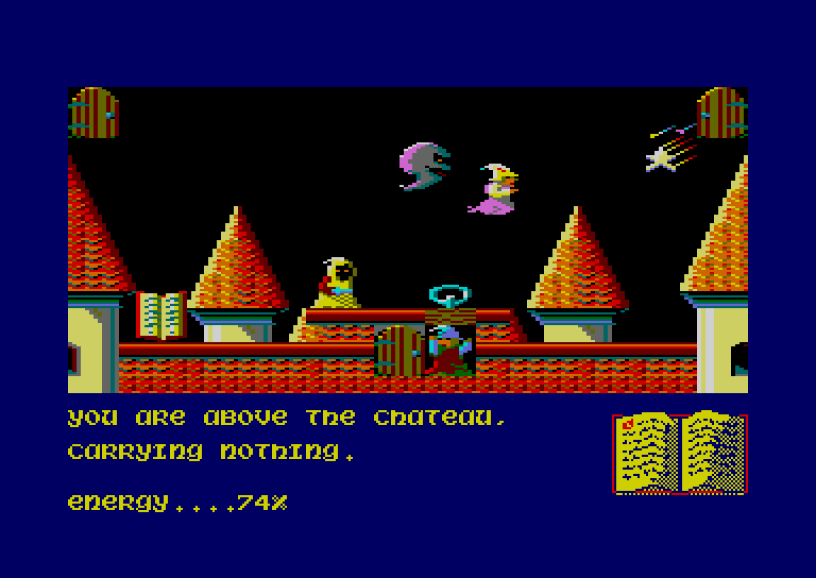
As a ZX Spectrum owner, I could count the number of games I looked at enviously over on the Commodore 64 on less than one hand… Ghosts ‘n Goblins, Commando, Winter Games and Ghostbusters was the lot! As a long-suffering VIC-20 owner before that though, it was a page-by-page occurrence every month, as I flicked through the latest issue of Computer & Video Games magazine, and just off the top of my head, memories of being totally blown away seeing the likes of Cauldron, Gryphon, Bruce Lee, Summer Games II and The Way of the Exploding Fist for the very first time immediately come flooding back! This was particularly true as the pioneering days of the early eighties gave way to the golden years of mid-eighties, which is also when this fancy-looking upstart with a built-in cassette deck and choice of snot-green or full-colour monitors started attempting to make in-roads into what was fast becoming the dominance of the Spectrum and C64… Not that I ever knew anyone with an Amstrad CPC at the time, and I could probably count on one finger the games I was a bit jealous of on there!
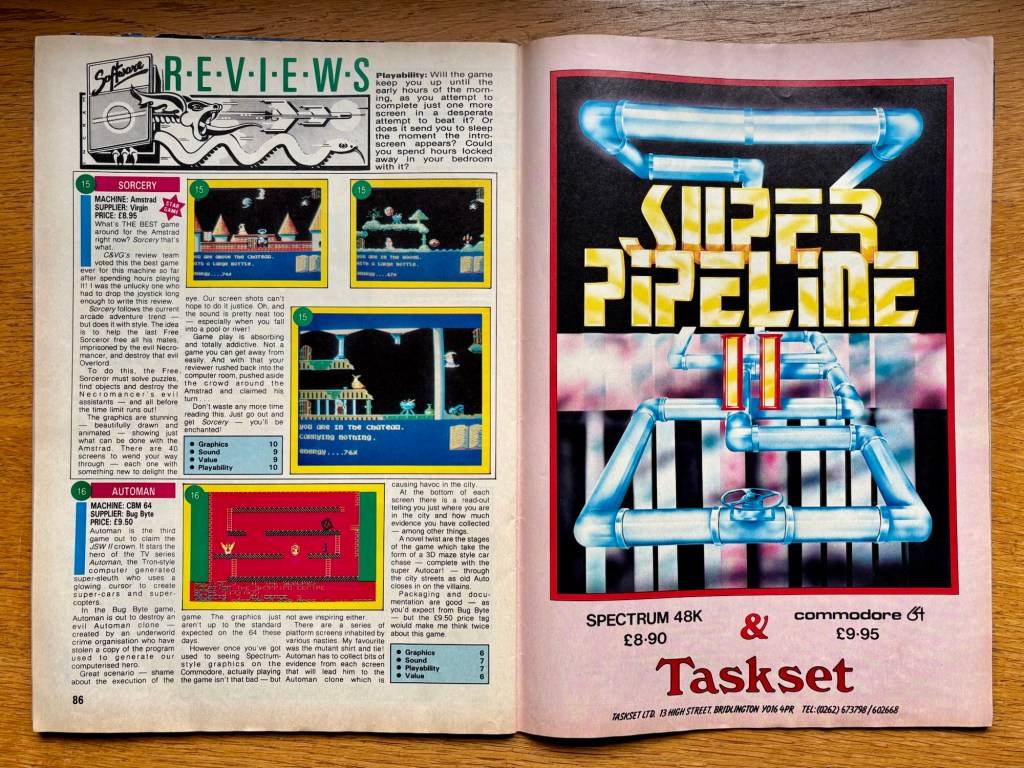
And as you might have guessed already, that one finger is pointing at a game called Sorcery, which I first came across when it was reviewed in the April 1985 issue of Computer & Video Games magazine! (You can check out my Retro Rewind feature on that here). Wasn’t easy to stand out that month either, with classics everywhere you looked, starting with the legendary Impossible Mission on the Commodore 64 getting the Game of the Month accolade, and followed by stuff like Staff of Karnath, also on there, and the big-scoring, incredible-looking spiritual successor to Knightlore, Alien 8, on the Spectrum, as well as Monty is Innocent, Technician Ted, Brian Bloodaxe and Finders Keepers. Some really cool (and mostly high-scoring) lesser-known stuff around too, like Buggy Blast and “can’t believe they got away with it” Star Wars rip-off Death Star Interceptor on the Spectrum, Athletic Land on MSX, The Quadra and Squish on the VIC-20, the aforementioned Gryphon on the C64, Conan on the Atari 800 and C64, The Hacker on BBC… There was just something (literally!) magical about those screenshots for Sorcery on the CPC though, and the 10 for graphics, 9 for sound, 9 for value and 10 for playability scores didn’t hurt either. Actually, just for context, if you switch the graphics and sound scores around, then that’s also what Impossible Mission got!

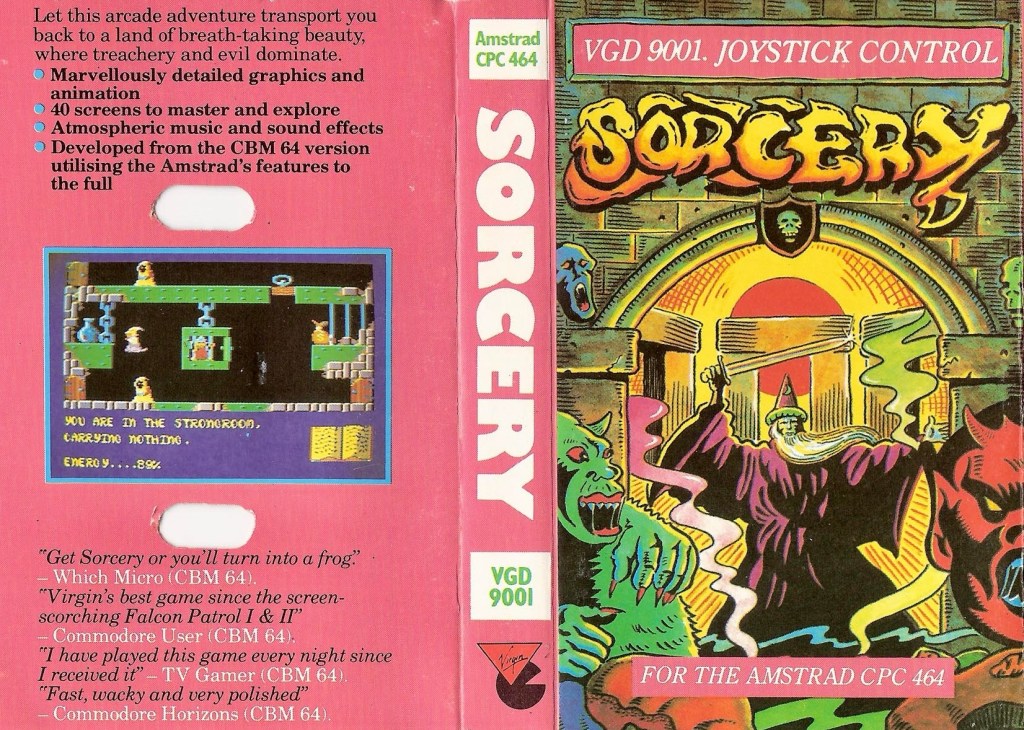
I was already sold but soon after, the screenshot-heavy map and guide in the May 1985 issue was truly a sight to behold, and remains one of the most iconic sights I remember from any of the issues I’d never miss well into the nineties! Turned out to be pretty useful in the end too, when emulation finally gave me the chance to actually get my hands on it several decades later… Maybe I wasn’t so sold after all!!! That said, I also can’t deny my first time with the game turned out to be a bit of a disappointment – yes, it was all I ever hoped for on the surface, but not having a clue what was going on combined with a classic example of old-school brutal isn’t exactly a welcoming brew! We’ll try and make a bit of sense of it all in a minute, but first we need to try and make sense of where the game’s come from, because it turns out that “developed by Gang of Five and published by Virgin Games” in early 1985 is only part of the story! Somewhat bizarrely, the back of the box seems to tell us precisely where it’s from, right after how this arcade adventure will “transport you back to a land of breath-taking beauty, where treachery and evil dominate” across forty screens of “marvellously detailed graphics and animation” with “atmospheric music and sound effects…” All perfectly good bullet points, if you still needed selling after even more glorious screenshots, but then the final one tells us it was “developed from the CBM 64 version utilising the Amstrad’s features to the full!” I don’t know, maybe it’s just me, but when anyone owning these things is more than likely already the butt of all the playground jokes, that’s probably the last thing they want to hear. Well, apart from a bunch of quotes from Commodore magazines raving about how good it is on there, especially when, as we’ll see, that’s a total disservice too! (Credit to CPCWiki for the inlay pic below).
Whatever, it’s still only part of the story, as if being a Commodore 64 hand-me-down wasn’t bad enough… All the way back in 1984, there was a ZX Spectrum game called Sorcery, developed by a school boy called Martin Wheeler, and published by Virgin Games. It did alright without setting the world alight, reflected by reviews from the time too, with Crash giving it a respectable 72%, while Your Computer scored it 3/5, although calling it “a one-dimensional Atic Atac” is a bit harsh! Still, I was about to say that as a Spectrum owner, I don’t remember seeing it in the wild at all at the time, then realised I own it on the (Band Aid spin-off) Soft Aid compilation, which is proper harsh! Anyway, at some point, that Spectrum version got passed across to Gang of Five, who set to work on beefing it up for a Commodore 64 release. It’s a bit primitive, the controls are weird and it’s too hard but I reckon the Spectrum version is alright once you get used to it. However, while there’s no way I’m criticising a kid in his bedroom producing stuff I could only dream about making while I was still typing in BASIC listings back then, this was a whole different level of polish, and effectively a whole new game. Which, in turn, is what the CPC version was again! Virgin ended up being fairly prolific on there, with loads of arcade ports like Continental Circus, Super Offroad and some Double Dragons, as well as versions of old and new favourites from elsewhere like Adrian Mole, Trashman and some Dan Dares, but it seems like they were pretty sceptical about the system when Sorcery was first on the cards. They weren’t exactly setting the world alight either though, so from what I can tell they took a desperate punt and ended up with what Amstrad themselves were very soon touting as a system seller!
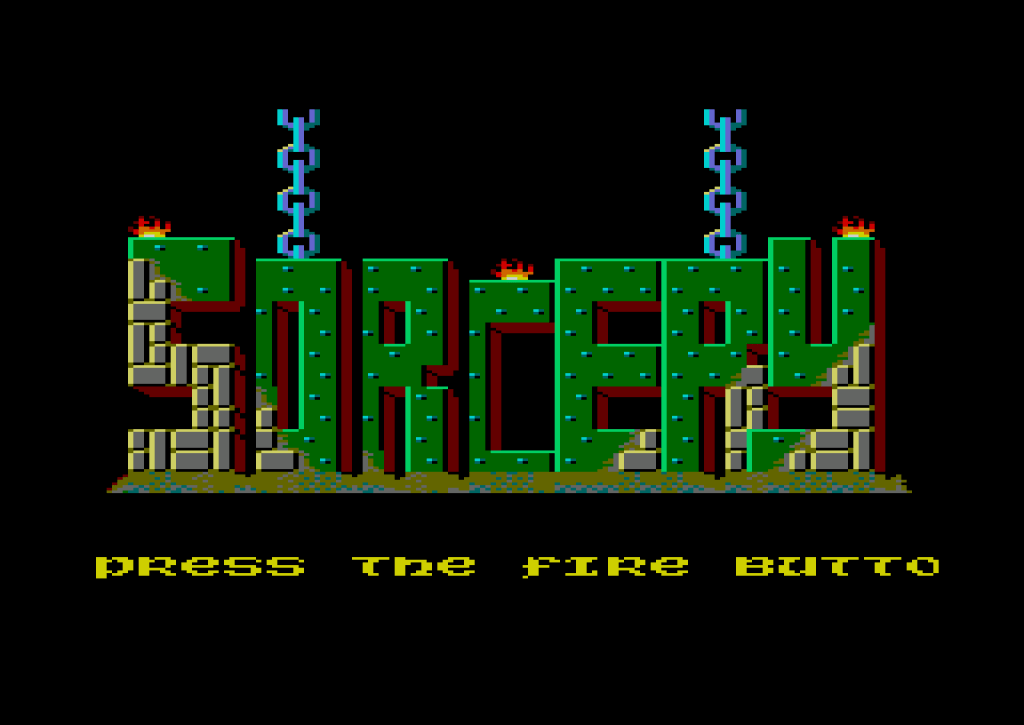
The origin story didn’t stop there either, but I think I’ll come back to Sorcery+ (speaking of whole new games) later, as well as some of the differences between the original CPC Sorcery I knew and loved from afar and its C64 and Spectrum predecessors, and we’ll get into the game itself instead. “The World has fallen into the Dark Ages. The Evil Forces of the Necromancer are creeping to every last corner of the ancient land that was once the powerful domain of the Great Sorcerers. You are the last free Sorcerer, all the others have, one by one, been entrapped by the hideous evil that abounds.” The aim of the game is to travel every corner of the kingdom, looking for your fellow sorcerers, and once you’ve freed all eight of them, you can all meet up and combine forces to get rid of the big bad Necromancer once and for all. Every corner of the kingdom can be found across forty screens, and actually, here’s the main difference between this and the other two versions, because they only featured seventeen screens. Same concept though, as along the way you’ll also come across loads of objects, some of which are useful, some not, but you’ll need to puzzle that out as you go. Likewise, you’ll also need to puzzle out the lie of the land, with that map from earlier being particularly useful when you’ll be starting randomly in any of five locations, and you really do want to search every bit of it too because the secret passages hidden away in some screens might make all the difference, when setting foot on any of them presents relentless danger, most of which seems to have a magnetic attraction to you!
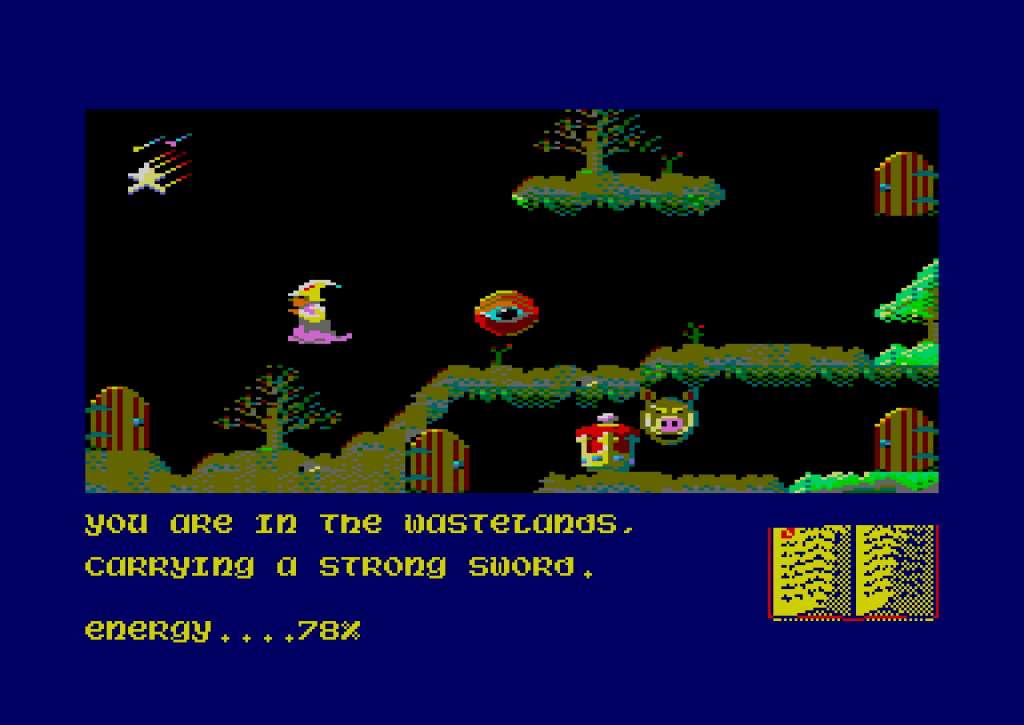
Controls are built for a joystick and therefore very straightforward, with up to fly, left and right, then let go to descend by himself. They’re precise enough and perfectly responsive, given you’re generally flying so there’s always some inherent momentum at play. Picking up objects takes a bit of practice (although not as much as the Spectrum version!) and involves positioning your little sorcerer over it and pressing fire. You can only hold one at a time too, and you can swap them for another but can’t drop them. I just mentioned puzzling out what they all do but some are more obvious than others – there are regular weapons, like axes and swords, as well as magic spells, that can be used to fight enemies with another press of fire (though which ones are good for which enemies is another puzzle). Then there are also objects that will solve specific location-based conundrums, not totally unlike what you’d find in something like Finders Keepers from earlier, or Dizzy a little bit later. Doors are used to get between screens, some of which will need keys too, and you’ll sometimes come across a cauldron you can hover over to top up your energy (or not), which you can otherwise generally see rapidly depleting at the bottom of the screen, along with the name of the area you’re in and what you’re carrying. There’s a crumbling book next to all that too, representing the limited time you have left to complete your quest, and if it disappears before you’ve freed everyone else, then it was all for nothing.
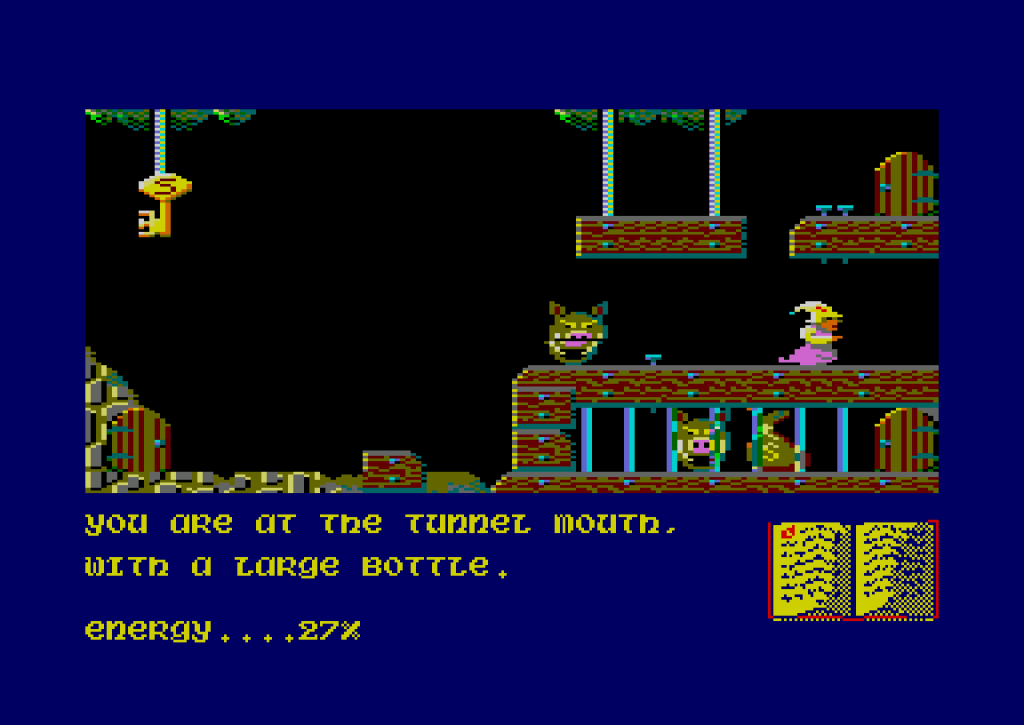
Aside from that depleting energy meter, which is a constant concern because every touch from every nasty making a bee-line towards you the second you enter a screen is going to do damage, and that’s just the beginning because they’ll still be all over you as you try to escape, so you end up coming in and out of screens before they get to you, as you try to work out the optimum (meaning least damaging) route to whatever it is you’re aiming for! There’s loads of back and forth regardless though, as you carry and swap items strategically towards their ultimate destination. and the simple act mixing up the start locations brings far more longevity to proceedings than the slightly pointless high-score table does during what will be very frequent game overs! All the same, as said before, control is precise enough, and it all gradually becomes fair enough too, as you get a feel for what’s where, what it’s used for, and where it needs to end up, even if that is usually among a load of crowded turrets on top of a chateau, or in a cramped dungeon, so it’s rarely not a frantic fight (or flight) for survival, despite the mercifully few number of enemies that tend to be on each screen at once! The variety of locations really gives those lovely visuals an opportunity to shine and shine again, and as well as fancy chateaux (check out my fancy French!), you’ll be travelling in and around more regular castles, more palatial palaces, villages, tunnels, woods, wastelands, waterfalls and even Stonehenge! While I have absolutely zero sense of direction though, the “map” back up the page here also seems to confirm my feeling that there’s little rhyme or reason as to how the whole thing is laid out, but there are hints in the location names, telling you generally where you are in relation to key locations, and the screens themselves will offer plenty of clues too.
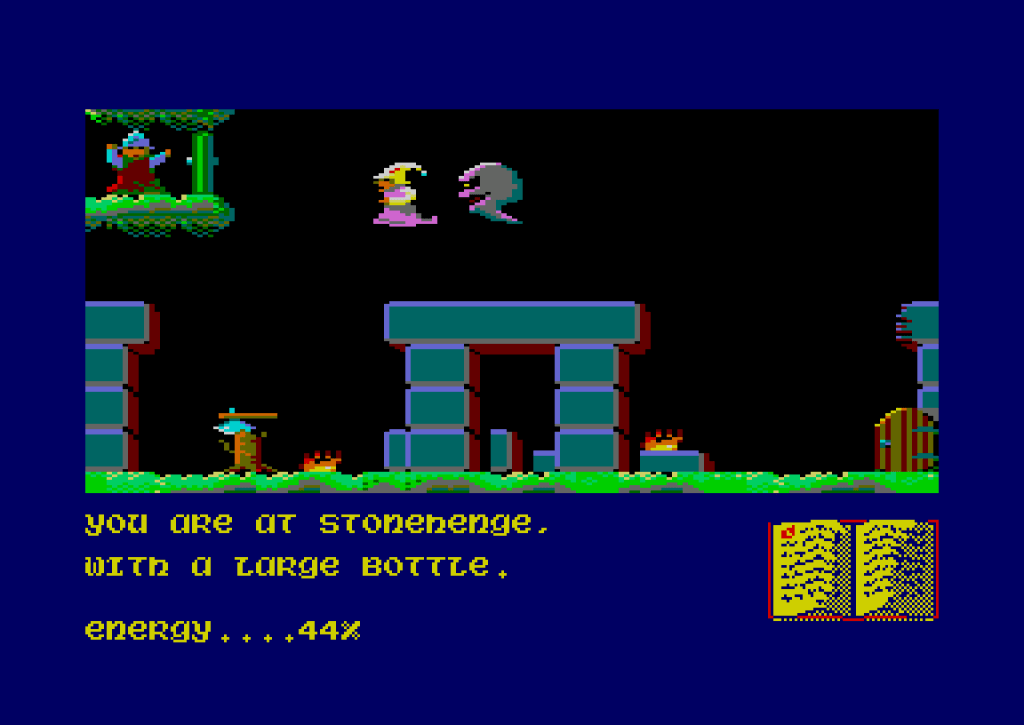
And as was often the case back then, part of the reason to keep coming back to a game was just to see a bit more of it, which I can’t think of many better examples of than this, as if the intended gameplay loop wasn’t addictive enough already, because once you’ve got your head around it and you get into it’s fast-paced, emergent and immersively atmospheric zone, it really is, and you’ll still be mulling things over long after you’ve turned it off the for day… Ten for playability indeed! We should jump to that ten for graphics now too, and I know I joke about the CPC and the weirdoes that owned one, but this thing could really pull off some wonderful things (see Savage, Get Dexter, Werewolves of London, Total Eclipse…) and I reckon Sorcery is about the best of the lot! It shares a very similar vibe to the C64 version but minus the chunkiness and quite as much brown; in fact, the colours at play here, crafted into scenic textures in places, or crammed into minute detail in others, or simply thrown together with wild abandon elsewhere, are at least half that score by themselves! Just looking at your own little character, his outfit and hat alone are a slapdash mix of yellows and greens and a lovely magenta, and while enemies are a little more subdued, they share all his character, and I just love the the blade-wielding hooded Jawa-type guy with the glowing eyes and sinister shuffle!
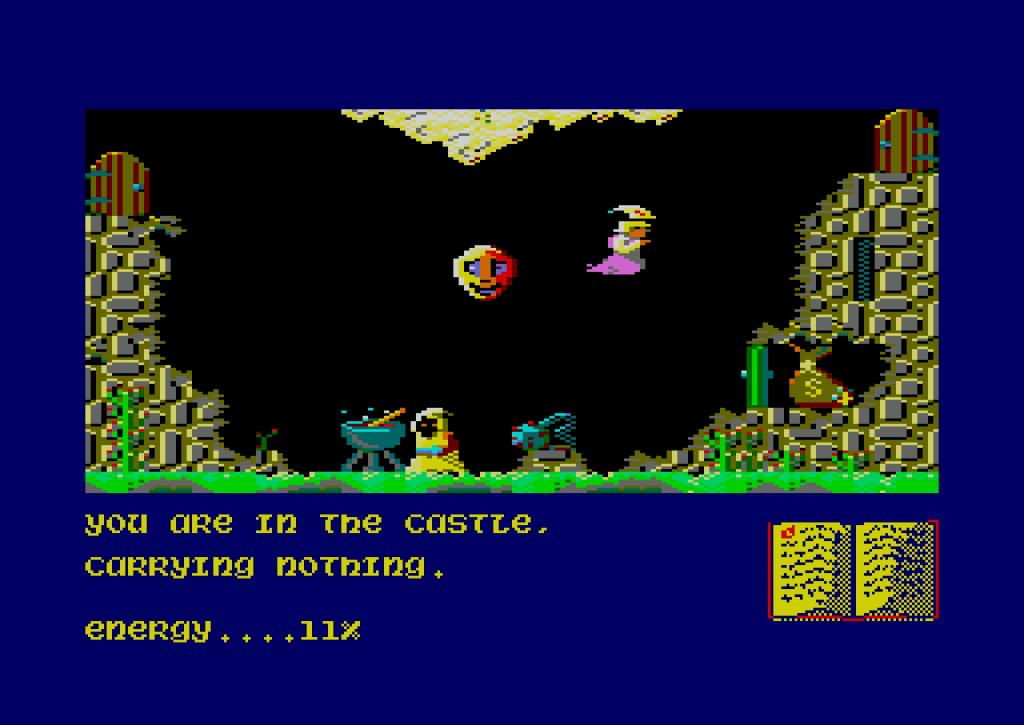
That shuffle too, and the animation on the whole, is also something else! So much finesse compared to other versions, and there’s movement everywhere, from water flowing in the backgrounds to the subtle, snorting sneer of the floating pig-head demon thing, and I can’t think of more lifelike motion of flouncy clothing in any other 8-bit game anywhere! The layout of platforms and other screen features also contributes as much to the general aesthetic as it does the gameplay, with everything carefully placed on a solid black background, not necessarily minimally but sparingly, and to maximum contrasting effect. I wish the same could be said of some of the sound effects though – that non-stop, squelchy door-opening one will soon start to drive you mad, especially when it’s only got some very basic and monotonous beeps or white noise for interactions with enemies and objects for company. It’s all bookended by a suitably haunting rendition of The Sorcerer’s Apprentice on the title and game over screens though, which also gives the C64’s SID chip a run for its money… Actually, that version’s version of the tune isn’t exactly SID’s finest hour, and as for the rest of the sound effects, if you closed your eyes you’d think you were in a World War II air raid simulation! That said, while the Spectrum’s door-opening is accompanied by a gratifyingly simple little blip, crashing into an enemy (and good luck then escaping) is the audio equivalent of a strobe light flashing an inch from your face!
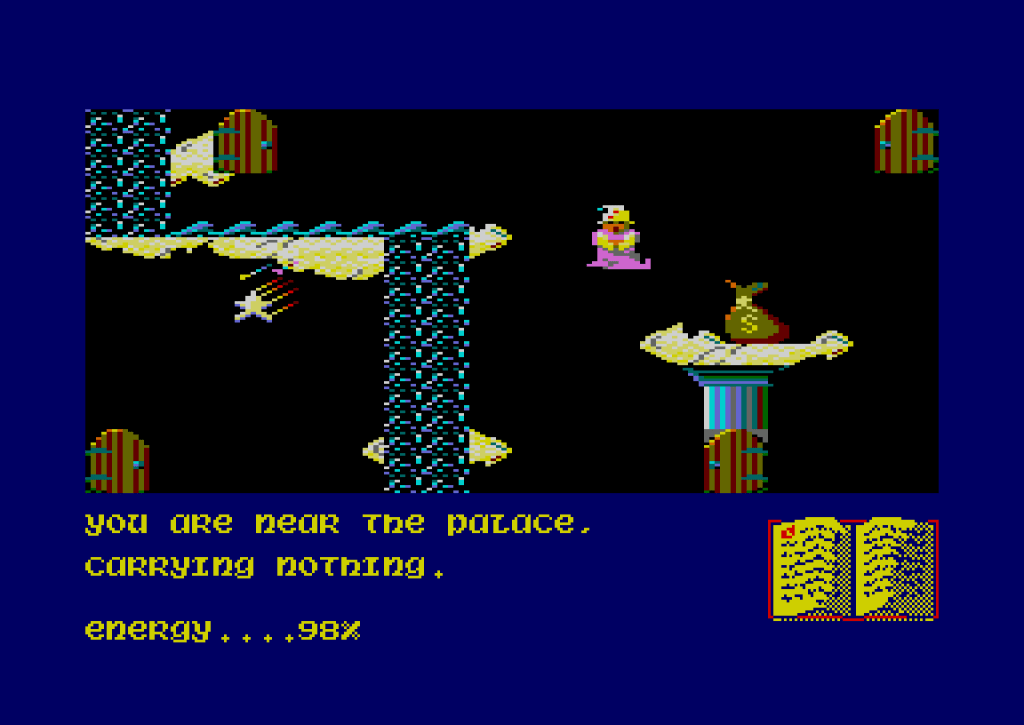
Right, while we’re talking sound, I think that’s a good place to return to Sorcery+ which I mentioned at the start, which came along for the disk-based 128K Amstrad CPC a few months after the regular version we’ve just looked at, and as a so-often disappointed Spectrum +2 owner, was a case of an enhanced version done right… And then some! As just alluded to, sound effects aren’t only less irritating, but the door creaking sounds are recognisably a door creaking, and there are even separate ones for open and close! Interactions with other stuff are similar to before but if you kill something, for example, or free a sorcerer, there’s an explosion or a flourish afterwards, accompanied by what I think is a marginally more exciting little animation, although I was starting to wonder if I was imagining these things the more I kept attempting to jump between two versions. What I definitely wasn’t imagining was how much bigger this version is again! As we already established, the first version of the CPC game increased the screen-count to forty, which are now included here as Chapter One, but it also includes seven additional screens. Same premise though, just more of it, with you rescuing your friends and ganging up on poor old Necromancer at the end. However, once you’ve beaten him, you enter Chapter Two, containing another twenty-eight screens of similar gameplay but loads of new locations, with labyrinths and cellars, churches and hideouts, gatehouses and bridges, and, er, London’s Gatwick Airport! Gameplay is similar, all about progressing towards what’s going to be a final showdown with the returning Necromancer, who would you believe seems to have brought himself back from the dead!
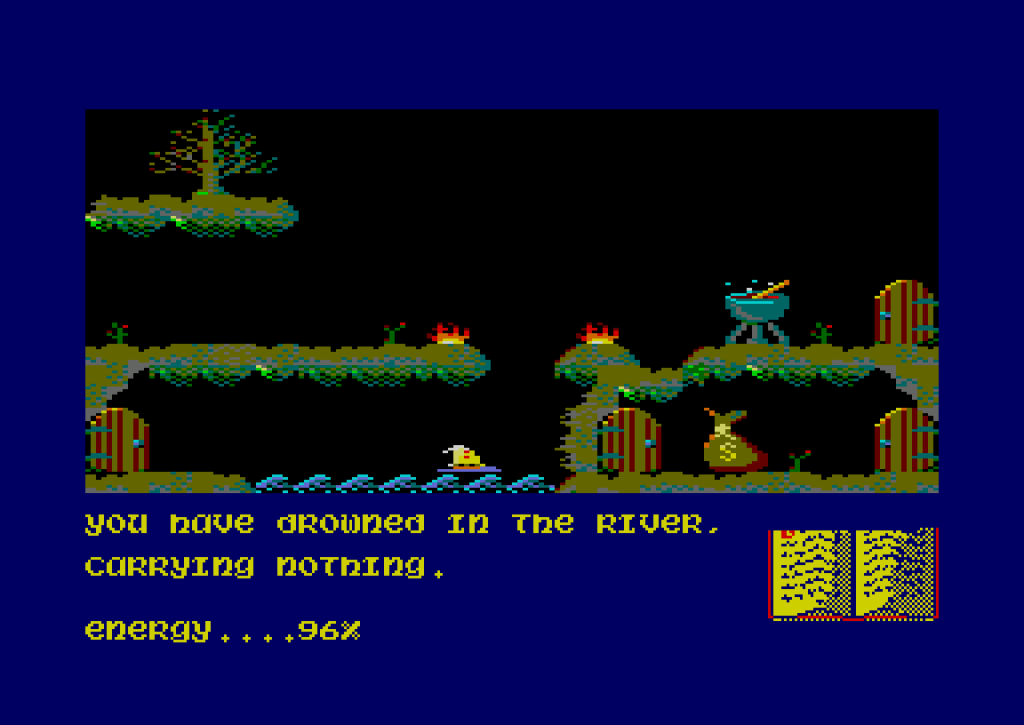
It’s all topped-off by a super-sophisticated, multi-layered take on the original game’s theme tune, and adds up to what seems to be the definitive version of the game, although while I can’t say I’ve seen the end of it myself, I did experience what must have been a short but relatively painful amount of time on original hardware as the disk was being accessed between screens! Doesn’t seem to have hindered its success though, or both its contemporary and retrospective positioning around the pinnacle of Amstrad CPC gaming! I certainly wasn’t disappointed when it finally transcended the pages of an ancient magazine either, even if Chuckie Egg will always be my own number one favorite on there! But whichever version of the game you consider definitive, there’s no doubt it’s on the CPC, and that also goes for the lacklustre Atari ST and Amiga cash-ins that inevitably followed in 1988, and inevitably offer almost no improvement in any respect. And while it’s hardly a welcoming game, and is going to take an awful lot of perseverance to even start making serious progress into, that also goes for the rest of the best of the 8-bit generation as a whole, from Manic Miner to Head Over Heels, and much like the latter right there, you won’t find many better ways to make those pesky Spectrum and Commodore 64 owning friends green with envy… At least that don’t involve horrible, snot-coloured pack-in monitors!
As always, I’ll never expect anything for what I do here but if you’d like to buy me a Ko-fi and help towards increasingly expensive hosting and storage costs then it will always be really appreciated! And be sure to follow me on Instagram, X (formerly Twitter) or Threads for my latest retro-gaming nonsense, and also on Bluesky, which is under my real name but most of it ends up there too if you prefer!
 Retro Arcadia