
Welcome to another in my seasonal series of features covering everything I’ve been spending money on that I probably shouldn’t have been over the past three months! This one is very much influenced by my Winter 2024-25 recap though, when I was lucky enough to receive an Atari 2600+ console for Christmas, which is effectively a modern replica of the original console, meaning you need original cartridges to play on it… And I might have gone a bit mad starting a collection of them, so here’s your warning that we’re a bit Atari-heavy this time out, and not only on there! It’s all good stuff though – even the stuff that popular opinion says apparently isn’t – and there’s plenty more besides, so let’s jump in!

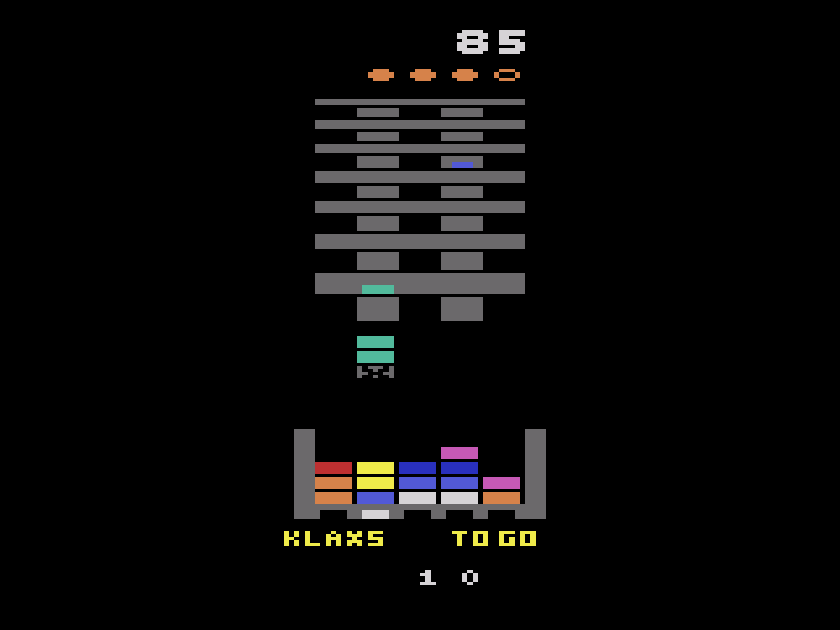
I’m going to start right where I left off last time, when a lovely sealed, boxed copy of Klax for the Atari 2600 was handed to me by the postman just as I was adding the finishing touches to the aforementioned Winter 2024-25 pickups recap! This was pretty much the Atari 2600’s last hurrah when it arrived (in PAL regions at least) in 1992, which is wild in all sorts of ways when you think about how long it had been around by then, and its topsy-turvy state(s) of existence in the interim, and the competition that had come and gone and come again several times over, and the fact that someone was still porting arcade games to it! Pretty amazing it could still pull-off an excellent take on a modern arcade game at that point too, although Atari’s original arcade game wasn’t exactly pushing 1990’s technical boundaries – more like trying to cash-in on the success of Tetris… It even emerged out of AmigaBASIC! Anyway, it’s also a (kind of) falling block-matching puzzler, with coloured tiles coming at you down a conveyor belt, which you have to catch when they reach the end and flip them into matching rows or columns to make them disappear before they pile too high. Once you’ve hit the target number you’ll move to the next level, which will be faster, have more colours and more challenging targets as you progress – score so many points, clear so many tiles, create so many diagonals… To achieve some of these, and also get the biggest scores, you can also stack a limited number of tiles on your paddle to save for later and create more complex patterns, but this is risky because new tiles keep coming, and whatever your level, sooner or later it just becomes a joyfully frantic rush to survive for as long as you can! The Atari 2600 has some great arcade conversions and I reckon they saved one of the best for last with this. From the second you shove the cartridge in, the presentation is obviously simplified but is totally authentic throughout, and the same goes for the gameplay itself, from the various difficulty-based start conditions to the inclusion of secret warps that send you way ahead into its total of one-hundred waves. It’s even got continues, which you don’t see much on here! Movement is precise and responsive, the tiles are vibrant and easy to distinguish in the emerging chaos, and it’s generally impossible to put down. There really could have been no better ending for this wonderful old machine, and no better fit for my new Atari 2600+ console!

As said, we’re by no means done with that yet either, although I think I’ll try and group together all the loose cartridges I need to get through or we’ll be here forever, then we’ll scatter a few other bits and pieces in-between, starting with Tekken 5 on PlayStation 2! I never did get around to Tekken 8 after it arrived last year but when I recently stumbled across a copy of this one from 2005 for next to nothing on eBay, I thought that would do instead, especially as it also contains the arcade versions of the first three games, all of which were old favourites but I’ve never owned myself! The arcade version of 3D shooter StarBlade is also unlockable but takes a bit more work in the mass of regular modes also included, with story and arcade battles, time attacks, versus and team battles, a survival gauntlet, a decent practice mode and also Tekken: Devil Within, a full-on 3D beat ‘em up in the midst of all the one-on-one fighting fun… Although once you’ve got what you wanted from it (meaning StarBlade), I doubt you’ll be back for much more! The fighting elsewhere is far more fluid than in Tekken 4, and more familiar too when those predecessors are old favourites, mostly based around single buttons for punch, kick, jump and guard, which can be deployed high, mid, low or dashing. You’ve also got counters and reversals, and each of the thirty-two characters (of which six are new and one is a variant) also has an unblockable special in their unique arsenal, which, with loads of difficulty levels, all adds up to plenty to keep you out of trouble! I’m not really into the mostly generic electronic soundtrack but there’s a lot of sound adding impact otherwise, and the visuals are great – big, detailed and full of character, with varied and dynamic backgrounds, and it moves beautifully. Maybe not quite my favourite Tekken all the same, but it’s filled a gap very nicely!

As well as the mass of stuff I immediately wanted for my new 2600+ console, I’ve also been making in-roads into my PlayStation Portable shopping list, which is just fifteen or so not too extravagant titles I missed out on first time around but always fancied, so a few months back thought I’d make an effort to get them as and when the opportunity arose. The first of those this time out is Colin McRae Rally 2005 Plus, which originally arrived all over the place (even N-Gage!) at the end of 2004, and while PS2 or Xbox is probably where you’ll get the most out of it, I do love a rally game almost as much as I move my PSP, so here we are! As with its predecessors, we’re talking rally racing simulation, and this entry brought new levels of realism to the party, in part down to its new graphics engine but mostly its new damage engine, from messing up your paintwork to dynamic driving effects based on specific problems you’ve brought upon yourself by playing it like Sega Rally regardless! (Which is also on my shopping list so watch this space). Although the mass of multiplayer and content sharing options options are pretty much redundant now, there’s still a huge amount to keep you busy here, with a career mode spanning thirty cars to race across seventy stages in nine countries, plus standalone rallies, championships, time trials and ghost-car events. It’s going to make you work for getting anywhere in any of them though – even for a rally game, steering at speed is seriously twitchy and is going to take some taming, but the analog nub soon feels right, even if winning anything is still something else entirely, especially when some excellent weather effects kick in! You are very reliant on your co-driver’s instructions too, which fortunately are also excellent, as is the rest of the in-race sound, Lots of nice scenery to enjoy too – this is a very good-looking game with pretty much PS2 levels of detail and lighting, which does mean performance occasionally takes a hit but it’s a small price to pay. Unfortunately, some hefty loading times are a bigger price, and I’d like a few more auto setup or repair options, but once you’re on your way, this is exactly the game I was hoping for.

Here’s the first of several batches of original cartridges I’ve picked up for the Atari 2600+, and a sentence or two on each is the plan, although with a couple of my absolute favourites on the system here, we’ll see how that goes! We’ll start with one of those too, Seaquest, which has probably been pipped by Solaris and Adventure in recent years as my number one on there but I don’t think anything else typifies what it was best at quite as much – undiluted arcade fun in the comfort of your own home! This is a single-screen, underwater take on Defender from 1983, with you rescuing divers in your submarine and shooting enemy craft and killer fish while keeping an eye on your depleting oxygen supply. It’s slick, atmospheric and deceptively immersive, with a very addictive sense of progression, and is just great, mindless fun! Frostbite from the same year wouldn’t be far behind in my favourites list either, blending elements of Q*bert and Frogger (although I think it was developed before Q*bert) as you leap between ice-flows, changing the colour of each block you land on, giving you another one to build your igloo with, which gradually emerges in the background. Once it’s done, you start again, more frantic this time and with more chances to fall in the freezing water, and with more aggression from the wildlife, including a terrifying polar bear that turns up later! Despite better-known similarities, this is definitely its own thing and I reckon is even more compulsive!


I love an ice hockey game but if you want to play on the 2600 then Ice Hockey is about all that’s on offer, although that’s fine because it’s also the only one you really need! It’s a simplified, two-on-two take on the sport, and while it seems primitive now, it was pretty groundbreaking in 1981, with the ability to switch between players and thirty-two different angles to hit the puck from, and is a really fun time on top, especially with two players. I’ve said it before but the 2600 really did have some fantastic arcade ports, and you really couldn’t expect any more of one than 1983’s Jungle Hunt. In fact, all it’s really missing is a bit of the flair of the original in the final stages, which see you first leaping between vines, swimming a crocodile-infested river, leaping over falling boulders then avoiding the local cannibals before rescuing your girlfriend from their big cooking pot! It’s so full of variety and character, and really nails the setting. A very nice showcase for the system! Two games for my set of paddle controllers next, starting with another arcade port that needs little introduction, Super Breakout from 1982. Like with its predecessor, there’s a bit more compromise to this one, as simple as bouncing a ball onto some bricks (or coloured lines) to make them disappear may be, not least that the ball is a square!


However, the paddle control makes all the difference compared to later joystick, keyboard or controller variations on the game, and it plays great, especially when you start exploring all the different game modes, with Progressive being my favourite, where the walls start scrolling down towards you! Our last game is Circus Atari, which dates all the way back to 1980 and is based on an even more ancient arcade game called Circus, and honestly I only really picked it up to give the paddles a workout, although once again, I was keen to see how they much they’d improve on what I’d previously experienced with a controller on various Atari compilations, which I’ve never thought was doing it justice. It turns out they bump up the fun a lot but it’s still very difficult, as you alternate between two clowns on a moving seesaw, bouncing the other up to pop ballons at the top of the screen. And yes, by “balloons” I mean more coloured squares this time! As usual here, it’s all about the gameplay though, and with that added precision I suspected might have been missing before, you soon find yourself in a zone you’re struggling to leave, which really comes into its own with two players controlling the clowns! I don’t think I paid more than a fiver for any of these, so not much money very well spent on a bunch of games which, if they’d been all I’d ever had in the early eighties, would have been more than enough, although today, it seems, maybe not…

When I started putting together that shopping list of games I just mentioned I wanted to add to my PSP collection, there was an arcade-like take on American football on there in NFL Street 2, as well as a more nerdy one in Blood Bowl, but not so much a “proper” game, so I decided to put that right by adding Madden NFL 08! I’m not sure if it’s the best on the system but I had a quick go with emulation before I committed and it seemed like what I wanted, which was something sim-lite, with all the features but also casual enough and without too much faff. Nice presentation too, right at the tail-end of being “video game realistic” shall we say, rather than like watching on TV, with decent commentary, environmental sound and well-chosen rock and hip-hop interludes, then loads of player and pitch detail, bone-crunching animation and super-smooth movement that translates to similarly smooth gameplay (although I understand that if you’d been playing online when it first released back in 2007 that wouldn’t have been the case)! Both offense and defence controls are extensive but intuitive, as is play-calling, and this edition also introduced a read and react system, where you can scan the field for specific strengths and weaknesses before each play to try and find an upper-hand. All the players, teams and modes too – jump into a game, do the full Franchise Mode thing, then there are some very extensive training and situational challenges, and a Superstar Challenge where you can take part in the biggest moments from the 2006 season. I am playing entirely solo but perfectly happily, and I’m not sure how dynamic the difficulty is but it’s feeling good so far. I picked a good ‘un!
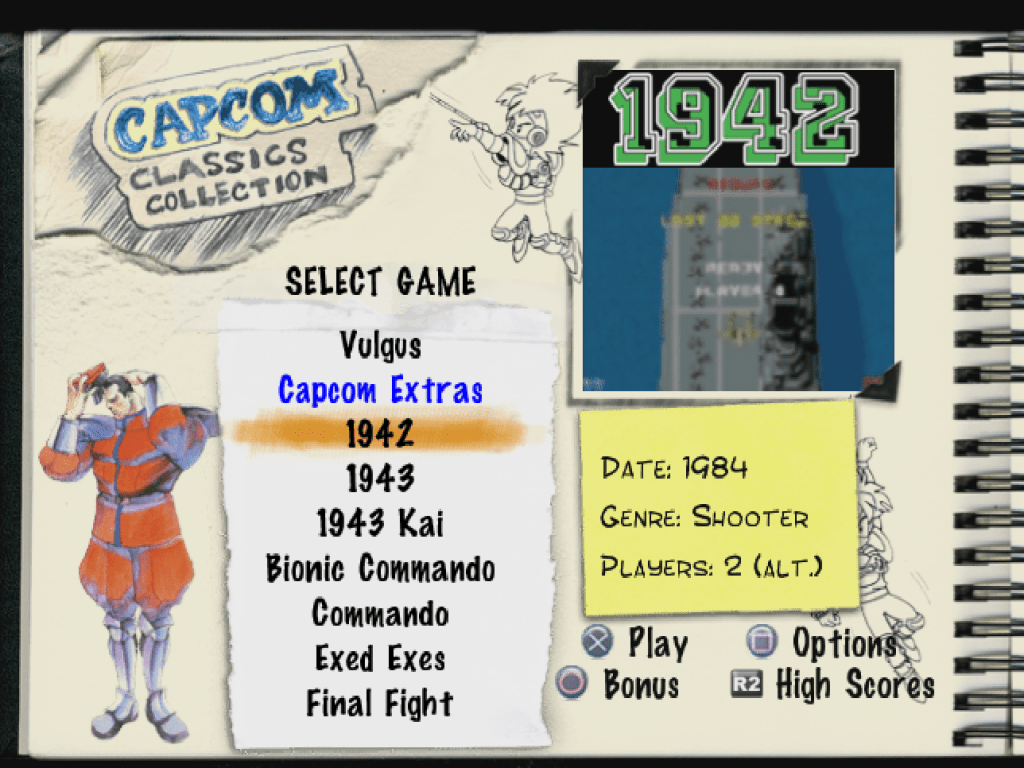
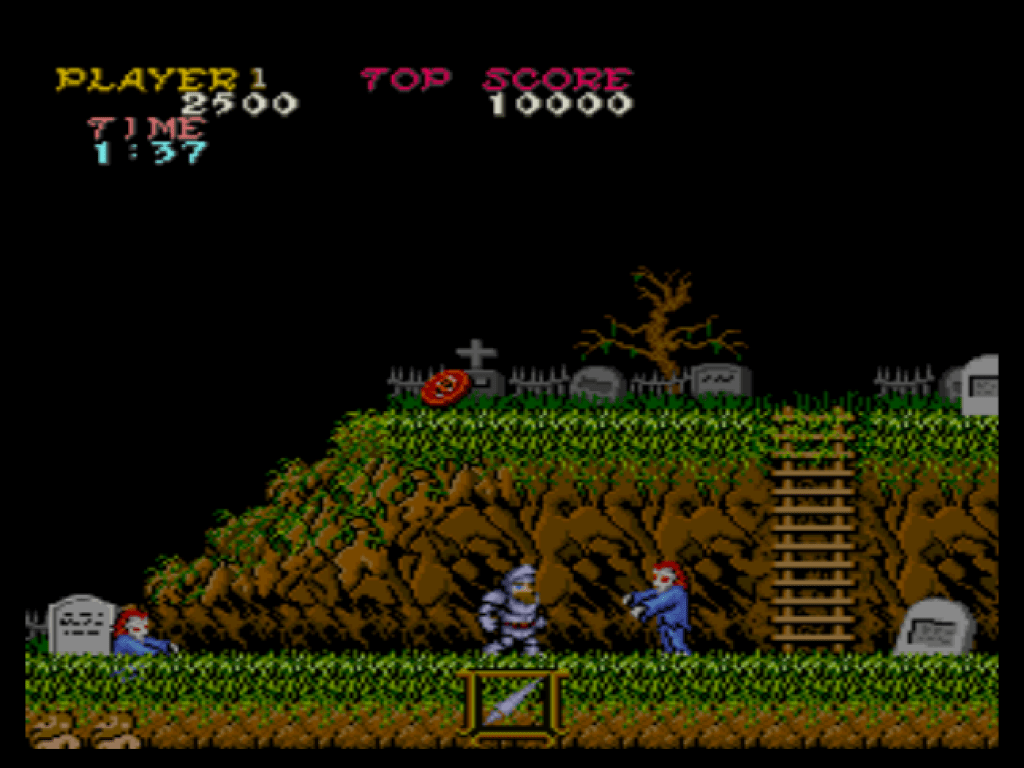
Although I bought a very similar compilation on PlayStation Portable at the time, and most of what’s on this one is now available to me in a dozen other places on top, I’m still not sure how it’s taken me so long to get hold of Capcom Arcade Classics Collection for PlayStation 2! First released in 2004, this includes twenty-two of their finest from the arcades spanning 1984 to 1992, and as you’d expect by then, they’re all pretty much perfectly recreated, with multiplayer also available on the likes of Street Fighter II and Mercs, and alternate screen modes for portrait-mode stuff like 1942 or Commando, where it’s shifting things like score displays and lives left to the side of the gameplay area, making better use of the PS2’s default screen space without messing with original screen ratios. Still not sure I like it though! You can mess around with other video and sound settings too, as well as DIP-switches, and there’s high score saving, and loads of bonus content – histories, artwork, playing tips, and you can listen to original and remixed music from each game. As for the games, on top of what I’ve already mentioned, it’s a really nice mix of all-timers like Ghosts ‘n Goblins, Final Fight and Bionic Commando, and lesser known classics like Pirate Ship Higemaru, SonSon and the fantastic vertical shooter EXED Exes. Several versions of Street Fighter II, 1943 and Ghouls ‘n Ghosts too, and then there’s stuff like Forgotten Worlds and Gun.Smoke and Vulgus, and they’re all worth your time, and it was definitely worth the wait for me!
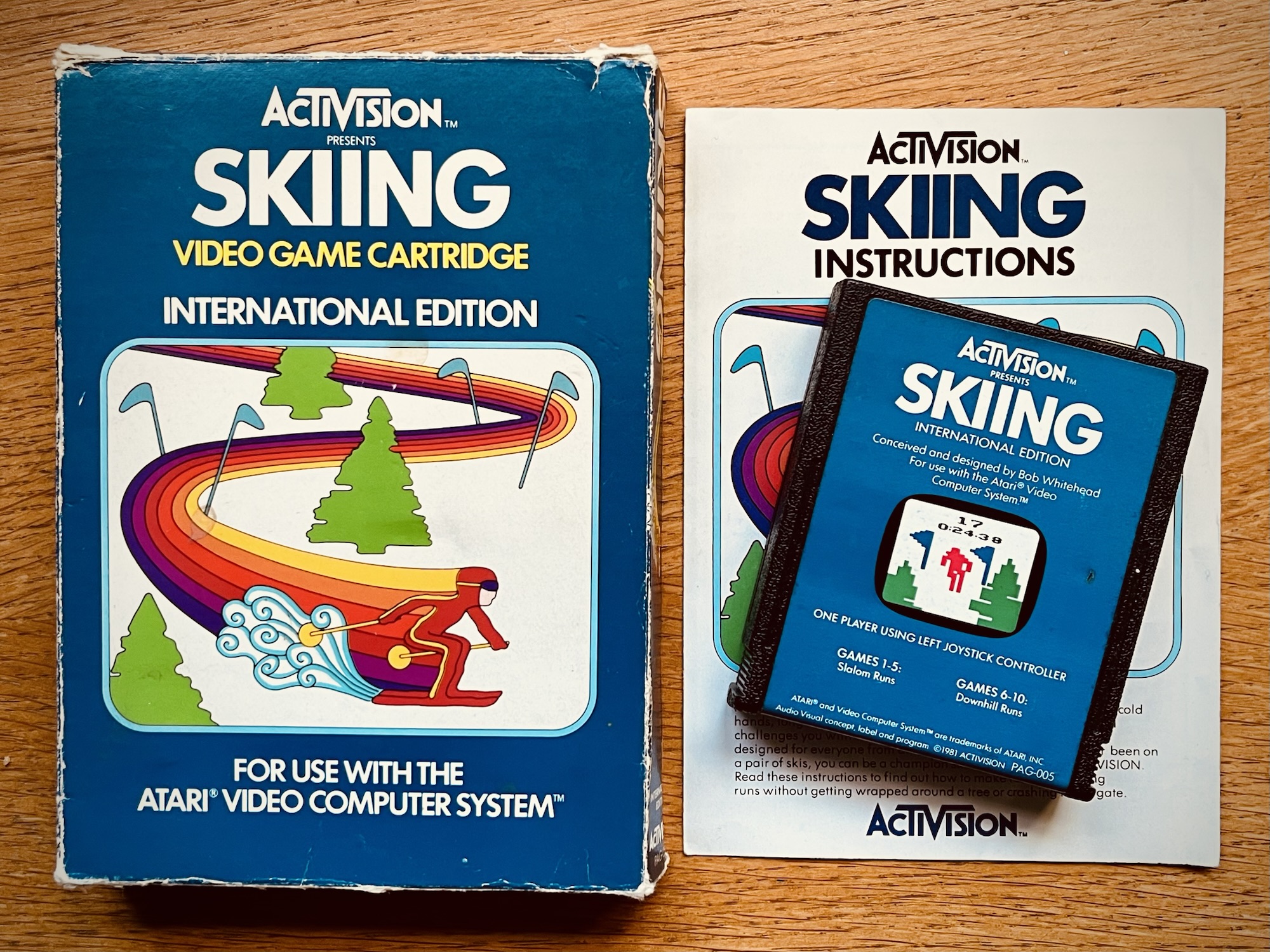

I know we’re all about summer now, but I reckon we can still sneak in a trip to slopes with Skiing on the Atari 2600! I’ll be honest, I’ve always liked the box art for this one, and that’s mostly why I’ve just treated myself to an only slightly tatty boxed copy, although I do enjoy a skiing game too, especially these more primitive ones that had no choice but to focus on nailing how it felt to be throwing yourself down a snowy mountain over trying to put you there. That’s not to say it doesn’t look fine though; just of its time. Which was 1980! Sounds like me… Anyway, what we have here is a race to the bottom in the fastest time possible (also sounds like me!), and we’ve got ten variations of two event types to choose from. In slalom racing, you need to go through all the gates, receiving a five second penalty for any you miss, with progressively faster, longer and more difficult slopes in game modes 1-4, while mode 5 generates a new expert course every time. That works the same for downhill racing, where you’re just going as fast as you can and the only penalty is time lost getting back up if you hit something. The two difficulty switches also come into play, and you can set one so trees are positioned more awkwardly on slalom, or it lets you jump on downhill, and the other will allow you to go off-piste (the edge of the screen), which can be fun for finding new and maybe faster routes in downhill. Skiing itself is just left and right, and the more they’re pointing down, the faster you go, so it’s as realistic as it is simple, but as quick as it also is to master, mastering each course in each game variation – especially the harder slalom ones – is going to take some doing, and then there’s almost as much fun to be had saving your best times in a notebook and trying to shave tenths of seconds off them later! Like I said, of its time, but it’s bright and breezy across the board, and a whole lot more than just a pretty box!
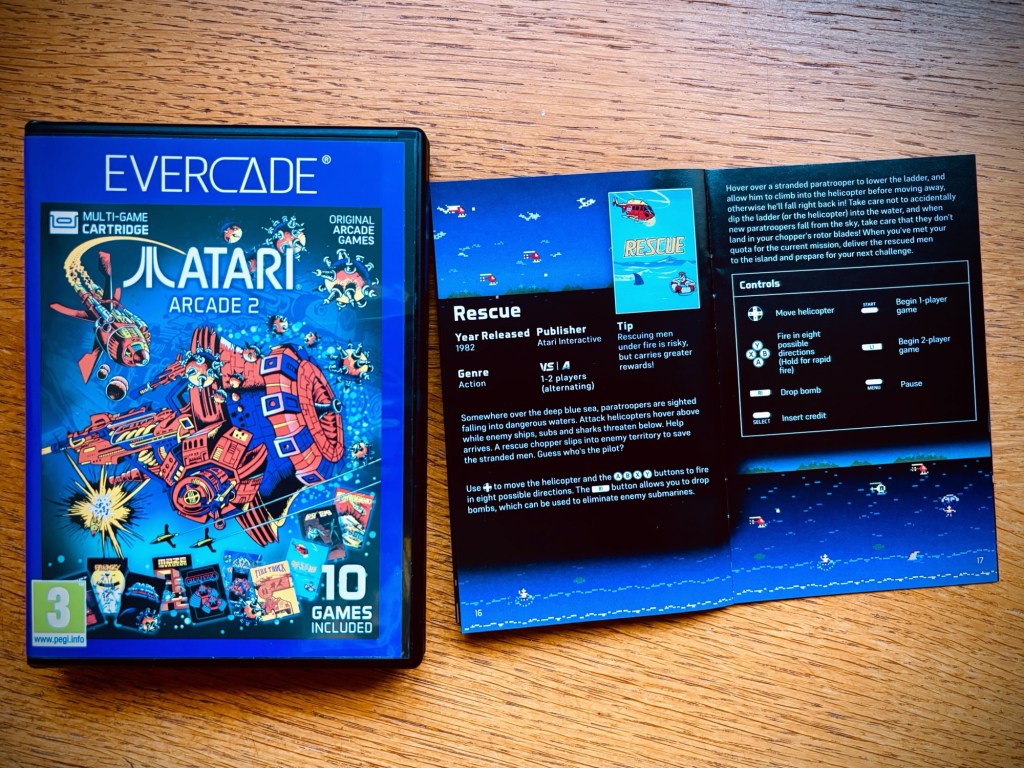
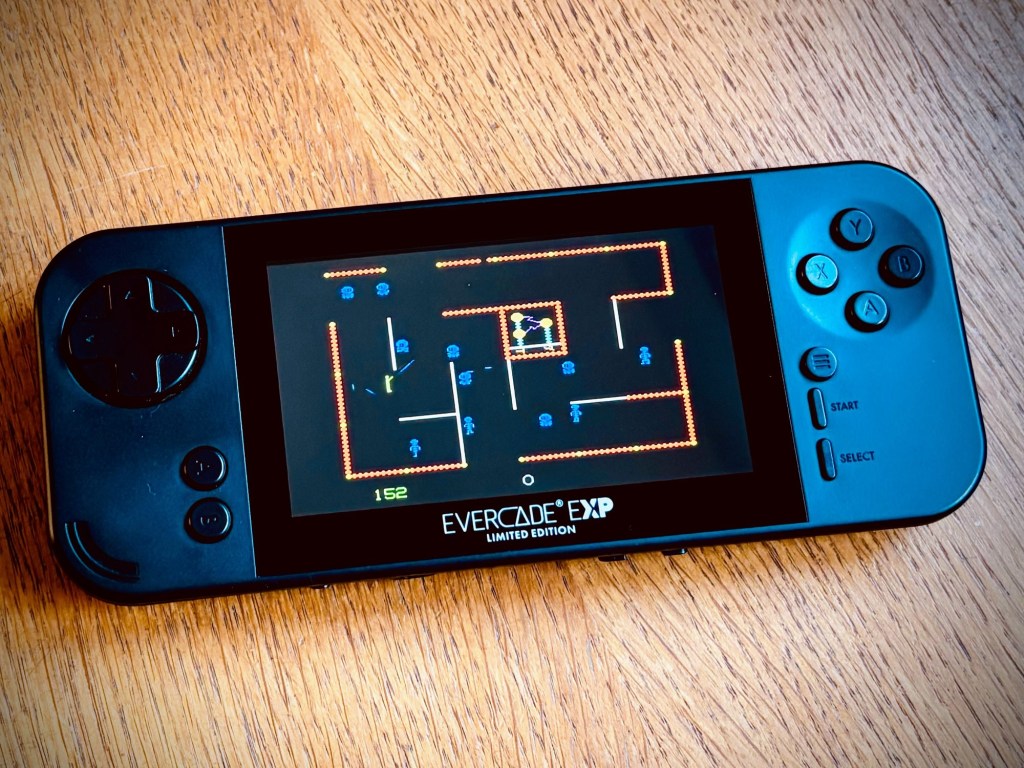
A quick look at everything on Atari Arcade 2 for Evercade now, featuring ten games from the early eighties that I think are mostly titles Atari picked up from Stern, a few of which will be familiar (meaning you probably own them several times over already) but otherwise it’s a pretty fresh and intriguing mix. We’ll go into each in turn in a sec but as usual with these, it’s all on a cartridge in a real box with an excellent manual covering histories as well as instructions, plus some stickers, and you’re also getting slick, sortable on-screen menus, game info screens, quick saves, TATE mode handheld, and the recent addition of DIP-switch settings for exactly these kind of games, which we’ll have a sentence or two on each of now, starting with Berzerk. This is from 1980, and you’re trying to escape a vast, top-down electric maze full of killer robots you can try and get rid of entirely from each screen for extra points, but take too long and the legendary Evil Otto will be after you! Like most of what’s here, it’s very simple to look at but his madcap primitive speech will never get old, and likewise the relentlessly addictive gameplay. Frenzy (pictured below) is its 1982 follow-up, offering similar maze-shooter gameplay but with loads more going on, more variety, and more Evil Otto! Not sure it’s quite as widespread today as its predecessor but it’s another good ‘un! Tazz-Mania doesn’t involve a Looney Tunes looney but is a kind of Robotron-type arena shooter with a twist, because as if that wasn’t frantic enough, the walls are closing in on you too! Although it’s been around since 1982, I’d never even heard of it before, so that’s an added bonus on top of a fun game. I do know Lost Tomb though, another 1982 overhead maze-shooter of sorts, not unlike Frenzy, but twin-stick and with a hint of Indiana Jones, as you collect treasure along the way through this big, non-linear pyramid. Possibly my favourite thing on here! Maze Invaders isn’t far behind though – a fast, loose and very dynamic take on something like Lock ‘n Chase, with you collecting stuff and escaping each constantly shifting screen. Unfortunately, it never saw the light of day in 1981 after it failed field-testing, but I reckon it was the field-testers that failed because this is also fantastic!
Unlike Moon War, which comes from 1981 and is something like Asteroids on a scrolling backdrop. It’s fine but not exactly welcoming, and might demand more of the modern player than they’re prepared to give it. Glad it’s here to be discovered though! Dark Planet is also going to take some effort, which the folks at Blaze have certainly gone to with this 1982 obscurity. It originally came overlaid on a modelled plastic backdrop, with a 3D effect created by reflecting different colours across the cabinet, and they’ve completely recreated it for inclusion here, and while it’s also not the most immediate of shoot ‘em ups, and it’s tough to see bullets (especially playing handheld), what you’re getting is pretty cool. 1982’s Rescue is a more straightforward prospect, with you in a rescue helicopter, picking hapless paratroopers from the sea while fending off enemy aircraft, submarines and sharks. It’s fast-paced, fun and very addictive, with some nice early parallax effects too, and is another nice discovery here. Which means Minefield is too… It came a year later in 1983, and is kind of a rebuild of Rescue, with the same look and feel but this time you’re in a tank crossing horizontal-scrolling enemy ground, a bit like Moon Patrol meets Breakthru, and it’s a blast once you get into it. Last up is Fire Truck, all the way from 1979, with you controlling the titular vehicle from above, racing across the top-down, multidirectionally-scrolling town, although in reality, you’re nursing it around like a rally car on ice! It’s monochrome but impressively atmospheric, and while it’s always been better two-player as originally intended (with cab and trailer controlling separately), you soon get used to it solo plus computer, and I’ve always enjoyed it this way in its frequent appearances on other compilations. Glad to have it here too though, and same for Berzerk, but the real value in this compilation is in what you don’t often get elsewhere, as archaic and inaccessible as some of it might be!

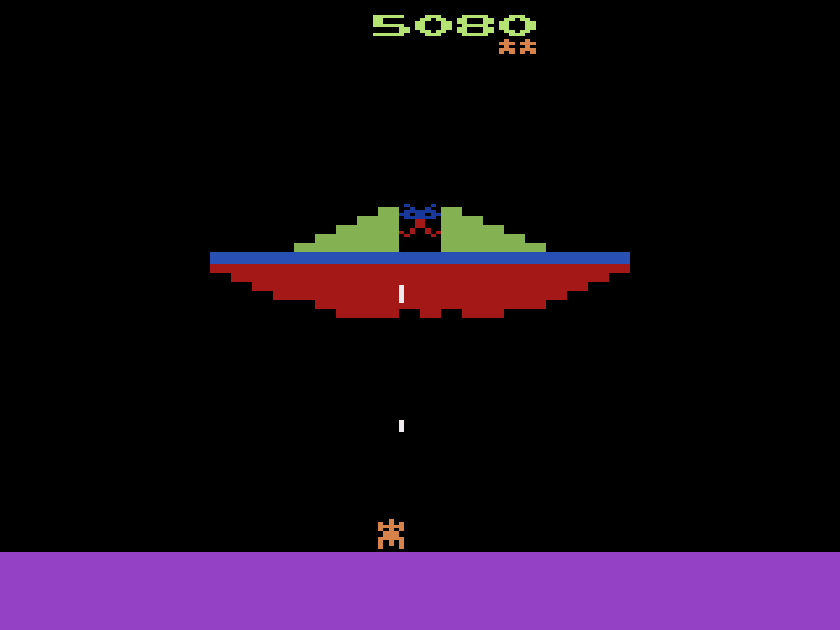
Not sure how much this counts as retro, or how much we need even more Atari stuff here, especially for this creaking old system, but it’s cool, so it’s staying! When Mr. Run and Jump first arrived in 2023, it was Atari’s first 2600 cartridge release since 1990, which was wild in itself when, as said earlier, you think about how long it had already been around by that point! Hasn’t aged a day either, as you travel left to right through six colour-coordinated worlds, jumping over obstacles, climbing ladders and dodging deadly enemies to rescue your dog, Leap, who’s run off in the direction of the Dark Realm! Presentation is simple but full of character, with smooth movement and super-precise controls – think blocky Meat Boy! Come a cropper and you’ll be sent back to the start of the level, which isn’t so bad, but while there’s no lives, your score is a depleting timer, so every death is still costing you, although you’ll be doing well to reach the end when whatever’s left becomes your final score! I haven’t even got half way yet but that’s all on me because while the game is tough, it’s also perfectly balanced, with each level and its own flavour of fiendish obstacles quickly becoming as much a puzzle to solve as a test of timing and reflexes. The different monsters each present their own challenge too, especially when they gang up on you, which can be properly cruel, but I don’t think it ever frustrates much. Again, any frustration is on you! As good as it is, I’m not sure there’s the original $30 of value here, but I’ve already had my money’s worth out of the less than a tenner (sealed!) I just spent on it, and I’m nowhere near done yet! By the way, credit to Atari for the pic here – way better than me trying to get it off a TV screen!
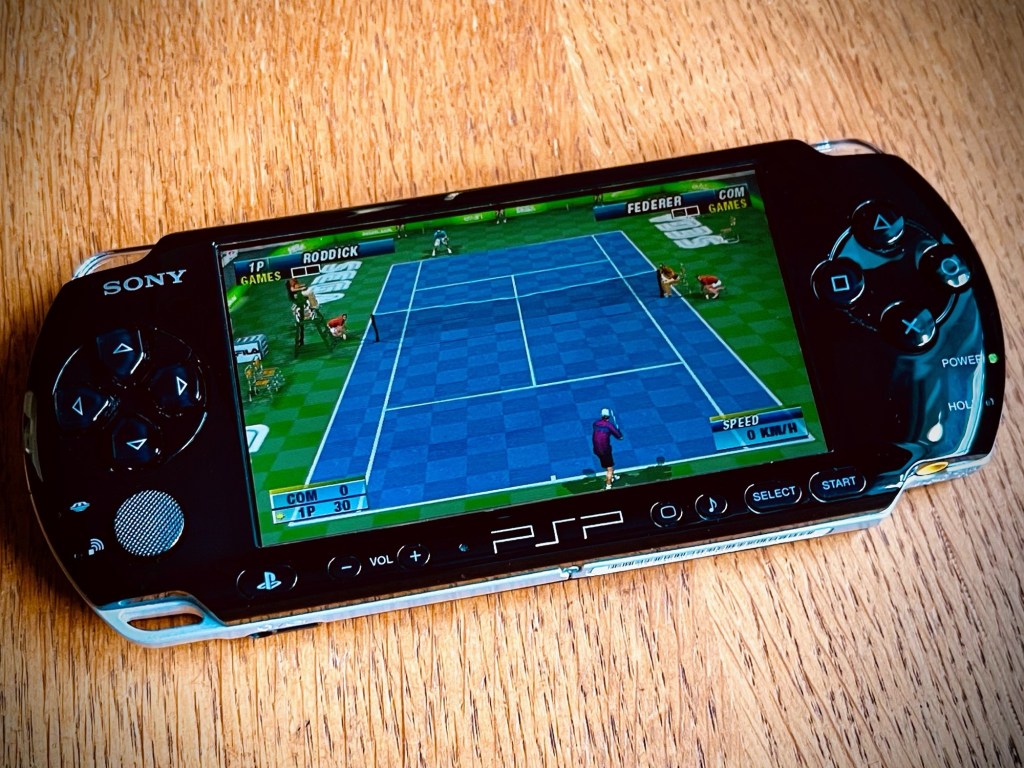
I’ll subject you to some more crappy pics of a PSP screen instead because I’m a big fan of Sega’s Virtua Tennis games, and it turns out that’s a great place to play them! Virtua Tennis: World Tour first came out in Europe and North America in 2005, then became Power Smash: New Generation in Japan the following year, and I think was a PSP exclusive. It’s got fourteen real-life players to play as and against, and we’re talking the likes of Maria Sharapova, Venus Williams, Tim Henman and Roger Federer, although the World Tour bit of it actually involves you creating both a male and a female character of your own and taking them through a series of singles and doubles tournaments, trying to become the world number one. Between tournaments, there are a bunch of mini-games to improve your skills, like Tank Attack for your stroke and Pin Crasher for your serve, and then there’s other modes including quick matches, various tournaments, exhibition modes and a nice variety of multiplayer modes, although as alluded to before, good luck even getting your PSP online nowadays, let alone finding a game! More than enough solo stuff here though, and as well as more than decent AI and a really pleasing flow to things, it all feels so good to play on the analog nub-thingy, with serves, regular shots, lobs, slices, drop shots and smashes on buttons, while shot strength is down to you setting up your return in time, and ball direction is totally intuitive on the directions as you’re hitting the ball – which, most importantly, you can actually pull-off from the outset, unlike many of the more stuffy tennis games! Arcade heritage or not, the ball physics are good and feel distinct on the different surfaces, and the presentation is equally slick, with realistic thwacks and grunts really adding some weight to the gameplay, and recognisable player models moving smoothly and acrobatically, with good-looking between-play close-ups and replays, and the five well-known “fictional” courts look really great too, full of life and colour. Which also nicely sums up the game, which is just immediately fun, and that’s so rarely the case with these!

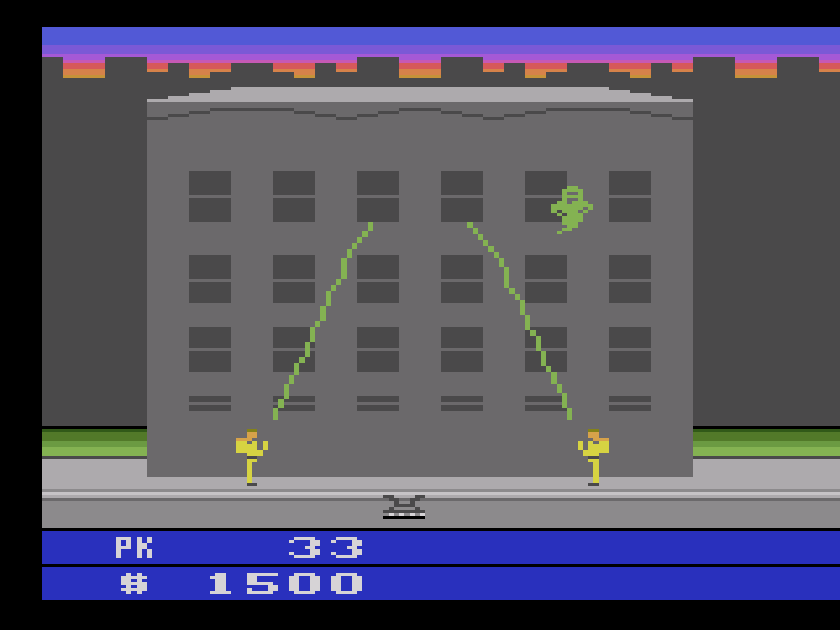
Here’s the next batch of Atari 2600 games in what’s quickly becoming my not-so-fledgling collection anymore! We’ll go with 1983’s Phoenix first, an arcade port that, according to my Top Ten Favourite Fixed / Single-Screen Shoot ‘Em Ups countdown, I prefer over the original! It’s as faithful as you could hope for, with multiple stages, the big boss at the end, fantastic visuals throughout, so much variety and so much action! Next is an action-adventure from 1982 by the name of E.T. The Extra Terrestrial that’s way better than the hype suggests, especially if you read the instructions! Yes, it’s over-egged and under-cooked in several respects, but you can’t fault its ambition, and I like how it looks and mostly how it plays across six screens (plus pits!), finding what you need to “phone home.” And no one can deny it’s a piece of gaming history! No one can deny that Ghostbusters from 1985 is a movie tie-in done totally right either. It’s an impressively not very scaled-back version of one of the Commodore 64’s finest, with you setting up your own ghost-busting franchise, patrolling the city catching ghosts and keeping the Stay Puft Marshmallow Man at bay, then going for Zuul if all’s gone well. It’s understandably barebones but the game I love is all there, and it’s even got the theme tune too!

A couple more arcade conversions next, starting with another of the best of them, Popeye from 1983, and actually, everything I just said about Ghostbusters also applies here! It’s a single-screen platformer, with you going up and down and all around, catching a certain number of whatever Olive is chucking down to you from the top while avoiding Bluto, as well as Sea Hag’s projectiles. Grab it all and you move to the next of three levels, which are authentic if basic, and that goes for the presentation too, but not the gameplay, which is just about spot-on! The last of our arcade ports for now is 1982’s Joust, which probably couldn’t be much better and is fine but isn’t quite enough for me – I think if I had a player two it might make all the difference though. It’s recognisable but really cut-down, and while the flying knights knocking each other off their buzzards gameplay more or less feels right, there’s not a lot going on in this version, and it soon gets a bit tedious playing solo.


Enter Midnight Magic to make the save, where I’ve had exactly the opposite problem, and genuinely struggle to put it down! It’s a pinball game from 1985 that I’ve never really played before, with some impressive ball physics (for a square!) and plenty of features across the table, with drop targets, bonus multipliers and rollovers, and optional extra drains or blockers for a bit more or less challenge, as you desire. In fact, all it’s missing is nudge and tilt, which were in its wonderful predecessor, Video Pinball, all the way back in 1980, but are weirdly absent here. You soon don’t miss them though, and once you’ve got to grips with a few of its scoring mechanics, going for high scores is so much fun, to the point this game played havoc with my recent feature on my top ten favourite pinball games, which was all done and dusted but I can see me having to come back to it at some point in the future now this has come along! Anyway, nice problem to have, and another excellent batch of new old carts!

I called in to see my Mum after work on her birthday a couple of months ago, which my youngest brother had also done, and we got onto the subject of old toys, and he mentioned he’d come across his Donkey Kong Game & Watch in a recent clear out in his loft. The orange one, I asked? Yes. With two screens that fold up? Yes! I don’t remember him ever having this, and he would have only been 3-years old when it came out in 1982, but anyway, guessing it was about to go on eBay regardless, I said to him I’d give him whatever the asking price is on there instead because I’ve been after it for ages. That was that, but I said I’d stop at his place on the way home to pick up some stuff he had for me, and when I did, there he was with an orange box in his hand for me to just take with me! Our neighbour definitely had one in the early eighties, and I used to play it whenever I could, so this was proper Holy Grail stuff for me, and like most of these games, it’s really stood the test of time too! It’s a small handheld that opens up into the dual-screen format that inspired the Nintendo DS, and I think it was also the first appearance of the cross-shaped d-pad we still use today. The game itself is adapted from the arcade original, with you as pre-Mario Mario making your way up the girders on the bottom screen, jumping over the barrels rolling down from the top, then flipping the switch to activate the crane on the other screen, which you have to time a jump onto to rescue your girlfriend, Pauline, defeat the big monkey, and do it all again. The gorgeously detailed monochrome sprites on colourful screen overlays are timeless, and the beeps and blips that accompany them are so nostalgic! As is the score chasing, one more go gameplay, from a time before most of us had consoles or computers, and one game that played as well as this was literally all you needed. All you were getting too, if you were lucky, so I’m very happy to finally have one of my own!

Okay, one more flurry of 2600 carts, hot on the heels of the last one but then we’re done! I’m also pleased to report that with this last lot for today, my buying addiction seems to have slowed up a bit too, so although I’m about to present you with yet another six of them, I think it’s going to take me a while to get to the next six, especially now my shopping list is mostly in the realms of harder to come by! At the opposite end of that spectrum, Pac-Man was the system’s biggest seller despite leaving a bit to be desired in many people’s eyes, but if you’re able to get past the extreme simplification of the visuals, the horrible sound and questionable collision detection as you travel around its single maze, I don’t think this port from 1982 is too bad! In fact, once your senses adjust to it, it’s pretty enjoyable, and certainly doesn’t deserve the abuse it still gets, even if its sequels are admittedly what you want to be playing on here. Maybe I’ll be able to get hold of one of those for next time and we’ll find out…


These are in no particular order so I’ll go with Tennis next, a pretty pioneering sports-sim from 1981 that might play as simple as it gets but does a very good impression of the sport for the time, with a bit of nuance and a nicely competitive back and forth, especially with two players. Speaking of which, let’s jump to Fishing Derby! This one’s all the way from 1980, and has two anglers sat on the docks either side of a lake full of fish and a big (lake?) shark, who’ll try and nab them off you before you can land them to add to your weight tally. Especially the big ones at the bottom! It’s an iconic game with a great cartoon look and is a real blast to play as you try to catch fish faster than the other guy while avoiding the shark! That was by Activision’s David Crane (of Pitfall fame), and so was Freeway a year later, so we’ll go there next… It’s kind of like Frogger but also has plenty of personality of its own, as you race to get as many chickens across increasingly busy roads as possible against the clock, and once again, ideally against another player. It’s colourful, fast-paced, pleasantly infuriating and just a lot of fun!

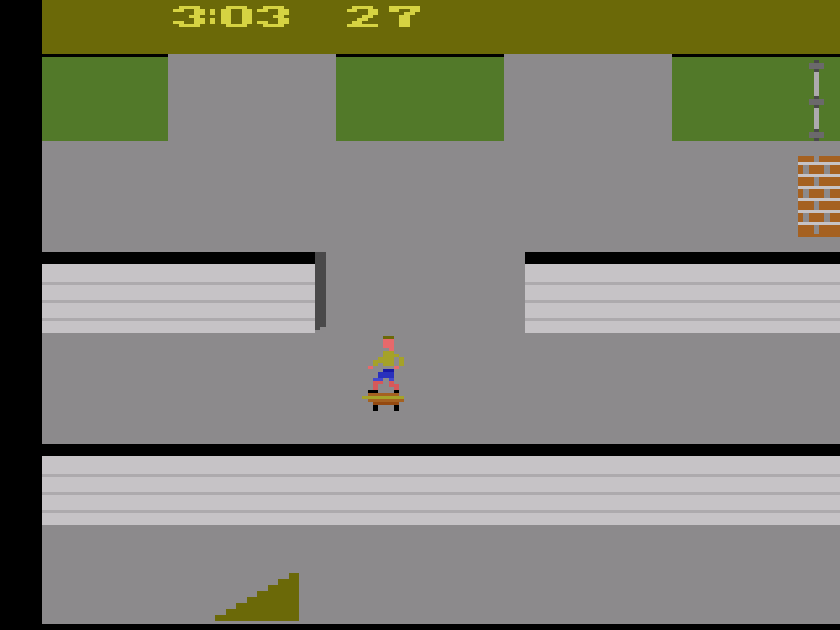

We’re going to fast-forward all the way to 1987 now but stick with David Crane again for Skate Boardin’ (or Skate Boardin’: A Radical Adventure). Far more sophisticated thing too, as you skate around a maze-like, top-down-ish town, looking for the thirty tricks you need to perform within a time limit; they could be ramps to jump off, pipes to crouch through, and you can even get a tow from passing cars to save a bit of time finding them! It takes a while to get your head around but once you do, it’s hard to leave alone, and has some really nice music too! Our last game for now is another arcade conversion, and it’s another take on Donkey Kong from 1982. Although maybe a bit more faithful than Pac-Man, it’s had similar treatment, with only the opening falling barrel stage and the rivet-popping stage making the cut, and graphics and sound are toned down too, but it’s all authentic enough, and at the very least, is way better than all the clones (or klones) I used to enjoy on my VIC-20 at the time! And at less then £20 for the lot, I reckon that’s another decent haul! Which is a good place to call it a day for this time, so I hope you’ve enjoyed having a look at this stuff, and didn’t mind all the 2600 love too much! I also hope you’ll join me again in precisely three months to see what’s turned up over the summer, but as always, don’t tell the wife!
As always, I’ll never expect anything for what I do here but if you’d like to buy me a Ko-fi and help towards increasingly expensive hosting and storage costs then it will always be really appreciated! And be sure to follow me on Instagram, X (formerly Twitter) or Threads for my latest retro-gaming nonsense, and also on Bluesky, which is under my real name but most it ends up there too if you prefer!
 Retro Arcadia