In the unlikely event I’m ever asked to name my favourite game series, among the likes of Silent Hill, Resident Evil, Castlevania, Mega Man, Cotton, Metal Gear and Darkstalkers that would all, no doubt, be in the running, you’re also going to find “The Games” games by Epyx! They began with Summer Games in 1984, which came out on all the usual home computers, as well as a bunch of consoles – from the Atari 2600 all the way to the Sega Master System – some time later. Its sequel, Summer Games II, only appeared on the Commodore 64 though, and it was only really when they both appeared on various compilations based on games for that machine on Evercade, from the end of 2022, that I properly sank my teeth into either. Reckon I’ve made up for lost time since though!
Back in the eighties, Winter Games quickly followed these, and I played it to death on both my friend’s C64, usually in big multiplayer sessions with all our brothers and sisters, all of whom soon became experts, and then also on my own ZX Spectrum. The C64 is always where I’d consider home for any of these core titles though – the presentation was always out of this world, and they seemed to always be tuned to play on there ahead of anywhere else. This was also the case when the next game, California Games, arrived, which my brother had on his Atari Lynx this time, but that was a proper cut-down version, and proper multiplayer sessions once again either happened on the C64 or the Spectrum; that said, I think this time the Master System version might be the best of them… By the way, as I write, I am planning to do one of my “Revisiting” features on California Games, where I’ll be expanding on an ancient Lynx feature I did and will get into all that stuff on top!
World Games was next, and it’s why we’re here now so we’ll come back to all the details, but the real reason behind why we’re here now is that although we were there from the outset again, none of our “Games Gang” ever really clicked with World Games, and we dropped off it pretty quickly – probably to go back to Winter Games again! Okay, a fat guy trying to balance on a rolling barrel isn’t quite as glamourous as surfing on California’s Pacific coast, and I’m sure that came into it, but as for the events themselves, I really don’t remember anything wrong with any of them beyond being a bit weird, and the format hadn’t changed much, so I was really keen to come back and give them a proper go to try and find out why I’ve never really been back since either, while I never really stopped and I’m still nowhere near done with some of the others four decades on!
That was the end of those core titles in the series, but the 16-bit era brought with it beefed-up versions of past hits with The Games: Summer Edition and Winter Edition, as well as a sequel to California Games, but none of them ever captured the magic of those old C64 games in particular for me, and while I’ve enjoyed them all well enough over the years, and they certainly complement the series’ heritage, none of them are in my top fifty games list like Winter Games (top twenty actually!) or California Games are. Neither is World Games though, so let’s get into that now and see what we can come up with! By the way, I mentioned Evercade a minute ago, where all the Commodore 64 originals are now available across The C64 Collection 1, 2 and 3, and that’s where I’m going to be playing World Games, on the second of them, which also includes California Games. However, for a slightly more authentic experience with a proper joystick, I’ll be jumping across to The C64 Mini where it was also a pack-in. And that seems like an appropriate place to get started!

World Games first appeared just in time for Christmas 1986, meaning I would have first come across it in the days after that – I distinctly recall sitting in my friend’s bedroom with it around Christmas but couldn’t have told you which one! Anyway, it was initially available on the ZX Spectrum (where I’d later have my own copy) and Amstrad CPC as well as the Commodore 64, and it seems like on the Atari ST too, which was very early for that to release alongside the usual 8-bit suspects, not to mention very pricey at £25.95! I was still a good three years from having to worry about what things cost on the ST though, although to this day I’ve still never played that version, so maybe I’ll fire it up alongside my old Spectrum one before we finish here a bit later. Wherever you play though, this time we’re travelling the entire globe to compete in eight very diverse and sometimes very unusual international events, from the Highlands of Scotland to the treacherous cliffs of Acapulco, as we attempt to become the World Games Champion!
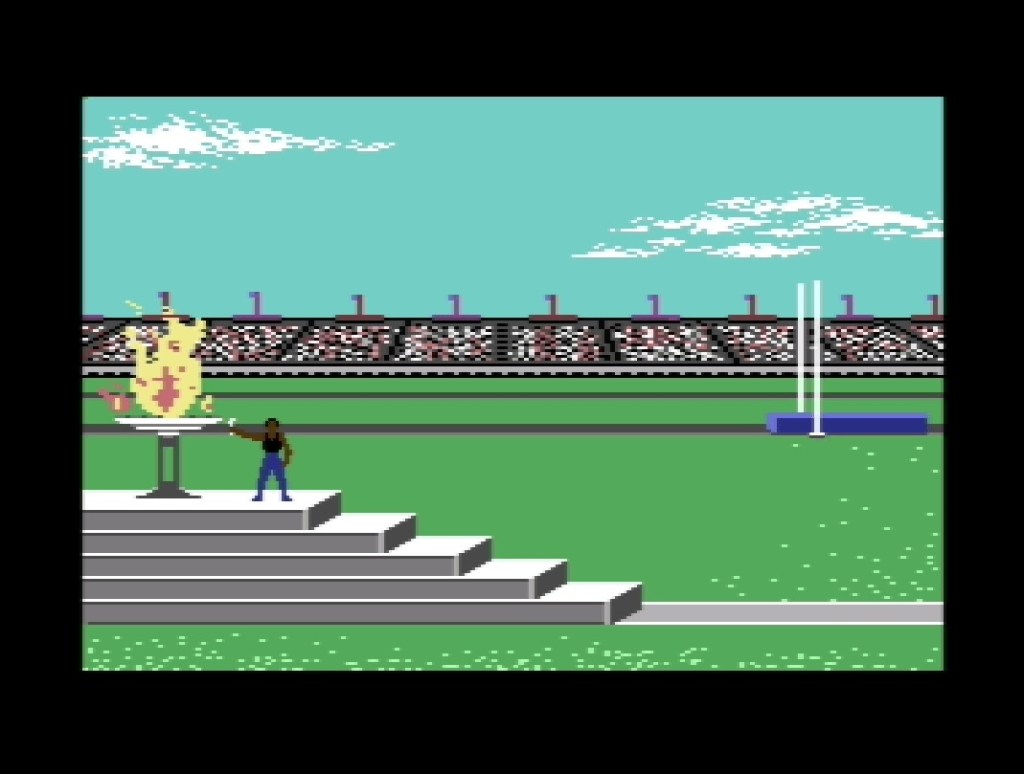
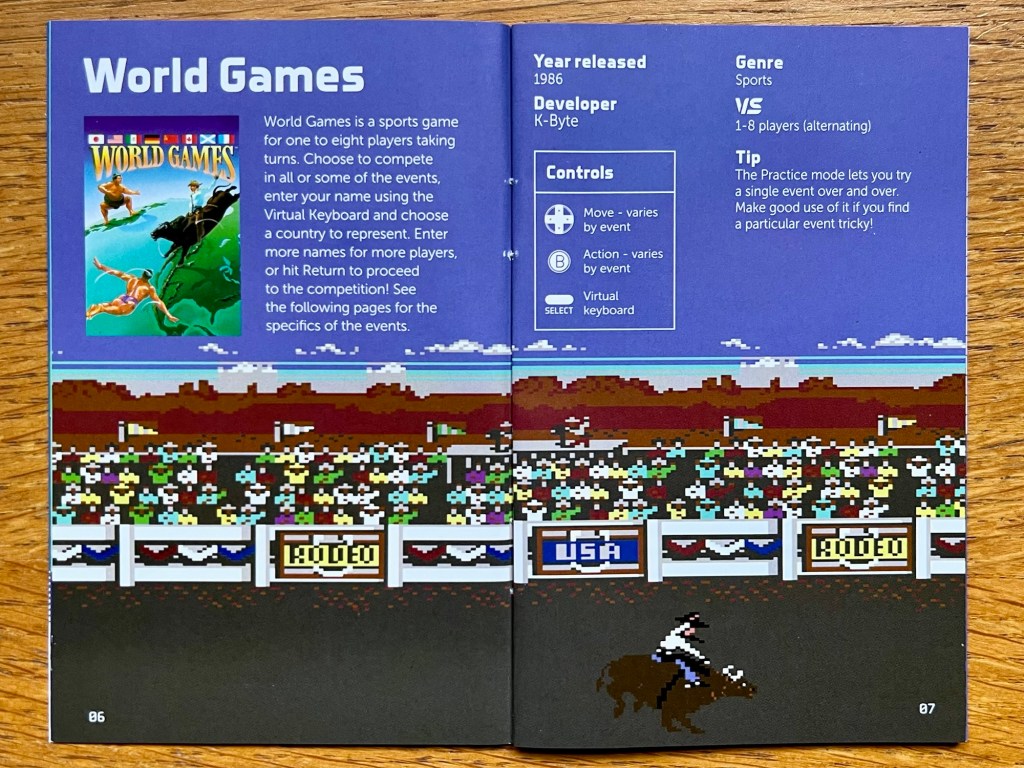
Up to eight players can play at once, and you’ve got a choice of competing in all eight events, competing in some events, competing in one event, or practicing one event. However you choose to compete, you each then need to enter your name and pick any one of eighteen countries (or just “Epyx”) to represent before starting. And if you’re playing solo, a press of enter on the name entry for player two will get you straight into the action, with the computer taking charge in the couple of events with two contestants, although I think that’s also an option for multiplayer too, with you taking turns instead. We’ll come back to all that! As the events are so diverse, I think we’ll get into each one in turn and look at each on their own merits before coming back to how it all hangs together at the end, but I’ll quickly mention that if you’re playing multiple events, the computer will keep score, with points awarded for gold, silver and bronze, which are then all tallied-up when you’re done. It also keeps track of world records, which is where I’ve found my single-player rhythm with all these games in recent years, and you can also access those from the title screen. And with that… “Plug in your best joystick. This is the game you’ve been waiting for. The new thrills of WORLD GAMES are about to begin!”
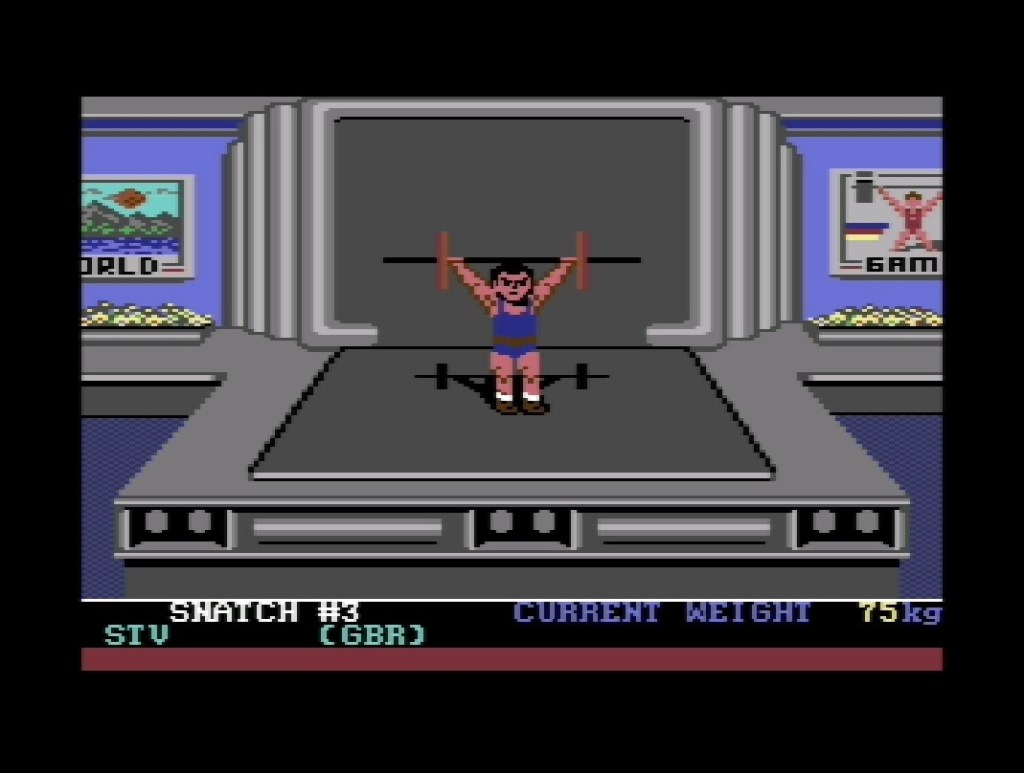
Actually, before they begin, a really neat touch is that every event gets its own travelogue entry at the start (which you can turn off once you’ve see them all), so maybe I can set the scene with those as we go through each one, starting with weightlifting! Nothing like some glamour and exhilaration to get everyone going… That said, I kind of like this one, and it’s way less frantic (and damaging to your best joystick!) than the weightlifting event in Hyper Sports was! This one is set in Russia, which has ruled the “Iron Game” since 1960, apparently, and isn’t just about strength but also strategy and style, which you’ll need to execute through three attempts each at two types of lifting – the snatch, and the clean and jerk, with the latter involving a more complex set of up and down movements. Up and down is pretty much how this one controls too, as you choose your starting weight – ideally a lower one just to get a score on the board – and then pull back on the joystick to grab the bar, lift by pushing forward, then continue as such between the two as you get it onto your chest, squat and go for the final lift. I’ve both simplified and made it sound way more complicated than it is though – it’s all about flow and timing as you move from one position to the other, with a nice sense of progression as you increase the weight. Some lovely atmospheric (and stereotypical) music as you prepare, but while it’s visually a bit grey and unattractive (so probably quite realistic too!), the animation is superb, as your little guy’s breathing gets heavier and he starts to grimace, and then his face starts changing colour! It does go on a bit with the two separate disciplines, and it’s not exactly a party starter, but as a standalone event it’s alright!
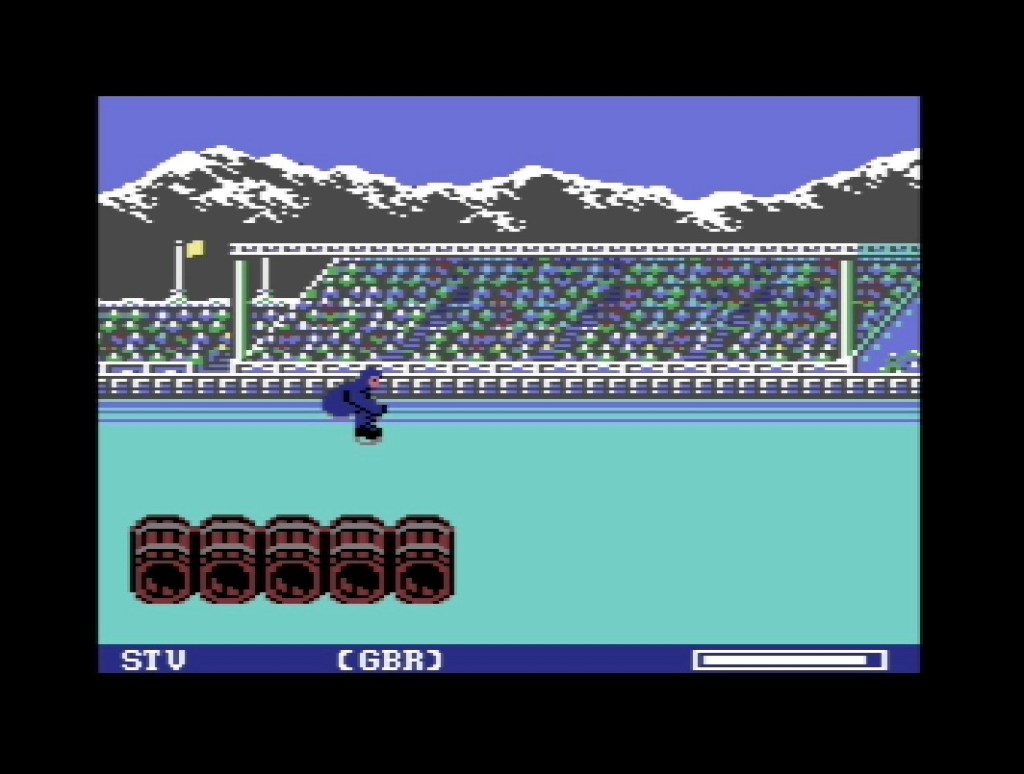
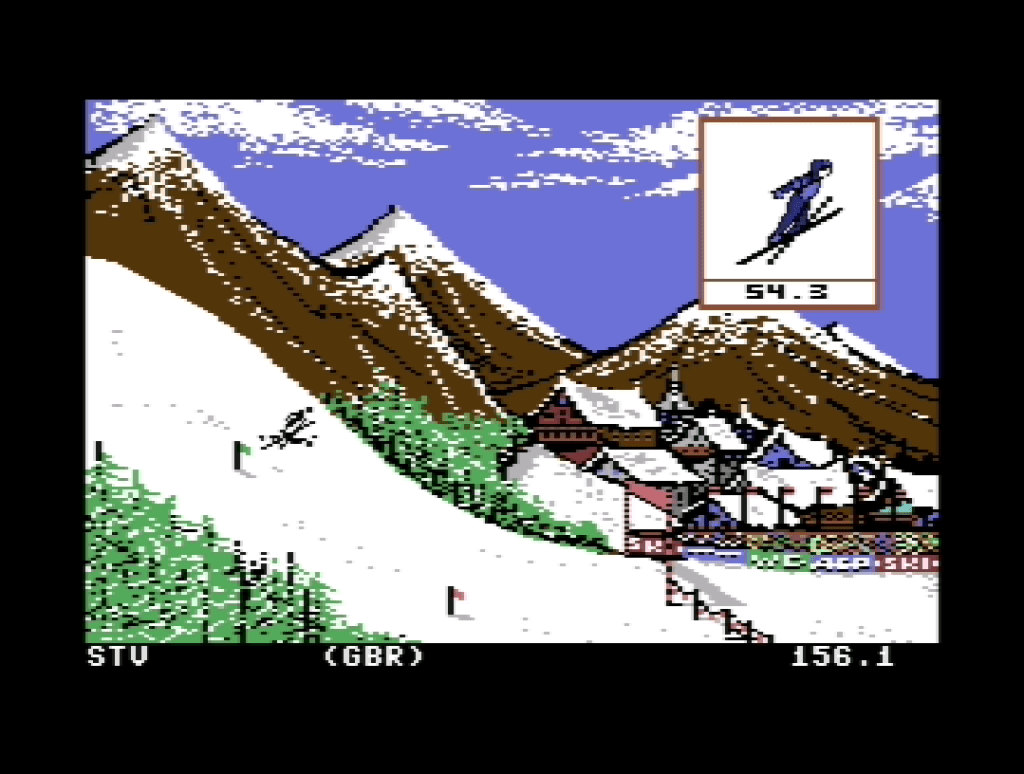
Once the little medal ceremony is over (involving playing the national anthem of the winner while you get the results and latest overall standings), we’re off to Germany for the three-hundred year old sport it’s, er, famed for – barrel jumping… Medieval Knievel?!?! The setting is straight out of Winter Games, set against the distant snow-capped mountains and some trademark lovely trees, while flapping flags, chiptune-oompahs and some icy sound effects add to the general coldness! This time you’re methodically moving the joystick left and right in time with the movement of your skater’s legs to increase his speed up to a whopping 40mph (we’re told), before leaping into the air with a press of fire as you approach however many barrels you’ve said you want to attempt before you begin. There’s a handy flag that’s more or less in the place you want to take off, then, assuming you’ve cleared the last barrel, you want to pull back or press down or whatever to prepare for landing, which seems pretty forgiving as long as you don’t forget to do it before you hit the ice again, so you can just concentrate on building up your speed then timing the jump. You’ve got three attempts to clear as many barrels as you can, although it’s always worth saving one for the calamitous head-over-heels animation when you clip the last of them with your skates! While I imagine you could eventually get good enough to reach the maximum possible number of barrels every time, there’s always an element of getting too greedy with them, or pushing the rhythm of your skater a bit too hard and getting your fingers in a flap, and it all combines to the kind of madcap event you’re probably here for!
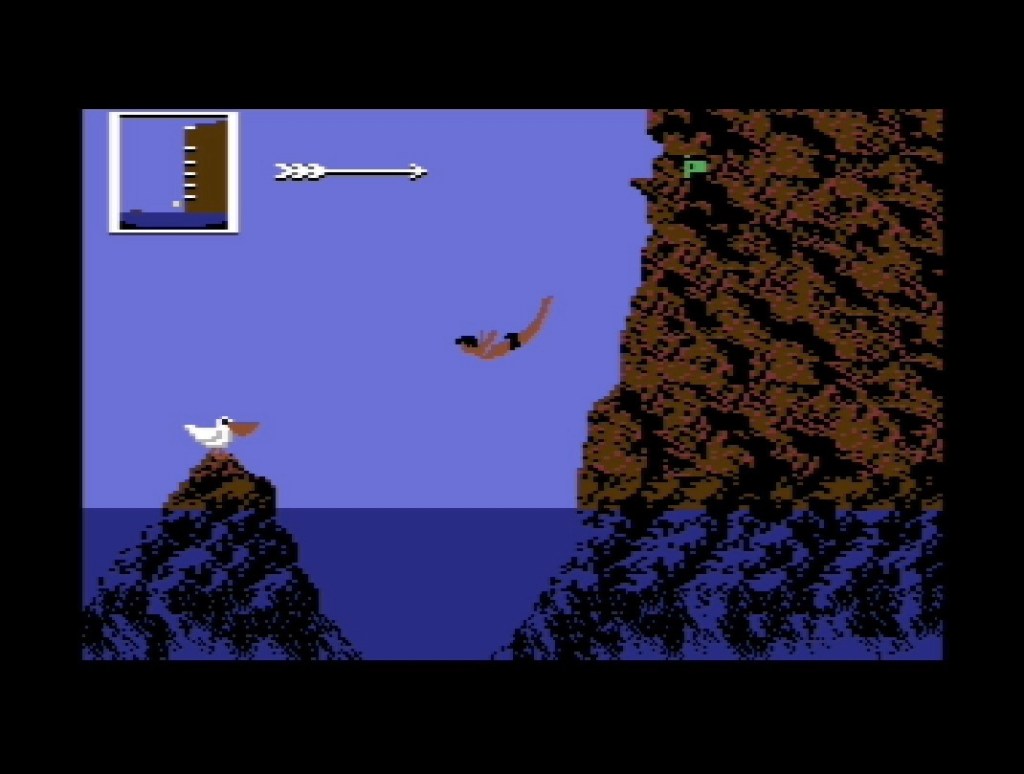
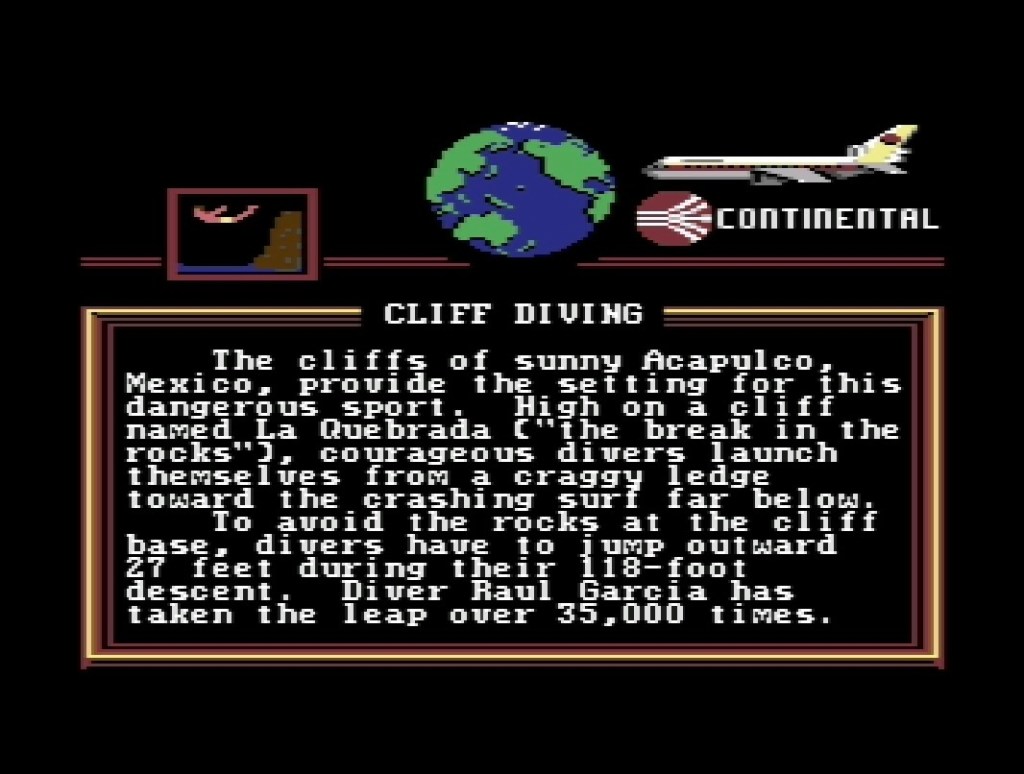
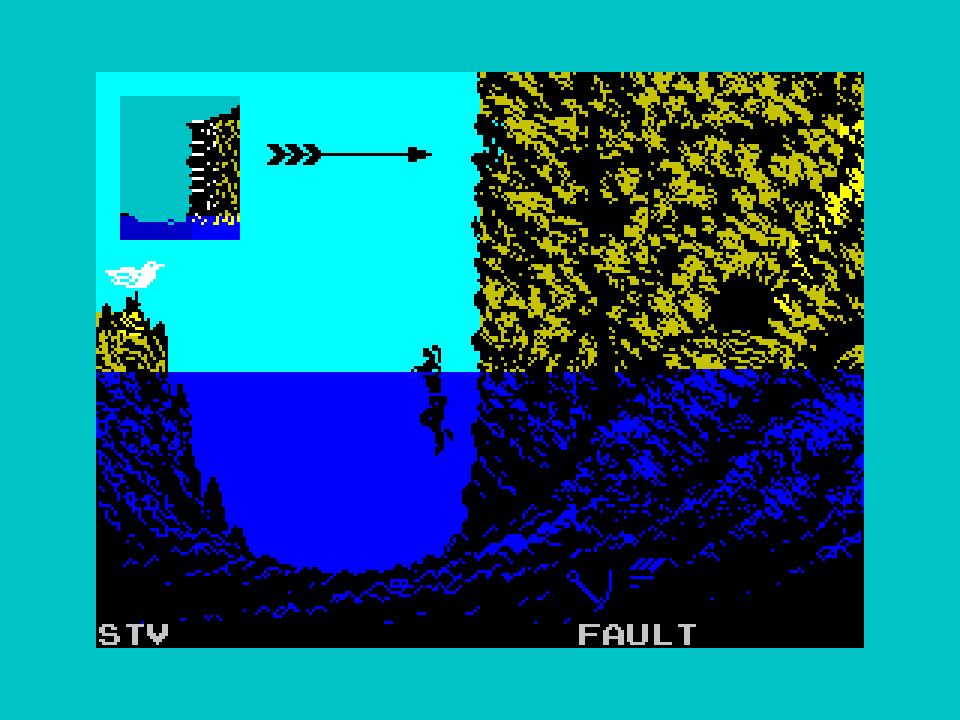
Speaking of madcap, next up is cliff diving, where we’re hurling ourselves off the craggy ledges of La Quebrada (“the break in the rocks”), situated on the dramatic coastline of Acapulco, Mexico! To avoid the rocks at the bottom, you need to jump 27-feet outwards during your descent of up to 118-feet, although you do have a choice of trying a couple of lower ledges while you get to grips with things! Nothing like a bit of ominous (but gorgeous!) C64 Flamenco to get you going though, as you find your diver perched on a bit of rock with just the sky and the clouds for company, until a press of fire sends him over the edge. Pushing forward during the dive will arch your back, which is going to help you avoid the rocks, but that’s where the wind gauge also comes in – the longer the arrow at the top of the screen, the stronger the wind, and the longer you’ll need to keep it arched before you can pull back for a high scoring entry into the water. Ideally you also want to time it so the little pool you’re leaping into is at its maximum depth, shown by another gauge with the waves coming in and out on it. Finally once you hit the water, you need to quickly push left in a split-second window to avoid more rocks on the bottom, and I think this is where the problem lies – the rest of the jump seems pretty straightforward, but no matter how many times I’ve tried it, and whenever and from whatever height, nine times out of ten doing this doesn’t seem to make any difference and I end up with a fault, I assume for hitting the bottom before resurfacing but I don’t really know. And that’s a shame because it’s all so atmospheric, from your diver timidly peeking over the edge, then some lovely animation on the way down, and this mocking seagull waiting on the rocks below, as the waves make you bob up and down when you finally do resurface, and there’s so much detail down there, and sound effects to match, but failing every time is just no fun regardless!
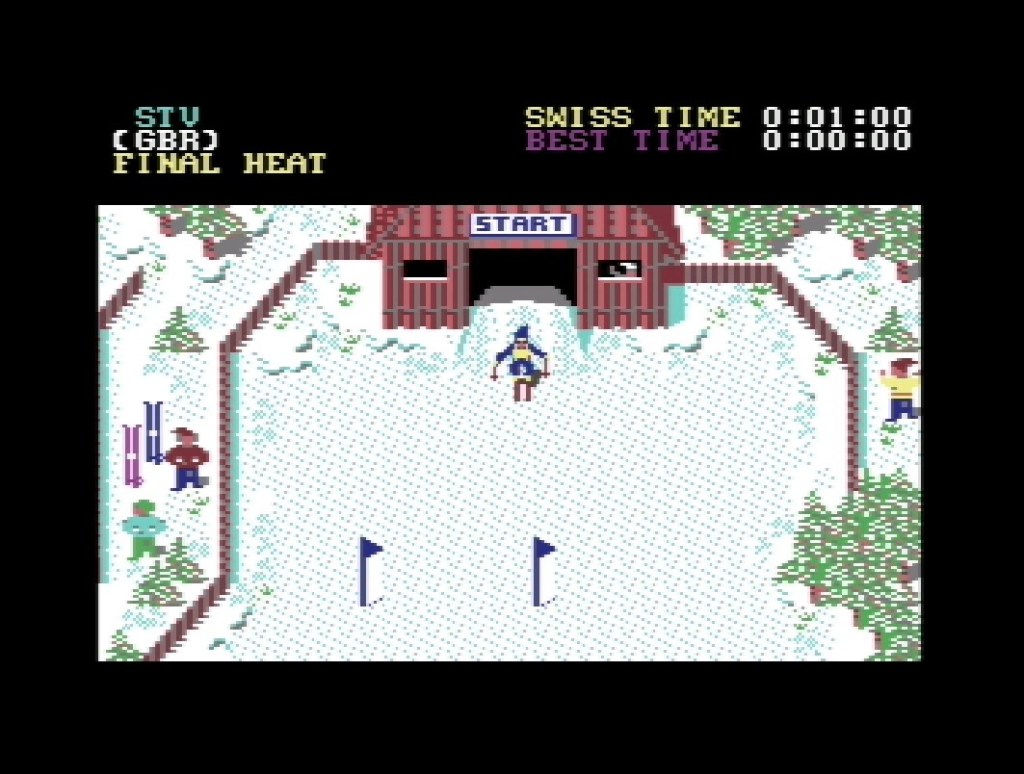
No fun is, unfortunately, becoming a bit of a theme as we continue our journey to Chamonix, France, which we’re told hosted the first Winter Olympics in 1924, and is now also going to host the next event, slalom skiing. It’s a race to the bottom, of course, but on the way you’ll need to successfully pass between a series of gates, which are made up of two flags of the same colour that then alternate with sets of flags of another colour all the way down. Unfortunately, the agility and precision this event requires is not really matched by the controls, which are a simple enough left and right as you go down the course, while pressing and holding fire will allow you to increase speed and adjust how sharply you turn (which in turn will affect your speed). There’s just no fluidity to any of it though, and where you expect to be consistently and elegantly gliding in different directions, anticipating the next set of gates before you even reach the current one, you’ll be awkwardly wrenching yourself back and forth instead, trying to correct anything but what should be the smooth physicality of skis on snow. Inevitably then missing a gate adds a five second penalty to your time, while falling or crashing into one means instant disqualification. This event really annoys me because I love a skiing game, and it’s not like Skiing on the Atari 2600 or Horace Goes Skiing on the Spectrum hadn’t nailed the feel of exactly this years and years before, so this should have been a highlight, but instead it’s a painful plod at best, and another event you’re unlikely to see much impact on your overall score from. Chirpy tune at the start though, and it looks just how a top-down, 2D skiing game should, but just doesn’t play that way. On the plus side, kind of makes you glad they didn’t put any skiing in Winter Games after all!
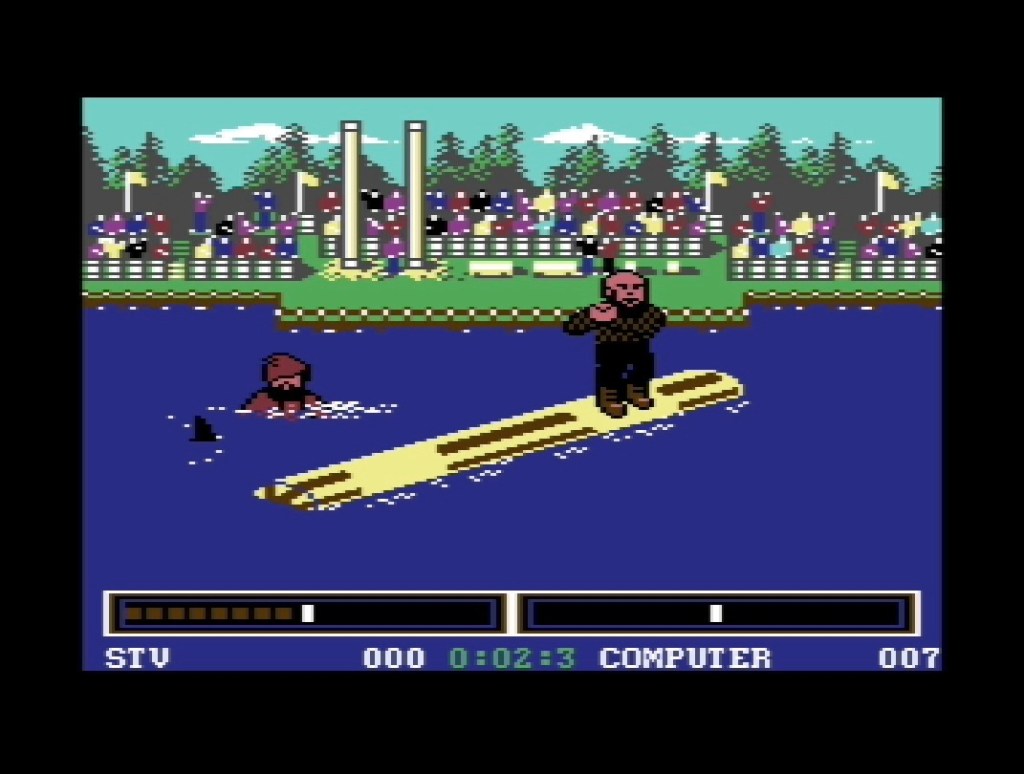
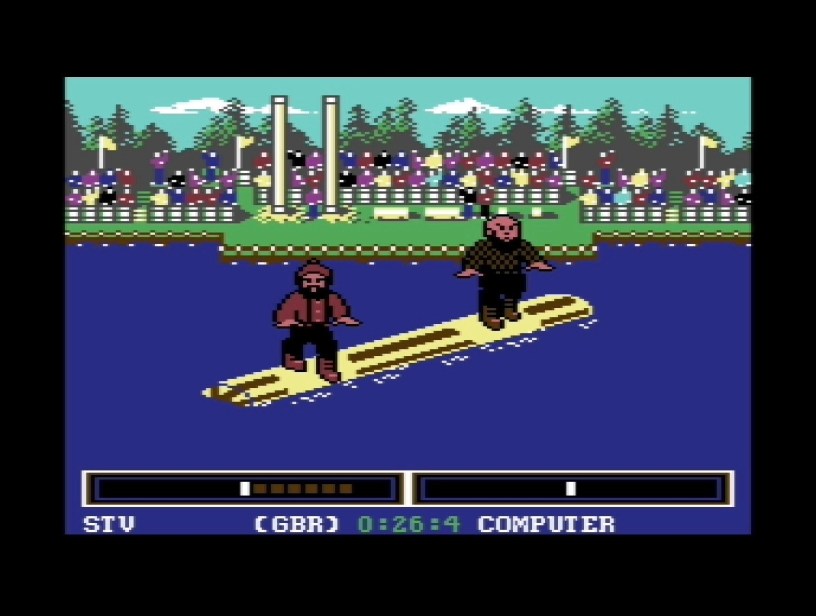
Come on World Games, give me something… And I don’t just mean advice like “never take your eyes off your opponent’s feet” as we go log rolling in Canada, which it seems has been entertaining the local lumberjacks there since 1840! There’s a reason why this event tends to appear in screenshots whenever World Games is around because it’s like watching a cartoon, with two perfectly-set contestants and loads of slapstick animation, as your arms extend and contract to do their best to maintain your balance, until the look of panic on your face from an imminent fall into the icy water quickly translates to your hapless legs, and then the subsequent huge, wet splash before your head sheepishly reemerges, only for a shark’s fin to start circling you to add even further misery, all to the sounds of Monty Python’s I’m a Lumberjack song. The idea is you’re trying to outlast your opponent on a rotating log, and you can do this against another player or the computer, using a rhythmic left and right on the joystick to get your legs into a cautious run while also keeping your balance, indicated by a balance meter at the bottom of the screen. How well you establish then keep your balance can also give you bonus points at the end, but mostly you simply want to be the last man standing on the log, which you can also help along by a press of fire, which will slow the rolling and then cause it to change direction, hopefully catching your opponent unawares. And once you get how it works, that’s all well and good, and you’ll soon be combining stops and changes and quick speed boosts to try and encourage them to fall, but the trouble is, in reality this can go on for minutes at a time as you also learn to recover your balance, and it ends up being a bit of a mundane endurance test. When it works it’s fine though, but could just do with a bit more spice.
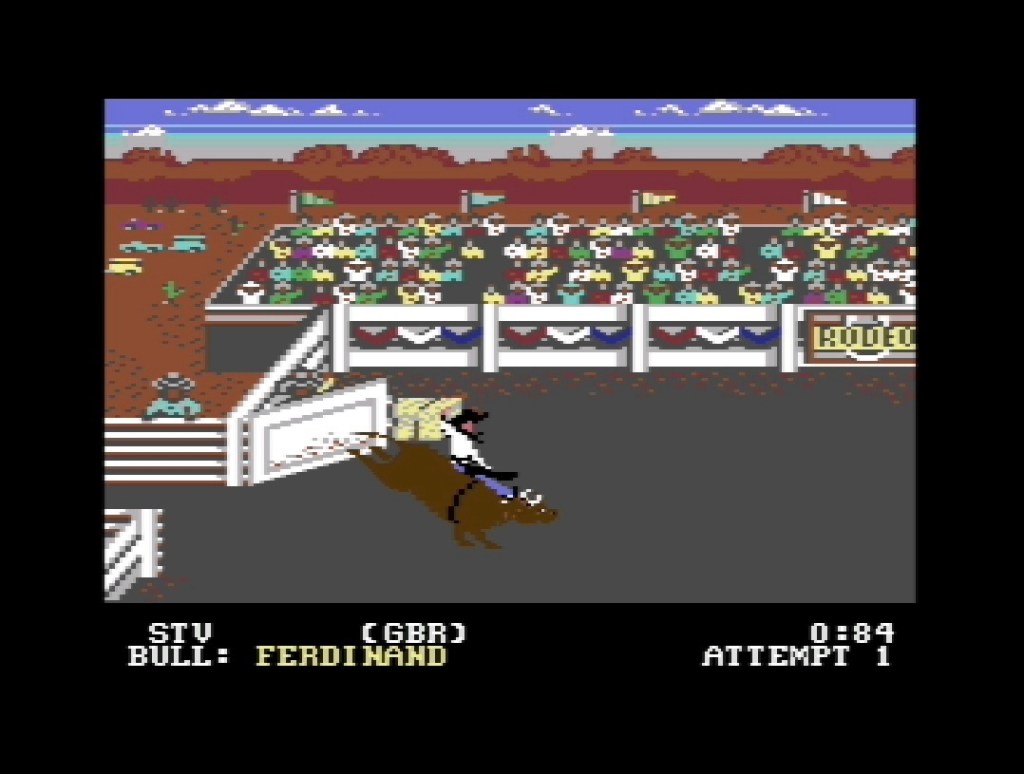
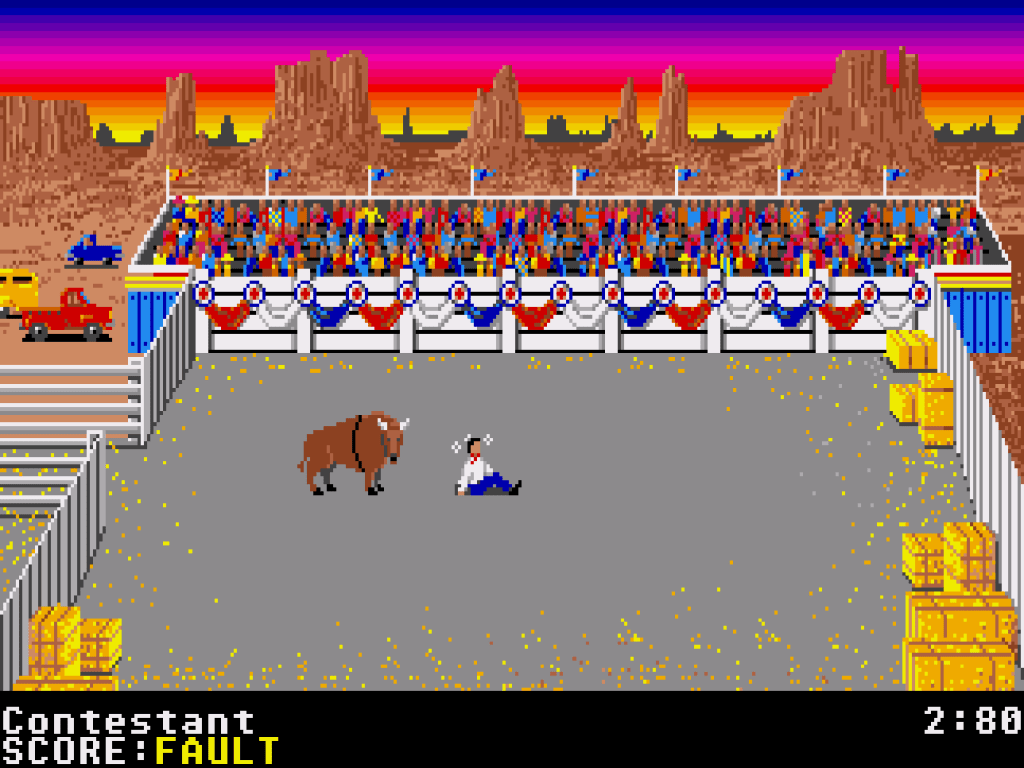
Plenty of spice as we head to the American West to try our hand at the most dangerous sport in the rodeo! The next event is bull riding, where you’re sitting bareback on two-thousand pounds of rampaging beast, with just a piece of rope preventing you from being thrown to what could be a very nasty ending! To start with, you’ve got a choice of bulls named Ferdinand, Elmer, Bob, Tornado and Earthquake, which you might have already guessed go from easiest to hardest, and of course, the latter is where the biggest scores are to be found, as well as the greatest jeopardy. Scoring is otherwise based on style and how long you stay on for over the course of three attempts, and this ain’t going to be no log-rolling tedium because that means eight seconds maximum on each… Or more likely that combined if you’re lucky because I’ve never been able to make heads nor tails of this one… Literally! Okay, maybe it’s just me, but this seems way too complicated – in theory at least, if the bull is bucking, hold left or right in the direction it’s moving; when it’s spinning, you pull back; and if it halts, you hold left or right in the opposite direction to the one it’s facing. I just don’t know what any of that means in practice – the bull comes out of the gate, bounces around a bit then throws you off every time, and you don’t even have a chance to try and remember any of that holding left and right in the opposite direction nonsense, let alone do it! The bull does look well pleased with itself when it’s done with you though, and the arena or whatever it’s called looks fantastic – so authentically Wild West, with the white fences and all the C64’s rainbow of browns creating quite the showground for this mean beast and your little cowboy! The music’s a bit lacklustre for this one but the rest sounds great, and the animation is almost as painful to watch as it sadly is to play. Of everything here, this might be the biggest missed opportunity.
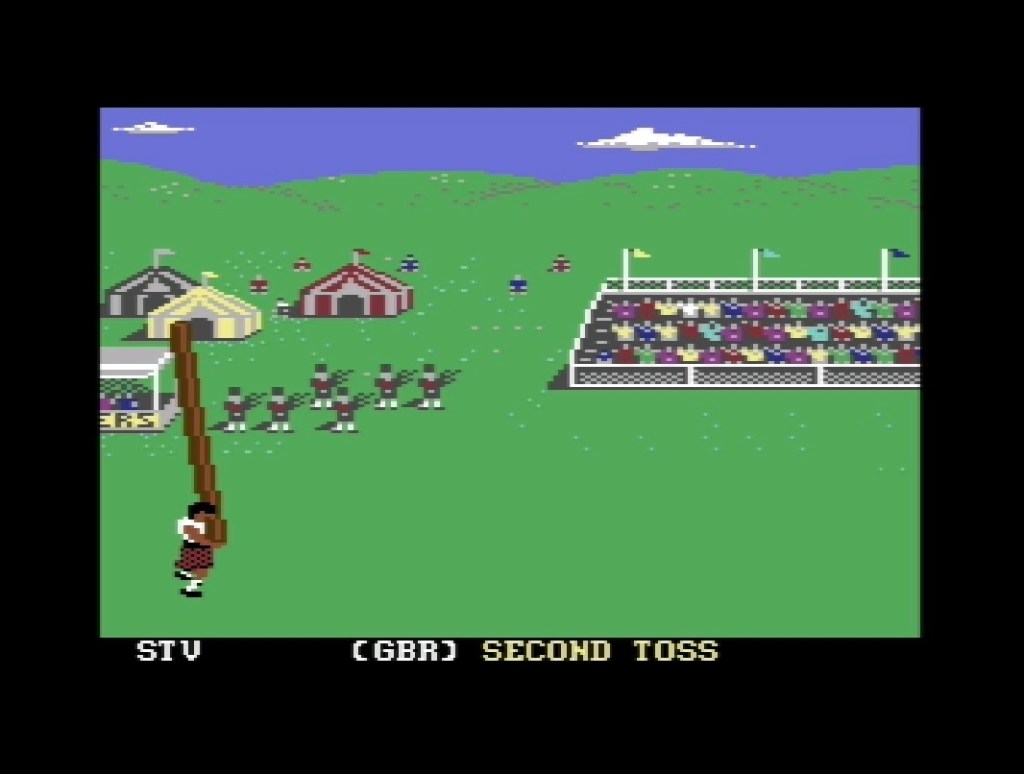
Right, two events to go, and it’s the heather-splashed hills of Scotland next for the ancient art of the caber toss! This involves throwing a tree trunk the size of a telephone pole, and making it flip over completely for a legal toss, then the farthest distance travelled wins the event. The music that greets you for this one is sublime – again, all the stereotypes, but it’s as good as a bagpipe is ever going to sound anywhere! The rest of the presentation is very simple though – like many of the events where I’ve not been specific so far, some perfectly functional sound effects, then the scene it further set by a few circus-style tents, a little crowd of little onlookers and the pipers playing that lovely tune, all gathered on a big green hilly expanse. This while your marginally less little kilted man tosses his big caber along the bottom of the screen, which is done by moving the joystick left and right to build up some speed, albeit increasing the tempo of the rhythm smoothly rather than waggling like mad, then when you’re ready, press fire to plant your feet, hold it, then as the caber pivots in your hands, release it to make it flip forwards, or otherwise just fall backwards onto your head repeatedly, comically pummelling you into the ground! Nice bit of Scottish dancing rewards you if you get it right though, and, of course, your points for distance tossed. As much as this event is kind of alright, not for the only (or last) time here, I’m wondering why! Seriously, when was the last time you had a hankering for playing a bit of caber toss in any other video game before this or since? And probably with good reason…
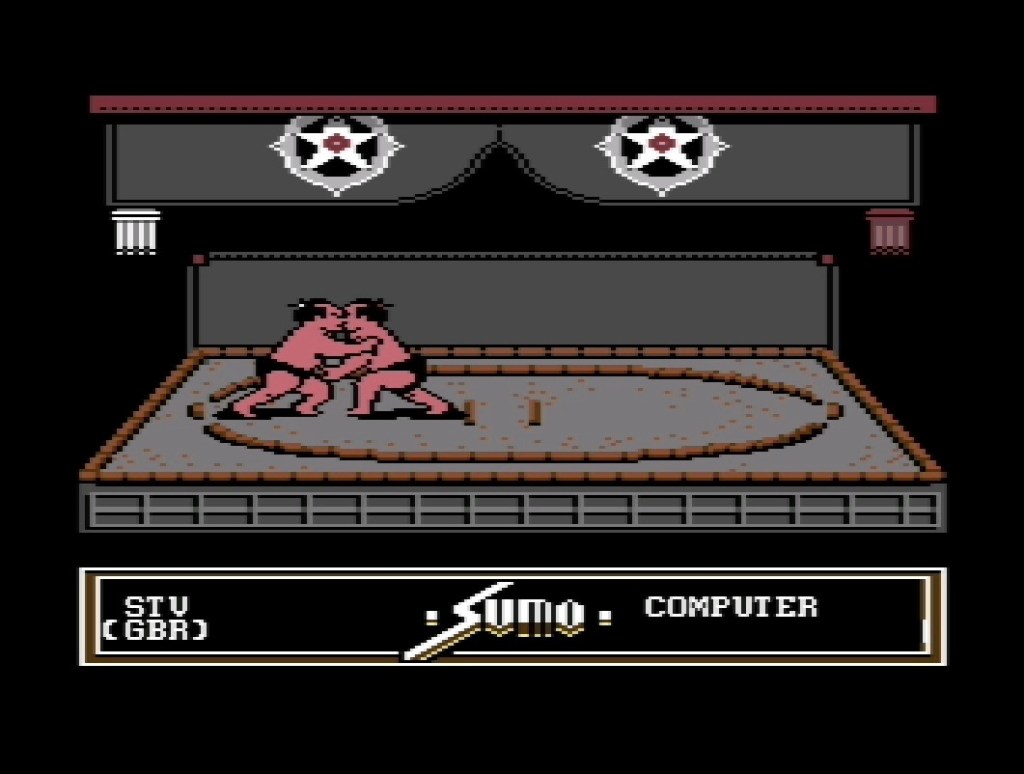
We’ll undoubtedly come back to that point shortly but first we’ve got to go all the way to Japan for our final event, and another ancient sport by the name of sumo wrestling. Steeped in tradition and elaborate pre-match ceremonies involving throwing salt around, this one is all about two naked fat guys with bits of cloth up their cracks trying to push each other out of a dusty circle! This is another event that might be a bit too sophisticated for its own good, especially given the slog it’s been to get here, but what it does is reasonably admirable. Like many early one-on-one fighters, we’ve got as many moves as possible crammed onto a single-button joystick, and in this case we have different slaps and pushes on six directions, then another six holds, grabs and trips on the same directions but with fire held down. It all happens so fast though that it’s going to be some time before you even know what’s hit you before you’re chucked out of the ring, let along worked out how to hit back! You really need to use that practice mode for this one because it’s not just about shoving in the right direction either, but how fast you react to different scenarios, and how well you’ve timed your move, especially those with a button press. I reckon if you’re a sumo fan then there’s probably enough game in just this event alone to justify buying World Games, but for everyone else… Just mash buttons and directions and it will be over one way or another in a couple of seconds! Not much to say about anything else here – uninspiring music and sound and even more uninspiring environments but nicely sized and detailed characters that move well, if without any of the charm we’ve seen elsewhere. All the same, I’m sort of tempted to say I’m tempted to try and get into this one. It’s got something but I’m just not sure I’m interested enough to find out what it is!
In the meantime though, with our final event probably mercifully out of the way, let’s have a really quick look at the Atari ST and Spectrum versions I mentioned earlier, before we head over to the final standings. Right, ST version first, and first impressions are not good I’m afraid. I got used to lazy 8-bit ports on there a long time ago, and got very good at avoiding them too, but this is something else… It looks like the C64 version but with more colours, and it sounds more or less the same. It mostly seems to play the same too, and I was fine jumping between the two (which also goes for the Spectrum version) – the balance felt a bit different on some events but not necessarily better or worse. What is definitely worse, though, is all that character and humour has been almost entirely stripped out, and in the few instances where it apparently hasn’t been, such as the log rolling, somehow it still has! This version is really, really poor! Thankfully, less so the Spectrum one – it’s had the necessary colour treatment, so you’ve got a mix of patches of monochrome or black sprites on some wild hues, but there’s plenty of detail, plenty of character, and as said, it plays more or less the same too. The caber toss has an extended intro, and the diving and sumo wrestling do seem a lot less finicky too, but unless you’re playing them back-to-back with the intention of noticing that stuff, it’s the same World Games in a very Spectrum skin. And just to close on other versions, long before The C64 Mini and Evercade, and even those CDs you used to get in PC World with an emulator and three thousand C64 games on them, there were subsequent releases on Apple II, MSX, NES, Sega Master System and PC should any of those float your boat. Or roll your log…
When we started here, I was wondering why World Games didn’t grab me and the rest of my Games Gang like the previous games had, and I think the problem is three-fold. Firstly, the very first thing you do is six rounds of weightlifting… Each! Really? Unfortunately, too many of the events overall are just too niche and unappealing, and while not a showstopper, the lack of cohesion between any of them doesn’t help their cause either. Secondly, many are also not exciting at all – I mean, a quarter of them involve actual logs! And thirdly, too many of them are also too inaccessible to compensate for any of the above! Now, on this point, it’s always been the case that this series demands you at least have a quick look at the instructions for each event when you’re starting out, and while I know many struggle with that, it’s because they’re always tuned (admittedly for better or worse!) for their individual demands, and once they click, they usually work. However, if you’re repeatedly following instructions and failing and not knowing why, then that’s no fun.

And no fun on top of everything else sounds just like a recipe for falling off a game as quickly as you’d fall off a stupid log spinning around in a river! Which is unfortunate because for a series already so renowned for its groundbreaking presentation, this game can be another level again, with so much character and variety, and all those extended animations and the humorous touches everywhere, and some genuinely great music coming and going on top. All that stuff deserves to be appreciated… And I do appreciate them giving something a different a go too, but maybe it’s just a bit too different to want to persevere with, like I did with some of the occasionally more obtuse stuff in previous titles, such as the half-pipe skateboarding in California Games. What do I know though? I just dug out the January 1987 issue of Computer & Video Games magazine where they reviewed World Games and gave it nines across the board! All the same, despite that, and as much as I’d like to say I’ll gladly fire this up every once in a while and try to beat some of my previous records whenever I’ve got California Games, or Uridium or Cybernoid or anything else on the go on The C64 Mini or the Evercade cartridge it’s on, with all the best intentions, and despite a couple of decent events, I’m not sure I will, just like I haven’t for the best part of forty years now!
As always, I’ll never expect anything for what I do here but if you’d like to buy me a Ko-fi and help towards increasingly expensive hosting and storage costs then it will always be really appreciated! And be sure to follow me on Instagram, X (formerly Twitter) or Threads for my latest retro-gaming nonsense, and also on Bluesky, which is under my real name but most it ends up there too if you prefer!
 Retro Arcadia