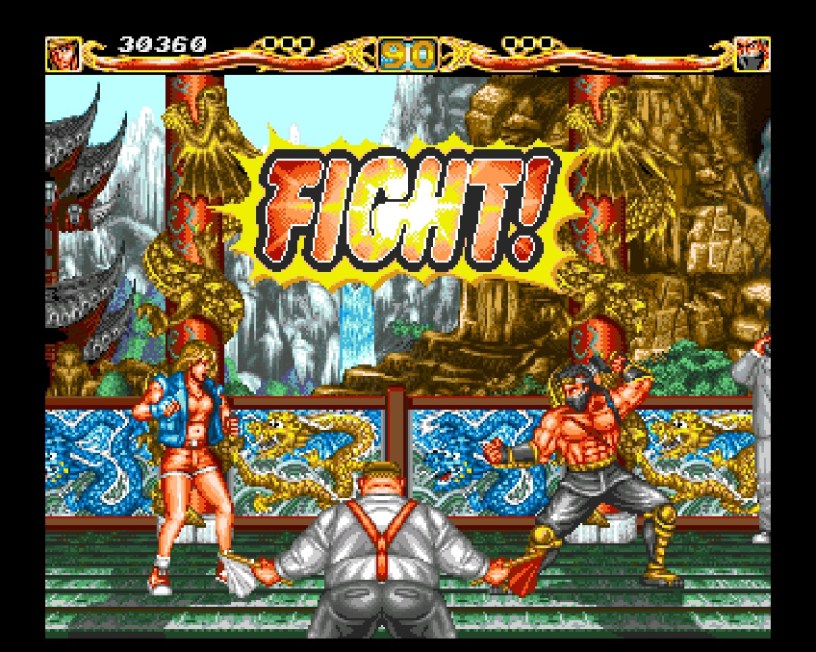
As much as I was asked to create more of these top ten features after I first had a go at them, and as seemingly popular as they’ve since become, I realise this one is a bit specialist! There is some method to my madness though, so hear me out… Back in the summer of 2023, I ended up doing a deep-dive on Fightin’ Spirit by way of a couple of other games I’d been playing that we’ll also possibly get to shortly. Along the way, we had a quick look at a bunch of other 16-bit fighters I was familiar with, to the point I realised I probably had enough to conclude the feature with a bit of a top ten. As is often the case with these things though, that deep-dive ended up going way deeper than was originally intended, and I decided to come back to it another time, and here we are! We’ll count down each of my top ten in reverse order, a paragraph on each, and it’s one-on-one fighting games with a little bit of leeway where necessary (and you might have already guessed why!), so let’s get on with it!
10. Body Blows

If you thought Dead or Alive was the first fighter with realistic big boob physics then think again because Team17 was doing it here right back in 1993! It’s not averse to a bit of the Street Fighter II in all other respects though, with eleven characters, each with their own move-set and specials, competing in best-of-three matches across various locations. Not for the last time here, I’m sure, the standard Amiga’s single-button joystick required simplified controls though, so everything is mapped to a direction plus fire, then the special has you stand still and hold down fire, while blocking is move away and fire. No throws or combos but there are three modes on offer, with solo, two-player and a tournament for up to eight players. All the same, it took a while to grow on me when I first found it on Evercade relatively recently, from what I thought were lacklustre environments, weird-looking characters, poor animation, stiff controls and just not being very welcoming… It seemed like I was missing something though, and when hunting for the original manual I came across a couple of reviews that convinced me to stick it out a bit, and while it’s still no Street Fighter whatever they said, there is a fluidity to it that comes with a bit of practice (meaning actually being able to land a hit without taking one), and eventually you start winning fights and having enough fun to ignore a lot of its negatives, most of which were later fixed in an enhanced, AGA chipset Amiga release, and is probably the way to play.
9. Full Contact

This earlier offering from Team17 in 1991 (and also on Evercade) has you battling a ruthless Triad gang in the single-player mode, taking on a friend in versus, or, if you’ve got loads of friends, setting up a tournament for you and up to fifteen of them! You’ve got movement on the eight original joystick directions and the same again for different kicks and punches if you hold down fire, and to win each round you need to knock down your opponent’s health in as long as it takes. The first thing you’ll notice when you load this up is the gorgeous music, dwelling on some suitably oriental pan-flute ambience as a text scroll sets the scene before transitioning to the kind of very cool incidental music you’d get in Miami Vice – that episode where Castillo is running around with a samurai sword, maybe! Anyway, what you might also recognise here is the silhouette of a bloke doing martial arts moves in front of a rising sun, especially if you’re familiar with the 1989 Van Damme classic Kickboxer – it’s straight out of the movie! And like the movie – and despite its own best efforts – I really like Full Contact! The thing is, this was going right up against the aforementioned Street Fighter II when it came out but it’s bringing what could be a 16-bit version of Yie Ar Kung-Fu to the fight instead, so your mileage here is dependent on how much you like that game because Street Fighter II this ain’t! Not everything needs to be though, and for all its dodgy animation and fighters that look like old men, there’s a really accessible and well-paced fighting game here! Mostly nice backgrounds too, good sound, and the fighting itself feels fun.
8. Master Axe: The Genesis of MysterX

Islona Entertainment appeared very late in the Amiga’s life, with the first of their eight original (and platform exclusive) titles appearing in 1996, with Master Axe coming a year later, meaning we can stop going on about Street Fighter II for a change and position this alongside Street Fighter III instead! Now, if the reviews of Body Blows led me to a better appreciation of that game, then it’s lucky I’ve only just looked up any for this one because they might have had the opposite effect, although I think they’re being a little harsh! Okay, had it emerged three years earlier as originally planned it might have done better but three decades on it’s all relative, and I reckon it’s a decent, polished game that I’ve been having fun with for a long time now! It’s based on the adventures of Neil Axe, possibly a real person who travelled around the USA doing kung-fu, and while that translates to a very familiar format for one or two players, it’s got plenty of secrets and some unique modes on top of regular tournaments and training, like Endurance, taking you across America to fight the locals, from a presidential bodyguard outside the White House to a Voodoo priest in a Louisiana swamp, and Spiritual Warrior, where you take on your own inner demons! You’ve got a choice of eight characters, some with weapons, and all with what becomes a very fluid, almost combo-driven move set, which is impressive considering the one-button joystick controls. I guess single player is set a bit easy and you will find a few spammable attacks but there’s plenty of variety in everything, and the backdrops can be gorgeous. Sound is alright too, crunchy, and with enjoyable enough music. Despite all that, I know it probably wasn’t what anyone wanted in 1997, but I’m enjoying it today all the same!
7. Panza Kick Boxing

Panza Kick Boxing was developed by Futura and published by Loriciels in 1991, although it was its sequel, Best of the Best: Championship Karate, released not long after on the Game Boy, where it first got its hooks in me (thanks to my student loan!), until a while later I got to know the PC-Engine version of the original, and finally this Amiga one far more recently. Wherever you play though, it’s a very well put together, deep and technical fighter that also manages to stay surprisingly accessible. It’s built on a really cool, highly addictive league table concept, which you need to try and climb by winning fights, eventually getting to take on the champion, the titular (Andre) Panza. You’ve got some serious tools at your disposal to get you there too, with a bewildering choice fifty-six realistic kickboxing moves that can be assigned to your eight joystick controls, allowing you to not only customise your fighter but also evolve your own fighting style, and it works brilliantly, in no small part thanks to the six hundred frames of animation in support of them! While it’s very much more simulation than arcade fighter then, it’s by no means po-faced about it, with the flamboyantly comedic little referee shuffling around and mumbling away incoherently as he keeps the action moving, and the expressive, up-close ring-girl adding some glamour between rounds. The two fighters look great too, with chiselled muscles glistening with sweat, and the animation really is sublime. The arenas, the sound and the rest of what’s on offer in general veer more towards the functional but this one is all about the long-haul and getting up that table, match by match, and is all the better for it.
6. Mortal Kombat II

Some fun fun as opposed to serious fun now, and Probe and Acclaim’s take on Mortal Kombat II from 1994, first released by Midway in the arcades the year before but a game I actually associate the most with my brother’s Sega Mega Drive! Great port here too though, even taking into account the simplified controls, and especially if you’re rocking 2MB of memory for the best of the music and all the nasty noises and sinister chat; in fact, I think the sound in this version is even better than in the original! You really couldn’t ask for more of the rest either, with authentic looks, all your favourite characters, and all their violent move sets too, complete with fatalities and babalities and so on, as well as bad guy Shao Khan’s demonic Outworld warriors to spice up the latest bonkers excuse for a world-ending tournament! Oh yeah, and lots of blood. Everywhere! I don’t think there was ever more than the regular single-button joystick option on offer here, so all those specials do take a bit of wrangling, especially if you’re used to less restrictive input methods, but it soon comes and you’ll be impaling or freezing or decapitating with gay abandon in no time! All the same, the default single-player tournament difficulty is rough, and you might want to tone it down to begin with in the absence of any training modes, but get someone else who knows what they’re doing in two-player mode and it’s a total blast! I guess the backgrounds can be a bit muddy but I’m picking hairs now – the characters are big and bold, the animation is great, and did I mention all the blood? I definitely mentioned fun fun though!
5. Super Street Fighter II: The New Challengers

I’m actually not the biggest Street Fighter II connoisseur – more of a Darkstalkers guy – but having skirted around it with several pretenders to the throne here already, it’s now time for the 1995 Amiga version of Capcom‘s Super Street Fighter II: The New Challengers from 1993, which I think was the fourth in that sub-set… And unlike the juddering, headache-inducing Amiga attempt at the original Street Fighter II, it’s very good too, especially the enhanced AGA chipset version, assuming you can get to run – The A500 Mini manages fine, hence the dodgy pic of my TV screen here and why I’ve now played it there more than anywhere else, but I never did get it going on regular PC emulation! You’ve now got sixteen fighters to choose from, their move sets translating fast and precisely, and combos and specials feeling good on a CD32 controller. There’s a well-balanced single player mode with selectable difficulty and a turbo option, and excellent two player support, where the game really shines if you get the opportunity. In fact, a few graphical limitations and flourishes aside, just about everything is there, with characters admittedly on the smaller side but full of detail and movement, contrasting with somewhat static but pleasant enough environments, and some lovely music throughout, although the sound effects can be a bit weird. A lot of disk swapping too. The regular A500 Amiga version also plays fine, albeit without the looks and sounds and extra button or controller support, but either way, if the Amiga is where you need to play your Street Fighter then you won’t be disappointed.
4. Shadow Fighter

As much as I enjoy that version of Street Fighter II, a year previously, in 1994, we also got Gremlin’s Shadow Fighter, and that is possibly the best version of Street Fighter the Amiga never got… Or did get… I’m confused now! Anyway, hopefully you get the picture, although what you didn’t get was Shadow from the Gladiators TV series because after he was lined up to be involved in promoting the game, he got sacked from the show for a drugs scandal and dropped! Plenty of other wacky characters to choose from in the generous selection of sixteen still here though, including a basketball player, a fakir, a German cop and plenty more traditional fighters, all of which, together with Pupazz, the slapstick puppet you can practice your moves on, add to the game’s cartoon aesthetic, which is possibly why it’s not even higher up this list because it’s just not my style. No denying its quality though, so full of polish and life and a bunch of special effects, and all of the above keep getting piled on top as you move between regular, AGA and CD32 versions, with the latter featuring a CD soundtrack and loads of speech, although you can’t really go wrong with any of them for sound, or for the control scheme, with is responsive and quickly intuitive whether on a stick or a pad. And while the modes are limited to single and two player versus, the aforementioned training mode and a championship mode, the latter has a lot of depth, with fair but challenging AI, and even more so when you factor in all the characters you’ll really want to try for size! This was a platform exclusive, so was a bit of a hidden gem for me until much later on, but it’s so much fun and I’m so glad I eventually found it!
3. Barbarian

We’ve already been at one end of the Amiga’s lifetime and now we’re heading all the way back to the other with Palace Software’s Barbarian from 1987, when the fun police didn’t know whether to be more shocked by its Page Three cover model or its gory decapitations! Bring back 1987’s fun police over today’s any time though… We didn’t know how good we had it! Anyway, like another game we’re still to get to, I owned this on the Atari ST, and despite both versions being a bit “8-bit” in places – as was often the case in this crossover period – it’s still a superb weapon-based fighter, with great sound effects, a really fun and to the point (literally!) move-set and, of course, that timeless head-rolling action! In single-player mode, you’re a Conan-type warrior with a sword, trying to rescue a princess from an evil wizard by fighting your way through eight of his similarly weaponised minions (who mostly look just like you but with different skin colours) in forests, volcanic vistas, throne rooms and fighting pits, before having a go at fighting the big bad himself. Controls are very simple, with fire plus direction on a joystick giving you a decent variety of sword attacks, as well as headbutts and kicks, and you’ve got a jump and a roll too. Some moves are riskier than others though, either taking more time or requiring pinpoint positioning, but you’ll score higher with those, and maybe be treated to that big decapitation animation, complete with the goblin arriving to drag the body away, after first booting the missing head off the screen! It’s simple and very accessible but there’s also a flow and an elegance to be learnt, which can also lead to some great two-player fights too! Graphically it’s fine and moves well but was never the eye-watering showcase for the 16-bit generation you’d find elsewhere at the time. The sampled sound effects are great though, and this version benefits from speech too. Medieval Maria Whittaker aside, Barbarian’s always been about the gameplay though, and there’s not much here you’ll have more fun with.
2. Fightin’ Spirit
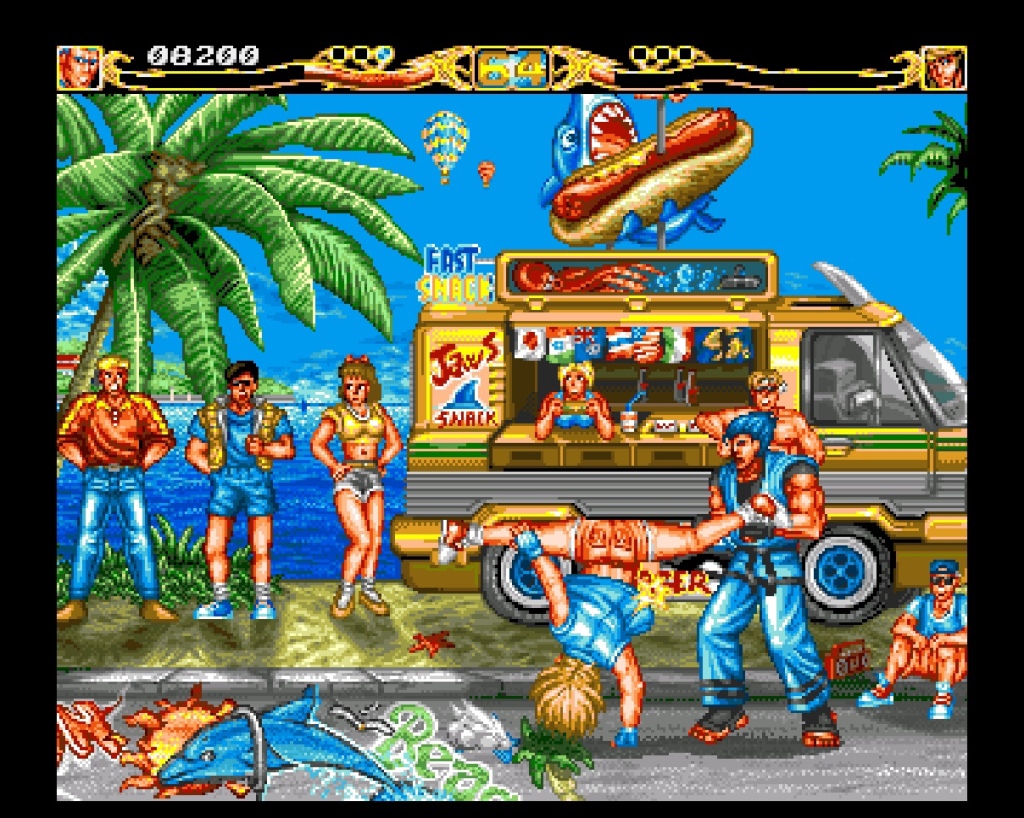
If Barbarian was a bit of a visual throwback, then Fightin’ Spirit is the other extreme, and undoubtedly the pinnacle of Amiga fighting games as far as presentation goes, and it comes very close on the gameplay front too! It’s another late one, developed exclusively for the Amiga by Light Shock, published by neo Software in 1996, and created for the AGA and CD32 systems first, although the regular Amiga 500 did get a colour-reduced port too. Before we get into the game, don’t press fire on the title screen until you’ve experienced all of Into The Night, the greatest theme tune to anything since Stallone’s Cobra movie in 1986! “You’ve got flames in your eyes, burning with rage. Into the night. Into the night.” And then there’s the guitar solo… Anyway, while the game is built around the regular nonsense tournament format for another bunch of oddball fighters, there are loads of modes here, including some very unique multiplayer modes for up to eight players, and loads of tweaks, customisations and secrets to find, which include unlocking bosses to play as, on top of the default cast of ten that includes spurned lovers, crime lords, folk who’ve had their sacred sticks stolen, a CIA agent who trains dolphins and a bloke whose DNA was mixed with a tiger’s! They know all the martial arts between them as well, so altogether you’ve probably got as much to get to grips with as the rest of the games here combined! Each also has four special moves to discover, dictated by their unique animal trait, or “fightin’ spirit,” from the aforementioned selection to cobras, eagles and a particularly vicious monkey attack! It’s all on a regular joystick too, managing an impressive array of moves on the eight directions with and without fire pressed, and also extended by mid-move direction tweaks. There’s blocks and even simple counters too, all combining to what might seem like a much more sophisticated console fighter to look at. And how good it looks too! The environments are varied, vibrant and simply packed with exquisite and dynamic detail, just like the fighters, who move and transition and transform so smoothly – it’s all just outrageously good! Lots of speech and impactful sound too, and as we’ve already discovered, the music doesn’t let the side down either. Just miraculous!
1. International Karate +
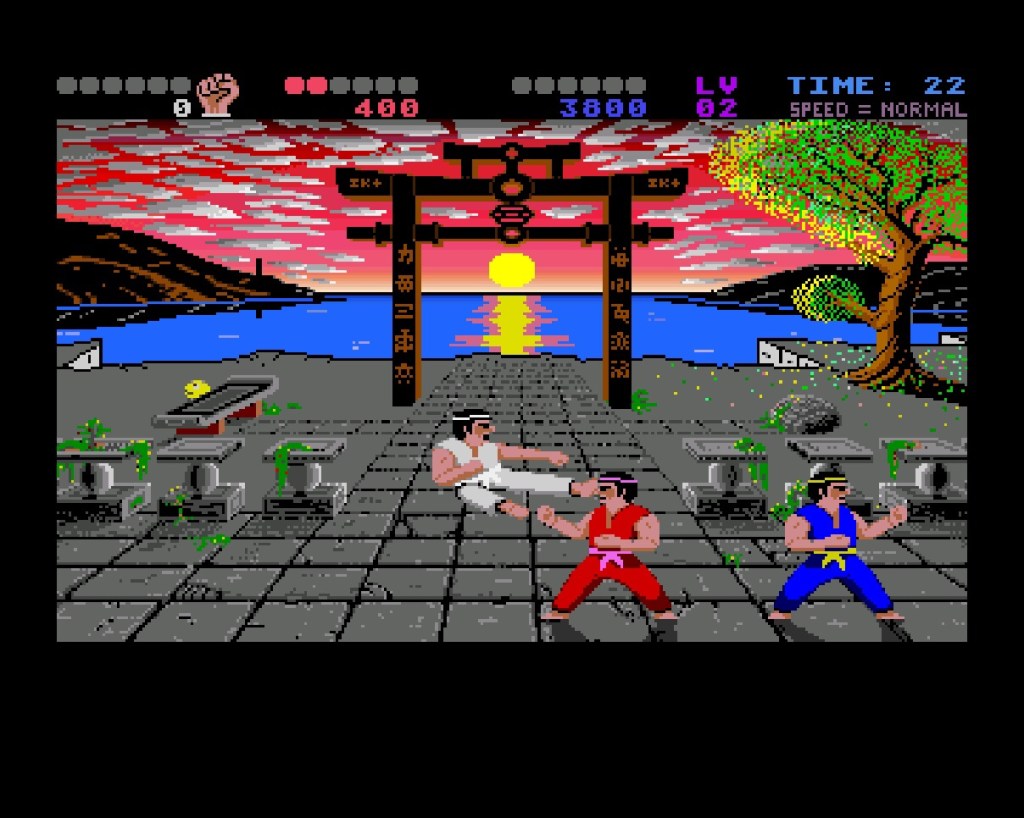
Not only top of my list but probably the last fighting game I was actually any good at too! System 3’s IK+ was another absolute favourite of mine on the Atari ST, and likewise the ZX Spectrum version from 1987, and its 1985 predecessor, International Karate, on there too! Both 16-bit versions came in 1988, with very little to choose between them except the expected cleaner sound from the Amiga’s music, although there is also a 1994 CD32 remaster with spruced-up sound and a load of parallax effects on that gorgeous oriental sunset, neither of which really add all that extra money’s worth to what was already a sublime experience! The format is, uniquely, three players at once, whether solo or multiplayer (where I had such great times with my brothers!), with the first to score six points by landing various karate moves of different values winning the round, while the one with the least is out, which is only really relevant if that’s a human player! Every two rounds there’s either a ball-deflecting or bomb-kicking bonus round, adding to your performance-related score, and you’ll also be rewarded by different belts, all the way to black, the further you get through equally increasingly proficient opponents. Controls are once again on the stick and a single button, and while they might offer the most limited selection of moves anywhere here, what you’ve got is so impactful, and curated to feel really extravagant, with spectacular high kicks, flying kicks and a wildly realistic backflip to get you out of harm’s way that you can then combo across the whole screen! And this is all going on while the other two are doing the same, meaning the action never lets up despite the demands for precision, so you’ll probably be thankful for having all the moves you need so readily at hand. Similar to Barbarian, the characters do betray their 8-bit roots but not in any kind of negative way, and all that leaping around is animated beautifully regardless. And you’ll never get sound effects like these sampled thumps and clangs on a Spectrum! The game takes place entirely in a single location, which you can tweak into different colours to sometimes glorious effect, but the default setting sun reflecting into the watery distance is a stunning example of pixel art to this day, and while the falling leaves, occasional submarine periscopes, Pac-Man cameos and other silliness – not to mention the trouser-dropping – still do their best to distract you from the violence at hand, the timeless gameplay is so unrelentingly enjoyable that they’ll never quite succeed. Will never stop you looking out for them though!

When I first came up with the idea for an Amiga fighting game top ten, I honestly wondered if I could get beyond a top eight but it actually ended up being a bit of a scrap for those last two places, so I’ve got to give an honourable mention to Dangerous Streets… And yes, I know it would have been difficult to justify that as part of any countdown but it’s also a bit of a guilty pleasure of mine, with its freakish cast of characters and their jarring animations! I’ll also quickly mention Capital Punishment for upping the filth-factor even further, and Primal Rage for just existing! And I’d better also just acknowledge the existence of too-stuffy Budokan, too-floaty Elfmania, and too-wacky Spitting Image, all of which I know some people are really into but none of which ever did it for me! And on those bombshells, I think we’re about done here! I do hope you enjoyed reading this as much as I did putting it together, and do let me know if there’s anything not here that I should still be checking out – being an old Atari ST owner does mean many things have fallen through the cracks as far as the Amiga goes! Lastly, I also want to quickly mention I’ve got a top ten favourite fighting games (on any system) countdown also scheduled for 2025, so look out for that or, if future me remembers, I’ll come back and post a link here when it arrives!
As always, I’ll never expect anything for what I do here but if you’d like to buy me a Ko-fi and help towards increasingly expensive hosting and storage costs then it will always be really appreciated! And be sure to follow me on Instagram, X (formerly Twitter) or Threads for my latest retro-gaming nonsense!
 Retro Arcadia