
I’m not entirely sure how I’ve managed to spread this over the course of the past couple of years but, at the time of writing, I’ve been very slowly making my way through various home versions of NBA Jam (including Tournament Edition) to try and decide which one I want to make “my” version because once I realised I‘ve never really had one, obviously I needed one! That’s not to say I haven’t dabbled with loads of them over the years though, probably starting with the Sega Mega Drive port around the time of its release in 1994, all the way through to having a surprisingly good time with the now-defunct iPad release when that appeared in 2011, alongside the console remake-reboot thing around the same time that was the last we saw of the series on any format, which I’ll come back to when we have a bit of a history lesson later. Back at the other end of its history though, I do have plenty of form with the 1993 arcade original too, although I’ve never had a great experience emulating it since – not that it doesn’t run okay nowadays but it’s just not the same on your own on a controller it wasn’t meant for on a crappy laptop screen through some crappy laptop speakers it definitely wasn’t meant for!

Not that this is something that’s ever particularly bothered me though – it’s great and all but I wouldn’t say it’s an all-time favourite; just one of a dozen or so basketball games I’ve really enjoyed since my brother and me pooled our pocket money and splashed out on Basket Master on the ZX Spectrum in 1987, and any of which I’ll happily spend time with then put away whenever I’m reminded I like a good game of basketball! And on this occasion, I was reminded of NBA Jam specifically on a t-shirt, of all things, in the NBA megastore on a trip to New York in 2022, which is what got me thinking I should return to some of the console versions and see if I could find one to sit alongside the likes of the aforementioned Basket Master, and NBA Street Vol. 2 on the Nintendo GameCube, and Basketbrawl on the Atari Lynx and so on to simply fire up and enjoy rather than have to “explore” whenever I feel the need! By the way, I am planning a top ten favourite basketball games feature, so if future-me remembers, I’ll come back and drop a link here when it’s done. In the meantime, as far as NBA Jam is concerned, I reckon I might have finally found my version, so what we’re going to do now is just make sure! At this stage it’s probably worth confirming I’m talking “original” NBA Jam here though, meaning Midway’s games called NBA Jam, rather than any of their own further adventures into the series, or the stuff they weren’t involved in that followed…

I do think it’s also worth quickly covering all of those too for context though, and I think we can afford to, given that I’ve been particularly restrained in not going into my history with basketball, mid-eighties Channel 4 TV coverage in the UK, or fighting jetlag during actual games in Madison Square Garden… Another time! I will say I’ve always enjoyed a game of Arch Rivals as well though, ever since I first came across it on Midway Arcade Treasures for PlayStation 2, and this is where we need to start if we’re talking series history, even though it wasn’t Midway’s first basketball game – that honour goes to TV Basketball, as far back as 1974! No question that Arch Rivals was the original basket-brawler though, a two-on two, slapstick arcade game by Midway in 1989, where you’re free to punch opponents in an otherwise fairly regular game of basketball, apart from the rubbish all over the pitch, the pulling down shorts and the tripping over the useless referee, of course! In 1993, NBA Jam took this concept to the next level in every respect, and we’ll get into it more shortly, but real players from licensed teams with digitised likenesses (and more besides), combined with an evolution of the accessible, fast-paced, exaggerated gameplay (not to mention cartoon violence) of its predecessor made this not only an arcade mega-hit but a cultural phenomenon to this day. Whenever you’re reading this!

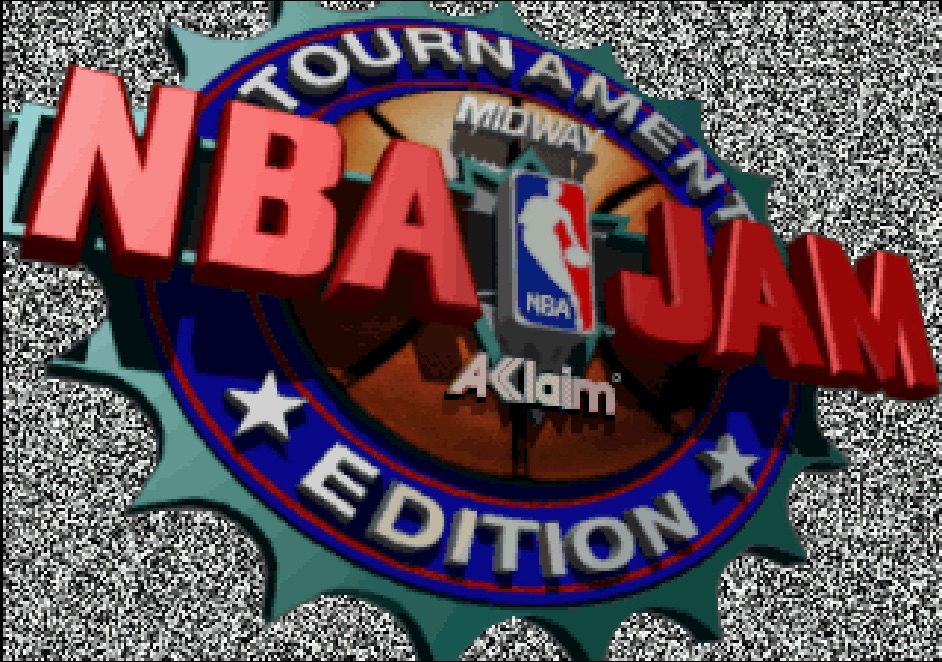
As well as the home conversions I’ll also get to soon, it spawned a few other games too, so let’s really quickly run through them all, starting with where we’re about to end up, NBA Jam Tournament Edition (pictured above) from 1994, which tweaked the gameplay, updated the rosters, gave you a sub, replaced the music and the commentary, and added Tournament Mode, where you effectively need to beat all the other teams with the power-ups, cheats and other wacky features we’ll get into later all turned off. NBA Hangtime came in 1996, with the NBA Jam name now taken by Acclaim for their home console games, but the gameplay was mostly familiar apart from a create-a-player feature, and there was another update to the presentation too. NBA Showtime: NBA on NBC in 1999 was the last of the Midway arcade games, and the last to feature two-on-two gameplay, but did feature TV-style presentation and went full 3D polygonal too. Midway weren’t quite done with the series yet though, and released NBA Hoopz direct to PlayStation, PlayStation 2 and Dreamcast in 2001, which retained the series’ arcade stylings but in a bit of a lazy way, while also upping the gameplay to three-on-three, for better or worse… Speaking of which, the Game Boy Color port of this one was an absolute stinker!

The next few games are from Acclaim rather than Midway, although the timelines do now crossover, and while I did just say these were console releases, I think 1996’s NBA Jam Extreme also got an arcade release alongside PS1, Saturn and PC. It’s fully 3D but I reckon is more of an impersonation of the original’s gameplay than a successor. The series jumped to Nintendo platforms for a while from there, and went five-on-five too for NBA Jam 99 on the N64 and Game Boy Color. Nice game this time too! We’ve then got yearly-named iterations, alternating between both platforms, until its debut on Game Boy Advance with NBA Jam 2002, which is fully-featured but also fully-average. Then we ditch the annual format for a reboot of NBA Jam on PS2 and Xbox in 2003, going back to the arcade roots with a three-on-three format and a slick new presentation but it also plays a bit average, like you’ve seen it all before. Acclaim went bust the following year, and seven more then passed, but seen it all before was mostly still the case when EA took the reins for the 2010’s NBA Jam on PS3 and Xbox, followed by the mobile version I mentioned earlier, although it looked very sharp and was fun as far as I could tell, and the Wii version, which did its own thing with different gameplay modes, seems to have been a real blast with a bunch of friends! The PS3 and Xbox then got an enhanced “On Fire Edition” in 2011, which was about it for NBA Jam, with no further movement fourteen years on as I write, but in reality I think we’d seen the best in the series an awful long time before then anyway!

Let’s now start to head back towards where we’re trying to get to with the console versions of the original Midway games, which began with the SNES, Genesis / Mega Drive, Sega- / Mega-CD, Game Gear and Game Boy ports of the first game, and that lineup was then tweaked to include the Sega 32X (rather than -CD) and Saturn, PlayStation and Atari Jaguar for Tournament Edition. When Hangtime came along, the handhelds and weird stuff no one wanted were ditched in favour of the Nintendo 64, alongside PS1, SNES and Genesis / Mega Drive, but the Game Boy Color did return for Showtime in 1999, with other versions available on the PS1, N64 and Dreamcast. Finally, as already said before, NBA Hoopz then dropped the N64 for the PlayStation 2 instead. And having now established the full series history, we can focus on the two “NBA Jam” games here and their respective home versions, they being NBA Jam and NBA Jam Tournament Edition, and specifically, I want to look at SNES, our European Mega Drive (including Mega-CD and 32X), Saturn, PS1 and Jaguar for both (where applicable) because the handheld ones may have their merits but are not the Jams I’m looking for! I do want to get into one in particular as quickly as possible though, so we’ll do a sentence or two on each version, starting with the first game from 1993…

And I’ll start with Mega Drive (pictured above) because that’s where I started myself, and honestly if this was the only version I could play then I’d gladly take it as the version I’m looking for! The visuals are obviously scaled down and scaled back but it looks good, sounds good and plays just right. The Mega-CD version then adds better audio again but nothing else of merit, so I guess is the one to have but I’m good either way! Unlike the SNES version, which does play well but looks sterile and washed out all at once, and sounds awful – what the hell is up with that dreadful non-stop squeaking? On, then, to the second game, NBA Jam Tournament Edition, and once again I’ll begin with the regular Mega Drive version, which is fundamentally a lot more of what we got before so yeah, why not? That goes for the SNES version too so, er, why? At least they could have sorted out the sounds! I’ve been knocking around with the 32X version for a good few years now and I really like it! Okay, it’s neither one thing nor the other but it plays like the Mega Drive version with bumper sprites and improved commentary, although strangely, the music has lost its pop. From the games I’d never played before, the Saturn version was actually the one I had highest hopes for, mainly because from what I had seen of it previously, it simply looked like the best of them – and it really is a stunner, with huge sprites and vibrant colours and even more vibrant sounds that all blow the original out of the water! I like almost everything else about it too but a single game just goes on way too long – must be the best part of half an hour, which is about three times the arcade game length. So weird but the PlayStation isn’t much better in that regard either, and aside from that, I just didn’t really get on with this one in general – it’s all there but I found it a bit soulless and less in your face than pretty much any other version, which is surely what NBA Jam is all about! Which brings us to the Jaguar…
By total coincidence, on a similar timescale to my NBA Jam port odyssey, I was also getting to know the Jaguar’s library for the first time, having got a taste for it on the incredible Atari 50 compilation after that launched at the end of 2022, so this version was totally new to me when I got to it, and even though I still had several to explore after this one, here was my Goldilocks moment… Just right! The brief summaries of those other versions I’ve just given you came from notes I’d written on each as I played, so before we go any further, let me give this one the same treatment… “Jaguar just plays nice, with all the speed, style, modes and hidden extras. Commentary better than arcade (meaning doesn’t constantly repeat player names). Does its own thing with the music, which is dynamic and fine but unfortunately doesn’t pop like other versions. Graphics decently proportioned if not as big as arcade. Great colours too, lovely lighting, enough animation and spectators who have this fantastic, subtle parallax scroll as you run. Faces not all very recognisable but I wouldn’t recognise many even if they were! Did read somewhere the Jaguar version is based on the 32X one.” We could probably finish there actually and save us all some time! I’ll carry on regardless though… I can’t really find much detail on that last comment but the 32X version (and most of the others) was developed by Iguana Entertainment and released in 1995, while the Jaguar version came from High Voltage (with production input from Atari) the following year, according to their website, with all home ports published by Acclaim as far as I can tell; hats off to anyone who’s put together documentaries and even entire books on this lot though because it’s a right can of worms!

However it came about, it certainly wasn’t positioned as a mere 32X port! From the back of the box… “Your state-of-the-art system demands a state-of-the-art NBA JAM™ TE™ – and this is it! Arcade-quality player scaling! Updated rosters! want more? We’ve got all-new secret characters! Monster-jamming stereo music and authentic arcade sound F/X – including voice calls for individual players! NBA® JAM™ TE™… pump it up!” Note that the weird use of upper- and lower-case characters at the start of sentences is all original and not me! The game further promises over a hundred and twenty stars from all twenty-seven NBA teams, rookie and all star teams, tournament mode, one-on-one, two-on-two and two-on-one matches, substitutions and, of course, those Super Jam power-ups! Up to four players at once too, which is as sadly lost on me now as it was at the time, but I think that was unique among all the ports too. Firing up the game itself, we’re first presented with Head-to-Head and Team Game modes, which offer versus play and cooperative play respectively, each in the various configurations just covered. There’s a practice mode for one or two players too, where you can get serious about your dunking and specialist drills in peace, and the all-important options screen where, as well as all the usual stuff like clock speed and AI difficulty, a lot of what makes Tournament Edition – and this version of it – its own thing can also be found in a big list of customisations… Firstly, in a one-player or one human per team game, by default you control a single on-screen player throughout the game, while the computer controls your teammate (unless someone else hooks up a controller and jumps in mid-game, which is very cool in and of itself)! That’s also how the original NBA Jam (and possibly the arcade version of this) played but now we have Tag Mode, and turning that on means you’re in full control of whoever currently has the ball, which then switches when your teammate gets possession, or, in the case of a pass interception, will stay with the current player.

I’d totally missed this previously but there’s also an option to turn computer assistance on and off, which I think translates to a bit of a rubber-banding effect if one team is running away with it versus playing each other fair and square. Anyway, I already briefly mentioned the Tournament Mode adding a further dose of relative realism by disabling all power-ups, cheats, secrets and various other special features, such as being able to adjust the shot clock, overtime length and hot-spots, which are areas that can appear on the court and award bonus points if you shoot or jam when you’re standing on one… By the way, do we need to also discuss the “jam” in NBA Jam? I had to look it up to be certain so let’s play it safe and say it’s another word for a dunk or a slam dunk or whatever, where the ball is rammed into the basket while it’s still in the player’s hands. I think! Whatever, once you’ve enabled Tournament Mode, you’ll then take on all the other teams in turn, and beating them will unlock two additional players for your team, some special teams and a higher computer difficulty level. Leaving it off, on the other hand, lets you pick single matchups if you’d prefer a quick blast instead. Let’s quickly cover those power-ups too, which can appear at random and be picked up by a human or computer player, and include “regular” things like boosting your shot accuracy, speed and power, as well as an unlimited turbo boost, which speeds you up and is always available on its own controller button but is normally metered and depends on your player attributes, which is something else to add to the list of things I’m very likely to forget to come back to! Then there’s a bomb, which temporarily flattens every other player, and finally a catch fire power-up, which does exactly what it says to the ball, giving you unlimited turbo and more chance of scoring from anywhere on the court. You can also earn this in regular play by scoring three baskets in a row, when it will then last for another four baskets or until someone else scores one. Right, one last special feature, and that’s Juice Mode, where you can make things really wild by speeding every player up by a factor of one to four, and that’s before you hit that turbo button!

Time we got into a game but first we need to select our team, and as said, we’ve got a choice of twenty-seven, all fully licensed with the latest 1994/95 season rosters, from the likes of Phoenix Suns, LA Lakers and New York Knicks, as well as a rookie team made up of five newcomers from the 1994 draft. With three players per team (with two on the court at any time and one substitute) that makes about a quarter of the entire NBA player-count, but you’ve got plenty of big-hitters all present and correct, such as Charles Barkley, Dennis Rodman and Dee Brown, and they’ve all got their own stats, rated from zero to nine, for speed, power, passing accuracy, dunking and distance shooting abilities, blocking and stealing abilities, and clutch, which I think is how they perform under pressure but I’m about as sure of that as I am that I just picked a few decent big name player examples! Actually, I think it probably makes them more likely to score a last ditch effort from miles away in the dying seconds! Anyway, once you’re in a game, you can also now use those subs at the end of the first, second and third quarters, switching the three players available to you in Tournament Edition into the combination of two you want, which might ideally be about balance but will often be dictated by an injury rating that may progressively increase during a game and soon start to affect his attributes, but sitting out a quarter will provide a complete recovery so always worth keeping an eye on during the break. By the way, I mentioned game length earlier, and on this one you’re looking at about two minutes a quarter as standard, so a little under ten minutes a regular game once you’ve factored in reading stats and changes, and about in line with the arcade game. And from there, we’re ready to tip-off!

On the surface, NBA Jam controls pretty much like any other basketball game, with a button for shoot or block, one to pass or steal, and one for that metered turbo button to make you run faster for a bit, which, by the way, regenerates when it’s not being held down. Repeatedly tapping it also has the effect of protecting the ball, where you’ll jostle with any defenders to try and line up a clean shot. As for the others, pressing down shoot will make you leap for the basket, and the nearer the apex of that leap you are, with your hands at their highest, when you release the button, the more accurate it’s going to be. However, releasing it quicker (or slower) is also going to reduce the chances of a defender blocking or stealing the ball, while tapping the button will do a fake, which may fool the defender but will also bring you to a halt, meaning you then need to pass or shoot in accordance with the rules of basketball. Control then automatically switches to defence when you don’t have the ball, and that same button will make you jump for a block, which is all about timing but very quickly becomes intuitive, with you getting a bit of the ball indicated by it flashing white as you make contact with it. The pass button will do exactly that when pressed, automatically throwing in the direction of your teammate, or swipe at the ball if someone else has it to try and knock it out of their hands for a potential steal. And when your teammate has the ball, you can encourage him to pass or shoot by a tap on either button too.

They’re the basics but things get more interesting when you start combining the three buttons. For example, when you’re running at the basket and get close enough, turbo plus shoot / block will trigger a slam-dunk attempt, and depending on your dunking ability and where you’re trying it from, you might pull-off one of the game’s spectacular trademark Ultra-Jams! Similarly, when you’re out of possession, pressing both of these will make you go for a super-block, jumping way higher than normal! Pressing turbo and pass / steal when you have the ball will add a bit of flourish to your passes, like adding a bounce or throwing from behind your back, which don’t only look fancy but are thrown harder so are often safer too. And if you press these when you don’t have the ball, it will turn you into a bit of a tank, shoving anyone in your path (including your teammate if you’re not careful) out of the way, American football-style, which can be handy if you’re trying to instigate a steal or grab a rebound, or just make a last-ditch attempt at stopping a basket, but can also be useful in giving your teammate a decent chance at the basket if he has the ball! Rubbish original controller aside, this control scheme is just genius! Every bit of nuance and depth, and every bit of fun, all there on three buttons but also on a single thumb, seamlessly able to slide back and forth and all instantly accessible to a total newcomer from the outset. While you might be pulling off impossible windmill-jams from twenty-feet in the air in no time though, making your way through all twenty-seven teams in Tournament Mode is going to take some doing, and whether you’ve got any helpers on or not, you’re not going to be walking all over the opposition any time soon; just getting a bit closer, whether that’s five points closer or fifty! It’s really well balanced either way though, and the back and forth flow to the gameplay feels about right regardless of the score, or whatever wacky stuff you’re doing on the court!

While it’s common to most versions of Tournament Edition, these controls have been tweaked to translate to a more fluid experience too, with everything moving at the same crazy pace (and possibly a little bit more on top) but somehow easier to tame and react to now, in part down to what’s always been some very solid ball physics, but no doubt also down to what the game itself describes as more realistic situational play, which I think for me most significantly materialises in keeping the four players and the ball a bit more separated rather than saturated at peak mayhem, and therefore less of an overhead on your poor, overworked eyes to keep track of! Not that I’m complaining about that though – it’s a chaotic beauty in motion! And yes, the player sprites could possible be a fraction bigger, and a lot of their faces could definitely do with a bit more clarity, but while it might be lacking it fidelity here and there, most of the rest of it is nothing short of remarkable, with layers and layers of movement from the bottom of the court through row after row of the crowd, so smooth and effortless in every direction, as the player sprites scale up and down with both the camera and their relative position on the court. And the wash of vibrant, contrasting colours coming together from the patchwork wood of the court to the reds and blues of the basket frame, to the crowds and the players, and the NBA Jam and individual team dressing, all combine to make this cohesive, cartoon whole that’s nothing short of sublime! That effect is only deepened by such thoughtful and well-executed lighting, whether the glaring, spotlit reflections on the court’s highly-polished surface, or the more subtle movement of highlights on bulging muscles and shadows on authentically-drawn official team vests, or even the three-dimensional quality of simple darkness receding into the cheap seats.

A bit further forward though, that crowd really adds life and excitement to the game too, jumping up and down and pumping their fists in time with the action, while cheerleaders do their bit when it looks like the basket is about to see a bit of it! There is repetition when you look closely though, which is of its time but I think could have been ironed out to an extent, especially in the more prominent spectactors at court-side, but what I do really appreciate is how much variety there is in where they’re sitting, whether coaches on benches, officials and commentators behind tables, the fold-up chairs behind the baskets, or more regular rows of benches along the sides and further back. There’s a lot of stiff animation going on in them too though, which is also to be expected and I think is only really noticeable when you consciously compare it with the more important stuff happening on the court, which – with the possible exception of that glorious net bulge – might not be Darkstalkers but there’s a lot of it, with arms and legs flapping all over the place (including in some very special mid-air poses) in a realistic and functional – if not always massively silky – fashion, and I reckon it’s probably as good as it could be with so much of it happening at once, as was the case to an extent for the arcade game itself.
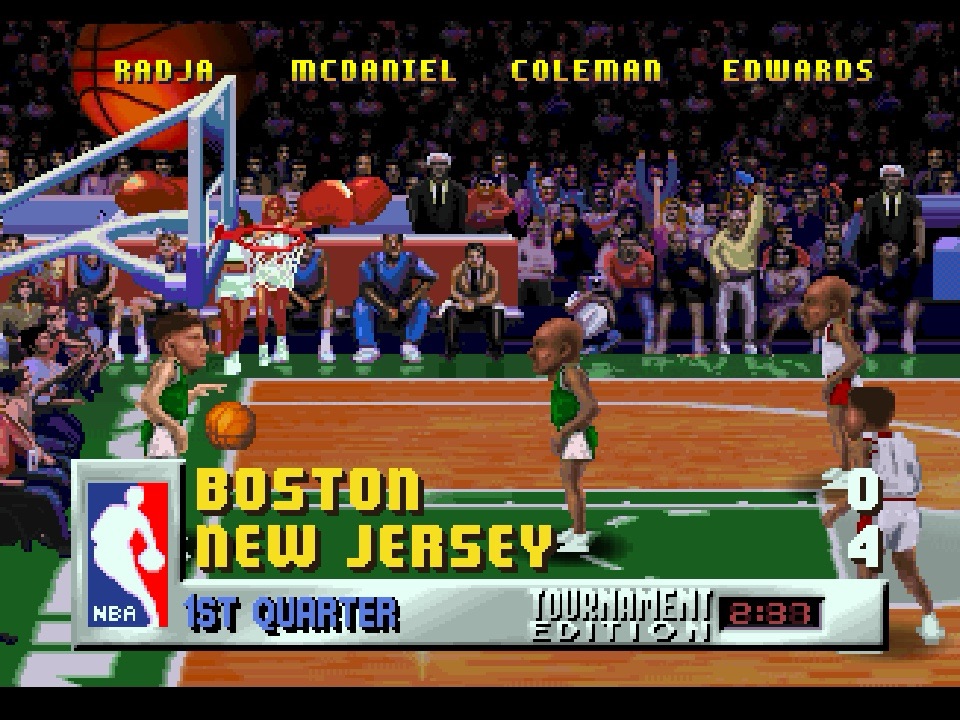
As already alluded to in my note-taking earlier though, where I think it beats the arcade game is in the commentary, which was another area that got an overhaul in Tournament Edition. Of course, it’s still got all the Boomshakalakas and Razzle Dazzles you could ever wish for, but for all its shouty yet surprisingly not annoying clarity, there’s also a bit of restraint, so player names are there (unlike in some versions) and sprinkled in every now and then rather than endlessly repeated (like in some versions), plus there’s all the play calls as they happen, so lots of “from downtown” and “no good” and “grabs the rebound” and “jams it in” which I find makes them more of a dynamic part of the soundtrack than an actual commentary you’re engaged with. Which is no bad thing because I’m not a massive fan of the music here. Firstly, it’s very low in the mix, and then it’s also doing its own thing, with a pleasant enough selection of perfectly atmospheric original synth rock and some jaunty tropical beats, but none of it is memorable in the slightest. It does what it needs to though, and the way it also behaves dynamically is very clever, as it weaves its way in and out of the action, but honestly I want my NBA Jam music shoved right down my throat and not relegated to inoffensive background noise! The sound effects are mostly great though – non-stop rubbery bounces and whooshes, klaxons and boinging rims, as well as a bit of a comparative whimper, I guess, when the crowd cheers, but like the way all the colours jump out at you at once, all this noise does the same thing, and that’s why I wish there was just a bit more to the music because it’s so close to totally nailing it!

Where it does then go on to surpass itself is in all the secret goodies no decent NBA Jam should be without, although with what I’m counting as at least thirty of them, as well as forty-plus hidden characters, I’m afraid I can’t vouch for every single one! They come in all shapes and sizes too, from the mundane, such as goal tending allowed or a display for the percentage chance of landing a shot, through to cheats like unlimited turbos or dunks from anywhere, and then they get increasingly wild, with teleport passes and a slippery court through to a tiny ball, big head, shrunken head and various other flavours of weird body proportions. There’s even Smurf mode and a way to make the game look like it’s playing in the Sega 32X version of Doom, although these are not really as exciting as they sound – everyone tiny and everyone flat, 2D and unanimated respectively! As for hidden characters, honestly I’ve never heard of most of them, but I am seeing the Beastie Boys, Prince Charles, Bill Clinton, the Chicago Bulls mascot (as well as several others), DJ Jazzy Jeff and his friend The Fresh Prince of Bel-Air, just to highlight a few! I realise this is a big deal for a lot of people but it’s an aspect of NBA Jam I’ve never been fussed about so sorry if I don’t get too excited about any of it though. I’ll just stick to the game…

Remember I said at the beginning that the arcade version of NBA Jam was one of a dozen basketball games I’d happily play whenever I had the urge? Well, since discovering the Jaguar version of Tournament Edition – my version – I think it might be a bit more than that now. Actually, I’ve developed a new-found fondness for that Mega Drive port of the original game while putting this together too! Anyway, while you were reading that last bit, I was quickly checking those notes I was referring to earlier, just to make sure I’d covered everything I wanted to, and I had, but that very first impression jumped out at me again… “Jaguar just plays nice, with all the speed, style, modes and hidden extras.” And as I also suspected at the time, all those words later, that sentence still more than sums up my feelings on the game! A couple of times, I also mentioned things like all the colours or all the parts of the sound design coming together to make something cohesive, and just looking at that sentence, that’s probably true of all the elements mentioned there too… Which I think explains why it’s my version, which I wasn’t expecting to come so easily when I started this summary! Regardless, it might not get much right but the Atari Jaguar has done alright with NBA Jam!
As always, I’ll never expect anything for what I do here but if you’d like to buy me a Ko-fi and help towards increasingly expensive hosting and storage costs then it will always be really appreciated! And be sure to follow me on Instagram, X (formerly Twitter) or Threads for my latest retro-gaming nonsense!
 Retro Arcadia