To avoid trying to pre-empt the eventual outcome of my already long-running and ongoing (as I write) series of top ten favourite shoot ‘em up features, where I’m looking into each sub-genre one at a time before hopefully culminating in an overall genre top ten, for now I’ll simply say that the original Deathsmiles came out on top of the horizontally-scrolling category! And I will also reiterate that someday, it will also get its own deep-dive treatment here, as previously promised when I did an unboxing feature on the Deathsmiles I + II Collector’s Edition for Nintendo Switch, as well as several other times since! Part of the delay, though, is that unlike pretty much every game I ever get into here, I genuinely can’t remember where I first came across it – I’m guessing some magazine or games website around its release in 2007, where I would have been totally sucked in by its heavy on the gothic vibes, as well as its hints towards older stuff I was into like Cotton and Cauldron.

From there, I’ll further guess that MAME was involved in actually playing it for the first time, whenever that opportunity presented itself sometime later, because I didn’t have an Xbox 360 or a decent PC when it came (then subsequently went) to them in 2009, and playing mobile, on a touchscreen, when that happened in 2011 wasn’t the way I’d have wanted to play bullet-hell, although I know some people do enjoy the genre that way, and I assume the 2019 update it surprisingly got on iOS at least did add controller support but again, still not where I want to be playing Deathsmiles! The unnecessary but happy extravagance of that collector’s edition in 2022 was certainly where I first legitimately owned a copy though, and was also where I first properly played the sequel we’ll get into shortly, albeit not for the want of trying beforehand – it was just one of those games my cack-handed MAME setups (or more likely underperforming PCs) could never run in a remotely enjoyable way. And while I’m going to focus on the original arcade version here, I will also quickly touch on the additional console modes in this release (which I think derive from the Xbox version) once we’re about done with that.

Before we jump to the sequel, I should finish setting the scene with the original first which, as already implied, is a horizontally-scrolling, bullet-hell shoot ‘em up arcade game by genre heavyweights Cave back in 2007, making it their second foray away from their more familiar vertical orientation, following the almost equally wonderful Progear back in 2001. You take the role of one (or two with a friend) of four thematically questionable, shall we say, “Angels” defending the magical land of Gilverado from an invasion by hell itself, across eight nightmarish (but in an almost-cute, anime kind of way) stages. This is where Deathsmiles brings a few of its own tricks to the party too, with a choice of where to begin, from Port Town, Forest of the Lost or Lake Shore. Beat the first level of choice and you’ll get another batch of stages to choose from – Graveyard, Swamp Wastes and Volcano, and then you choose from first lot again and so on until you’ve beaten all six, when you can either enter the hellish Gorge or go straight to the finale in Hades Castle. Things then get really unique because each of these stages has three levels of difficulty, and in the original game you can only choose each one twice before it’s locked out, so as accessible as this initially makes it, you’ll soon have some decisions to make about where it gets harder, or, indeed, where you’ll score biggest.
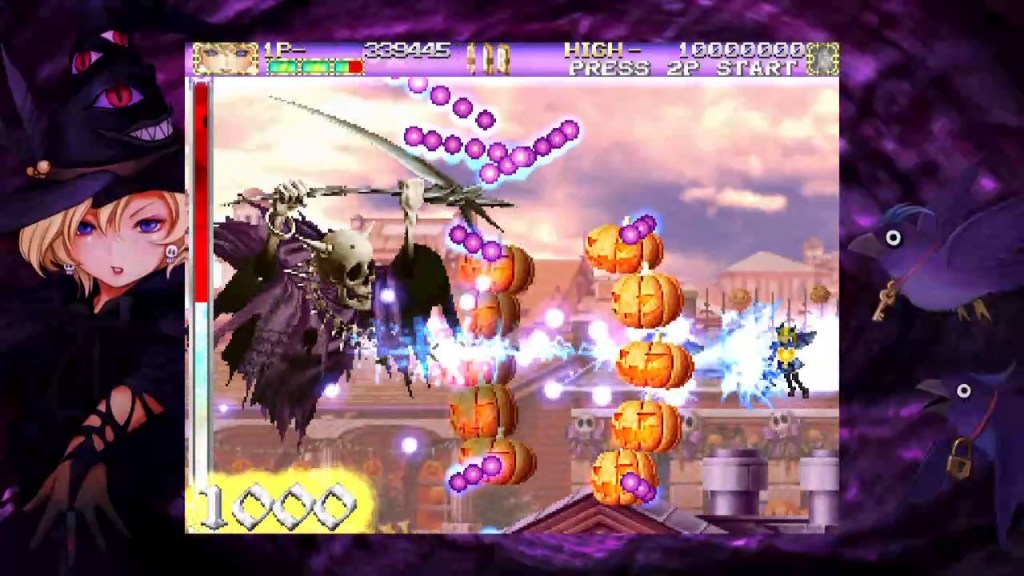
As well as providing new modes, such as Mega Black Label (which we can return to with the second game later), console rereleases over the years have loosened-up things like difficulty-based gatekeeping though, letting you choose whatever level you want, when you want, and since I got hold of this Switch version, I must admit I do like to play it casual this way. Not that it’s especially casual, but for a bullet-hell shooter there’s no better entry point into the genre, however you play, and with or without these difficulty gates. And while it might be (relatively) accessible, that’s not to say Cave’s trademark exhilaration isn’t also here in spades, with those majestic, breathless sweeps across the face of a wall of bullets and enemies – that no other developer has ever done better – equally evident here, and likewise some of the boss bullet patterns, which are as insane as their character designs! And such dark and brooding splendour elsewhere too, where every single aspect could have been made just for me! Visually it’s got everything great about Cave shooters in terms of detail, animation and general, creativity, but here that’s all running wild through a haunted house, and the soundtrack is equally Hammer Horror, albeit with what sounds more like Rambo running wild with a machine gun over a supernatural cacophony on top! And all of that adds up to why I love it, why it was top of my side-scrolling top ten, and without doubt will be at the business end of the forthcoming (eventually!) overall countdown.
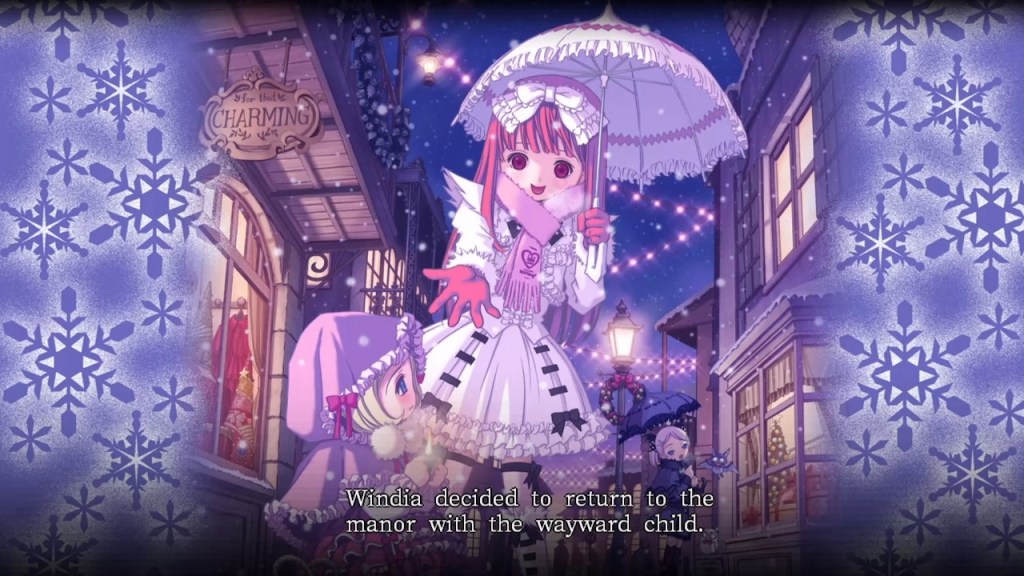
Its 2009 arcade sequel, Deathsmiles II: Makai No Merry Christmas, on the other hand, realistically won’t be anywhere close! However, should I ever decide to do a top ten favourite Christmas games… I’ll let you into a secret – I just liked that idea so much I’ve scheduled a placeholder for December 2025! Anyway, before I get any more sidetracked and embark upon that instead because there’s no way I can wait a year to put that list together, let’s get into Deathsmiles II which, despite the lukewarm welcome I’ve just given it, is still a shoot ‘em up by Cave, and it’s still a very good one; it’s just a bit different! By my reckoning, the English version of the original Japanese title, Deathsmiles II: Makai no Merry Christmas, turned back into Japanese characters then translated into actual English ends up as something like “Deathsmiles II: Merry Christmas in the Demon World.” However, the game’s own website further translates it to “Merry Christmas in Hell,” which makes me wonder if “Merry Christmas From Hell” was maybe the intention? Whatever, any of the above place us about two months on from the Halloween setting of the first game, as the magical world of Gilverado casts aside any lingering memories of any recent occult invasions and gets ready for Christmas, and we meet Windia, one of the returning “Angels” from the first game, on her way home through an idyllically festive, modern-Dickensian shopping street in the city, where she spots a freezing-cold little girl trying to warm herself on a tiny flame in an alleyway. She decides to take her home with her, and the next thing we know they’re back in the luxurious Dior Mansion, where Count (or Grandpa) Dior, who has devoted himself to taking care of Gilverado’s lost children, is lying in a pool of blood, with the now thawed-out little girl crying at his side and the rest of his Angels gathered around.

Probably also worth saying that all these “lost children” who keep turning up in Gilverado have been mysteriously, magically whisked there from what seem to be dicey situations in our own real world, and the ones he’s taken a special interest in taking care of also appear to acquired strange powers en-route that might come in handy for his sideline in protecting the world from unspeakable evil. Speaking of which, suddenly, the evil Satan Claws appears at the window, having recently escaped from the Demon World, and now celebrating his revenge against Dior for putting him there, before flying away with the treasured Wishing Notes (which seem to work like a musical genie in the lamp) he’s also just stolen under his arm and ripe for his nefarious aims. Which seem to involve unleashing a new set of frequently Christmas-themed monstrosities on the unsuspecting Gilverado that our Angels – who, it turns out, have already recruited their young new street-friend – need to put a stop to. And that “was the beginning of the nightmare on that holiest of nights.” And you know what? I’ve been dreading trying to fathom that nonsense from a combination of the in-game cutscenes and Cave’s own game website (all in Japanese) just so I can write these two stupid paragraphs, which are hopefully near enough but it’s going to have to do regardless! I’m going to steer clear of endings too, although mainly only because the game’s refreshingly to-the-point five stage length is short enough that there’s no need to spoil anything a few extra credits won’t fix, so I’ll simply say that wishes come in all shapes and sizes!
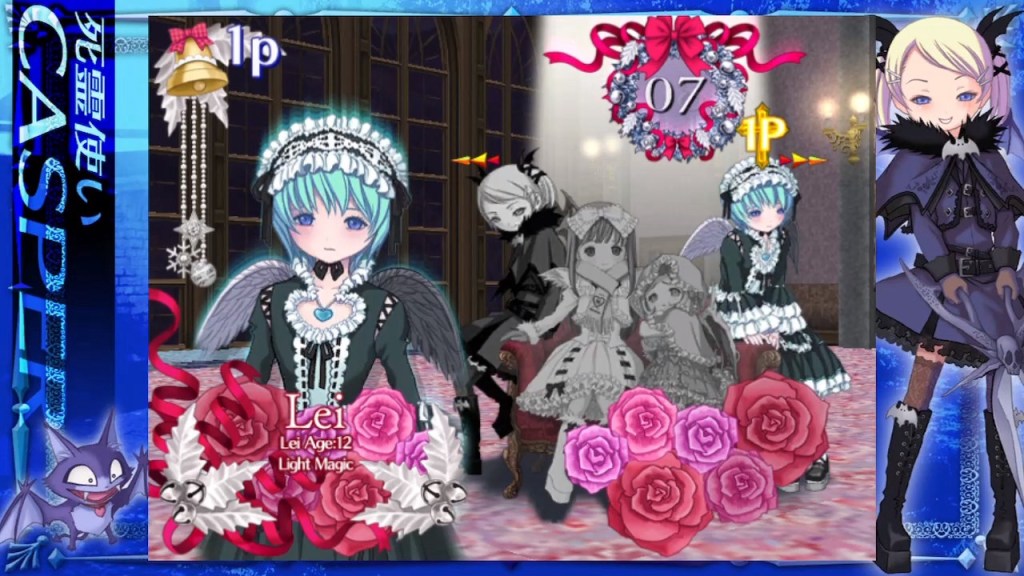
As was the case with its predecessor, we have four characters to choose from, each with their own unique weapons, familiar and magic, with two returning from the first game plus two new ones. The other two from before, Rosa and Follett, are present in the narrative but not playable, and while I doubt it’s by design, it does make things marginally less problematic for the poor player making their choice this time around. I think! I’ll just come out with it – Rosa is 17-years old and dresses like a Spanish prostitute with a bondage fetish, while Follett is apparently a 14-year old nurse in a uniform made for a fancy-dress party, shall we say. Now, I’ve been playing Japanese video games for the best part of fifty years, and a frequent visitor to Tokyo for half of those, so none of this shocks me. I just accept it exists (tellingly, almost exclusively in promotional artwork) to appeal to the tastes of its native market, like them or not. Moving to the characters that have carried over, Windia is a prim and mostly proper 13-year old, originating in London, wielding a wing blade, wind magic and accompanied by Hoo the Owl. Blood type A too, which is information provided on the whole gang but I’m not sure has any great relevance to our discussion here so I’ll probably leave that out for the rest of them! Casper is a gothed-up 11-year old who’s not a boy, comes from Berlin, and has the best-named arsenal of weapons ever… Her magical power is simply called Death, her weapon of choice is “Haunt Scissors” and her familiar is Kiki the Petit Evil! New to the roster are Supe, the 7-year old vagabond newly arrived from Copenhagen, apparently. I’m not sure but I think it might have been her dream magic powers that were hijacked to kill Grandpa Dior earlier, if I’m reading the minimally-narrated intro sequence correctly, and I’m also not sure what her weapons are called but her familiar is The Ghost of Tyrannosatan, an incarnation of the final boss in the first game, and her favourite food is “warm food” of all things! You’ll also be thankful to know she’s dressed like a cute little Tiny Tears doll or something like that, rather than anything sinister! The last character is Lei, who is not only a 12-year old boy dressed as the classic gothic lolita maid but also Supe’s brother, who seems to have some kind of light magic power and has two familiars called Pipi and Pepe. Again, his weapons don’t get a name but don’t forget that I do know his blood type in case you ever need it!
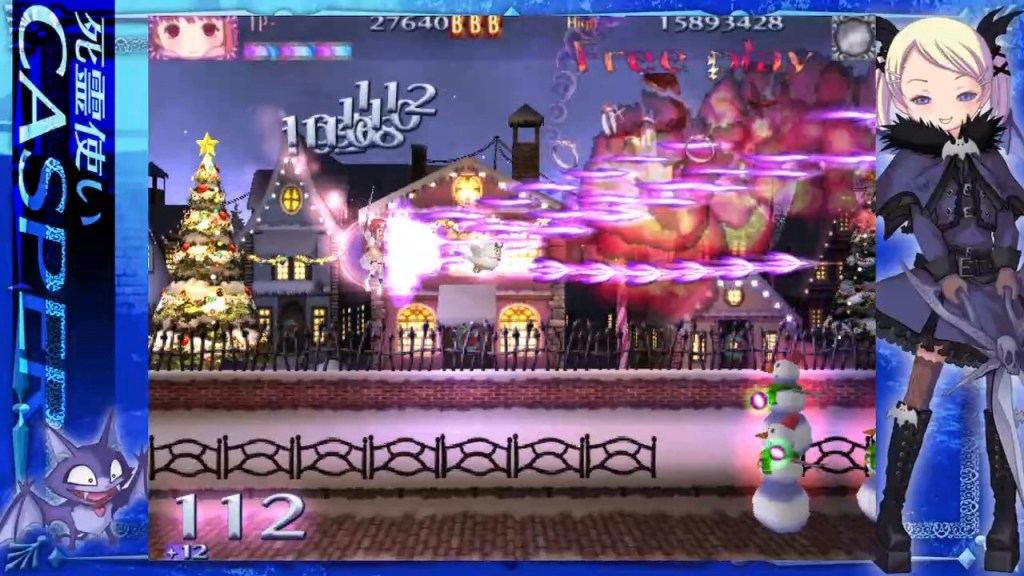
From this day forward I’ll struggle to ever pack a weapon that isn’t called Haunt Scissors but whether they’re named or not, as always with these things, it’s definitely worth getting to know each of the four characters, as well as their familiars, providing alternate secondary fire around you, and seeing which fits your play-style but for context, my impression is that Windia and Casper are reasonably balanced, Supe is high-powered but doesn’t generate a huge amount of pick-ups for score or extra power from dead enemies, and Lei is the opposite, with less firepower but wringing every last ounce of goodies out of every last enemy, if you want to hit the high score table hard! I’ll come back to scoring (as far as I can!) in a sec but let’s quickly run through how to play, and it’s pretty much classic Cave, where tapping fire gives you a regular shot and maintains your movement speed, while holding it down gives you continuous, focussed fire but also slows you down, which is anything but a disadvantage in a lot of bullet-heavy situations you’ll encounter here later! In the original Deathsmiles, tapping fire was, however, the only way to get certain enemies to spawn certain bonus items and I’m not sure that’s the case here but don’t quote me on that – while I’ve now finished it many times over, and in a reasonable number of credits, I’ve honestly never got into its more advanced mechanics like I did the first game but all the same, I haven’t really noticed it here either.
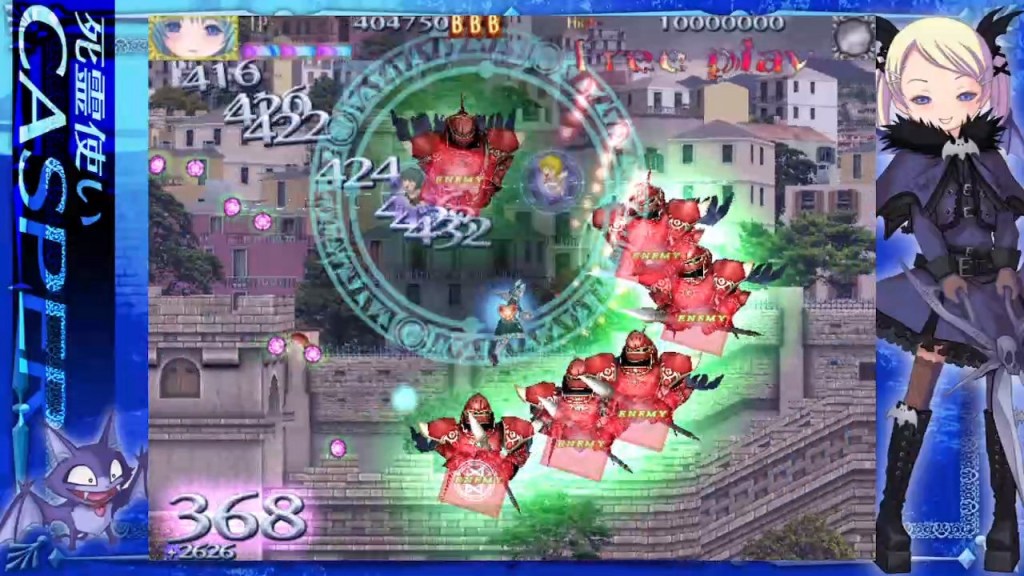
What definitely carries over from Deathsmiles, though, is having two fire buttons, one for firing right (ahead of you) and one for firing left (behind you). They both work exactly the same and deliver exactly the same damage, and if you hold them both down at once, you get a magical barrier that expands around you, and if an enemy enters that barrier, a homing “Magical Barrier Laser” will automatically lock-on and take it down. The extent of the barrier, and thereby how many enemies it can lock onto at once, depends on the item counter at the bottom of the screen, which is built up by collecting the items I’ve already alluded to dropped from vanquished enemies, and the nature of those does depend on whether you’re tapping or holding down fire, with the former creating red rings that will increase that item counter, and the latter creating blue rings that will increase a separate multiplier count… It’s probably a good time to mention that in case you hadn’t already noticed, as much as I enjoy a shoot ‘em up, I’m hardly an expert, generally relying on repetition over talent to get anywhere, and rarely playing for score over survival, but all the same, I’ll try and continue on this path I seem to have ended up on!
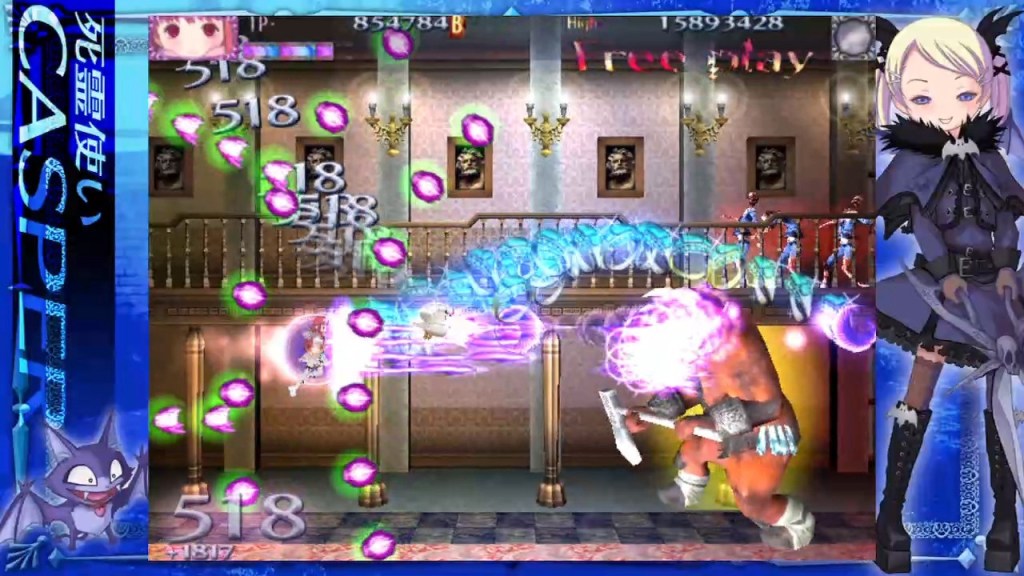
As well as attacking any regular enemies that happen to stray into your magical barrier when it’s active, there are some enemies tucked away in the background that can only be killed by locking onto them with these homing lasers. Some enemies targetted this way will also release homing bullets of their own as they die, and they’ll be on your case until you let go of both buttons, at which point they’ll turn into diamond rings for a massive item counter boost and scores gone wild! And once that item counter hits its maximum, and even more so if your multiplier has too, things get really wild when you do the two-button power-up, with every type of bonus item spewing all over the place, and so much so that you can start to juggle being powered-up and not, effectively recharging this maxed out condition, at least until you meet a boss or need to drop a bomb, which is the last of the functions available to you, and offers you a limited amount of summons for your character’s screen-clearing magic of choice. And with that, I think we’ve covered enough of the game’s mechanics to see how it plays!

As said, the game is split into five stages, or chapters, and we set out “on this holy night” in pursuit of Satan Claws as he disappears off into the distance, while we’re initially auto-swept along and then take control alongside the Christmas tree-lined streets and beautifully lit buildings of the snow-laden city, which is just about the most festive setting for a supernatural massacre you could ever wish for! In fact, none of the rest of the game ever really comes close to the Christmassy atmosphere we experience here, as the camera pans in and out, up and down and all around across the rooftops where the seemingly oblivious locals continue to dance away on one balcony, as a giant pair of possessed Santa-boots stomps all over the one next door! And before I even get to the menagerie of flying and ground-based demonic forms that swarm all over us from the very outset, I’m going to stop us right there and talk polygons, which, until this point (admittedly less than an inch-game minute in!), you’d be forgiven for having not even picked up on, despite the screen-filling, angry minotaur with the first real hint at some of the most outrageous bullet patterns you’ll ever see just now, which you’ve already casually turned into the first several of a thousand fireballs you’ll be creating before you’re done too! And actually, that jarring contrast between a really impressive, seamlessly integrated enemy like this and, er, some disembodied footwear, is my main problem with the game, far more so than the general moaning I’ve come across about Cave’s decision to scrap the gorgeous sprite-work from the first game in favour of polygons!
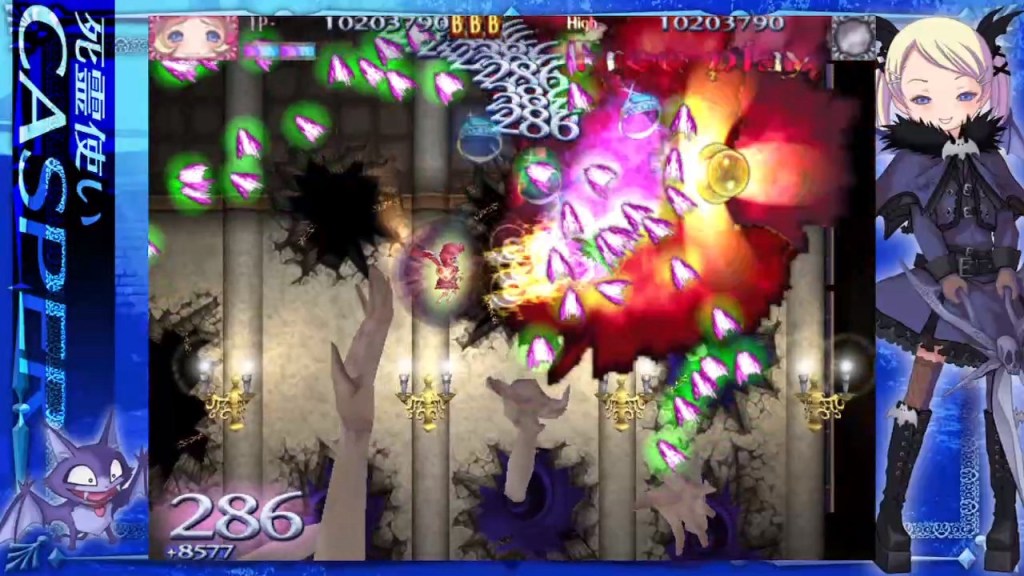
The haunted boots might be a bit odd but in reality aren’t actually so bad to look at but later on, we’re going to start seeing oversized zombie-like hands reaching out at you that look straight out of some bad Mega-CD FMV game (such as Corpse Killer!), or even more oversized, icy white chess pieces, totally devoid of any texture or anything but the most basic shading, lurching at you from the edges of the screen, unbelievably at the exact moment you’ve just emerged from the most stunning, large scale, geometrically-complex architectural framework, moving behind you with this amazingly lifelike 3D perspective meets dynamic parallax scrolling effect against this gorgeous, interplanetary backdrop, which perfectly introduces the final Bewitched Palace level and the game’s absolute climax! Really doesn’t need a great big piece of horse-shaped ivory spoiling its majesty! Some of it is truly unforgivable too, like the big falling pieces of masonry you need to negotiate as you make your way up a collapsing tower, which just have this random piece of badly-scaled, generic rocky texture pasted on top of them, none of which is helped by some of the game’s most rubbish monsters lined up on either side! There are far more places where I think the visual style really works though, especially on mid-sized enemies that end up looking like exquisitely painted Warhammer miniature figures, with this lovely air-brushed finish on some intricately detailed and often very imaginative things like caped undead knights flying on spears like witches broomsticks, terrifying porcelain-effect babies, fleshy gargoyles come to life, and even stuff like plain old bats, wings flapping just like they should, complete with that almost translucent fragility. Speaking of fragility, your player “sprite” is tiny but full of detail and just enough movement, if you look really closely, and perfectly recognisable too, for better or worse, from their representations elsewhere, and likewise your familiar circling around or doing whatever their own control quirk offers you. Most importantly though, no mistaking your hit box glowing away in the middle!
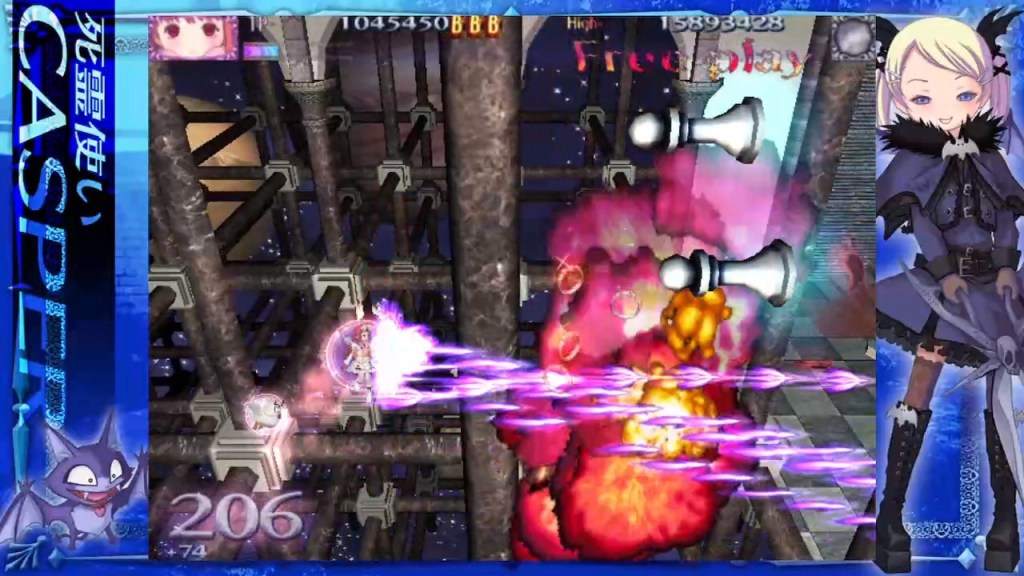
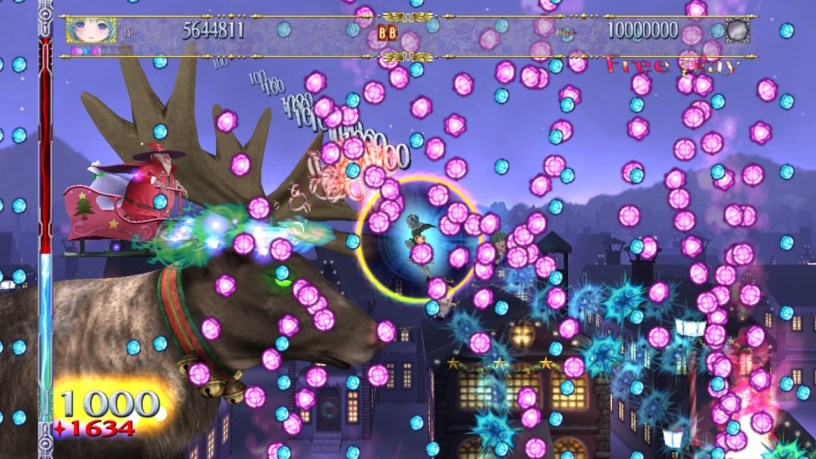
We’ll take in some more of the sights (and sounds) as we continue, which we really should do now because we weren’t even halfway through the first level when I got sidetracked by all of that, although it is something else I’m glad I got out of the way! That said, the first level is also the very essence of Deathsmiles II, and none more so than Giant Reindeer Lilly Lilly, the end of level boss, an enormous beast being ridden by the returning Satan Claws, dwarfed in his fancy star-spangled sleigh behind its death-dealing antlers and glowing eyes, as you’re swamped by the game’s first real bullet-curtains, coming at you from all sides while he sadistically shrieks and whoops at your inevitable demise… Although you’ll probably be okay… Just keep in mind you ain’t see nothing yet! Another “popular” opinion is that this game isn’t massively difficult, relatively speaking, for a bullet-hell shooter, and I guess a lot of it isn’t, but some of the bullet patterns thrown out by some of these bosses are totally insane! Whacking on focussed fire and picking your way through them, and equally, taking wild sweeps across the face of them is as exhilarating as in any Cave game though, and likewise, they can also be absolutely beautiful too. This is also the case for those instances where you’ve dropped a bomb or the screen is so full of pickups, fireballs, bullets and enemies too, creating this mesmerising soup of graphical styles that works against all the odds, and often totally negates whatever weird or inspired mess of polygons were previously behind it, and is where the game really feels most alive… Maybe just not as Christmassy as it once had been! What might be level two (I’ll explain shortly), Urban Sprawl, introduced in-game as Chapter 2, City of Despair, is a perfect example of this – a perfectly detailed and attractive medieval cityscape behind its increasingly intense action, culminating in Fortress Beast Bigote Bigote – an entire living castle like a blown-up version of the one from Battle Chess! If only that were the only time I’ll be referrring to chess here… But where have all the baubles and tinsel and stuff gone from what I assume were its outskirts in the first level?
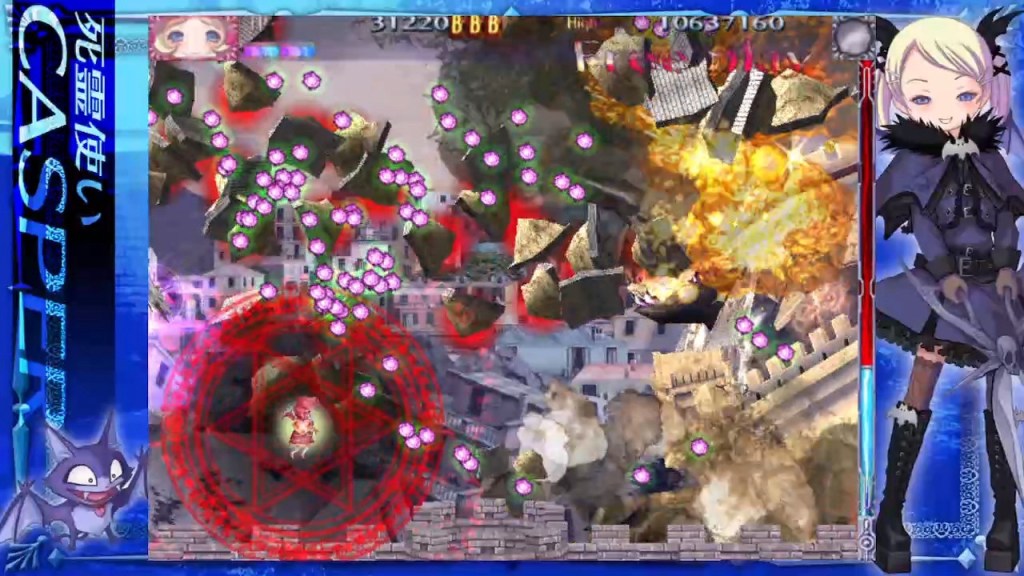
Apart from the multicoloured chaos you’re responsible for, the environment is suddenly incredibly sandstone and Middle Eastern-looking, which also goes for the Detritus stage, or Demon From The Depths, where you’re travelling upwards through those falling bits of tower (where the pig-chef monsters from the first game have now taken up residence!) as a bunch of giant anacondas (or similarly scary big snakes) slither around menacing, in preparation for the boss, Heavy Snake! Sounds like it should be in another game but like its minions, that looks a bit rubbish too – plenty of size but just not “heavy” enough (or, more specifically, “solid” enough)! I’ll quickly mention that the two levels we’ve just touched on, as well as the next, Haunted Ruins, or Shadows in the Ruins, can be played in any order before the final level, known as Chateau, or Bewitched Palace. Which is all pretty pointless because there’s none of the enforced difficulty selection of Deathsmiles here, where, as described earlier, you would pick the stage order and your preferred difficulty for whatever you picked, whereas in the original arcade game (rather than any later console-specific modes), you could only use each difficulty level once, and had to use all of them at some point. Anyway, Haunted Ruins is a once-grand and luxurious gothic mansion that’s a bit of a poor relative to something out of Castlevania, with a borderline rubbish-looking boss called Nice Older Man Tamecos Tamecos… Actually, I’m now wondering if they thought all of these were so good they named them twice, or if the words are just being repeated on screen for effect? No matter, he’s a very tall, aristocratic Slender Man meets Frankenstein’s Monster-type who chucks some alternately dense and downright vicious bullet spreads out of his shoes as he also tries to stomp on you mid-comical, Basil Fawlty-esque walk, occasionally interrupted by a close-up battle with his massive face! He’s alright though, and from there you’re on the home stretch, although the last bit (where we found all those crappy chess pieces earlier) is virtually as long as the rest of the game combined… Which still isn’t that long!

It is incredibly cinematic though, throwing impossible, Escher-inspired camera angles at you from all over the place as everything rotates and goes upside down and floating through space and all kinds of visual madness, and nowhere else in the game is there so much on-screen lunacy, or indeed, more disturbing audio! Once you’re past the stupid chess pieces and the mind-bendingly skewed sweeping staircases they’re gathered around, you emerge into this splendid, ornately carved chamber full of those porcelain-faced ghostly dolls from earlier, and regardless of all the flames and numbers and colourful clouds of whatever all over the screen, you’ll know they’re there by their incessantly creepy childlike laughter, made worse by the full-on church organ intro from out of nowhere that precedes the pop-horror opera that’s about to accompany you mowing them down in their hundreds, before bigger (and therefore more disturbing) versions of them appear, then Heavy Snake turns up again, and then the laughter gets louder, only to be replaced by someone else’s laughter… I’ll come back to the prolonged final showdown with Satan Claws in a sec, but while we’re on the soundtrack, I think it’s really excellent throughout! Up until now, it’s maintained the Christmas vibes far more than the level designs have too, whether by use of things like Christmassy bells on top of original melodies, or just going for the old classics themselves – you’ll be humming Joy to the World all day long after playing this, whatever the time of year! There’s so much more than carols though, from the deeply gothic echoes of the the first game’s returning theme tune to fully-voiced choirs over what sounds like medieval instrumentation that seconds later is some upbeat, J-synth electronica! Then there’s more opera, epic classical pieces from full orchestras, ambient electronica, high-octane techno, more opera, and it all blends seamlessly in and out of each other, as well as the drama of non-stop otherworldly shrieks, deaths, explosions, item drops and all those bells chiming and babies laughing! It’s total chaos and undoubtedly one of the high points of not just this game but also the series, such as it is.
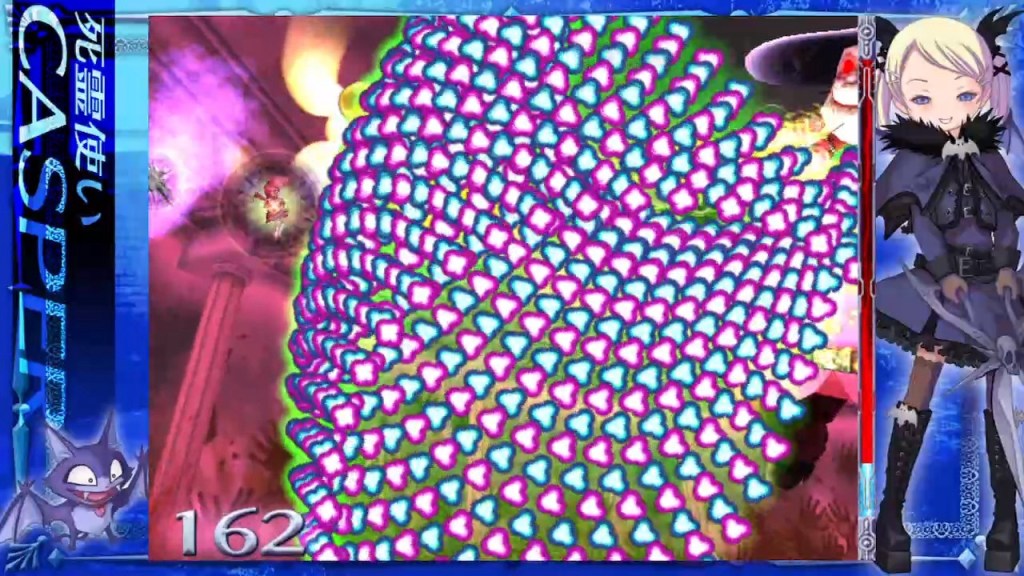
Right, we’d just reached the final boss, and don’t let anyone tell you this game is easy until you’ve seen them beating him in one go! Don’t get me wrong though, it’s a lot of fun, it’s a thrill-ride, it’s got loads of variety in its various phases and it’s a lot to sink your teeth into, but some of those bullets coming at you are literally solid blocks that you’re somehow expected to negotiate – totally nuts! All part of the bullet-hell puzzle though, and a lot of the reason I’ve learned to enjoy the genre, even if I haven’t quite learned to play it to the same extent yet! Anyway, I would say that the rendition of Satan Claws we’re presented with here is the most successful use of polygonal “sprite-work” we’ve come across so far, and in whatever form he’s taking too, from his sinister entrance where you’ll probably realise why he’s called Satan Claws (apart from it being a rubbish play on words), to his quickly extended and particularly rotund form, where he’ll now rarely fit onto the screen all at once from this point onwards! Not that there’s much space anyway, what with all those glowing, neon bullets literally leaving no room for your tiny character either, let alone his devilishly jolly bulk! The format is the same as all the other bosses so far, which is a simple one – weave around their attacks while you hold down fire until its energy meter is gone and it’s dead! This guy just has a lot more stamina than the rest, and all the bullet patterns too, coming at you in all flavours of regular shapes, then falling like snow, then coming in thick, broken-circular waves, expanding out across the screen in what I think are the most beautiful, glowing, gem-like patterns I’ve ever seen in one of these games (and you can see in a screenshot back up the page), and then there’s buzz-saw balls of light things amidst the next hail of bullets, and then there’s those totally impenetrable walls of bullets spreading out towards you… And now he’s coming at you from all sides, with these awesome mass item drops between phases that are as dense as his attacks, and with all the explosions and lights and mocking laughter, and the room – which is now covered in awful Blair Witch-style hand prints – is spinning around you and the most ridiculous J-pop anthem, all dressed up for Christmas with a proper shrieking opera singer over the top, this ending is such a spectacle!
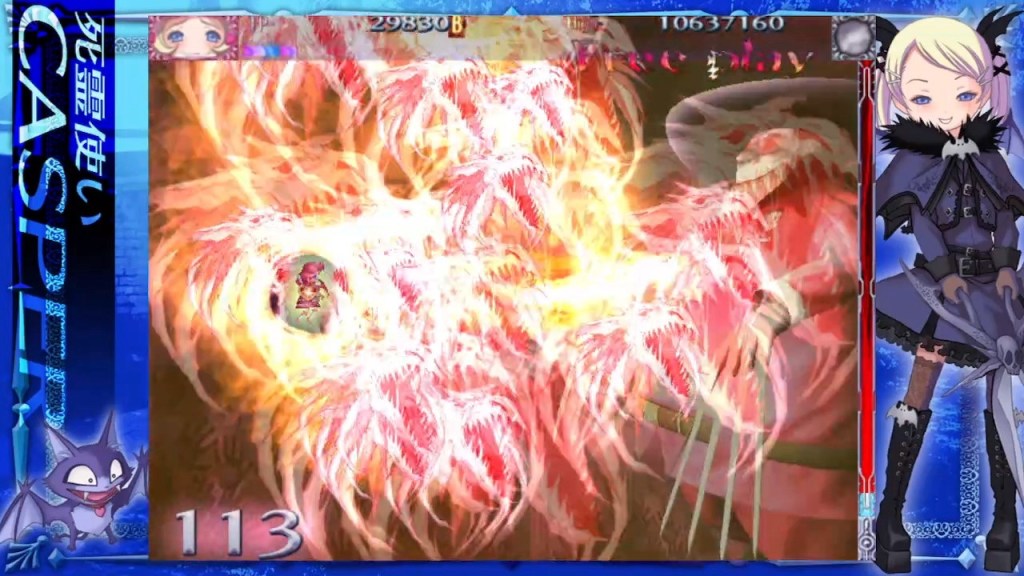
Which then ends with a different static cutscene and closing narrative for each character, which I think is a nice touch, as Satan Claws is once again sent back to the Demon World and happy wishes can be made. And while I did say earlier that some of the more problematic elements of the game were almost exclusively restricted to promotional imagery, the exaggerated appearance here of one of the characters I highlighted (and less so but also the other one too) is really unnecessary, unfortunately, however fleeting. And whatever the reason for doing so, if you’re putting this out to the wider world then you need to be a bit more world-wise. Or add five years to their made up age, or even better, just remove their bloody ages from the narrative if you really need to perv-out, and problem solved! And it’s such a shame because once again, it’s an unavoidably dark cloud over what I think is a fantastic shoot ‘em up (which also goes double for the first game) that’s a perfect introduction to the often unwelcoming bullet-hell sub genre it belongs to… Those none-more-white chess pieces and weird floating hands really are crap though! Not very festive if that’s what they were going for either, and although that theming does ebb and flow throughout the game, it is in itself debatably a very odd choice too, but I’m going to take it for what it is and try and finish on a positive because I can’t think of any game that nails it better than this, and that first level in particular, albeit admittedly in a very dark, Batman Returns kind of a way! And I think that’s everything I wanted to say about the original arcade version of Deathsmiles so let’s finish with a quick look at the two other modes on my Switch release.
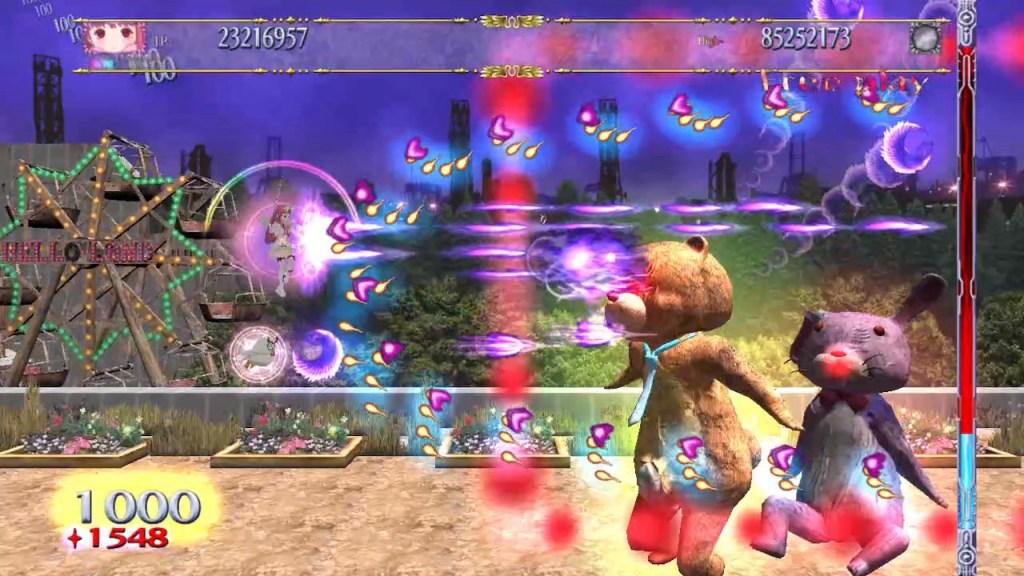
I’m not going to go wild on these but somewhere along the line (I assume in 2010 for the Xbox 360 release) there was clearly significant effort put into both beefing up the original experience and giving it a bit more polish too. I’ll start with X Mode, which is pretty much a full remaster, with an enhanced widescreen presentation and a lot of improvements to the visuals, although there’s only so much you can do with those grabbing hands (aside from adding more of them). Heavy Snake is looking heavier though! There’s also some really stunning lighting effects making for some striking reflections too – the marble floors in the palatial Haunted Ruins area really jump out now in this regard! We’ve also got two new levels, the first of which, The Maze, is mandatory, introducing some weird jellyfish enemies among others, as well as a new spider boss, which might have my favourite bullet patterns in the game, although the rest seems like what was left on the cutting room floor from the City of Despair level. Then there’s an optional pre-final level, Lost Paradise, which is like an industrial theme park dressed for Christmas, with giant circus elephant enemies, and a pair of not-very-cuddly toys for bosses. And that’s quite the challenge, especially if you ramp up the reinstated selectable difficulties for each level, although the lower ones are a really nice way of learning the game and probably taking your first steps into the genre too. Rosa and Follett have also been reinstated as playable characters, and there’s new (Japanese ) voice-acting in some of the cutscenes, most of which are now skippable, and there are new full-motion pre-boss introduction scenes too. Powering up has also been modified, I think with the intention of making it more fluid during gameplay, but I’m not so keen – seems less intuitive to me now… Maybe I just need to spend time in the new training option inside this one too though!
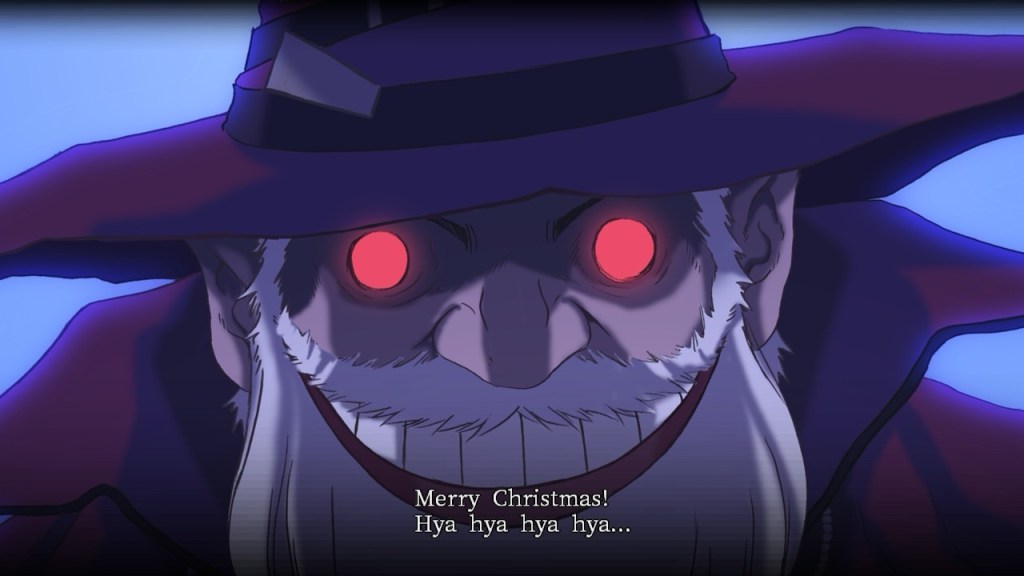
The second new mode here is Arrange Mode, which I think takes most of the above and adds a couple of new gameplay mechanics on top. Firstly, you can now throw your familiar, which can both mow down enemies like a magical bowling ball and cancel certain bullets. Then second, there’s a tension meter, and I’m not entirely sure how this one works because I tend to stick with the X Mode when I’m playing for fun, but I think “tension” increases with your multiplier, in turn making enemies more aggressive. I don’t know, I just see these as two mechanics I don’t really need, which might also be why they were either removed from the original game or didn’t exist at all, but equally, maybe I just need to spend more time with them because I haven’t really so far. Which is the problem with a Christmas game because it’s a strange thing to be spending time with at any other time of the year, although you could argue that Deathsmiles II is a strange thing to be spending time with period, especially when its glorious, polygon-free (but equally problematic) goth-fest of a predecessor is available at the touch of the Switch’s start button! Good game all the same though, so make your choice, take your pick, and Merry Christmas… From Hell!
As always, I’ll never expect anything for what I do here but if you’d like to buy me a Ko-fi and help towards increasingly expensive hosting and storage costs then it will always be really appreciated! And be sure to follow me on Instagram, X (formerly Twitter) or Threads for my latest retro-gaming nonsense!
 Retro Arcadia