
The last time I looked at a Game Boy compilation here – a year or so ago as I write – I had absolutely no idea of quite the impact it was about to have on my life! I’m talking about Namco Gallery Vol. 2 , which I’d first come across when I reviewed Game Boy: The Box Art Collection from Bitmap Books, which in turn was somewhere around the start of 2021. Like the collection we’re about to look at here, it was a Japanese-only release, and included Game Boy takes on four arcade games: Dig Dug, Galaxian, The Tower of Druaga and some baseball game I’d never previously heard of called Famista 4… Knowing very little more about the sport it’s based on either, and with the game also being mostly in Japanese, I decided it might be a good idea to head elsewhere to at least get a basic understanding of what was going on before I wrote about it, and that led me to an idiot’s guide a few minutes long on YouTube, which, it subsequently turned out, was all it then took to get me totally hooked!

I did go into the whole tale when I also looked at R.B.I. Baseball on the NES here a while back, but in short, I quickly then became borderline obsessed, not only taking in over four decades of baseball video games in a ridiculously short amount of time (and then becoming engrossed in several new favourites I’d discovered), but also watching live or recorded proper games on TV to the exclusion of pretty much anything else for the duration of the rest of the entire relentless season, and even seeing my first live MLB game! Then another one this year too, and I just can’t get enough of it! And all thanks to some weird game on an obscure handheld compilation I only decided to dive into because I didn’t fancy writing about the Nigel Mansell game I originally started out covering and needed a quick alternative! And while it’s slightly less momentous, flicking through that beast of a box art book again when I was looking for that alternative also threw up Taito Variety Pack as an option, and I also promised I’d get to covering at the time, and here we finally are, so let’s see if this one can throw up any new life-changing surprises too!
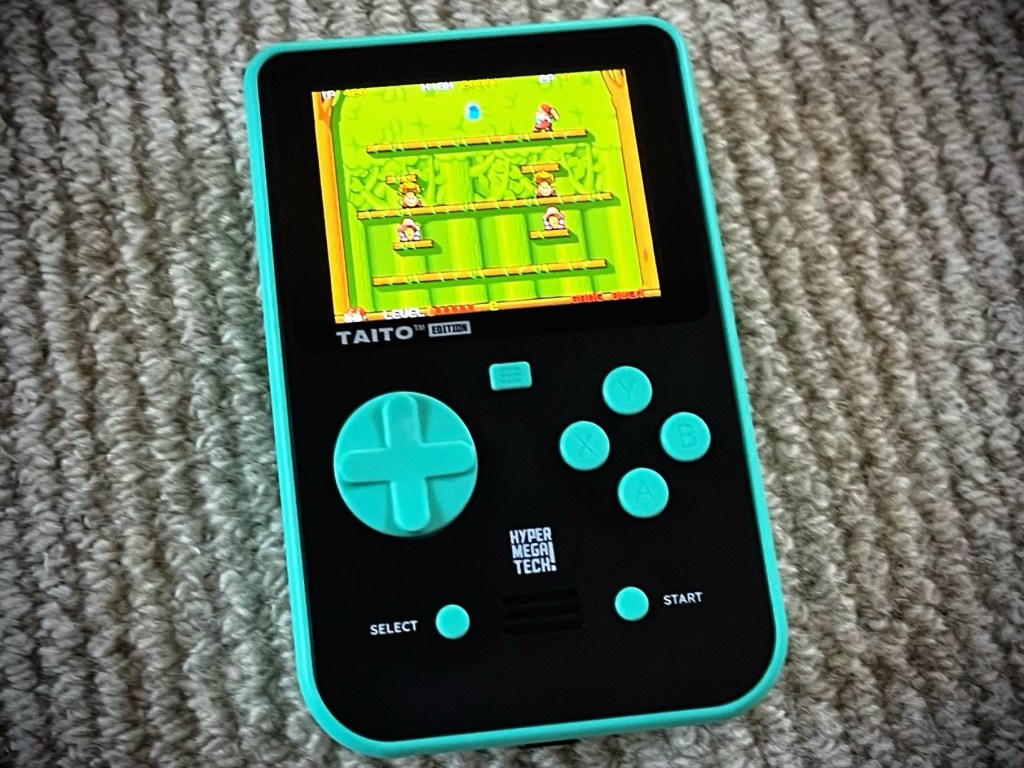
Well, honestly, looking at the lineup of games on there, that’s unlikely, but we’ve got a bunch of serious heavyweights to get into all the same! And, having now also covered a ton of Taito systems and compilations here, spanning well over a hundred games, it did get me thinking, if I had to pick only four to stick on a Game Boy compilation, would they be? To narrow things down to stuff that should work handheld at least, I decided to get a head-start with the Taito Edition of the 2023 Hyper Mega Tech Super Pocket handheld console by Blaze Entertainment, the Evercade people. It comes with eighteen officially licensed Taito games, including the arcade originals of Space Invaders, Operation Wolf, The New Zealand Story, Rastan, Bubble Bobble, Elevator Action and more of a similar vintage, alongside the console version Space Invaders ‘91. Lovely machine, and really good value and a quality build for the price, with an excellent screen, surprisingly decent sound and great battery life, although it is properly pocket sized, which makes me appreciate having girl hands, especially on the shoulder buttons! Not much need for them with the in-built games though, and 15-year old me still can’t believe I’ve got actual arcade Operation Wolf in my hands, even if a little d-pad really isn’t the same as a cab-mounted Uzi, but most of it is absolutely timeless however you play, and even that works alright on the go!

Actually, the only one that doesn’t really is Volfied, the line-drawing, screen-filling Qix follow-up that comes in portrait mode and is way too hard to end up that tiny! However, Qix did work great on the Game Boy, and its monochrome reimagining meant even us colourblind types could finally enjoy it, so against all the odds, I’m going with Volfied as my first pick, albeit only because I own the Qix cart already! Likewise, I also own the Elevator Action cart but as its arcade version sits painfully just one place outside my top ten favourite games of all time, the more places I can play it the better, and I’m going with that next. And it’s on the cartridge already so an even easier choice! If we’re talking all-time favourites (as well as stuff also already on there!) then I’ve got to go Bubble Bobble next. Then Puzzle Bobble would follow that nicely, and be another game where my colourblindness problems could finally be solved, although I suppose it’s not offering much variety so I’ll keep hoping for a standalone release of that one day instead! Last slot then, and as much as I’d like to say Growl or Operation Wolf or Football Champ, they’re all going to be crap on a Game Boy. I think The Legend of Kage and The New Zealand Story might be too, and we don’t need any more Space Invaders on there, or single-screen platformers for that matter either, so I’m going with Rastan for the final slot because the Game Boy does do a nice scrolling action-platform hack and slash thing!
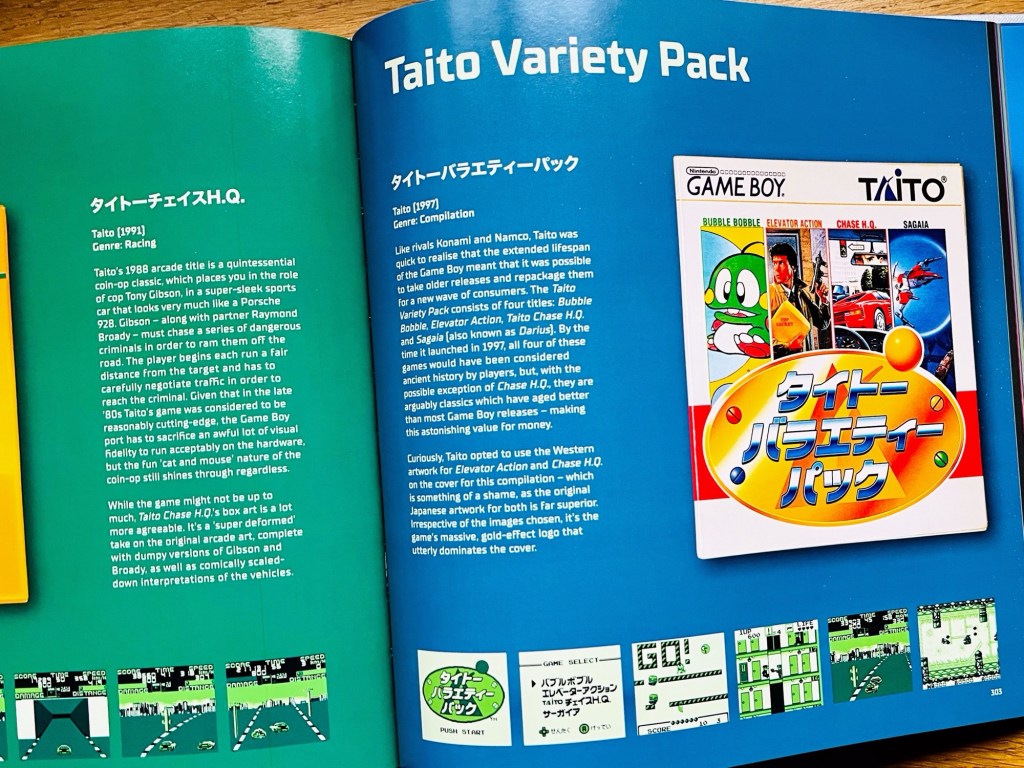
Right, my modern little handheld has helped me pick two of the four games that actually made it to Taito Variety Pack, and honestly I’d probably take Rastan or Volfied over at least one of the other two but I’ll come back to all of that in a sec… Just to close on my daydreaming first though, and without simply listing a dozen other Taito games I like (some of which had Game Boy efforts anyway), I suppose the only other two I wanted to quickly mention that might work well here would be some take on Arkanoid or Rainbow Islands, which did get a Game Boy Colour conversion, where I guess it makes more sense given the subject matter! And again, variety is in the name of this compilation and it’s not really offering much of that either, so maybe Taito knows best after all, which is a good place to start the process of confirming that! And also a good place to confirm that alongside Elevator Action and Bubble Bobble, we’ve also got Chase H.Q. and Sagaia, or Darius II, as it originally began life. It came out in Japan at the end of February 1997, so we’re talking late in the console’s life and, like those contemporary Namco compilations from before, or the similar Konami one and possibly others, is no doubt an attempt to milk one last bit out of some of their earlier arcade ports before they fell out of favour completely. Or at least until eBay came along…

Before we get into each of the games in turn, as well as how they’re presented as a package (such as it is), I do have a quick bit of housekeeping to mention as far as playing them is concerned. I’d love to say I’ve spent the £200 or so this thing is currently going for to give you the original cartridge experience but I haven’t – apart from Elevator Action, the best I can offer is emulation on my PocketGo handheld for a more or less authentic look at them, and where I’m already pretty familiar with the other three games as individual ROMs. As I often do in cases like this though, to avoid you suffering dodgy photos of a tiny screen from my phone, I’ll switch to PC emulation for any screenshots, but I did find a little complication there I want to pass on in case you fancy a go yourself… I generally use the Gambette or Gearboy emulator in RetroArch for this kind of thing but they were just loading up Sagaia, and I couldn’t get at any of the other games. It turns out the original cartridge used some weird memory controller to handle what seems to be four individual ROMs inside it but it seems like those emulators and several others don’t recognise that specific type of cartridge, and therefore just default on the first regular ROM they find rather than going through the compilation boot-up, and in this case, that first ROM happens to be Sagaia, so depending on the emulator, that might be all you get. I did get it to work okay using the SameBoy emulator though, which can also be installed inside RetroArch if that’s your thing. In terms of presentation, there’s not really much to report! There’s a nice title screen that Google Translate tells me says Taito Variety Pack, would you believe, then a press of start gives us a four-point list of the titles included, where you choose one and off you go. No frills and they’re obviously all listed in Japanese. I guess my only complaint is that you seem to have to reset the console to get back here but that’s hardly the end of the world, so let’s now have a look at each game in turn!

Despite what I said about Sagaia being ROM number one, that slot on the game menu is taken by Bubble Bobble so we’re going to start there, all the way back in 1986! There’s no way they could have put this compilation out without Bubble Bobble – it’s simply one of the all-time great arcade games that brushes with perfection in so many respects as you take Bub and (or) Bob, our heroes who’ve been turned into bubble-blowing dragons by an evil wizard, across a hundred single-screen levels made up of increasingly intricate platforms and increasingly fiendish enemies to rescue their girlfriends, who he’s also kidnapped. To get through each one, you need to kill all the monsters, which you do by first trapping them in one of your bubbles, then popping it with your spiky spine. It’s unbearably cute, the soundtrack is eternal, and the general simplicity hides insane depth that took players years to uncover if you really want to go there, although once you do you’ll never play the game the same way again, so beware! However you play though, this is pure, undiluted fun that inevitably got converted to everything and spawned a dozen or so sequels and spin-offs. It made its way to the Game Boy in 1991 (as well as the Game Boy Color in 1996) and kind of did its own thing to try and make the best of what the machine could offer, to varying degrees of success…

The first thing that jumps out at you here is the iconic theme music, that’s not only perfectly intact, but really pops, all multi-layered and melodic from this understated but frequently remarkable little sound chip! The gameplay itself is also intact… in theory! The thing is, it’s compensating for the small screen by only showing a portion of the level and scrolling around (nice and smoothly) for the rest, and while the levels themselves have clearly been designed to this end, the monsters roaming them haven’t. This means you’ll constantly be moving up or down beyond the current view of the screen, and there’ll be one waiting there, going about its business exactly where the jump or fall is now unavoidably taking you. And while you do get a feel for the layouts, which does make it better, you’ll still mostly be dying cheap deaths in this way. Likewise, you’ll also lose track of all the bonus goodies, and often lose track of the level itself once you’re dropping down through the bottom then back through the top! They’re on the bland side too, although they do really nail the various characters running around them, and overall arcade aesthetic too. Still tough to love this game as much as I love Bubble Bobble elsewhere though – it’s fun while it lasts but I’m not sure that’s ever for long enough to outweigh all the frustrations, and having now played loads of that Super Pocket handheld arcade version – obvious issues regarding resolution aside – I can’t help but wonder if the full level on the screen at once might have still worked better.

The second game on the list is Elevator Action… Wonder if they’re in alphabetical order in Japanese? We’ll never know but I do know my Elevator Action! I didn’t play many arcade games at the time but I did play a lot of this game for several years after its original 1983 release. You play as Agent 17, or Otto for short, and you’ve been dropped on the roof of a high-security skyscraper you need to work your way down through, stealing secret documents before making your escape in a waiting sports car in the basement before hitting the next building. Elevators (and escalators) link the door-covered floors in each one, and they gradually become more complex to navigate while more and more enemy agents emerge from all those doors to shoot you if you don’t shoot them first. You can flying kick them too, and even shoot out the lights as you travel between floors, both concealing your shenanigans and dropping one right on an enemy head if you’re lucky! It’s as simple as it is unique, but with a real sense of mastery as you work out how to manipulate elevators to avoid damage and progress a bit further. Crazy addictive too, and full of slapstick humour, set off by its garish art-style and ear-worm music. I was thrilled to get reacquainted when it arrived on the ZX Spectrum in 1987, even if it’s missing some of the nuance of the original, but I was much later to the party with the 1991 Game Boy release, only picking it up in the early 2000s. Hell of a party all the same though…
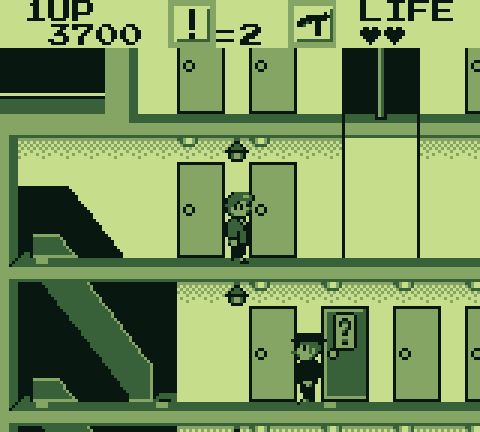
Once again, the music here is immediately superb and, if you’re a fan of the arcade version, immediately heartwarming too! And if you are a fan, this is just the start of what might be one of the great conversions on the Game Boy, and then a bit more besides! Like Bubble Bobble, this also does its own thing but in a way that’s totally authentic, right down to the original sound effects and little mannerisms built into the Spy-vs-Spy presentation. It doesn’t just look and sound like the arcade game either – it controls perfectly, and all those little touches like being able to shoot out the lights or see an enemy get squashed by impatiently riding on the roof of an elevator instead of waiting for the door are all present and correct. However, there’s also new doors with power-ups and new weapons hidden behind them, and you get an “okay” once you’ve collected all the secret documents you need to escape the building because they are easier to miss in your hurried descent on the smaller screen. Plays a bit faster too, and the enemies seem to congregate in higher numbers but play a bit fairer. And these little additions make the game feel almost like Elevator Action 1.5! I know I’ve got the cartridge but all the same, this thing is worth the asking price for this compilation alone!

Next game is Chase H.Q. or Taito Presents Chase H.Q. as it’s written on the title screen. Amazingly, despite having covered a hundred-plus whatever Taito games here previously, I don’t think I’ve ever come across Chase H.Q. on any of the several Taito Legends, Taito Milestones, Egret II Mini, Super Pocket and so on collections of one form or another, which in my case date all the way back to the PlayStation 2, where it seems like it did appear on a Japan-only Taito Memories compilation but that’s about it. Not that I’m particularly complaining because one of my dirty little gaming secrets is that I really don’t like Chase H.Q… I was playing RoadBlasters the other day on a Midway compilation on PS2 and I’ve never liked that either, so maybe it’s a combat-racing thing! This was first released in 1988 and sees you playing an exotically-named cop called Tony Gibson, and Tony Gibson is part of a Chase Special Investigation Department who, together with his partner Raymond Broady, and with the help of Nancy back at the titular headquarters, they need to chase down criminals in a Porsche 928. Once they’ve caught up with them, it’s time to start ramming their car until it’s beaten down sufficiently for you to apprehend them. This all takes place against the clock and over five levels, and while it’s not for me I do love my racers and can see the appeal, with everything moving at super-speed and controlling great, plus some gorgeous visuals and fantastic sound that really elevates the experience to the legendary status the game holds to this day. It also got converted everywhere at the time too, mostly very well, although I do remember the Commodore 64 version being an absolute stinker, which was par for the course with these things on there by then! The Game Boy version arrived a couple of years after that, in 1991, so let’s see how that fares…

I know we’ve already established I don’t like Chase H.Q. wherever I’m playing it, but I’ll be the first to admit that the ZX Spectrum conversion, for example, is nothing short of a masterpiece. This one, on the other hand… It’s still got Nancy, I suppose, even if only in written form, which still surprised me because I’m sure I’ve previously played a totally Japanese standalone ROM of this game, whereas the one on here seems to be the Western release. Either way, Nancy being here is about the only good thing I’ve got to say it! The worst thing I’ve got to say is the dreadful, ear-splitting siren when you finally catch up with your target criminal’s car – you’re genuinely better off just letting him escape and playing something else for that alone!!! And in-between you’ve got a very stripped-back take on Chase H.Q. where it takes way too long to get to where you’re going through some very sparse environments and frankly boring road layouts. Horrible sound effects aside, once you have caught up with the target it’s a pretty decent game of cat and mouse, where you’ll briefly be thankful for the boring road layouts, but any excitement is short lived then it’s back to the all too familiar mundane. It controls alright though, with a choice of button-schemes, and the music throughout is fine, and the far-distant backdrops look nice in monochrome. Just not much going on anywhere else in any respect! I guess if you’re a die hard fan of the arcade machine it was pretty special getting to play it handheld at the time but even come 1996, I can’t imagine many people were that fussed by this one.

We’re at the last game already, and it’s Sagaia, which, as said earlier, is what the Japanese Game Boy port of the outstanding 1989 horizontally-scrolling shoot ‘em up, Darius II, was called. Despite being a long-standing fan of the series, with G-Darius featuring in my top ten favourites in the genre countdown, I only played the original version of this one for the first time back in 2023, when it appeared in its rare triple-screen format on Taito Milestones 2 for Nintendo Switch… And good luck seeing all those bullets flying around on the resulting narrow-band of play area if you’re handheld on there! That aside, it’s a hell of an entry in the incredibly convoluted series, where the recurring giant robo-fish bosses seem to be the only things that make any cohesive sense! Gorgeous visuals, incredible soundtrack, loads of weird speech, all the regular Darius branching paths, power-ups and ludicrous narratives, and some tricks of its own, like the introduction of mini-bosses into the series. This is the only game here so far that I think skipped any home computer versions but it came to the Sega Genesis or Mega Drive and Master System (albeit in limited form), and also got a fantastic version on the PC-Engine Super CD-ROM, with a superb soundtrack of its own! The Game Boy version was one of the first to arrive though, in 1991, and while it’s also a bit scaled-back, there’s no denying it’s a Darius game…
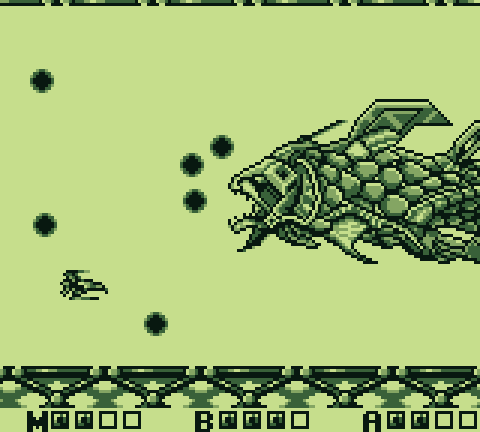
Like everything else so far, this one also does its own thing to make the most of where it’s ended up, and in this case, what we’re getting is a bit of mix of the first two Darius games in an exclusive set of eight zones. While those don’t feature the branching paths of the original until right near the end, rest assured that all your favourite bosses like King Fossil, Ancient Helm and Great Thing not only made the cut, but they also made it in their very impressive traditional large-scale too! Impressive doesn’t stop there either – the whole thing is an amazing feat, from the smooth parallax scrolling on some brilliantly detailed, shaded and varied backgrounds to the Game Boy renditions of a load of Taito house-band Zuntata’s epic tunes from the arcade games. It plays beautifully too, with the challenge ramping up once you’re beyond the first zone but not unfairly so, and is countered by a forgiving power-up and instant-respawn system, as well as the option of auto-fire and up to nine lives. And those screen-filling boss fights don’t just look the part but feel authentic too. This isn’t just a great remixed version of Darius II and its predecessor that both plays to the strength of the system and sucks everything it’s got out of it too, but is also one of the best examples of the genre on there, which is no mean feat either!

And that’s a perfect way to conclude our little journey through Taito Variety Pack, which might be one of the shorter Taito-based excursions I’ve taken here but I think it’s also one been one of the most enjoyable, Chase H.Q. and all! That said, if you were forcing me to play it anywhere then this is a good a place as any, which isn’t the case for Bubble Bobble but I’ll listen to its theme tune here anytime! Elevator Action and Sagaia are magnificent though, and if the former was already worth the asking price alone then throw in the latter and you’re getting some serious value for money… Well, you were until eBay came along!
As always, I’ll never expect anything for what I do here but if you’d like to buy me a Ko-fi and help towards increasingly expensive hosting and storage costs then it will always be really appreciated! And be sure to follow me on Instagram, X (formerly Twitter) or Threads for my latest retro-gaming nonsense!
 Retro Arcadia
Didn’t know about this old compilation, it looks very interesting, but I have to thank you for busting my balloon early in the post, as I feared it would be impossible to buy nowadays and that proved to be true, so I finished reading the article without interrupting it and look the asking prices up.
Anyway, great post, as always!
LikeLiked by 1 person
Thank you! Really appreciate it. Yes, too expensive for me too now. Lucky we can discover these things in other ways though.
LikeLike