
I promise we will get to American football sooner or later but a few months ago, as I write, I bought the five-hundredth issue of White Dwarf, the Games Workshop magazine that now seems to be mostly about Warhammer. Hell of a milestone considering but honestly I didn’t have a clue what was going on – loads of pictures of impossibly well-painted miniatures and a load of bearded middle-aged men talking tactics and skirmishes and the like, with some pull-out bits of card I had no idea what to do with (except slip back into the commemorative packaging so it’s all complete if I ever decide to sell it one day when it’s obviously going to be worth a fortune like all the other magazines I’ve ever kept)! I was a bit more au-fait with the old fantasy-battle tabletop wargame the last time I bought a copy back in 1987 though, which was around the time it became exclusive to Games Workshop properties rather than stuff like Advanced Dungeons & Dragons and RuneQuest, as well as the general fantasy and sci-fi boardgames that had brought me to reading it in the first place.

It wasn’t like I wasn’t into Games Workshop too though! I adored their Talisman, Chainsaw Warrior and Rogue Trooper games in particular, all of which are still sitting with a bunch of others on a shelf above me where I’m typing these words, but to this day, there’s one of their games I’ve always wanted to play but have never taken the plunge with, and that’s Blood Bowl. From the very first time it appeared back in 1986, this turn-based, tabletop-take on an ultra-violent version of American football set in an alternate Warhammer universe absolutely fascinated me! The problem was, I had no clue about American football, and while it’s certainly true that I had no inclination to learn about it either, at the time I’m not entirely sure how I even would have – there might have been some late night summary show on Channel 4 or something but I wasn’t aware of it if there was, and no one I knew (especially any fellow role playing geeks) was into it, so apart from going out and getting a book about it, it was just some weird, unfathomable version of rugby (which I also didn’t understand), so beyond alluring features in White Dwarf and seeing the box on the shelves of our secret but very well-stocked nerd section attached to a backstreet stationary shop in Bedford, that was the end of Blood Bowl for the time being!

Fast forward a little way to 1988 and along came an arcade game called Cyberball, although it would be two years further on again when Domark’s home conversions started coming that it first appeared on my radar. Now, at this point, I still might not have had a clue about American football, and would no doubt have ignored any regular video game versions of the sport I’d come across in the interim, but I didn’t even have to read the review in Computer & Video Games magazine to realise what I was more or less looking at in those screenshots! Okay, it was robots not orcs and goblins and the like but it was clearly as much about violence and destruction as it was bizarre diagrams of formations you had to navigate every five seconds, and was probably as close as I was ever going to get to Blood Bowl. Of course, not having anyone to play with wasn’t a problem anymore but I still didn’t have a clue what was going on, which became very evident later in 1990 when it appeared alongside Klax and Escape From the Planet of the Robot Monsters on the wonderful Tengen Trilogy compilation for Atari ST! I’d like to say I really tried now I owned it too but in reality I played a lot of Klax and that was it!
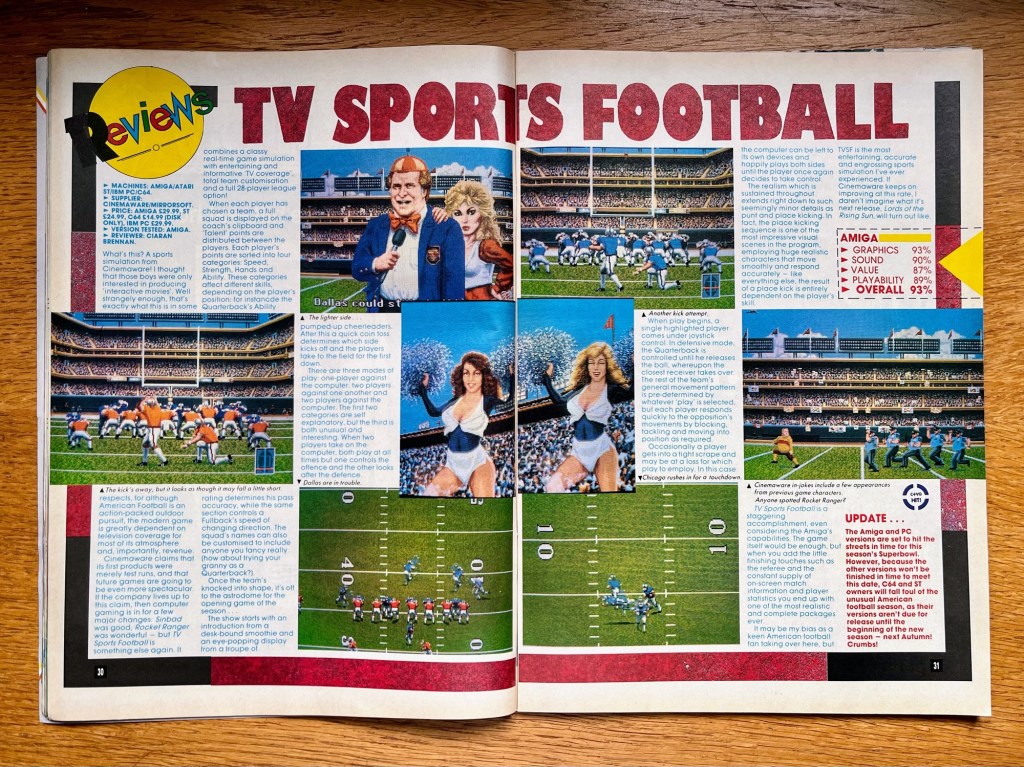
When I said just now I’d have ignored any American football games in the interim, there was an exception! It’s one thing skipping by some generic numbered lines on a green background when you’ve got no interest in something but there’s no way anyone is doing so with the lifelike, cinematic beauty that was TV Sports: Football in the February 1989 issue of Computer & Video Games magazine! I vividly remember thinking it was absolutely stunning and, looking back at the screenshots accompanying that review again now, it still is! There had simply never been a sports game like it, although one look at where it came from started ringing some similarly cinematic bells, but I’ll come back to those! In the meantime, once again, there was no way I could spend all that money on something I’d never be able to get the most out of and properly enjoy, so it joined the growing list of American football-related shiny stuff that wouldn’t be allowed to shine again for another thirty years…
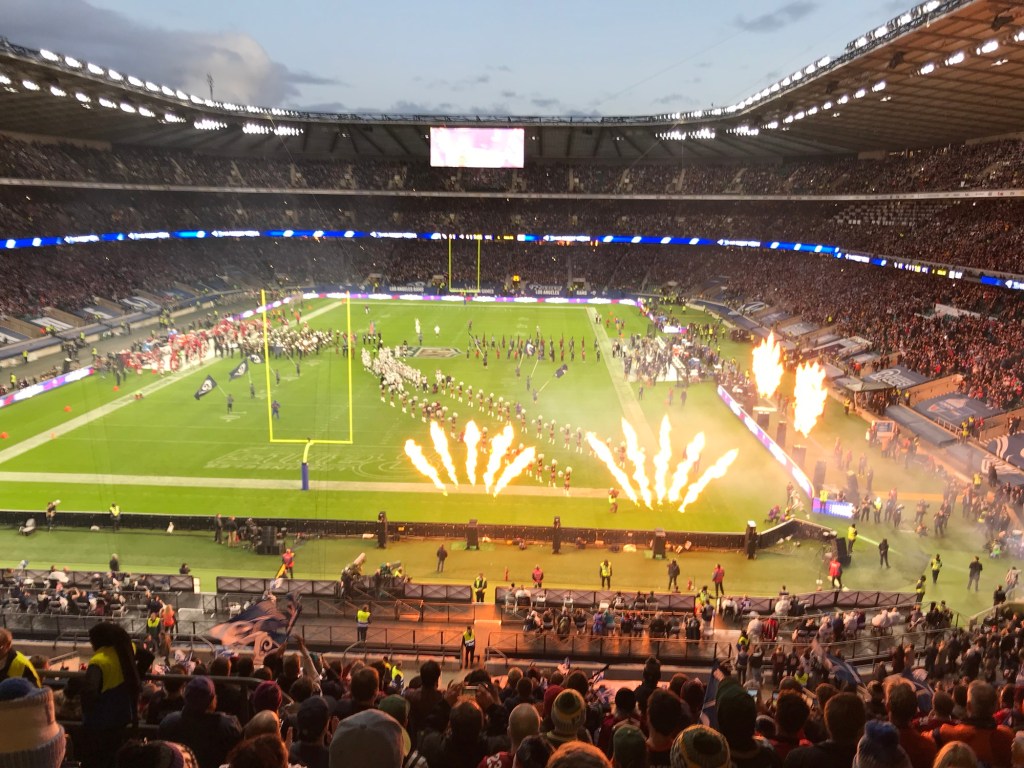
It’s now 2017, and my sports mad eleven-year old son has become quite the expert in American football, and it’s always on the TV, and I’m still none the wiser! However, when an email arrived from a well-known ticket agency announcing the NFL’s London games for that year, we thought we’d give him the opportunity to see it live, and that October, the three of us went off to Twickenham Stadium near London to see the Arizona Cardinals play the Los Angeles Rams. As with many American sports (and, believe it or not, I’ve actually been to quite a few of them live quite a few times now), it all started out as quite the spectacle, with fireworks and flames, and huge flags flying and bands playing and cheerleaders doing their thing, and then the game got underway… Then it would stop… Then start again for a few seconds then stop again… And so on! After a few minutes of this, the wife and I decided that as we were now stuck there for about three hours (another feature of these things), it might be worth a quick search on Google for American football for idiots, and seconds later, we’d worked out you’ve got four attempts to get the ball forward ten yards. And then I had the time of my life that night, and we’ve been back every year that they have since, and, more regularly, from that point onwards I’ve watched every live game on TV I could, and recorded every one I couldn’t (meaning rip-off Sky Sports remains hanging by a thread), and I’m a born-again total obsessive!

And to think just one sentence of knowledge was all it would have taken to not miss out on all that related stuff for decades! As you can probably imagine, I have caught up since though! My first port of call was, of course, Blood Bowl, which I finally got my hands on via the now-defunct iOS port of what I think was a 2009 or 2010 PC game that in turn was a pretty straight video game version of the original tabletop game. I loved it too, as far as I could at least because it wasn’t exactly welcoming, but it was Blood Bowl and I could now play to my heart’s content all by myself on a lovely big iPad screen! Which I eventually swapped for a small but perfectly-formed PSP screen, when I picked up that equally faithful version from 2007, and remains where I play to this day (alongside NFL Street 2 )! I did enjoy the far more recent Blood Bowl 3 beta on PC too but I’d rather that on Xbox, and Madden currently scratches that itch on there so I’m still waiting for a sale! The definitive Madden NFL 2004 does the same on GameCube too, then there’s Tecmo Bowl and 10-Yard Fight via Nintendo Switch (and Evercade), all of which I play to death, and a bunch more besides, but those are all stories for another day! As is Mutant Football League on the Switch, which is a fancy modern spiritual successor-up to the 1993 Sega Genesis game of a similar name, Mutant League Football, and they both play a fantastic, more arcade-like version of almost Blood Bowl! Think the original is on EA Replay on PSP too, which is something else I owned but ignored, so need to have a look into that again!
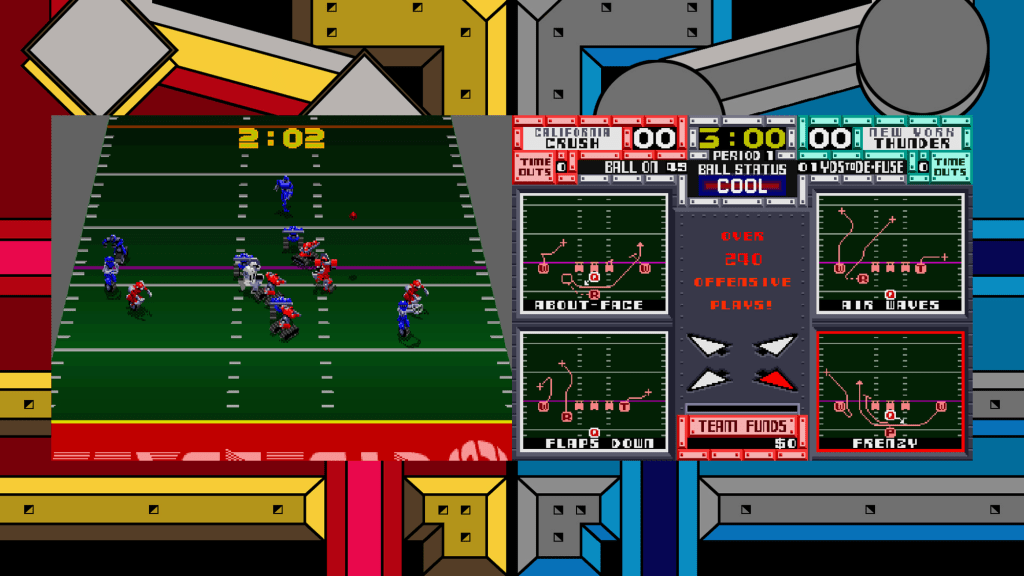
And speaking of owned but ignored, it turned out I’ve got Cyberball and its spin-offs all over the place already too! It’s also very much an arcade game (as you’d expect of an arcade game!) but is a more methodical experience than the above – especially the home versions, which do run comparatively slowly but I kind of like it like that… Which meant I finally got my money’s worth out of my old Atari ST compilation (and check out my Top Ten Favourite Atari ST Loading Screens feature for more on another game on there)! Then there’s the 1989 two-player sequel of sorts, Cyberball 2072, on Midway Arcade Treasures 2 on PlayStation 2, which is right at home with that controller, and the same goes for the PSP’s analog-nub on Midway Arcade Treasures: Extended Play. Its four-player variant, Tournament Cyberball 2072, then appears on Midway Arcade Origins for PlayStation 3, although the picture of it you can see here is from when it was subsequently given away with Xbox Games With Gold, not long before that stopped being a thing. Hell of a compilation if you can get to it anywhere though! This Tournament edition got a really interesting port on the Atari Lynx too, which you could play four-player using ComLynx cables if you had them.. Or, more to the point, had three Lynx-owning friends to play with in the first place!
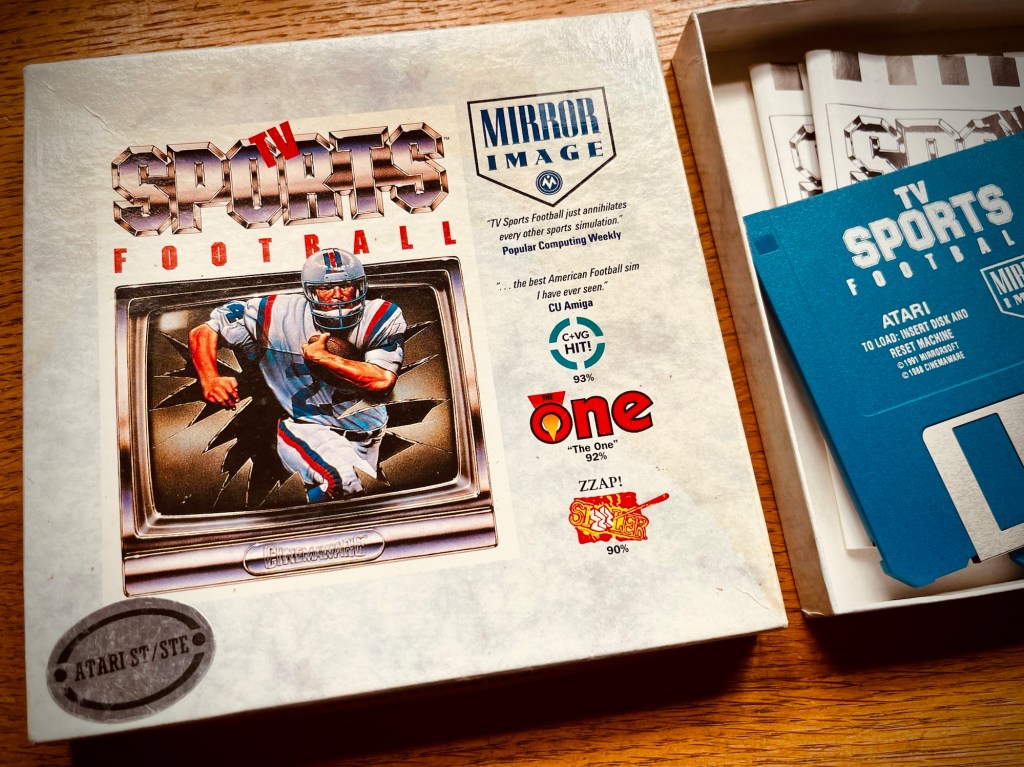
It took me a bit longer to get to TV Sports: Football though… Almost as long as it did to get to it here! From my revelation in 2017, it would be another three years before my Atari ST came out of its hibernation in my parents’ loft, then it became another title on my carefully curated (but admittedly huge!) list of games I couldn’t get at the time but could now if the price was right. And I guess it wasn’t mega-popular in the UK when it came out – probably for reasons similar to my own – so that took a while but here we now are with a lovely boxed copy that we’re finally ready to discover. I do literally mean that too because as I write, I’ve done nothing more than test the two disks it comes on to make sure they actually still work! It can’t have been too bad though, otherwise I’d have switched this feature to the aforementioned Madden NFL 2004 or Tecmo Bowl or something by now! By the way, just for transparency, while I am writing about playing on original hardware, to avoid dodgy photos of dodgy TV screens, I’ve grabbed the screenshots you’ll see from the Hatari emulator running in RetroArch on PC, although I might throw in some of the fancier stuff that was disappointingly only present in the Amiga when we get to it later too! Right, as alluded to earlier, this is a game published by newspaper offshoot Mirrorsoft and developed by Cinemaware, who had previously ushered in the spectacle of the 16-bit home computer generation with the incredible-looking medieval strategy-swashbuckler Defender of the Crown, as well as the likes The King of Chicago, The Three Stooges and Rocket Ranger, before migrating their unique, blockbuster movie presentation style to a sports-themed TV style for TV Sports: Football in 1988.
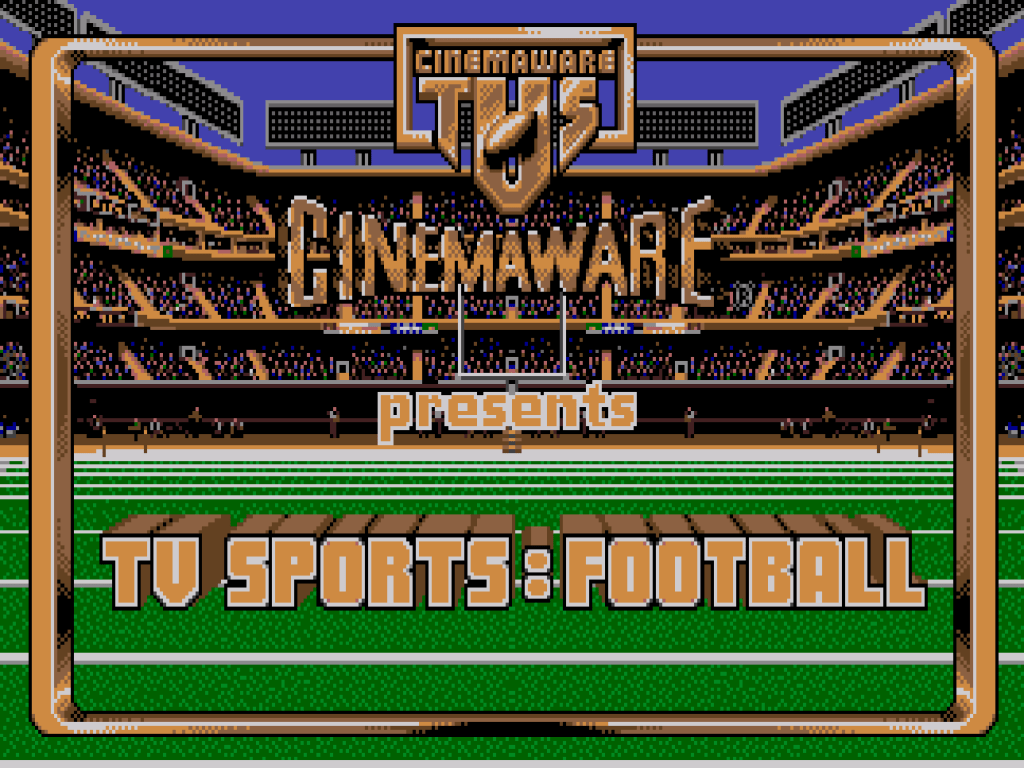
This was closely followed by TV Sports: Baseball in 1989, TV Sports: Basketball in 1990 and TV Sports: Boxing in 1991, which was the last game released by Cinemaware’s original incarnation before it went bust the same year. Had it not, we’d have seen an ice hockey game too, but despite the likes of It Came From The Desert and Wings also adding to their incredible legacy in the meantime, as well as significant investment in the company by NEC, the general state of the economy, as well as software piracy, had led to falling sales, and combined with spiralling production costs on some of their titles, they were simply no longer viable, disappearing until the name and its IP was resurrected from 2000-2005. While I’m not planning on going to go into any of the other games in the series here, it’s worth noting that some of these were totally repackaged for their American release, such as Bo Jackson Baseball and ABC Wide World of Sports Boxing. I don’t think this was the case for TV:Sports Football though, which, as well as the Atari ST and Amiga versions we’ve already mentioned, also came out on the Commodore 64, the TurboGrafx-16 and DOS, appearing first in the US then in Europe in 1989, followed by what was presumably a localised PC-Engine version in Japan in 1990. There were also issues with some versions being held back because they couldn’t be completed in time to coincide with the SuperBowl, so were forced to wait for the next season to start in the autumn, which I think included this one I’ve got, although I’m not really sure which other ones or where. Just to close on other versions for now, the DOS release also got the TV Sports: Football 1989 NFL Season expansion in 1990, which seems to be by a company called Freedom Productions and not something Cinemaware was involved in.
Before I get into a game, it turned out it would probably have been an ideal place to start out with American football after all! The first sixteen pages of its thirty-two page manual are a beginner’s guide to how the teams are set up and what the players do, with multiple pages covering each of the positions and its functions, from quarterback to safety to kicker. Then, after going through the getting started information (which includes making a copy of disk two with all the league information on otherwise the default data will become permanently overwritten as you play), you’re taken through the game modes, including exhibition, league and practice [plays], as well as viewing league schedules and player standings, before being walked through an entire game, including not only how to play but its overall flow too. The detail this thing goes into is really impressive – to the point of being intimidating at times – as you’re taken from the top level menu to the next and the next for everything, which is then explained in copious depth, assuming nothing, and with everything spelled out to you in plain English. As a quick aside, if you know your way around an American football game you’ll also have no problem completely ignoring it all… Except the bit about disk two, which, had I not been putting this together, would have been totally missed once I’d had my fill of exhibition matches to get acquainted with the game without any reading instructions as usual!

Know what I would have liked? A nice loading screen or even just a nice title screen before we just got into boring old menus! For a game that’s so focussed on its presentation, a few choices written on an illustrated clipboard isn’t the greatest first impression! That said, you can have all the pictures of cheerleaders you like but try exiting the practice mode on an Amiga without rebooting it! Maybe I can quickly start with that because it is a really nice feature – you can practice any plays you like, including handoffs, passes, pitches and punts, taking all the time in the world to look through the play diagrams, work out what’s what, then try them out for real. Nice way to get a feel for the game too, although you can do all of the above by just jumping into an exhibition match instead, and here’s another interesting thing… You can play one player against the computer, or competitive two player, or you can play two players versus the computer, where one is in charge of the offence, so they’ll always be the quarterback, with the other player as a wide receiver or running back, then that other player runs defence, and is always the left-inside linebacker, while the other player can be anyone else. The multiplayer aspect gets really wild when you get into the season mode though, where “you can compete in a league with up to 27 of your friends.” Making some big assumptions there though, however cool it is!!!

TV Sports: Football doesn’t carry an NFL licence but doesn’t really let that stop it! The first thing you get when you start a season (which you can also happily play by yourself!) is an option to edit your team, and you can call them whatever you want, although by default it’s not far off to reality to begin with, with three “Western Divisions” and three “Eastern Divisions” of either four or five teams each, made up of city names rather than official team names, so Green Bay, New England and so on, and then when you get to cities with several teams, such as New York, the teams are then abbreviated to NYG for New York Giants, for example. But one click of your little pencil pointer (and that clipboard is making more more sense here) and you can call it whatever you like anyway, and that goes for player names too. You can also change every single player’s rankings, where the best player on the team has twenty-four talent points that can be tweaked and redivided between speed, strength, hands and ability attributes; then for the next best player you’ll have twenty-three points, decreasing all the way down to nine points to allocate to the player ranked eighteenth. Really nice system and I can imagine it would have meant the world to many players to have so many customisation options, not only for the team you choose to play as but for all of the rest too! And that’s why you want your own league data disk…
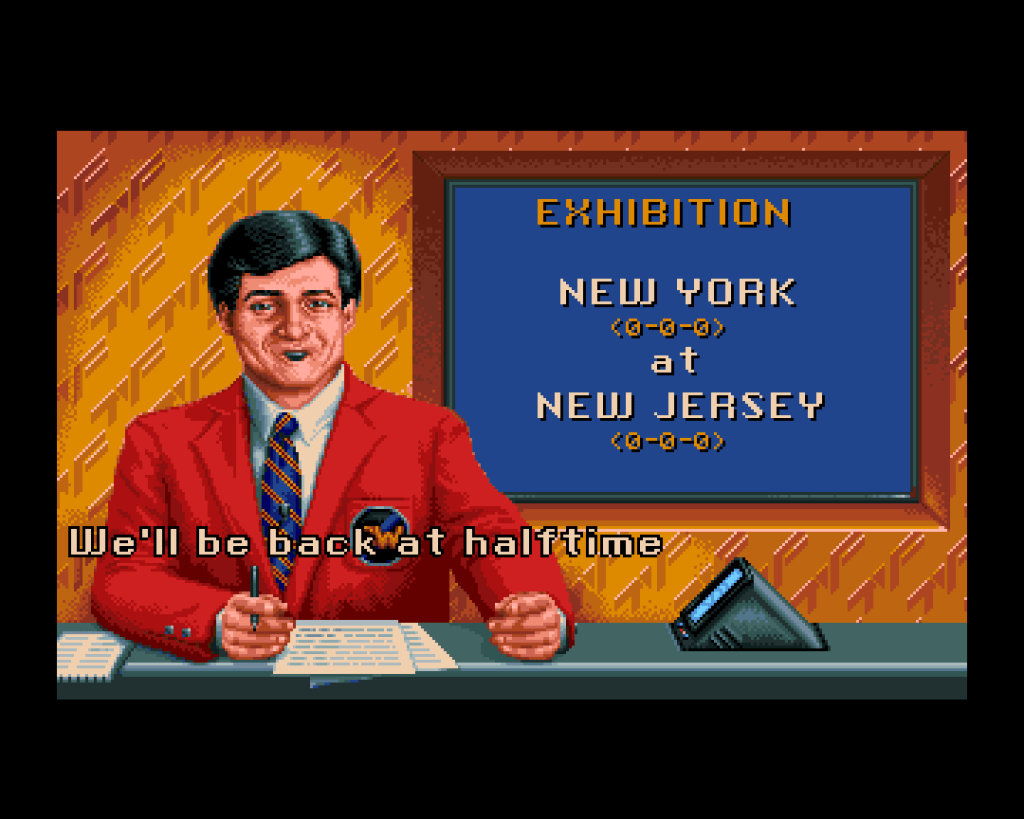

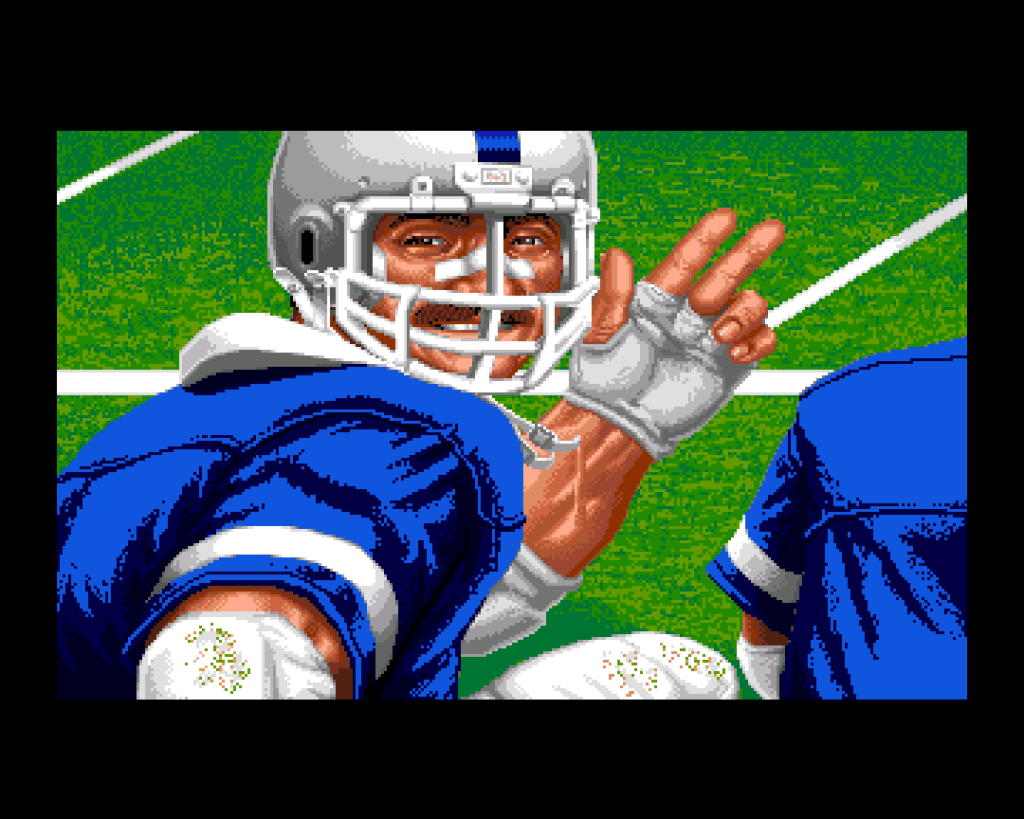

I’ve alluded to the Amiga’s additional features a couple of times now but once you’re into a game, there’s little avoiding that it’s actually the majority of the whole TV-style razzmatazz this game is built around that we’re talking about! And even if you’re just playing your own version and remain oblivious to any others, a framed, sweeping camera shot across the stadium before a logo appears introducing the game, then an animated kicking routine whenever that’s called for, isn’t exactly NBC Sports! Oh yeah, in its defence, the animated coin toss, is quite nice though! Over on the Amiga, however, we also get those things and a whole lot more… A studio view as the camera is moved into place and the lights come on, followed by an admittedly simple but animated all the same presenter sequence, who’ll be back again for the halftime show, where he’s also joined by the pitch-side commentator outside a locker room as the door bursts open to reveal a coach reading the riot act, or maybe somewhere else with other madcap scenes going on! Then there’s more humour as sponsor adverts appear for things like Glitz Beer (“for people who can’t taste the difference”) or Dear John Toilet Cleaner (“say goodbye to bathroom odor”), and other occasional illustrated scenes like player faces celebrating a good play or those lovely cheerleaders. And while none of it (as pictured above) is particularly groundbreaking or sophisticated or even, I’d argue, of the same standard as some of what we’d previously seen in Defender of the Crown or Rocket Ranger, it does the trick as far as the game’s biggest gimmick goes, and ties everything together in an exciting way. Just like real life TV does! And when you consider most of it even made it into the lowly (and very impressive!) C64 version, I really don’t get why any of it is missing from the ST, let alone virtually all of it, especially when it’s all over the back of the box too! That said, in reality, you’ll watch the couple of variations of each scene once or twice, and then you’ll show them to your mates, and then you’ll skip all this stuff forever after and concentrate on playing the game instead, so I guess it’s not the end of the world, even if I am only trying to put the vaguest of positive spins on this sorry state of affairs!

And genuinely, I think I’d marginally prefer to play the game bit itself on the ST – I’ll get into it more in a sec but while we’re comparing, it’s a bit more twitchy and a bit less impactful on the Amiga, which is accentuated by smaller player sprites, although once again, you’d probably never notice any of this if you weren’t playing them side-by-side like I just did! Stupid, sexy Amiga… As a final point of comparison, there’s also the sound to consider, which I might as well get out of the way now too… As we’ve already established, there wasn’t a ZX Spectrum port of this but if there was, try and imagine what it would sound like, and that’s exactly how it sounds on the Atari ST! Okay, there’s a pleasant enough bit of title music but from there, it’s literal beeps and blips as you play… If you’re lucky! Obviously, it’s not a surprise the Amiga won out on sound here, but all that crowd noise, the in-game effects and some very cool sampled speech is really rubbing us ST sufferers’ noses in it! And we’d have been so happy with nothing more than a simple, sampled “touchdown!” Just to close on other places you can play, the TurboGrafx-16 or PC-Engine version takes the amount of in-play chatter to another level again, with both snippets of commentary as well as on-field play-talk. That’s complemented by its own cutscenes commenting on key plays, and it even got a proper title screen (pictured)! You are stuck with a small selection of very fictional teams though, and while the gameplay is perfectly competent, it’s perfectly cautious too, with a bit of a boring flow to things. Which, thankfully, is where my lovely new ST game of TV Sports: Football happens to really shine, so let’s forget all these other systems and go and enjoy ourselves back over there!
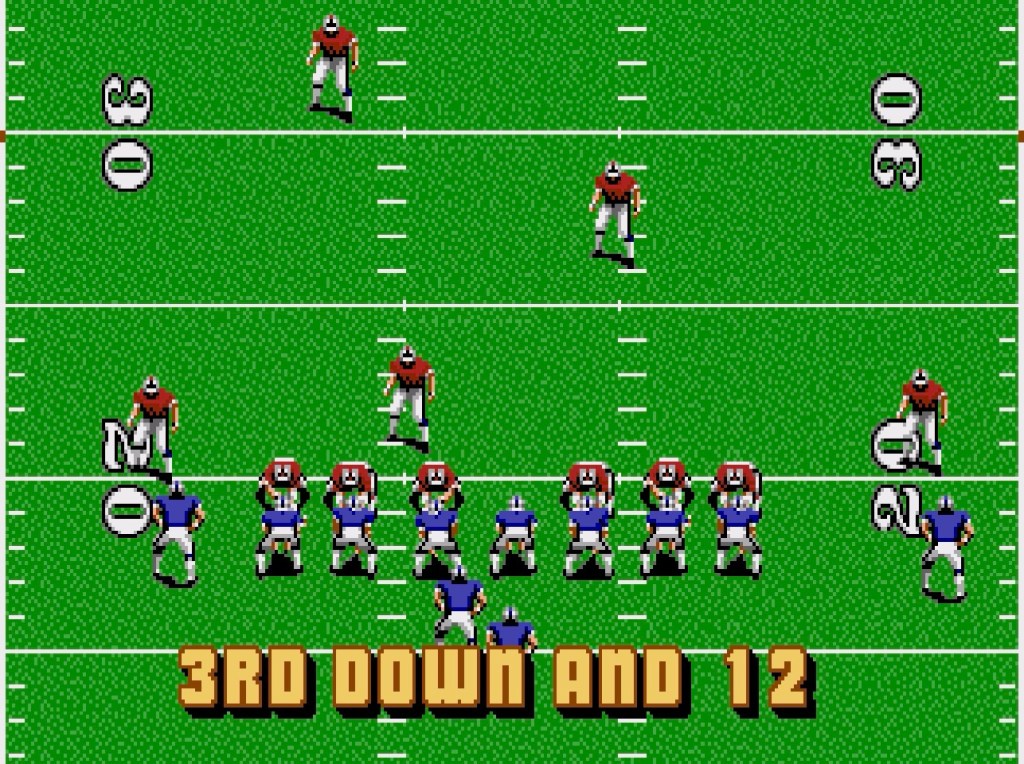
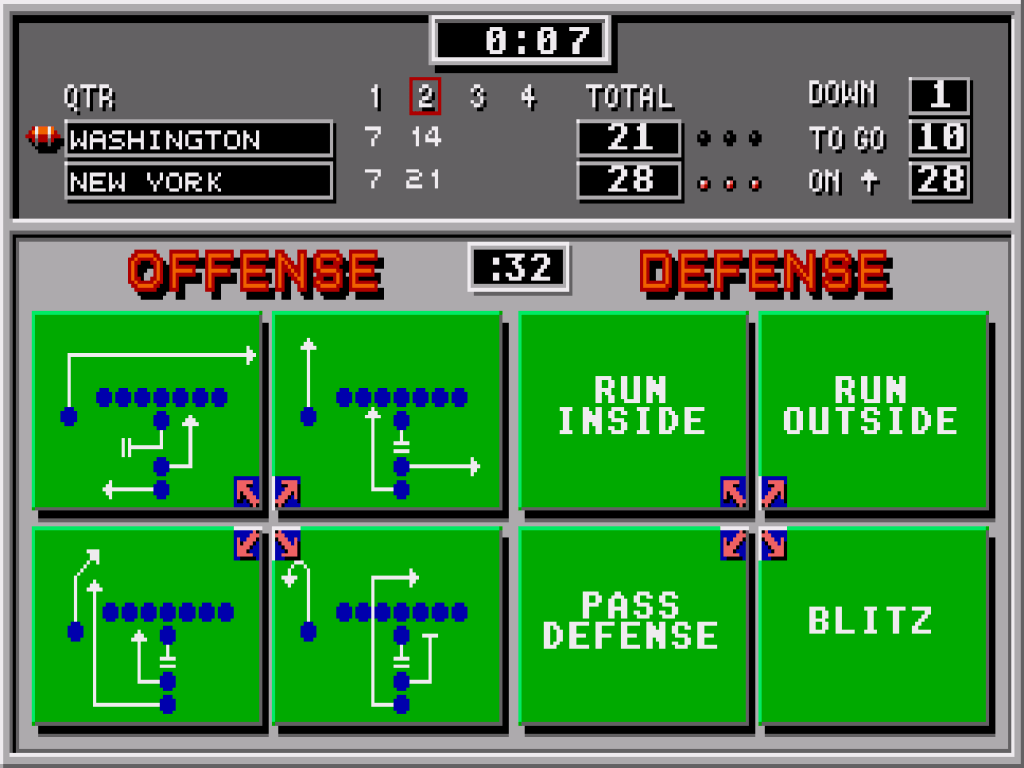
Right, we’re done whining, we’ve watched the pre-game show, such as it is, and we’re ready to begin! First up is the coin toss, which is about as dynamic as the “show” ever gets, although spare a thought for the poor old PC player, who I’ve unforgivably totally ignored until now, because they don’t even get this! Anyway, whoever wins gets a choice of kicking or receiving the ball first, and the game gets underway. Regular American football rules, four quarters of fifteen minutes of in-play action, and it’s playing a bit faster than real-time, but even so, you’re in for the long haul if you’ve got twenty-seven mates round for a full season! Whether you’re kicking or receiving, once the ball’s in play, you’ll have a flashing player you’re in control of, so one side is running as far as possible up the pitch with the ball while the other is trying to tackle. Regular 16-bit joystick rules too, so eight directions and a single fire button for everything, and it works just great, assuming you’ve learnt how it works, and I’ll come back to that in a second! Once the ball has come to a halt one way or another, you’ll be taken to the play-calling screen, where you not only select your next play but is where you’ll find the game clock, score, number of downs played, distance to next down and other such useful information, as well as more esoteric stuff like score by quarter!
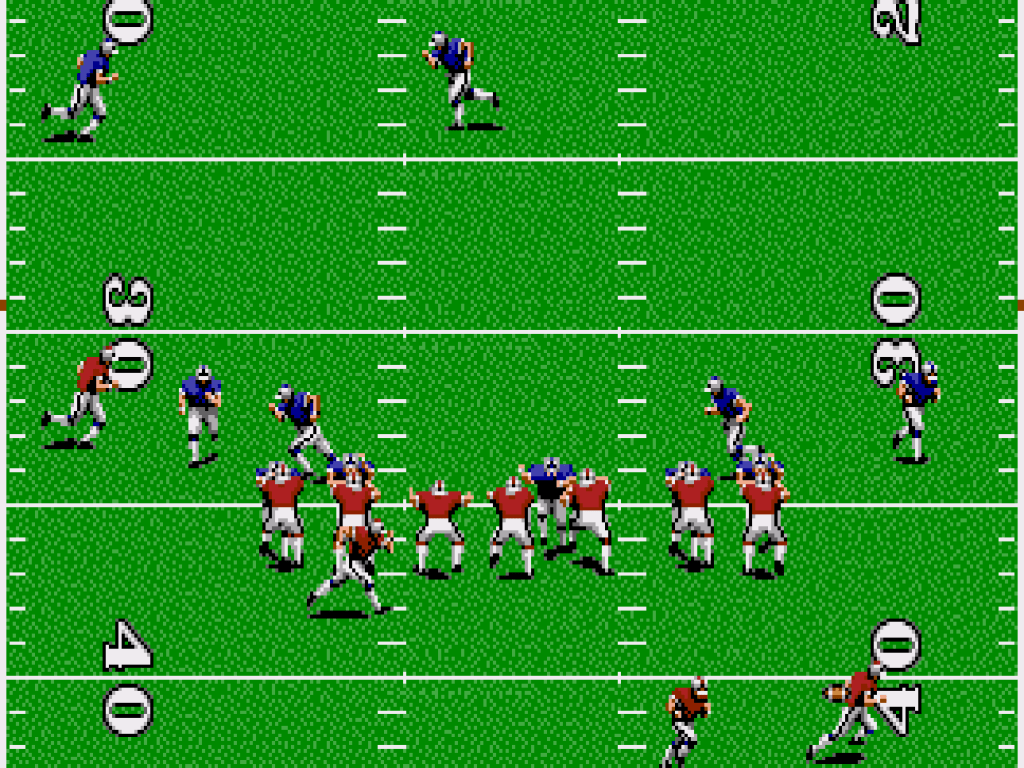
Depending on whether you’re offense or defence, both teams will get a choice of four possible formations, and once you’ve both selected your preference, you then have a choice of four related plays, although in offense, you can double that by holding down fire as you call the play, which will offer a reverse option for each of them, so pitch left becomes pitch right, for example. And here’s another cool thing… You’ve got fifteen seconds to make your choice, and if you don’t, the computer will do it for you. Now, apparently, the clever old computer is also learning your play-style as you go, so will, after a while, theoretically make the choice it thinks you would have made. And on a similar note, the same goes for the play itself, and the computer will take control of your players too, so leave the joystick alone and it will just play for you! And this isn’t always as mad as it sounds because – especially as a novice – you might be in a sticky situation you could really do with some help on, so you see what should be done then take control again at any time, just by moving the joystick. When you are in control, there are a few little concessions to a single joystick button you need to keep in mind, and this mainly applies to offense, so let’s have a quick look at that now.

At the start of the play, you’re in control of the quarterback, and you have some decisions to make – first, if you want to send your wide receivers into motion, you need to press left or right accordingly, before the ball is hiked into play, and in turn, there are two ways of doing this… Pushing the button means the quarterback is going to follow the play in the diagram and make a handoff or pitch as soon as he can, then when a running back has the ball, he’ll start to run automatically but you can then take control any time you like, same as before, simply by moving the stick. With this method, you can’t pass the ball forwards, so you want to pull back on the stick to hike it instead, and now you’re in total control of the quarterback. Once he’s where you want him, stop moving and you’ll enter pass mode, and moving left or right is going to direct the pass, holding the button to dictate the strength of the throw, which is gauged by a green X on the pitch. Let go when you’re ready, giving your receivers a chance at running onto it, and you’ll then be automatically in control of the nearest one to try and catch it as it drops, or attempt a diving catch with a press of the button. It does take a bit of getting used to but is way more intuitive in practice after a couple of goes than it is reading a description, and I reckon it’s a very clever solution to the one-button challenge! Running with the ball is a bit more straightforward but there’s clever stuff going on here too – remember those player stats from earlier? Well, cutting right or left when confronting a defender will depend on your agility rating, while that combines with strength when it comes to avoiding tackles, as well as things like recovering fumbles.
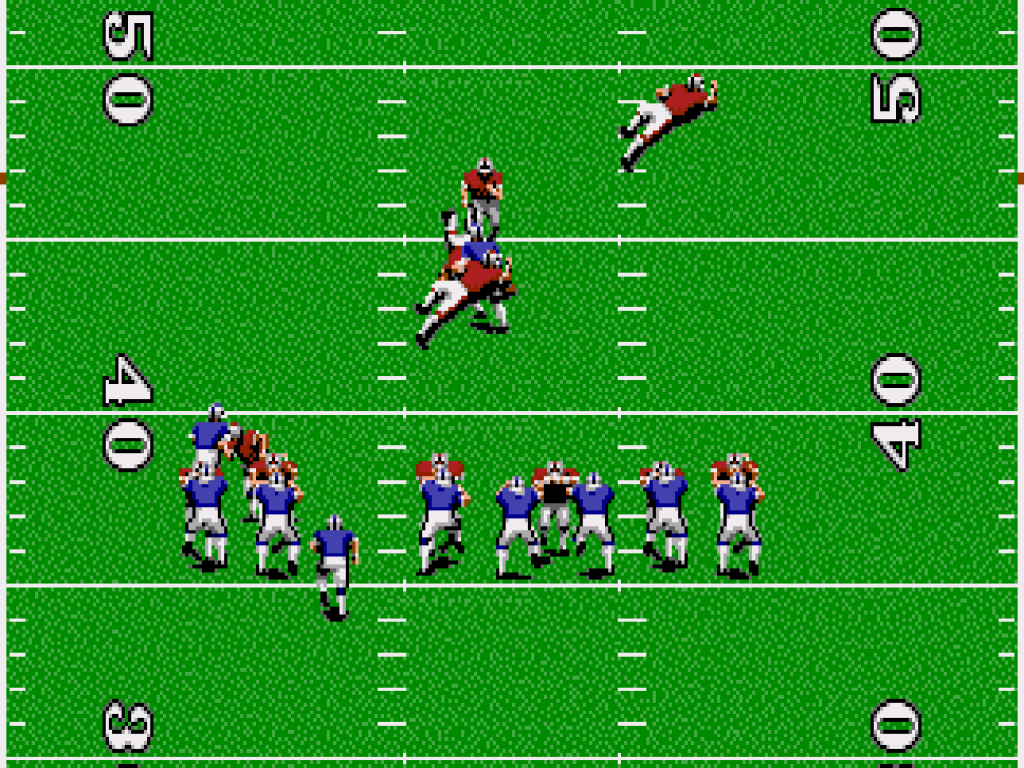
Punting is pretty straightforward too, with the ball hiked into play then you’re timing a button press to determine strength, with left or right for direction. Field goals are a little more involved, and I must admit I like the almost default option of hiking the ball myself then letting the computer kick it for me! However, if you’re feeling brave, there’s a pretty complex system of short and high or long and low kicks using a meter that’s not unlike something you’d find in an old golf game, with directional controls on top, as well as stuff like accuracy, strength and speed ratings. There are a few little intricacies on the defensive side too, but it’s mostly what you’d expect – make the player you’re in control of charge at someone then press fire to tackle. No fancy limb-based physics tech like in a modern Madden but it works! You can change plays with a press of the button before the play starts, then move a player to where you like, or, before the ball is in play, you can press fire and down to change their planned assignment to something like blitz, for example, if it turns out there’s no wide receivers facing him. A press of fire will also allow you to jump and try to block a kick too but that’s about it for the mechanics of defending. However, as you can imagine, there’s all sorts of strategy involved in setting up both types of play, and then reading the opposition before each play begins, especially with the ball, when you might need to abandon your plan altogether and just run with the ball yourself, or even throw it out of bounds if being sacked way behind the line of scrimmage (where the ball began the play) is suddenly on the cards! And while this isn’t the place to get into the merits of shotgun plays or 6-1 defences versus 4-3 ones, there are dozens if not hundreds of plays available to you, and that practice mode really is somewhere you want to spend some time to experiment and learn how each works if you’re serious about playing.
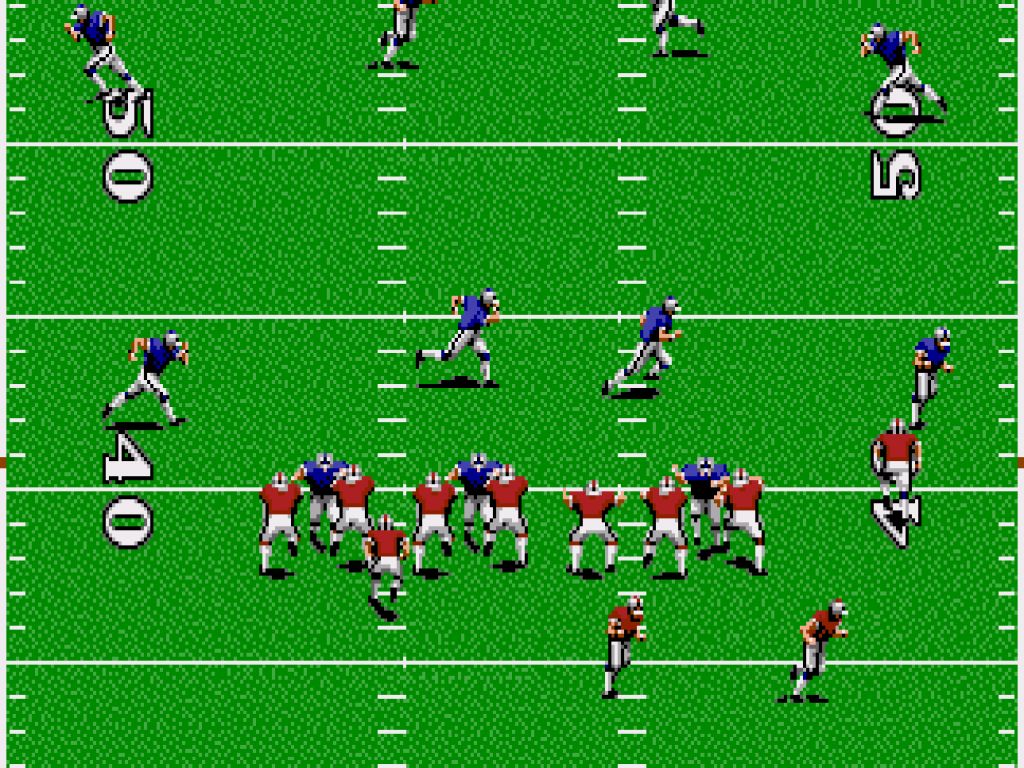
Actually, for all the hand-holding in the instruction manual, this is probably where the beginner is going to struggle the most because they won’t have a clue about whether an I-formation is more likely to get them out of their third-down hole than a pro-set formation, and experimenting is really the only way to work it out; plays themselves are a bit more self-explanatory once you’ve chosen your formation and are looking at diagrams but again, the choices you need to make in fifteen seconds can be pretty bewildering for a while. No different to playing that latest Madden game though, or pretty much any other sports game I guess, and it’s not like it’s not fun to try, so had it not gone to such lengths to be so welcoming elsewhere I doubt I’d have even mentioned it! And for anyone who has played these things before, you’ll be fine once the obligatory 48-10 thrashings for the first few games are out of the way! And once they are, as said before, the ebb and flow of a real game can be really evident here, whether it’s the tension of a standoff on the 20-yard line with a minute to go before the half ends, or those games where both teams are just cancelling out everything the other does, and you’re still only separated by a single field-goal as the fourth quarter ticks away, or, indeed, the simple thrill of needing to complete a field-goal to win a game in the dying seconds! Then right down to individual play level, there’s a realistic air of unpredictability about what your opponent might be up to, and simple things like fumbles, interceptions, blocks and knock-downs completely changing the course of the game, or the lovely cat and mouse situations you can get yourself in with individual opposition players!

Despite the depth under the hood and some clever control choices, gameplay itself is very much of its time and quite arcade-like in its simplicity – run and tackle, run back and forth and pass, run for the gap between defenders… That’s not to say it doesn’t feel fine though, with a nice weight to the players, and a small but noticeable effect from those individual stats. The only problem is, apart from the occasional comments that appear in a horribly plain and obtrusive text box on the screen after a play that might refer to someone, there’s not really any way of knowing which player is which! And that lack of meaningful sound really doesn’t do anything any favours either, although it is another case of being less noticeable when you haven’t just been playing the Amiga or PC-Engine versions! Away from the lack of TV-style polish, in-game things are fine to look at though, with as realistic a grass effect as you’d ever get on a 16-bit machine (meaning green with lighter green pixel-flecks) and all the proper pitch markings, with the whole thing within the width of the screen then viewed more or less top-down, and more or less to scale. Scrolls up and down alright too, albeit it reluctantly and only when it’s forced to! The player sprites are a decent size and with plenty going on too, with things like striped details on their kits and shadowed areas that follow the animation, which, although very impressive for the time, is more on the functional side through modern eyes – a bit stilted and every player looks and moves exactly the same! I suppose a bit more variation in kit colours is all that’s lacking for me on that front but hardly a showstopper.
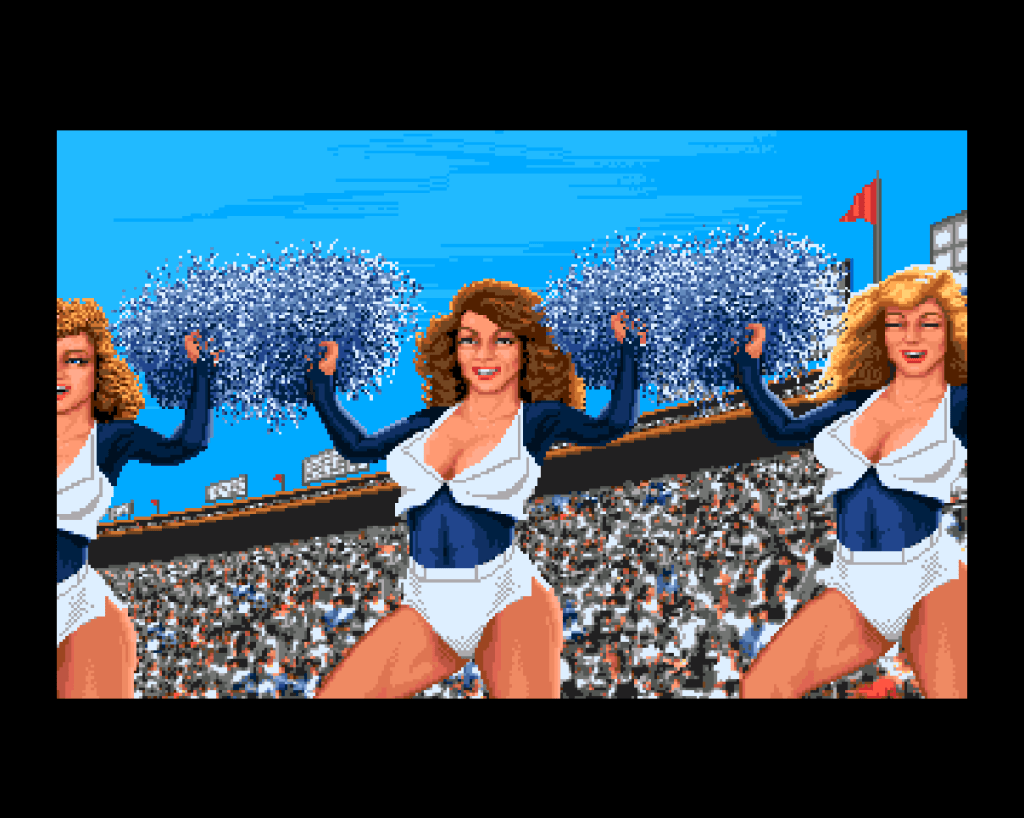
And with that, I think that’s about the end of the show as far as TV Sports: Football is concerned. Which wasn’t always much of one! Oh yeah, it would also be wrong of me – having made fun of the Amiga version earlier for doing the same elsewhere – not to mention that after a game, the only way to get to the next one is to reboot the computer, which took me ages to work out and is always a scary prospect regardless! It did turn out to be hidden away right at the back of the instructions though, together with several reminders to make a copy of the data disk! In some ways, I wish I’d never looked at the Amiga version, although if when you’re telling me they’re Amiga screenshots I’m looking at on the back of an Atari ST box then I’m going to be suspicious from the outset… And I’d never have finally got that gratuitous cheerleader shot I wanted to close here with otherwise! It really is mystifying why the ST version was missing so much of that stuff though – as said before, sound I get, but a handful of minimally animated illustrations that could surely have been lifted wholesale from one machine to another? The thing is, all of that is window-dressing you can soon do without, whether it’s the ST’s ultra-minimal take on TV presentation or the flourish of other versions, and once you’re beyond that, you’ve got a very decent, very polished, fully-featured game of old-school computer football, twenty-seven friends or not, and I’m glad I finally got to enjoying it!
As always, I’ll never expect anything for what I do here but if you’d like to buy me a Ko-fi and help towards increasingly expensive hosting and storage costs then it will always be really appreciated! And be sure to follow me on Instagram, X (formerly Twitter) or Threads for my latest retro-gaming nonsense!
 Retro Arcadia