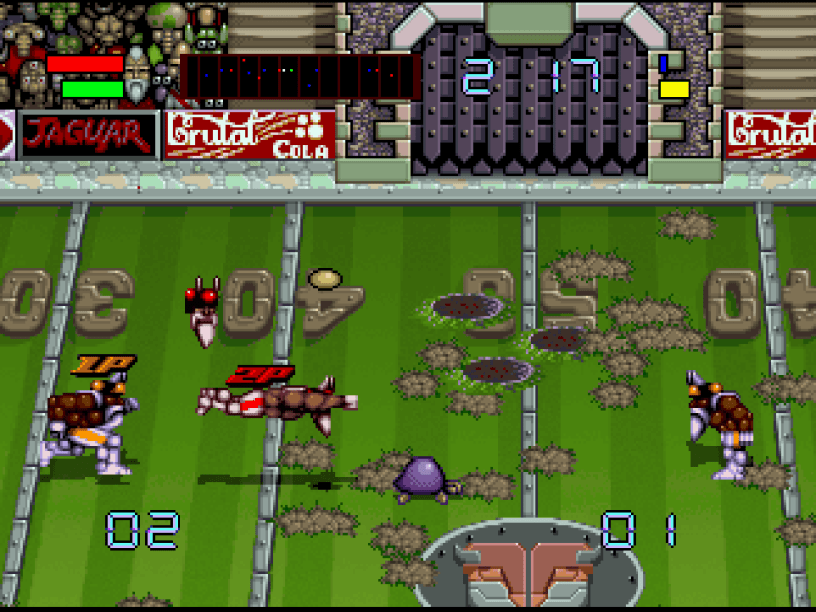
Ever had a game you know you’re supposed to like but for whatever reason, and no matter how many times you’ve tried on however many different systems, it’s just never clicked? As you might have already guessed, that’s where I was with Brutal Sports Football, which I’ll come back to, but by complete coincidence, until this week that’s where I also was with a totally different but possibly better-known (or at least well-regarded) game called Another World. I don’t know how many times I’ve started but not finished it over the years – actually, when I say not finished, I mean not got more than three screens in! Anyway, having recently fallen for the not totally dissimilar Ico on PS2, then noticed its baked-in icon on the Amiga A500 Mini games carousel a few weeks back as I write, I thought I might be in the right frame of mind to give it a proper go. Which I did, and I finished it, and I’m a total convert! And I know it’s already considered by many before me as one of the all-time greats but I’ll follow convention and quickly describe it anyway…

It was originally released on the Amiga and Atari ST at the end of 1991, although there’s not much since it hasn’t been ported to, virtually to this day – in fact, it came out on Evercade with a couple of other Delphine Software games I also don’t think I currently like as recently as the end of 2023. It’s a cinematic adventure, almost point-and-click in its essence, where you play a nuclear scientist whose latest experiment doesn’t go quite to plan, and ends up travelling through space and time to an alien planet that’s immediately inhospitable, leaving you with the simple goal of surviving… Over and over and over again as you try to puzzle or fight your way through every single one of its surreal flip-screens that tell this incredible, minimally narrated tale through minimal interactions with this fantastically atmospheric (and minimal) world! The controls are pretty minimal too, and, combined with zero energy bars, scores or anything else onscreen, result in total immersion and singular focus on whatever the immediate problem you need to solve to progress to the next one. And the next. And the odd terrifying monster to run away from too! Incredible game, and even more so now I finally get it!

Not bad for something I thought was total rubbish until mere days ago! Which brings us to Brutal Sports Football. Or Brutal Football. Or Crazy Sports Football. Or even Beastball… We’ll get into some of that later, and instead keep the old Commodore Amiga switched on for a while longer, which I’ll be generous and say was still just about in its prime in 1993 when the game was first published on there by UK-based Millenium Interactive, of James Pond fame at the time, although in later incarnations as SCE Studio Cambridge and then Sony-owned Guerrila Cambridge, they’d also be known for stuff like MediEvil and various flavours of Killzone and LittleBigPlanet. Back to Brutal Sports Football, that was developed by Teque London, who’d also do the Atari Jaguar version we’ll get into in a bit, and had done a load of arcade conversions on loads of formats of stuff like Toobin’ and Pit-Fighter, and versions of a bunch of racing games, and the first Desert Strike, and the Shadoworlds and Shadowlands RPGs… And I mention those last two specifically because that’s also what Brutal Sports Football also started life as – a role playing beat ‘em up, of all things! I guess it’s not so weird when you think about the ongoing popularity of Blood Bowl, the ultra-violent, ultra-nerdy, Warhammer-infused 1986 American football tabletop game by Games Workshop that was clearly an inspiration here, as well as to stuff like Speedball and its wildly popular 1990 sequel, and Mutant League Football (pictured above) on the Sega Genesis, also in 1993, and not to mention a few decent video game adaptations of its own over the years! And having played a fair bit of the most recent, Blood Bowl 3, when it came out in 2023, I can also totally understand how what was probably a pretty complicated, number-heavy, rule-heavy proposition got turned into a more widely attractive, side-scrolling, violent fantasy sports game instead!
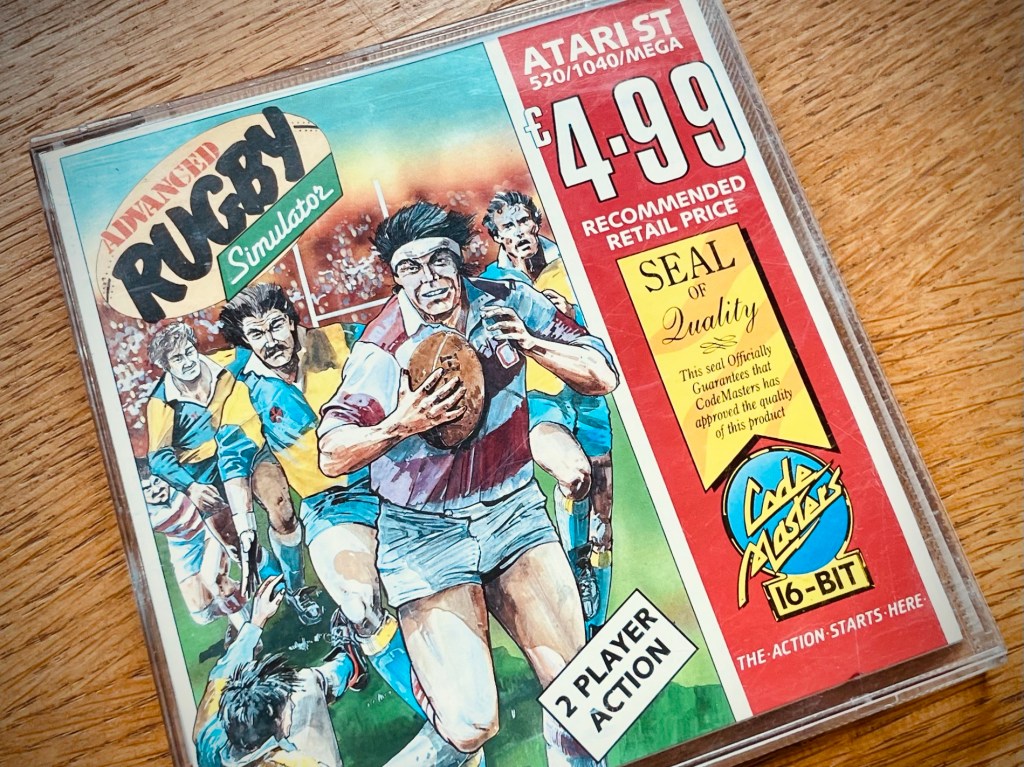
I’ll add precisely what sport we’re talking about to the growing list of things I need to come back to, but the horizontally-scrolling bit is also interesting, given the massive popularity of both Sensible Soccer, Kick-Off and sequels by now, if we’re talking proper football, or Joe Madden Football ‘93 (whose engine the aforementioned Mutant League Football ran on) for the American variant, all of which ran very nicely vertically. That’s not to say horizontal sports games had had their day by any means though, but in 1993 the best there was (and arguably the best there would ever be!) were playing the other way. Perhaps we can say then, not in vogue but all the same, not unfamiliar when at the time, most of us had grown up with side-scrollers like Real Sports Soccer, Match Day and Emlyn Hughes International Soccer, or Tecmo Bowl, or even Advanced Rugby Simulator… Okay that’s the only rugby game I know, but I am very fond of it! It’s a 1989 budget game by Codemasters on the Atari ST, which might be profoundly average but then so would Speedball be if you removed the violence and general chaos, so let’s not remove it, then I think we’re approaching the right ballpark as far as precisely what sport we’re talking about with Brutal Sports Football!
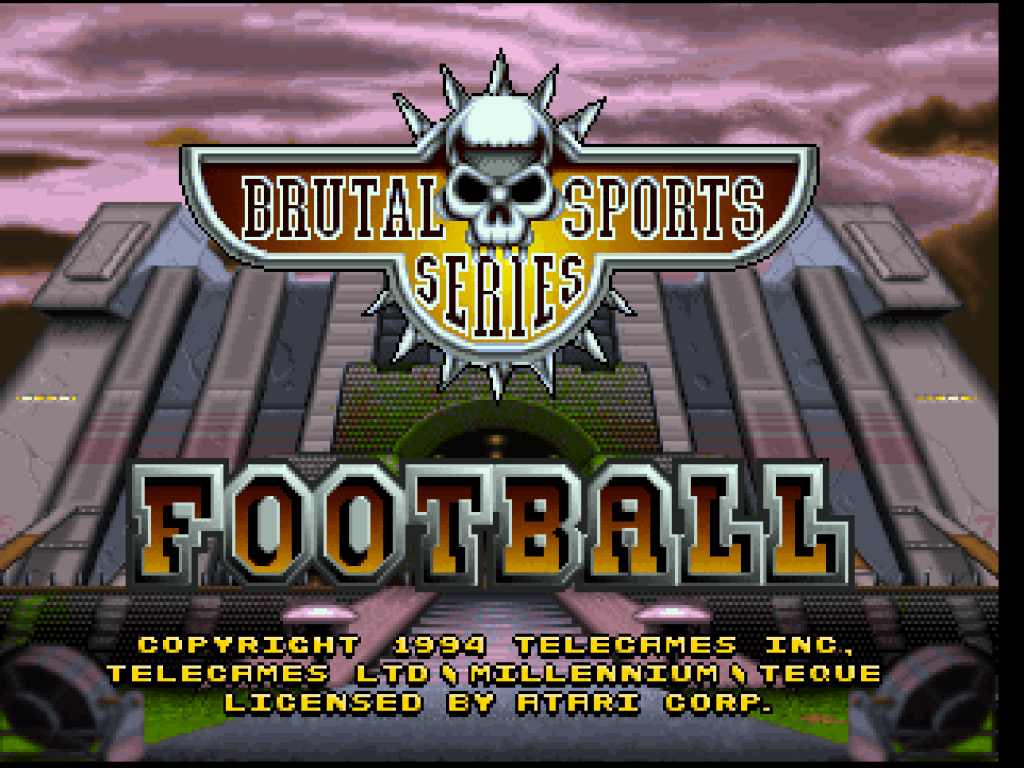
“Do you like sports games but think American Football is for wimps? Do you like action but reckon that chainsaw massacres are for grannies’ tea parties? If you do then Brutal Sports Football is for you. This is an all action, crunch ’em, stamp ’em, stomp ’em, no holds barred game of mutant football combat where heads will roll and where injury time means just that. Football with a new set of rules, No Rules!” That’s from the back of the Amiga box, and it translates to seven-a-side teams of monsters, mutants and, er, Vikings, playing matches of seven minutes that you win by either scoring the most goals or severing the heads of six of your opposition! This is done with the help of pick-ups, as well as relentless bone-crunching rugby- or American football-style full-body tackles and punches, as well as a good kicking when an opponent is down, while goals are scored by throwing or punting the oval-shaped ball (like in both of those sports) into the opponent’s net (or brick wall), or just running across the goal line with the ball. If the game ends in a draw, it’s sudden death, where the ball is taken away and it’s a race to decapitate whoever is left on the other team first! Otherwise, as alluded to before, it mostly plays like simplified rugby but without the stupid backwards passing rule. Or, indeed, Speedball! And despite its very medieval fantasy presentation, the manual describes a futuristic backstory but before we get to that, I’m going to quickly cover my own very brief backstory with the game, and likewise the platform I think I’ve finally settled on playing it on!
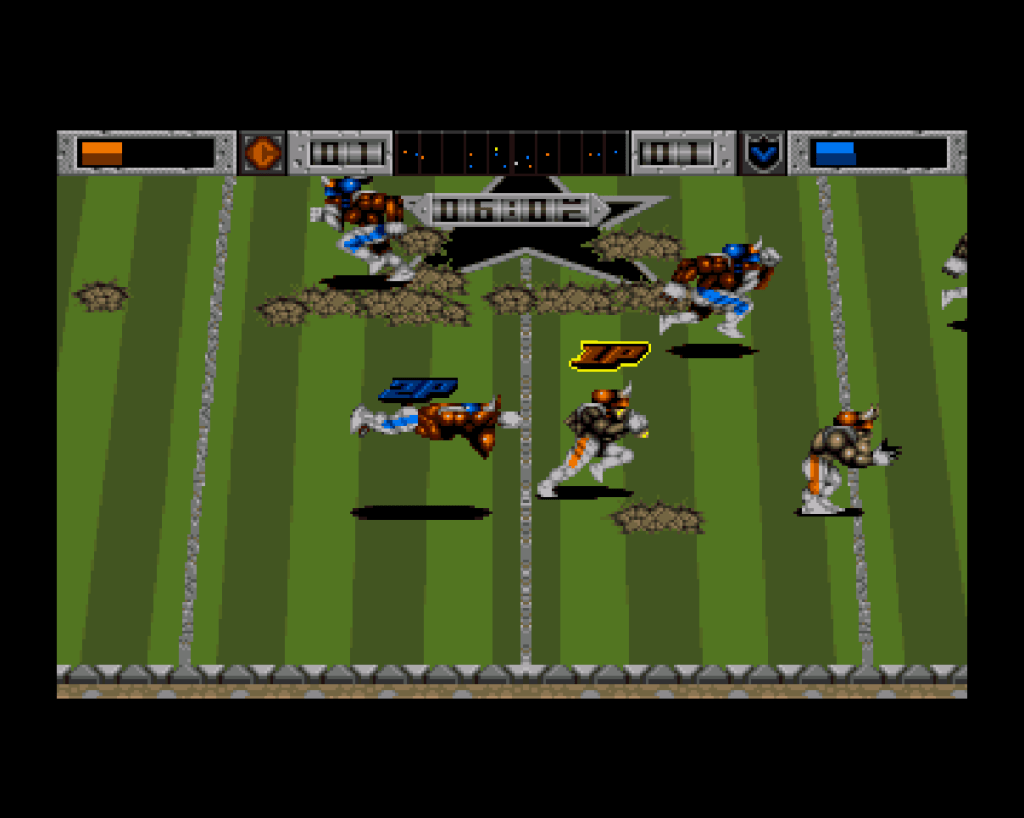
I’d just started my third year of university when Brutal Sports Football arrived on the Amiga, and was actually living near Lyon in France on what was the first of two pretty miserable work placements during that sandwich year, which made being able to play it a pretty unlikely prospect for a while. Didn’t stop me liking the look of it though, having become pretty much unbeatable on both Speedball and its sequel by then, and there was no denying it scratched the same itch! But my only Amiga-owning friend back home was also still away at university, and we’d pretty much gone our separate ways by then anyway, and over time I forgot all about it, probably until around the time the Amiga Mini came along in 2022 when I got properly reinvested in everything the system had to offer! Two versions to try by then too, because as well as the original release (pictured above), there was an Amiga CD32 release in 1994, which upped the environmental graphics, sound effects and music, but was effectively the same game, and therein lies my problem with both… Okay, it’s not Speedball II but nothing is, and that’s fine, and the CD32 controller also offers extra buttons which do somewhat counter the original game’s comparative lack of elegance when it comes to controlling it – it actually plays really good this way! The problem, for me at least, is it’s not exactly red-green colourblind-friendly, and while the current player icons do make distinguishing between certain combinations of team colours more stressful than originally intended but not impossible, unfortunately the ball colour means it’s regularly disappearing from view, and not having a clue where it is ain’t so great!
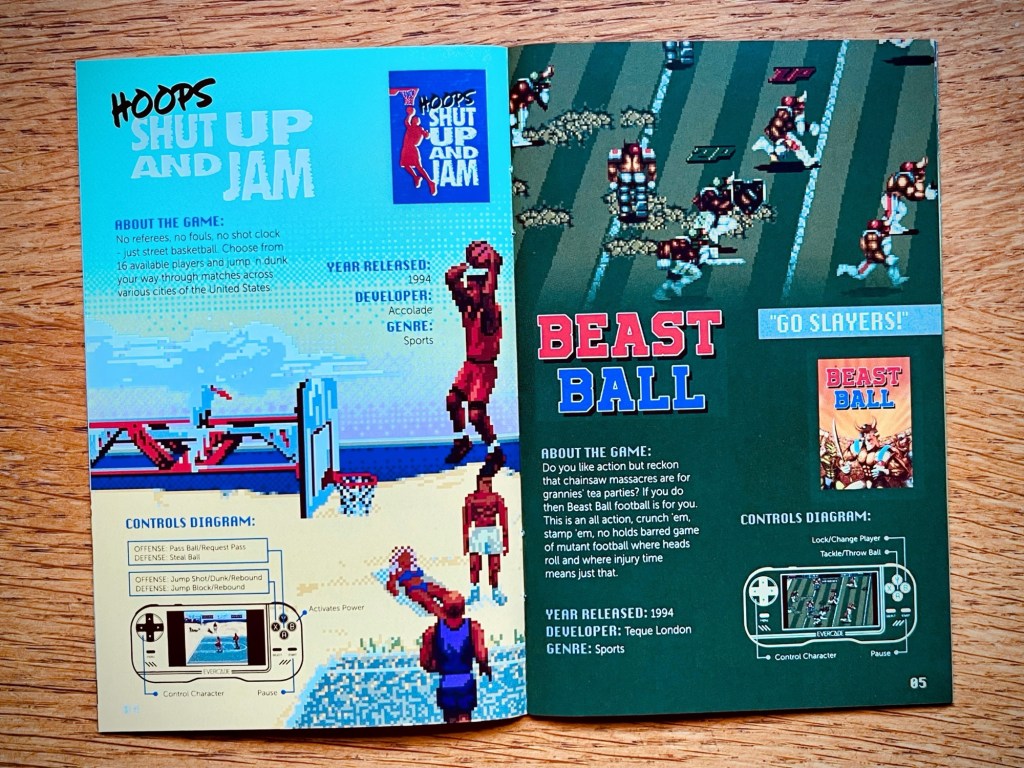
And with that, I forgot about it all over again, until along came the Piko Collection 2 for Evercade – which I think I got for my birthday in 2023 – including Beast Ball for the Sega Genesis or Mega Drive, a near-complete but unreleased port of Brutal Sports Football from 1994. The prototype version on this cartridge apparently turned up in 2011 but I’ve no idea why it (and the planned SNES conversion) disappeared originally though, considering it was as close to release as being advertised in the gaming mags, and even having review copies sent to a few of them. I’ve had a really good time playing it too – it’s definitely lacking some polish, with some graphical glitches and a general jerkiness, but at least I can see what’s going on. That’s the version I originally pencilled in to look at here too, until another recent compilation, Atari 50, which I’ve got on Nintendo Switch, inspired me to do a bit more digging into the Atari Jaguar’s library after I eventually properly got into a couple of its games on there at the tail end of 2023… Probably no surprise that one of them was Tempest 2000 but Atari Karts has become a real guilty pleasure of mine – totally janky Mario Kart rip-off but it has its moments and I rinsed everything it had to offer! The likes of Club Drive, Fight For Life and Trevor McFur that further represented the platform on Atari 50 can do one though, which left me wondering what was missing that I should be looking at, which I think took me as far as what might be my favourite version of NBA Jam (and if future me remembers, I’ll come back and link from here to the deep-dive I’ve got planned on that too!), and, of course, the very pleasant surprise that in 1994 it also got a port of Brutal Sports Football, so here we are to try one more time!
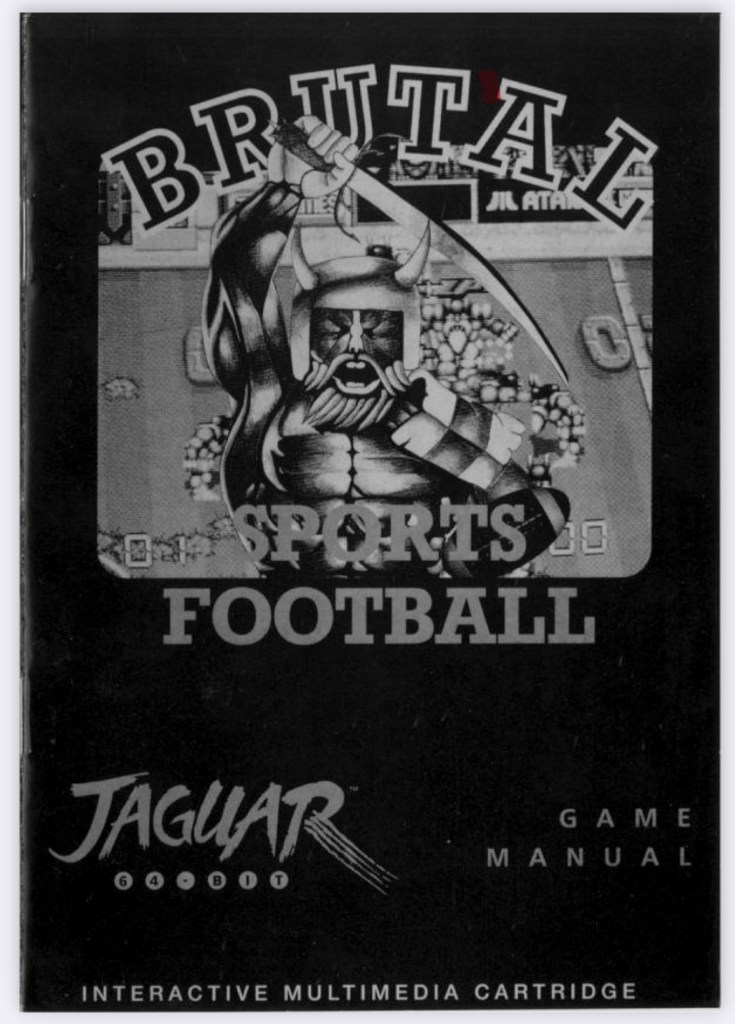
Before I get into that, I said I’d return to the backstory, and now we’re at the Jaguar version, I’ll relate the tale as told in its manual, which is also provided by the Evercade people because there isn’t a Mega Drive one… I’m sure I read somewhere it’s set in the 2080s but it clearly wasn’t here, although it sounds about right, as we are told the idea formed in 2034, by which time everyone was bored with whatever form of football it’s talking about… Wonder if F1 will evolve into combat-racing for similar reasons – I can’t imagine we’ll have to wait another ten years to find out either! Anyway, despite its potential for also offering some much needed population control, interest in the new sport died almost as quickly as its players, with games often lasting less than a minute! All the same, two dominant teams emerged from this period, and a huge crowd gathered for what was to be their final encounter – quite the explosive one too, with one team declaring nuclear war and wiping out an entire continent in the process! It turns out that wasn’t so much of a problem as the weakness of its human participants though, until along came Professor I.M. Looney and his range of genetically-engineered bipeds who couldn’t be better suited, and Brutal Sports Football was back in business! Not sure any of us benefitted from knowing any of that but regardless, we’re left with sixteen teams, five of which are apparently too wild for player selection and I’ve never encountered again, while the rest are made of up of the relative weakling Vikings, the marginally stronger Lizards, the mid-league Wild Goats and the almost unstoppable Rhinos, all of whom you’ll encounter through the game’s various game modes, which we can have a look at now.

You’ve got three modes, starting with Unfriendly, an exhibition match for one or two players that can be played as a one-off, a best of three or a best of seven, from a choice of eleven teams of all denominations. Every mode also has a range of difficulties, novice, intermediate, advanced and expert, each with additional options available for things like how many buttons you’re using, automatic player change and so on, which do sometimes vary between modes but generally give you more control over everything the higher you go. As well as playing way faster and with way more aggressive opposition! The League mode does start you off a bit more gently though, with four divisions of four teams, beginning with Viking-only at the bottom of the fourth division, then its six games per season, with the harder team classes then added as you’re promoted, and as this might take a while, you can password save at the end of each game. Same for the final mode, Knockout, where you’ve got eight Viking teams competing in a tournament. Aside from when you’re first getting to grips with how the game plays, when playing novice is a must, finding the right difficulty after that is something you’ll need to experiment with, especially when you’re in the League mode, although Knockout is similar, whereby novice is too easy for the first few games but anything higher is going to give you a depressingly high-speed pasting from the start, and conversely, things like manual player selection aren’t available until much higher difficulties, and I want that from the outset, especially when I’m a couple of players down but the game doesn’t seem to have realised, so it takes forever to regain control of the player that is nearest the ball, even if he’s not onscreen! It’s alright once you find your level though, allowing you to properly develop your game, but you’ll probably need to put the time into the different modes to do so.

Not that it’s exactly sophisticated! More a case of moving the ball faster, knowing when to go for goal and when to focus on wiping out the opposition – which is most useful when you’re in an otherwise no-win situation – and protecting your weaknesses while exploiting theirs… And by weakness, I mean the goalkeepers! Now, I’m not talking Speedball II cheesing the goalie where you put the ball in the air, tackle him as he grabs it then score, but let’s just say if you’re going to focus on wiping anyone out, then they’re the best bet if you’re struggling to score a goal or need a flurry of them! And in the case of your keeper, just get rid as fast as possible, ideally with a punt for a bit of distance, and get the other team concentrating on other players! You do have some basic formation options too, with Aggressive loading up their side of the pitch, which can buy you a few chaotic goals as the defence doesn’t know where to go first, then Defensive will load up your end when you’re trying to hold on to a lead, while Standard gives you a balanced approach, although I’d say you don’t need to worry too much about any of those until you’ve at least moved on from novice. Presentation aside, I think “chaotic” is where this version outshines the others – obviously the Jaguar has a performance advantage, meaning when sprites are piling on sprites it can somehow still keep each one under control rather than just enabling a big jerky mess, but also it feels very intentional here, like you get in the Destruction Derby games on the original PlayStation, where you’re somehow vaguely in control in the midst of it all too, and that’s where the real fun lies!

And just to close on gameplay comparisons, I reckon the overall experience is more fluid here, possibly because it’s slightly less frantic and you have a split-second to decide if you take out the thrower or the intended recipient, for example, and once whichever one is out cold on the ground then stop to mercilessly (and repeatedly) stomp on their head to take them out of the game permanently while they’re thus exposed, or you could follow the ball instead. Or pick up that sword you just spotted and do some really serious damage… There are always loads of pick-ups littering the pitch, which can cause damage, like this or the axe you can throw from a distance, or you can get a shield to protect you from the same treatment, then there’s a magic potion to make you invisible, plus bombs, grenades, speed-ups, freezes and more. Two-player games also get a couple more on top, with a direction reverse and an entire team control swap. You can also store some of these and save them for later but honestly I’ve not worked out how or really felt the need to find out, although I know the manual mentions it! Which reminds me, it also talks about “lock” on one of the buttons (likewise the Evercade manual pictured back up the page), and you’ll also find it in the difficulty options in-game, although neither ever says what this is – lock on the opponent with the ball, I guess? Again, I never really felt the need! Whatever it is, it’s on the same button as change player, if you can access it on your difficulty setting, while another button will pass and the other will kick when you have the ball, or they’ll flying tackle or punch or jump if you don’t, and despite all the stuff going on (or not), and all my words to describe it, it’s really all very simple!

Like Speedball II, you’re going to get your money’s worth in the League mode, and also like Speedball II, there’s stuff going on in-between games that isn’t quite as simple as the gameplay itself but you’ll quickly get your head around once you know what’s going on! As well as getting three points for a win, or two for a sudden death win, or one for a sudden death loss, your performance is going to earn you money, and you need to use that money to simply keep your team on its feet, and should you have anything left over, then try and improve it. This all happens in the Locker Room, which you can access after a match to see all nine of your squad and their individual current state of repair. I should mention this is also on a meter while you’re playing, as well as one for the overall team health. Anyway, there are three options for each player, which include first aid for regular wear and tear, and “cranial reconstruction” for more serious injuries incurred, and then you can also choose to increase their speed, which will give them about a quarter boost for a couple of matches, or a bit more if you splash out on a second shot of whatever it is they’re taking! As you can imagine, this then becomes a balancing act across the seven that have just played and the two spares, but you need to keep in mind you only have one goalkeeper so he can’t be rested. Everyone else can play anywhere though, so once you’ve spent your money on the ones that look to be in the best shape (mainly indicated by them actually standing there unaided as opposed to not having a head!), you then choose (or auto-choose) the best of them and move on to the next game. I must say I was never that keen on this aspect of the game in its aforementioned inspiration either, so I’d have preferred an auto-everything option but it’s all pretty dumbed-down here, so not the end of the world.

As throwaway and ultimately irrelevant as that backstory from earlier was, I am still a bit mystified by the whole future-medieval aesthetic going on here! Okay, going all metallic might have been a bit too blatant even for this game, but while the fantasy elements are more or less satisfactorily explained away, at what point in the next fifty years or so do all the swords and shields and a glorified jousting arena come back into fashion? It’s not like it’s an excuse for some kind of graphical showcase either – I mean, it looks nice and all, but so did the Amiga game… I suppose are talking about a system where a Jeff Minter remaster of a then thirteen year-old arcade game is the best thing on there though! Anyway, what we’ve got looks good and it mostly moves really good, tracking the non-stop action from one end to the other, changing direction without a hitch and scrolling smoothly enough, albeit with the occasional stutter. There’s plenty of detail in the players too, and they also move well enough, but there’s not a huge amount of character to any of them, whether rhino or lizard or Viking – suppose there’s only so many ways you can cut a white beard! Where Brutal Sports Football really excels though, is in all the little (and big) details that are appearing and disappearing all the time. The most obvious is in the grass degradation as the pitch takes a beating from all the heavyweight tackles being made all over it, and it ends up a total patchwork of mud, but there’s also smaller things like blood sprays, or the the goalie crying if you score a goal by sending him backwards into it while he’s cradling the ball, or even the decapitated heads mounted like trophies and bouncing around on the killer’s belt! This kind of thing definitely elevates the overall experience as you’re playing, and so does the arena itself – weird as it is – from the exquisitely-textured patterns in the brickwork around the goal to the vibrant billboards and wonderfully alien spectators. Still looks like a stunner of an Amiga game though! I’m not sure the sound quite hits that level – I’m always suspicious when the music gets a dedicated on-off button! I’ve not felt the need to turn it off yet though; generic, cartoon Euro-synth isn’t my thing but it’s also inoffensive, and to its credit does ebb and flow dynamically according to what’s going on in the game. Same for the sound effects, which serve their purpose but could do with being a bit more crunchy.

The gameplay offers plenty of crunchy all by itself though! Obviously, if you owned an actual Jaguar, you might question whether or not you need the best available version of an old Amiga game, although in the interests of transparency I’ve never played the DOS version so am just going by Steam reviews with that claim! However, Speedball II has proved itself timeless, and as this inescapably sets out its stall as a horizontal take on that formula, I reckon it succeeds at least as well as something like Speedball 2100 did when it took it 3D on the PS1! I’ll also go out on a limb in its defence and say it also does it better than the Mega Drive version of Speedball II did! Brutal Deluxe indeed, but wherever you play – assuming you can – then Brutal Sports Football is a lot of fun if you give it a chance, and I reckon I eventually found the place where it’s the most fun, which might have been a happy coincidence but I’m very happy it was! I’ll close by quickly mentioning its 1994 successor, Wild Cup Soccer, which was a similarly-themed, isometric take on the sport for the Amiga (and CD32) which never made it anywhere else, although you could always go for Sensible Soccer: International Edition on the Jaguar for a decent 16-bit football fix on your 64-bit console instead!
As always, I’ll never expect anything for what I do here but if you’d like to buy me a Ko-fi and help towards increasingly expensive hosting and storage costs then it will always be really appreciated! And be sure to follow me on Instagram, X (formerly Twitter) or Threads for my latest retro-gaming nonsense!
 Retro Arcadia