
When Silent Service first appeared on the Commodore 64, Atari 8-bit and exotic places like Apple II and IBM back in 1985, I was still playing Submarine Commander on my souped-up, 16K expanded VIC-20. Incredible game it was too! In fact, as I write, I’ve been playing a lot of the original 1982 Atari 8-bit version, which seems more or less identical to the port from a year later where I’ve spent what is probably getting on for hundreds of hours playing over the years, and to this day, still manages to capture the incredible claustrophobic tension I remember – if you’ve ever seen one of those old war films where a submarine is being depth-charged then you know exactly what I’m talking about! Its atmosphere and sense of place for something from that time on those machines is nothing short of incredible, as you travel the Mediterranean, hunting down enemy shipping convoys using a long-range map, using the surface for speed and recharging your batteries before diving as you approach, tracking them with sonar from below, then switching to periscope, launching an attack and disappearing before the destroyer escorts even know what hit them. Well, that’s the theory anyway! I can’t think of anything else like it on the VIC-20, and maybe only the remarkable Star Raiders on Atari 8-bit, with that kind of accessible complexity and, in this case at least, such realism – a true simulation where it had no right to be one!
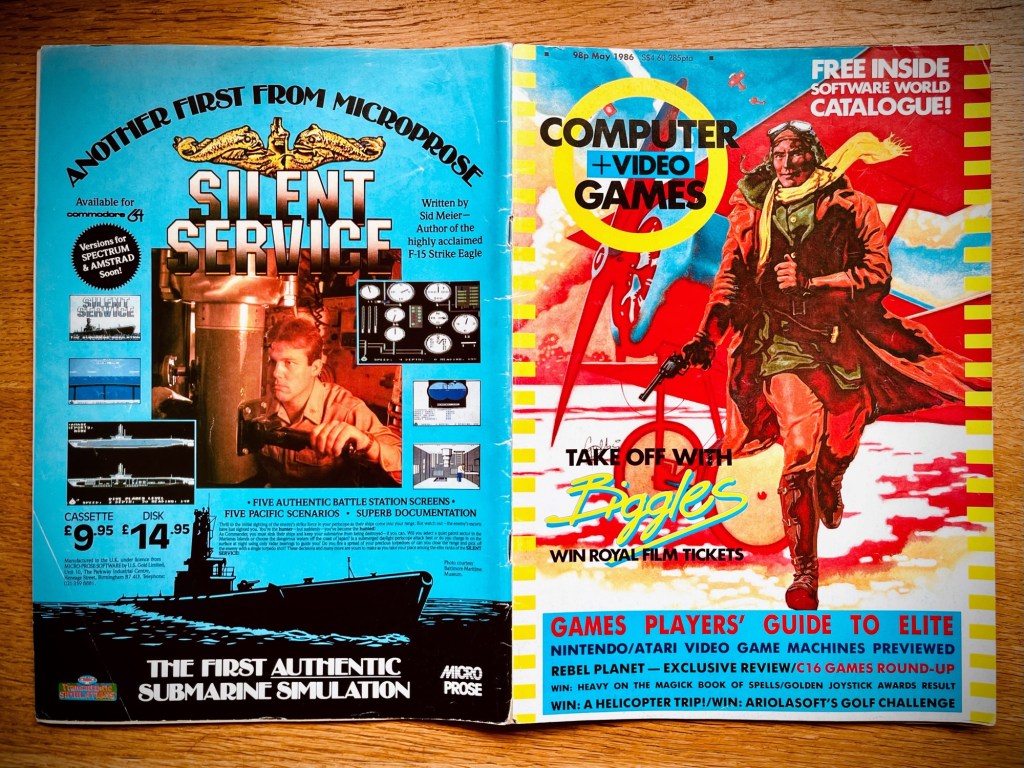
I do very much remember seeing the adverts for the C64 version of Silent Service when those started appearing on the back cover of Computer & Video Games magazine around May 1986. Not sure if had been delayed or what but the review appeared in the July issue, which was part of a war games special they were running that month, although that does seem to be around when the other mags were doing also reviewing it so who knows. Did alright for itself regardless, although I don’t really recall my usual bigger-boy machine envy from what I was seeing; obviously, it looked better than my submarine game but so did everything by then, and there were a few more scenarios too but I was just fine with the one I had! Beyond a note on the same advert to say the Spectrum version was coming soon, I don’t think I ever encountered it again – when I got the Spectrum +2 I shared with my brother a few months later, we didn’t play stuff like that, and that port simply passed me by until mere minutes ago as I write, as confirmed by those garish views which you’d never forget had you ever seen them before! The Atari ST version, on the other hand, was back on my radar again when I got mine in 1989 but that was way too late for it to be able to compete with the latest nerd stuff like F-19 Stealth Fighter or F-15 Strike Eagle II, both also from Microprose, who were now well on their way from being genre pioneers to its undisputed champions, as the early nineties brought with them new levels of realism and exhilaration that would go on to help define both the simulation as we know it now, as well as the 16-bit home computer generation as a whole.
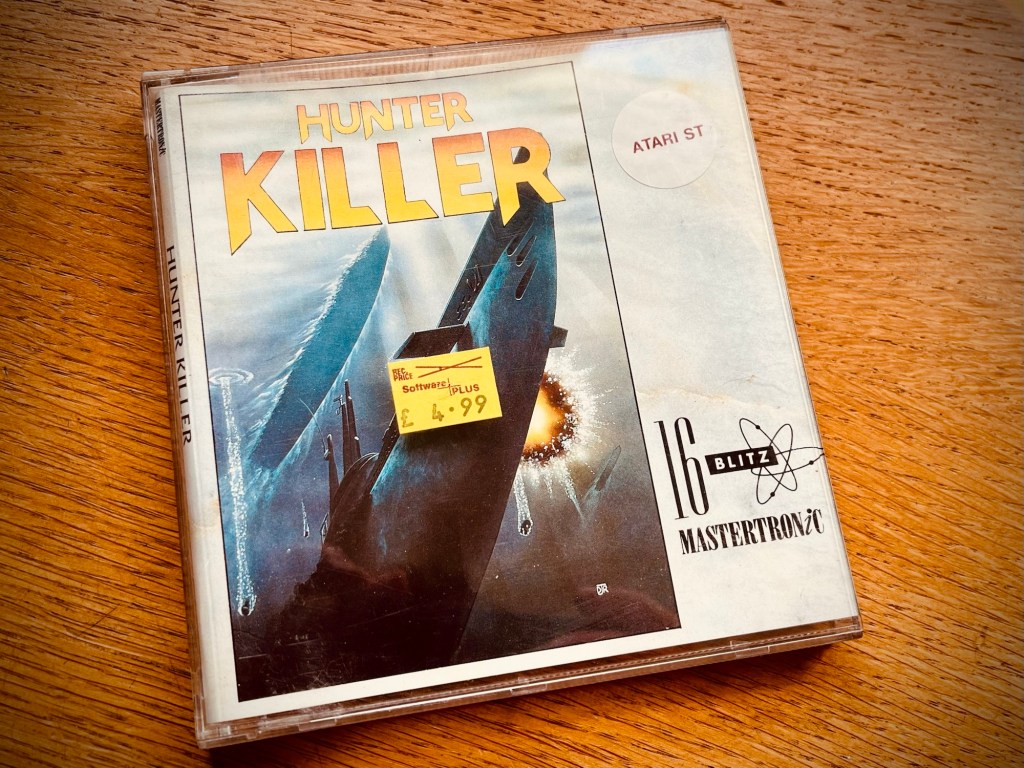
But while Silent Service was effectively an 8-bit game in a 16-bit skin, and there were way higher priorities for my lack of money than something like that, that didn’t stop my hankering for an up-to-date submarine simulation, so when a brand new budget one called Hunter Killer came along, it seemed to fit the bill on both counts! This also arrived in 1989, on Mastertronic’s 16-Bit Blitz label, and not only does the case I’ve just dug out confirm the cost of £4.99 from the price label I never took off, but it also solves a long-time mystery about the name of a long-since gone independent games shop in Bedford, found up a set of narrow stairs with a presence detector halfway up we used to step over, behind a totally missable door between a couple of other shops! And it was called Software Plus! Which is more exciting to me than the game I bought there was – it looked the part, meaning marginally shinier than 8-bit, and had loads of submarines to master and missions to conquer and there was even a machine gun on the deck to fire at helpless, newly-shipless sailors floundering in the water, but it was fundamentally mundane no matter how much there was to it, or however much I tried to like it. Never came close to capturing that unique essence of Submarine Commander either! And that was me done with submarines until I first installed Steam on my big old desktop PC – I guess around 2008 – and desperate to spend money on something on there, I bought the DOS version of Silent Service for £1.50 or thereabouts, and I had a go and didn’t know what I was doing and that’s been that as far as that version is concerned ever since!

But that’s just a part of the story, which properly begins sometime after 2016 when I’d got the NES Classic Mini, which in turn got me properly exploring the system’s wider library, and somewhere along the line, I found Silent Service on there, and it was love at first sight, and before long I was suddenly thinking we were now getting very close to treading all over Submarine Commander’s hallowed ground! Which is not something I was expecting at all when I fired it up out of nothing more than idle curiosity after the name jumped out at me from the enormous ROM dump I was poring over – I mean, who wants a stuffy old submarine simulation on their NES or any other console for that matter? After the Spectrum and Amstrad CPC ports arrived, followed by the ST (and later) the Amiga ones, Microprose did also get it out on several other weird and wonderful systems, like the PC-98 and the Thompson MO6 but, as far as I’m aware, it only ever got this console release, which came in 1989 and was developed by the legendary Rare, published in Europe by Konami and their Ultra Games spin-off in America. Can’t tell you why though, but like the iced doughnut bun I had on a double hamburger with cheese and bacon when I was at the baseball game at the London Stadium the other week, it worked all the same! Silent Service was the brainchild of Sid Meier, a co-founder of MicroProse back in 1982 and producer of all sorts of cool simulations that followed (including the helicopter masterpiece that is Gunship), as well as the likes of Pirates! and Railroad Tycoon, and some nerdy turn-based strategy series called Civilisation but I’m not sure that ever really went anywhere!
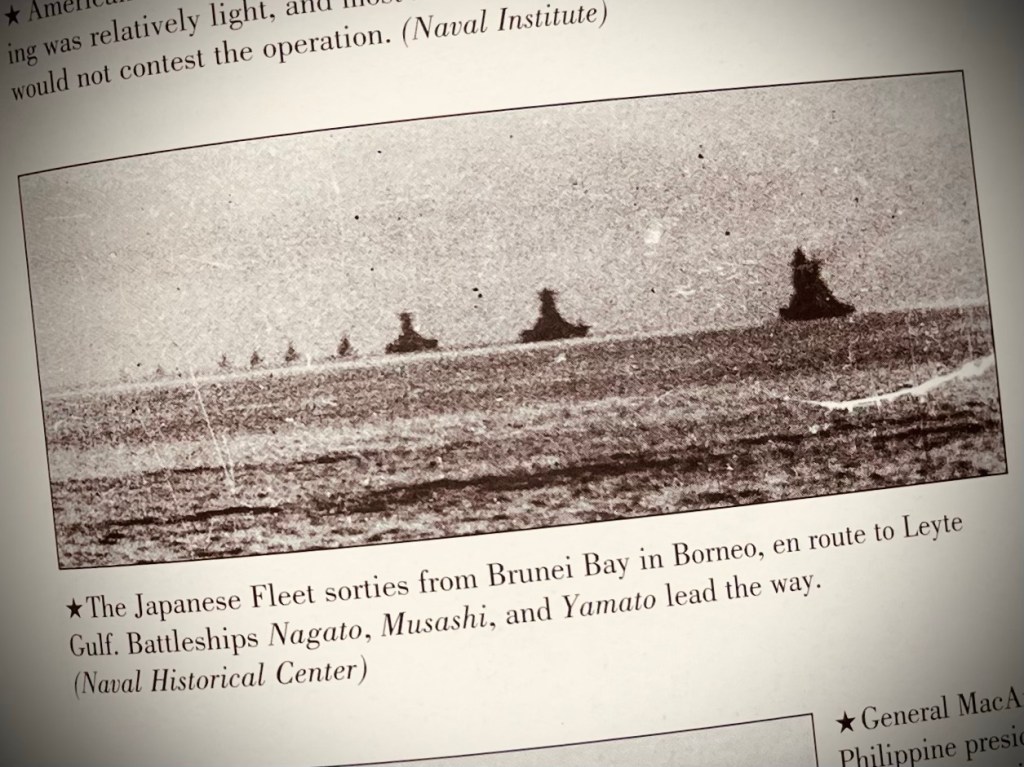
For Silent Service, he was inspired by a book called Clear the Bridge!: The War Patrols of U.S.S. Tang, written by it its captain (and Medal of Honor recipient), Rear Admiral Richard H. O’Kane, and it’s a wild story of bravery and tactical genius that played no small part in turning the tide against both the Japanese navy and the country itself towards the tail end of World War II, setting records for more ships and more tonnage sunk, as well as taking part in daring rescues that saved dozens of downed pilots. Definitely quite the inspiration! We can pick up where the game took this inspiration from the back of the NES box… “The world is deep at war, and you’re submerged among the enemy. Prepare to dive into Silent Service, the ultra-realistic submarine simulation that recreates authentic World War II sea patrols in the bloody waters of the South Pacific. From the second you take command, you’ll live by the motto FIND ‘EM, CHASE ‘EM, SINK ‘EM, as you follow instruments, charts and your instincts in search of hostile convoys. Every decision you make will tempt fate, whether you risk a nighttime surface attack with deck guns blazing, or fire your last torpedo at a troop transport escorted by sub-killing destroyers. Your only relaxing moments away from the depth charges will come during torpedo and gunnery practice off the bomb ripped coast of Midway Island. So batten down your mental hatches. And remember, onty 2 inches of steel and your tactical genius come between you and a watery grave.” Sounds good to me, but before we get started, I should also say that “Silent Service” was a nickname for the US Navy’s Pacific submarine force during World War II!

The game immediately sets out its stall as a simulation, with you as the commander of an attack submarine, presented with the same information, problems and resources available as an actual sub captain. That said – and despite the typically verbose MicroProse instruction manual – it’s all very intuitive once you know what’s at your disposal and where to find it, and it being set in World War II game, it’s all relatively simple too… Even compared to Submarine Commander in some respects, and the same for some of its home computer siblings too, although streamlined might be a better way of looking at it, but I’ll come back to all that! Your primary mission is to take on the Japanese Navy in their home waters and to neutralize the Japanese Merchant Marine. With a limited number of torpedoes and fuel, you need to sink the maximum tonnage of enemy ships possible then bring your sub safely back to base, where your overall evaluation by Fleet Command will be based on the number and types of ships you sink. At the outset, you’re presented with a choice of three scenarios, the first of which is Torpedo / Gun Practice in the relative safety of the waters off your Midway Island base, where you can go wild on four old cargo ships with your torpedoes, with them loaded into the bow or aft or front or back tubes automatically depending on where your target is in relation to the submarine, and also your four-inch deck gun, which can be shot when you’re on the surface, and is handy for finishing off a damaged target without using your very limited supply of torpedoes, or for slowing a ship down and separating it from a convoy. And as much as the instructions like to make out otherwise, it’s a simple click of their respective icons when you’re pointing in the right direction to do so! Likewise, port and starboard or left and right rudder controls, as well as diving and surfacing controls, are all on directional arrow icons, while you’ve got a four-speed throttle and reverse to get you moving (or the opposite), and everything is selected with what is effectively a mouse pointer. Works fine though, and it’s all very cleanly laid out and easy to keep under control, even in the height of battle, although there is more to it than meets the eye…
In what I assume was an admirable attempt to keep the various battle station screens uncluttered, as well as compensate for being on a console (i.e. no keyboard), Silent Service was built to use a second controller for certain functions. In combat, for example, if you’re on the deck gun, you can use its up and down controls to set “deflection” – effectively an allowance you need to calculate for the speed a ship is coming at you versus the time it takes for a shell to reach it at that speed, which is honestly way beyond my level of play here, and, dare I say, possibly also beyond the actual demands of the game, whether it’s available for use or not! More useful then, perhaps, would be using the second controller to rotate the periscope without having to if to turn the entire submarine, or blow your ballast tanks to bring you back to the surface if you find yourself in a fatal dive, or my favourite, release a load of oil and debris to try and fool the enemy into thinking they’ve sunk you if you find yourself in a particularly hairy barrage of depth charges, although both of these tricks are once per engagement only. Which reminds me, I was talking about the different kinds of engagement you can select before I got sidetracked with controls, although I will come back to them again shortly. In the meantime, our second mission type is Convoy Actions, which are a choice of six short-ish missions that place you in specific (or Pacific if you prefer!) historical situations, and as I’ve already had a dig at the MicroProse style of instructions, it’s only fair I commend them here for the really nice summary of each mission scenario, as well as its historic context and some gameplay tips too. And none of it is that wordy for once either! Let me give you a quick example of a short one, called Tautog at Night… You’re in the shoes of Lt. Commander Sieglaff for this one, on 16th March 1944, at a latitude of 42-25N and longitude of 144-55E, which puts us just off the eastern coast of Japan, where the USS Tautog has encountered a Japanese convoy.

This being a night attack, how you play it is going to depend on the visibility when you get there, so if visibility is poor, you can use that to your advantage and close in on the surface without too much risk of being seen before you get in torpedo range but if visibility is good, then you’ll need to be more cautious, diving and using your radar, although this is one thing I don’t like about the game – rather than a traditional radar view, or the typical round sonar display and white blips and distinctive pings, you get messages on screen as to what the sonar operator is seeing, which is realistic, I guess, but not very useful in a game where you’re effectively playing an entire crew! Instead, you’ve got four map views, from the whole of the South Pacific to a 500 x 300 mile patrol area, to a 60 x 40 mile navigation map, to an 8 x 5 mile attack plotting screen. According to the manual, these collectively combine map information, visual sightings, radar and sonar to display your position, torpedoes in the water and known (but not unknown) enemy ships, as well as land masses. Which all combines really nicely with your periscope or binocular view but I just find this unnecessarily video gamey, and as such, any inherent tension takes a hit that I think would have been solved simply by a big green circle replacing one of those map views! In this case, less woudn’t have just been more but that lack of information would have been more realistic too! This is especially true when you’ve been detected and have a destroyer on your back, and you want to dive as deep as possible, as fast as possible, as quietly as possible, and apart from the sound of depth charges exploding around you, that sonar giveaway of their propellors turning is the only hint of your chance to escape! It’s not like there’s not enough tension regardless but from experience with my old VIC-20 game, I just know what it would have added! Anyway, as well as weather conditions to consider, and time of day or night and how that affects visibility on both sides, some of the convoys you’re attacking will have escorts equipped with radar, or you might be up against the clock before a destroyer gets on the scene, or you might just find yourself in shallow water with limited escape routes, so carefully positioning yourself before the first torpedo hits the water and gives the game away becomes your priority.

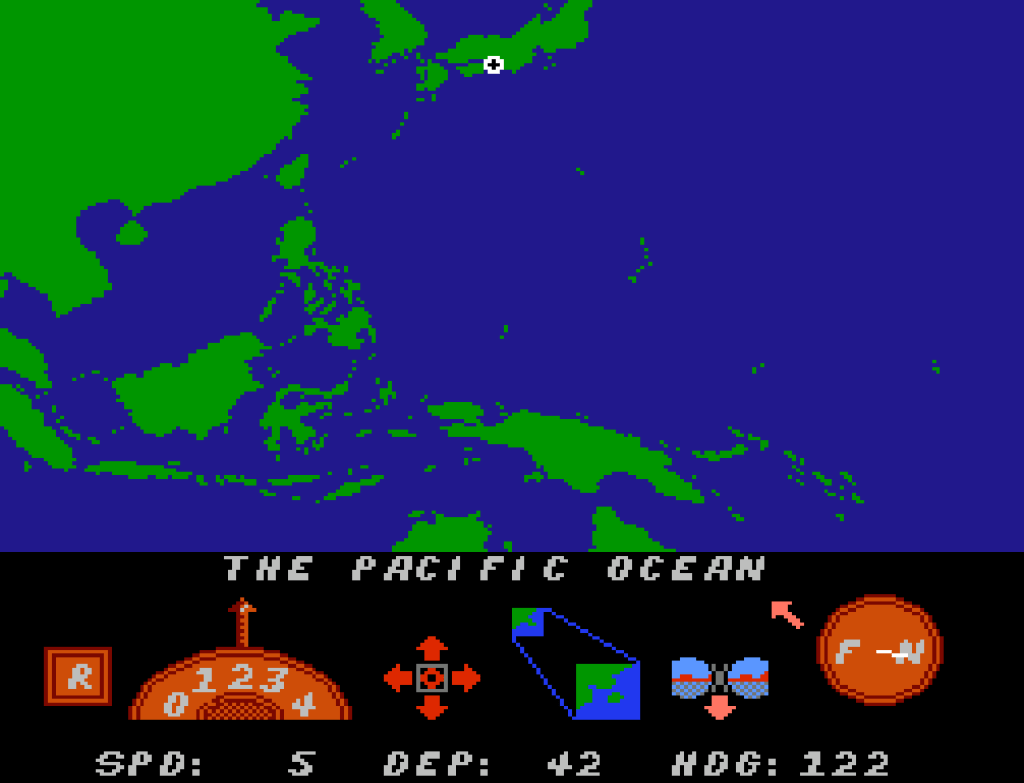
Each mission then has four overall difficulty levels, from Midshipman to Captain, on top of very customisable combat difficulty levels, which include how much visibility you have (which can add a bit more realism to all those map views), the extent of convoy zig-zag tactics, possible dud torpedoes, whether you can repair your sub at sea or in port only, the level of training of enemy sonar operators, and the need to search out convoys then work out the approach rather than having them shown on a map from the outset. This gives you loads to sink your teeth into with these six scenarios alone, which do take quite a bit of practice and tactical thought before you start upping the realism, but we’ve still got a third mission type left, the War Patrol Scenarios, and this is where you’ll find the real test of your skills! You need to scour the Japanese convoy lanes, first finding them and then attacking and sinking as much tonnage as you can. Once again, we’ve got a choice of War Patrols, each taking place in different submarines at five different stages of the war, and there’s a really cool touch here because those convoy lanes evolve throughout its course, as Japanese control of the Pacific started to shrink, so for the last of them, at the end of 1944, you’ll do best to find your targets around the islands of Japan itself. Once again, you’ve got the overall and combat difficulty levels to sort out first, then once into the game, you’re presented with a War Patrol map of the South Pacific and your starting position at either the Fremantle, Brisbane or Midway bases, shown by a tiny white dot that you’re then going to move around the map, like a cursor, while the time that would take is simulated (where these patrols might last up to two months), as is day and night by changing colours around the map. When it turns red, however, you’ve sighted an enemy convoy, when you can exit from patrol view to engage in battle. It’s worth saying that you really need the original instruction manual to get the most out of this one because it does show you the shipping routes, and while there is a thrill to finding an enemy (if not so much moving a pointer around a map!), you can easily waste an entire virtual two months within a couple of minutes without sinking so much as a seagull! Either way though, once you’re done, you need to get back to a port to finish the mission. Whichever mode you’re in, and whether you’ve returned home triumphant or been sunk or rammed or you’ve simply beached yourself, you’re then awarded an ensign class (rank) and your tonnage goes on a high score table, if you’re lucky!

I’ve mentioned periscope views and map views and so on but I want to quickly mention getting around them all (before I get to the views I haven’t mentioned yet) because it’s such an iconic sight! This Conning Tower screen (at the top of the page) acts as your menu, and by moving your character around it – which is literally a visual representation of pressing up, down, left and right – you can select any of the four battle screens, which additionally include the Instruments and Gauges screen, and the the Damage Report screen. It might not be as glamourous as your periscope view but this Instruments and Gauges screen is where it’s really happening! There’s loads of stuff being displayed on what’s initially a bewildering number of dials, displays and meters but there are just a few you need to be very aware of at all times… Your battery level is probably the most critical because if it’s not charged then you can’t move underwater, so you’ll be a sitting duck for any passing destroyers with a decent sonar operator until it is, which you do by resurfacing, where there’s also a different chance you’ll be a sitting duck! Actually though, you want to be on the surface as much as possible, not just to keep the battery topped up for when you need it, but because you’ll be able to travel at twice the speed (up to 20 knots) there versus below, although that’s still burning regular fuel, which you’ll also want to keep an eye on in its three tanks. There is a depth gauge here too but you can see that on every other screen, so what’s more interesting is the one for depth under the keel, which is the distance between you and the ocean floor, which ideally you want to avoid! Obviously, that’s pretty much the extent of your eyes down here, and you really need to pay attention to this one while you’re also panicking about trying to dive and escape! It’s always fun seeing how deep you can go too though! Speaking of which, something else for advanced play is the thermometer measuring water temperature because if you can get below a thermal gradient layer (indicated far simpler than it sounds by it being in the blue!) then it will help disguise you from enemy radar and possibly fool them into moving on. There’s loads more – clock, compass, torpedo ready indicators, periscope indicator and so on – but the last one I want to mention is the Christmas Tree, which indicates all the hull openings in the submarine, green for closed and red for open, and that’s another very simple source of tension when you dive and for whatever reason you see that one of them hasn’t shut automatically!

The last view, the Damage Reports screen, will give you a bit more information on why that might be! You’ve got a graphical view of both the inside and outside of the sub, and any type of damage sustained by depth charge attacks or gunfire are shown here. This includes bow or aft torpedo damage, meaning they won’t fire; periscope damage, stopping that working; dive plane damage, restricting your ability to dive or surface; fuel leaking, which is self-explanatory but does also rise to the surface…; engine damage, affecting your speed; machinery damage, making you louder and easier to pick up on sonar; battery damage, which means they don’t charge for as long; and water damage, and you really don’t want your submarine filling up with water! The extent to which any of this happens is very much dependent on the difficulty level you’ve selected, and likewise how soon you can get it fixed will depend on those combat difficulty customisations, but this screen in particular isn’t something you need to worry about too much on the lowest levels, and the same for much apart from the depth indicators on the previous screen. However, beyond treating these lower difficulties as training missions, I don’t think you want to hang around there for too long because where Silent Service really comes alive is when you start to need eyes in the back of your head, taking in all this boring stuff while also keeping your attention on tactical views and which ship is positioned where relative to you and each other on the map screens, and the more immediate concerns out of the other end of your periscope! Thankfully, you can catch your breath by pressing Select to leave your current view and head back to the Conning Tower one, where the simulation is thoughtfully paused to allow you to navigate to the next view with no reliance on the dexterity of your fingers on a controller (or two)!

Coming to presentation, I know there’s limits to how much you can dress up the inside of a World War II submarine but there’s really no excuse for the graphics looking as “serviceable” as they do! I keep going on about old VIC-20 games but on there it was perfectly possible, after mere minutes of play, to be able to identify the ships making up the convoy you were attacking on sight, mainly because they weren’t just a mass of vaguely rectangular blocks of brown and grey pixels! Which I guess is why the “Tornado Data Computer” under the periscope also includes a ship ID function alongside it’s target speed, range and course indicators, that help with firing a torpedo in the right direction! It’s a shame because I think it’s another wasted opportunity to ramp up the tension when you realise that’s a deadly Kaibokan sub-killer escort ship suddenly appearing from behind that dirty great oil tanker or troop carrier you were happily tracking, without having to wait for a far more mundane text confirmation. The rest is hardly pushing the NES, but it it’s all a fine array of dials and gauges and indicators, and all within easy reach, while the periscope effect is atmospheric enough as it scans the very basic sea under a basic sky with occasional basic bits of green for land or the single white pixel hint of an enemy ship in the far distance, and of course, it’s always fun to see your little captain being busy around his conning tower! Which reminds me, I mentioned streamlining earlier, and that was specifically referring to the on-deck view missing here but I can’t imagine it’s for any other reason than improving the game flow because the Atari 8-bit version, for example, happily managed it, and the little ladder and hatch to point at to get out there is still present in the conning tower here, so it can only be non-functional because it wasn’t massively functional in the first place anywhere else – I’ve been playing a lot of the Amiga version in parallel to the NES and it’s not something I use very much and certainly don’t miss it here.

I would have liked a bit more care going into the animation where it matters too because the torpedo wake is just about effective enough as it heads from you towards its target but the column of flame when it hits is a bit crap, and even more so when it’s left hanging in the air after the ship eventually goes down in a very binary now you see it, now you don’t fashion! A game like this isn’t particularly reliant on graphics though, so, rubbish ships aside, it’s not something that particularly bothers me one way or the other, but there is a bit more to the sound, which is used really effectively for upping the atmosphere and creating a sense of urgency, for example the ping of the sonar (you can’t look at) when a destroyer is closing, or the dreaded splash of a depth charge being dropped before the excruciating wait for it to either hopefully explode in the distance, or the whistling explosion that means you’ve been hit! There’s also the horrible grinding sound when you run aground or when you collide with something but it’s not all bad news, like the lovely sense of relief when you hear the alarm ringing to announce the tanks are being blown the stop the crash dive you’ve found yourself in, although what’s on the surface might not be much better! And that sense of the unknown, with you trapped in your little metal skin, swimming almost blind beneath the vastness of the world’s biggest and deepest ocean, is where Silent Service really succeeds beyond its presentation, and the hardware limitations of the console it’s found itself running on here. Then, once you get a handle on how to play, you very quickly develop a sense of place in this terrifying new world where you really have no place, but find yourself both terror and terrified, hunter and hunted, and that’s why I’ve grown to love this game in exactly the same way as I love Submarine Commander, and that’s regardless of where I’m playing either. Which probably then goes back full circle to why I never bought it on my fancy new 16-bit computer at the time, and how it subsequently took me as long as it did to realise that!
As always, I’ll never expect anything for what I do here but if you’d like to buy me a Ko-fi and help towards increasingly expensive hosting and storage costs then it will always be really appreciated! And be sure to follow me on Instagram, X (formerly Twitter) or Threads for my latest retro-gaming nonsense!
 Retro Arcadia