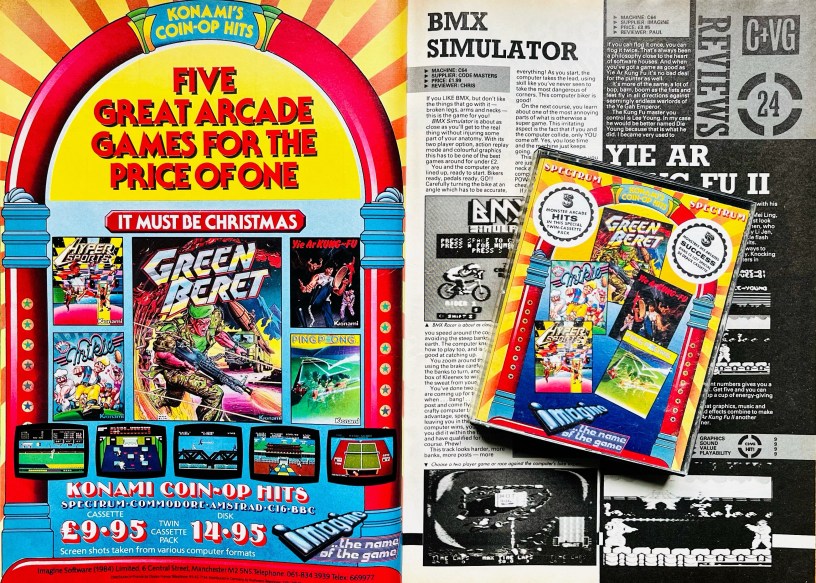
When Konami’s Coin-Op Hits arrived on the ZX Spectrum in time for Christmas 1986, it was a toss-up for me between that and Ocean’s Greatest Hits. Which they really weren’t… the old isometric Batman and Frankie Goes to Hollywood were, of course, tempting to a new Spectrum +2 owner, but as much as I loved the TV shows, Knight Rider and Street Hawk were proper stinkers, and I didn’t love the V TV show so wasn’t fussed about that game, and Daley Thompson’s Super-Test wasn’t his Decathlon, and I’ve still no idea what N.O.M.A.D. is. Maybe we’ll find out together later! Anyway, when compilations were all about how much value for money you were getting for the selection of games on them, in retrospect it was an easy choice…

In reality, though, all my brother and me wanted at the time was to be able to play Hyper Sports at home and at any cost! Anything else that came with it was just a bonus. But what a bonus! We’ll come back to all that, but the attraction of Hyper Sports specifically wasn’t even down to us having played the 1984 arcade original (although we were big fans of its 1983 predecessor, Track & Field) but was actually because of the mostly forgettable BBC kids’ quiz show, First Class! Two things weren’t forgettable though – first and foremost, its presenter and Miss Great Britain 1984, Debbie Greenwood! Second, after the two teams representing their schools were done with all the boring general knowledge and popular culture rounds, there was an arcade round, which is where we were first introduced to Paperboy, 720 (I think) and Hyper Sports! It looked phenomenal, so now we were finally equipped to get it and it was suddenly in our faces on this compilation, making it an easy decision!
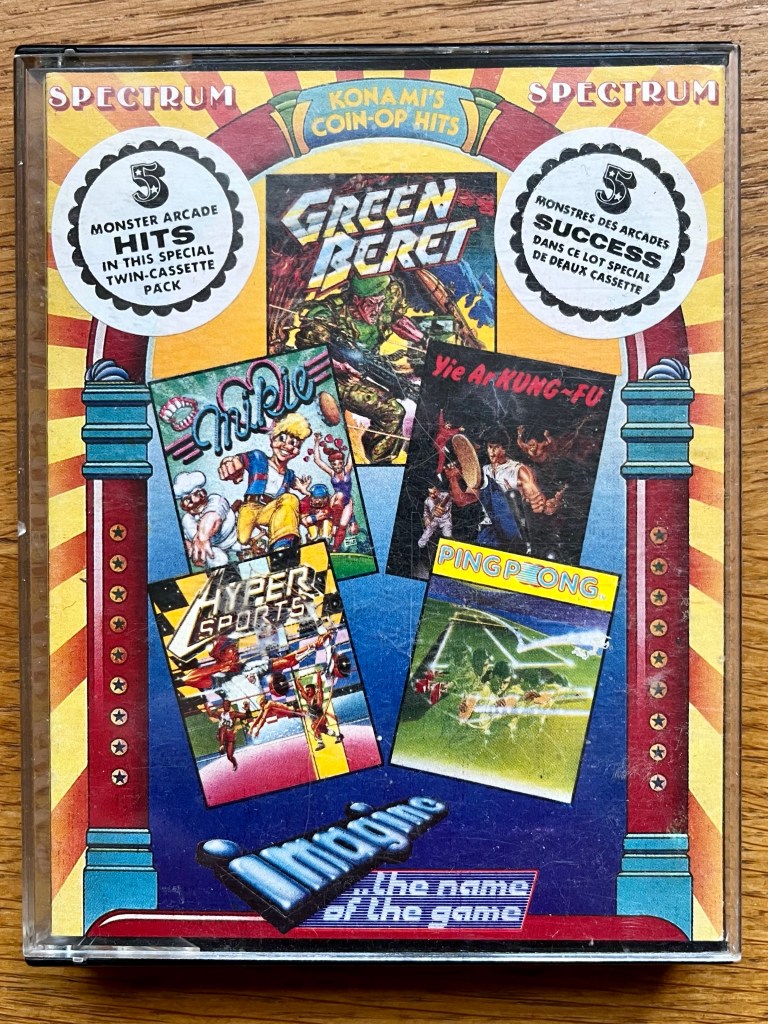
The January 1987 (but in reality December 1986) issue of Computer & Video Games magazine was where we first came across Konami’s Coin-Op hits, with Green Beret in particular leaping out in full-colour opposite a couple of very dour-looking black and white reviews for the wonderful BMX Simulator and Yie Ar Kung-Fu II – not to be confused with Shao-Lin’s Road, “the smash hit follow-up to Yie Ar Kung-Fu” being advertised elsewhere in the same issue! Anyway, it came on cassette for £9.95 or disk for £14.95 and featured three, four or five games depending on which system you owned! Spectrum, Commodore 64 and Amstrad CPC owners were getting Imagine’s conversions of five Konami arcade machines, including Hyper Sports, Green Beret, Yie Ar Kung-Fu, Mikie and Ping-Pong – and in fairness to Ocean’s “Greatest Hits” I didn’t know anything about the last two of those at the time either!

Over on the BBC, you were getting four of them, with Ping-Pong missing because I guess it had never had a standalone release on there the year previously, when it came out elsewhere. Did get a Famicom Disk System version though, which I really should have a go on… Anyway, amazingly, considering both the lateness in its lifetime and how much you could cram into 16K of memory, not to mention other technical limitations, the Commodore 16 also got a release! This time it was missing Mikie, but while they’re not exactly arcade perfect by any means, the rest are all recognisable, and I’ve always thought Yie Ar Kung-Fu on there (pictured above) was an absolute miracle! Not sure about Green Beret but I think this was the only place you could play Hyper Sports and Ping-Pong on there, and I also think there might have been a further German release without Green Beret because it was banned there, though I’m not sure whether it was also excluded from other versions for that reason too. Probably, if it got a release at all, but there’s definitely no German flag on my cassette box.
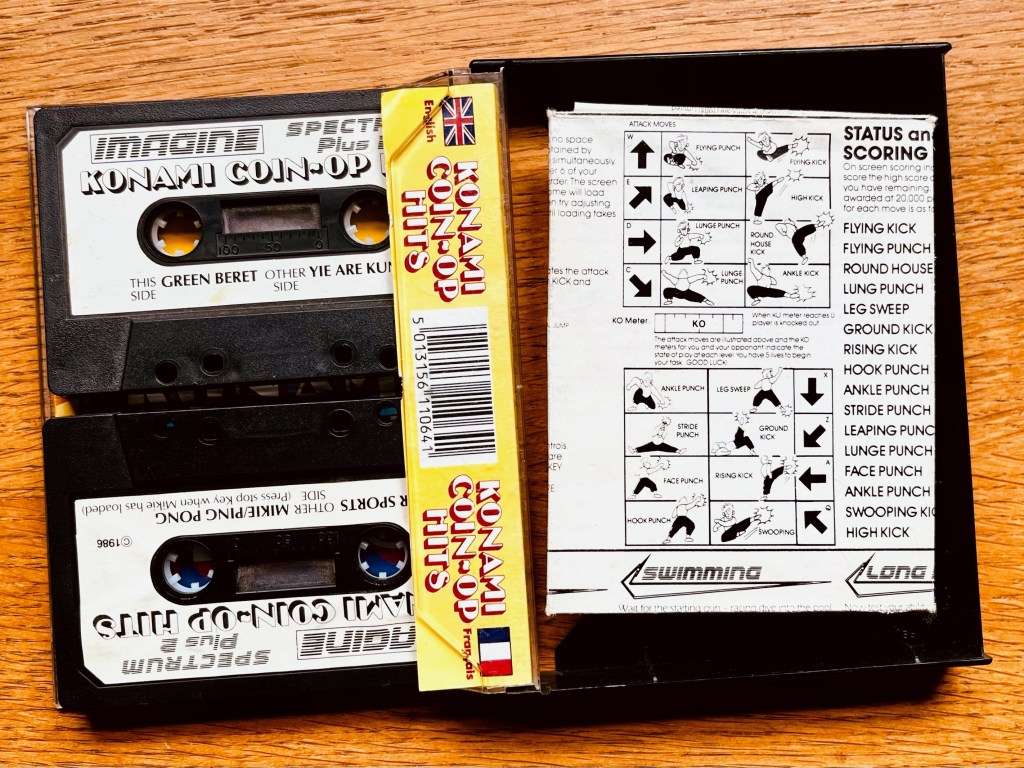
Speaking of which, the Spectrum version came across two cassettes, with Green Beret and Yie Ar Kung-Fu (or Yie Are Kung Fu if you go by the label) on one and Hyper Sports, Mikie and Ping-Pong on the other, so if you’re playing along with me you’ll want to press stop when Mikie has loaded! Both cassettes come in one of those big, double-size boxes, although it’s a very snug fit because the instruction manual shoved in behind them is a beast! It’s actually a collection of what looks like most – if not all – of the full-size original inlays for each release, stacked on top of each other like a fold-out poster, with English on one side and French on the other. Lucky the German one was banned because I’m not sure where it would have gone otherwise, especially with all their sentence-long words! And with that, I reckon we can now take a look at the games. I’m planning a couple of paragraphs on each in turn, starting with a bit of background and story, then we can have a mini-review of the Spectrum versions included here. And while I’ll be using original hardware, for quality purposes and also convenience, I’ll grab any screenshots you see using emulation. We’ll also go in the order the games come on the two cassettes, so let’s begin with Green Beret!

Green Beret (also known as Rush’n Attack) is a port of the run and gun arcade game from 1985, where you need to infiltrate four stages of a Soviet military installation to free POWs from the firing squad. It starts out in a base full of trucks carrying missiles, then you move to a harbour, then across a bridge, and finally the prison camp itself. Each one is swarming with a variety of enemies, from regular goons to ones on jetpacks, manning mortar guns, carrying flamethrowers and even unleashing the dogs on you. You begin with a combat knife but by killing certain enemies can pick up grenades, RPGs or that flamethrower, all of which have very limited use and are best saved for the end of level bosses (of sorts). There’s a bit of verticality where scenery allows for it, and you can jump and lie down, which is a great way of avoiding bullets but you really don’t want to hang around to avoid too much company!

The Spectrum version, which first released only a few months before this compilation and topped the home computer charts that summer, must rank alongside the likes of Operation Wolf and Enduro Racer as one of the great conversions on there or on any 8-bit system. While not quite as spectacular as either of those though, the gameplay is as authentic as you could hope for, and there’s certainly no punches pulled when it comes to the original’s difficulty either – this thing might only have four levels but good luck getting much beyond halfway! It controls really nice though, which it needs to when you’re trying to time a jump over a landmine in a tiny gap between a swarm of enemies! Everything moves well too, with detailed monochrome sprites on sparsely coloured but impressively bold backgrounds. The sound is as you’d expect, with crunchy white noises and simple beeps that just about do a job, although the siren between levels is as punishing as the game itself. Which is a great way to start any compilation!
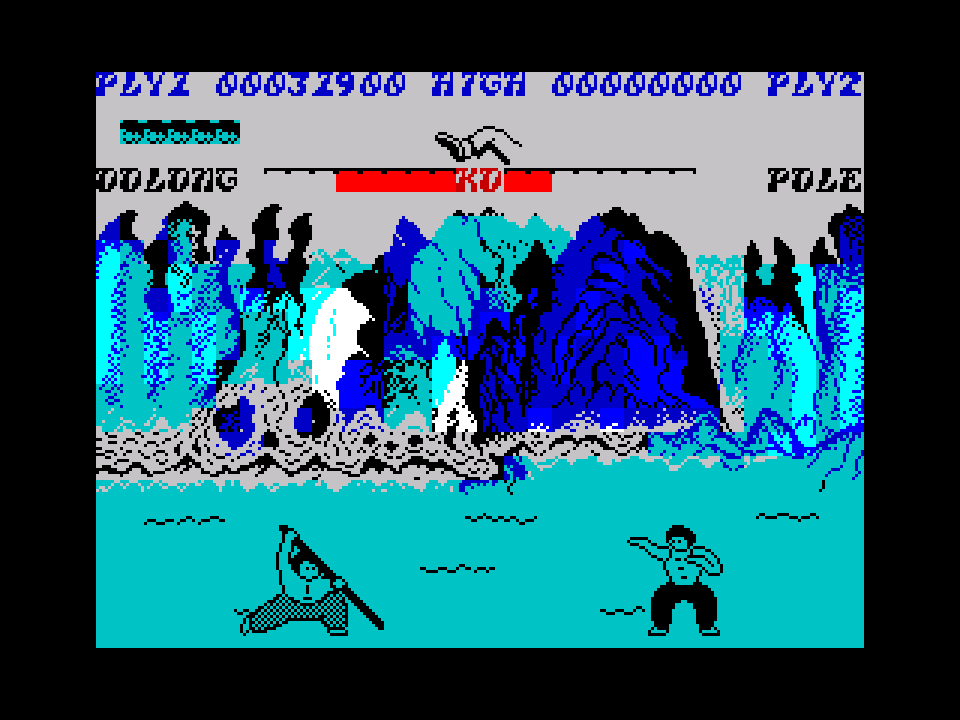
Yie Ar Kung-Fu is on the other side of the cassette, a Bruce Lee-inspired one-on-one fighter that, together with Karate Champ, created the template for the fighting genre – in this case, introducing multiple characters, and swapping realism for a wilder move-set and a faster pace. It arrived in Japanese arcades in 1984 then everywhere else a year later, which is when the home computer versions also started to appear. These varied in how many of the eleven original opponents you fought in your bid to become grand-master were included, but on the Spectrum we got nine of them, each with their own unique style, usually based on their size or the weapons they use, such as throwing stars, swords and nunchuks. The original move-set is pretty much intact though, controlled on the eight joystick directions with or without fire pressed, which gives you no less than sixteen different attacks, each of which score differently depending on difficulty to land.

The original arcade game was very much a game of cat and mouse, demanding patience as you hit and run and wait to do it again, as well as an increasing appreciation of both what context makes your own attacks successful and also the strengths and weaknesses (and they all had one!) of your current opponent. The Spectrum version is far less nuanced than that, and far less of a challenge as a result – I’d not played it for years until I came back to it recently, and I looped all the characters on my first go. That said, I do still play a fair bit of the arcade game so that could be why. It’s a decent version all the same though, with combat demanding precision, which you can easily focus on because once you get your head around the controls, they’re very intuitive… Will always amaze me what you could get out of a single joystick button when you had no choice! The look of the original is really well replicated too, with monochrome but familiar sprites and just enough animation frames for you not to notice any different, as well as colourful renditions of the original’s backdrops behind them. The 128K version does a great job on sound too, especially that iconic theme tune! Overall, on the easy side but it’s serious fun while it lasts.

Second cassette now, and that begins with Hyper Sports, which I’ve already mentioned was the sequel to Track & Field, which interestingly didn’t get a Spectrum port until 1988 when it was released for the first time on the Game, Set and Match compilation. And it stank big time! Anyway, Hyper Sports arrived in time to get an official 1984 Summer Olympics license in Japan (only) and featured seven events that mixed button-mashing and timing, meaning your poor fingers generally got a break between beatings! Plenty of variety too, with swimming, skeet-shooting, long horse gymnastics, archery, triple jump, weight lifting and pole vault, with the latter being the only one that didn’t make it to the Spectrum when it got there in 1985. Each event came with a qualifying time or score, depending on its mechanics, and apart from swimming, you’d get three goes at each one to make the cut for the next. And wherever you’re playing, some are going to take a lot more perseverance than others to be able to do that!

When I mentioned Green Beret being one of the great Spectrum arcade conversions earlier, we need to add Hyper Sports to that list too! As the game that sold us the compilation, we couldn’t have been happier with it, and while there wasn’t a single game on here we didn’t play all the time, we absolutely played this one to death, looping all the events multiple times until our hands (or joystick) just couldn’t keep up with the weightlifting anymore, and being able to get a perfect score on the skeet-shooting literally with our eyes closed and playing by sound alone! And when I eventually got to the arcade version – which I still also play regularly – that translated right back again, which I think is a pretty good indication of how good the Spectrum port was! It takes a few hilarious, seventies pornstar-like liberties with the presentation but that’s all good too, with every event perfectly recognisable and controlling like the joystick-killer it needed to! Proper all-time favourite right here that I’ll do a proper deep-dive into sometime as well.

Until today, apart from a couple of screenshots in the January 1985 issue of Computer & Video Games magazine, I’d never even seen the 1984 arcade version of Mikie in action, let alone played it! Which is strange considering how much I grew to enjoy the Spectrum version. Also strange is how it began life in Japan, where, after initial field testing, it was pulled because of its portrayal of violence in schools, which was a controversial topic there at the time, and would later be revised for that market so the game took place in a workplace instead. A further revision, High School Graffiti Mikie, then reinstated the original setting but all physical contact was replaced by a paralysing shout instead. It’s a strange game regardless! You need to collect hearts from around the school by either shoving people out of the way or shouting at them, while avoiding teachers, chefs, maniac janitors and dancing girls (with their deadly kisses). Collect all the hearts in each location, which include a classroom, locker room, gym, canteen and playground, and you’ll spell out a message to your girlfriend so you can exit to the next one before finally meeting up with her, when it starts again but harder.

There was another quick turnaround on the ports for Mikie, with the Spectrum version arriving in Europe in 1985, not very far behind the arcade machine. And it was the most Spectrum port you could imagine, with some great-looking (if stiffly animated), totally black sprites on some really garish backgrounds, colour-clash be damned, particularly when three of your pursuers end up on top of each other as they close in for the kill, and it’s just 8-bit chaos! The sound is equally chaotic and garish, if that’s a thing, with some real screechy stuff being thrown around, although the fully licensed Hard Days Night is as good as The Beatles version to my ears! I really enjoy the game too, playing out like Pac-Man meets Skool Daze, and once you’ve got a handle on some particularly aggressive enemy AI (especially in the space-constrained hallway that connects each level) it becomes an even more fun game of cat and mouse than Yie Ar Kung-Fu was. However, like that one, play enough and the first loop is maybe on the easy side, and I did soon find myself remembering how it went and finishing it. Got nowhere on the second one though! If I was ever asked for a hidden gem on the Spectrum, it’s Mikie. Fantastic game and a great example of how discovery has always been as big a deal to me with compilations as value for money and the quality of the games I do know.

With the tape duly stopped once Mikie was loaded, we can now move on to the game it shares a side with on the second cassette, and finish with Ping-Pong. No strangeness this time around – it’s a table-tennis simulation from 1985 for one or two players with five skill levels, and while it’s certainly true to say it was the first of its kind (assuming we’re not classing Pong as a simulation), I’d also venture to say it hasn’t been surpassed for gameplay at least since, even if I’m not really an expert! It’s a regular first to eleven setup, where you need to be leading by at least two points to win, and it’s all viewed in a partially top-down isometric view from one end of the table, with disembodied bats “floating” on either side of the net. Controls are super-simple but with plenty of nuance once you get a feel for the ball’s distance as you play them. You’ll be pressing down to serve, which tosses the ball above the bat, then you’ve got a choice of a driving shot or a slower cut shot to send it over the net, which are left and right respectively. When there’s an opportunity to smash the ball, that’s up, and then you can switch between forehand and backhand with a press of the button. I’ve never seen the arcade machine in the wild but remember the Spectrum version scoring big in the magazines when it first arrived on there earlier in 1986, so for one last time, let’s find out why…

If a couple of the games on here are a bit on the easy side, there’s no such worries about finishing this game after a few goes! It’s one of those cases where my brother and me used to have some monumental matches at the highest skill level, but going back to it now for probably the first time since then, I couldn’t get a serve over the net half the time and I was losing without getting a point when I could, and it was generally miserable until the controls clicked again, then quickly became second nature, and I was soon winning at the first couple of levels at least. Like Mikie, it’s another wonderfully Spectrum port, although having reminded myself of how the arcade game looks again just now, it’s surprisingly accurate, right down to the blue monochrome audience! Their very binary excitement between points adds more than enough life to what’s otherwise a sparse but equally accurate rendition of a pair of smoothly animated bats on a cleverly proportioned 3D table though. There is sound too, which in-game is mostly functional and occasionally grating, but the title screen tune is among the best on the Spectrum. It’s awesome! It’s the flow of the game, combined with very decent ball physics, where Ping-Pong really shines though! Find your right skill level, get a few games in to establish what you can do and where with each swing type, and you’ll have a great time going back and forth looking for that point-winning gap! In fact, as much as I’ve had a blast going through everything here again, this is the one I’ve had the best time with again, and I’m just left wondering why it’s taken so long to go back to!

Apart from Hyper Sports, as much as I’ve always enjoyed them, I wouldn’t really say that any of rest are all-time favourites, but if you asked me what my all-time favourite compilation is then I’d have no hesitation! This was always more than the sum of its parts to me, with five perfectly positioned games just about perfectly converted and definitely perfectly suited to the Spectrum. And while sooner or later there’d be compilations full of dozens of actual arcade titles, sometimes less is more, and back at the end of 1986 you couldn’t ask for more than the miracle of a decent version of an arcade game to play in your own home!
 Retro Arcadia