
Back at the start of 2022, I took a very favourable look at Game Boy: The Box Art Collection from Bitmap Books. The thing’s still a beast too, with 372 hardback pages covering the box art from almost as many original Game Boy games! With so many to choose from, to give a flavour of what was inside I decided to pick a few examples, including a couple of old favourites of mine, as well as the one that jumped out of the pages at me the most, something I don’t know at all and finally something I’ve never played before but would like to as a result of reading the book. And you can read the review to find out what they all were, but the last of them was Nigel Mansell’s World Championship Racing, and the plan was to get into a bit of a deep-dive here once I’d got around to playing it…
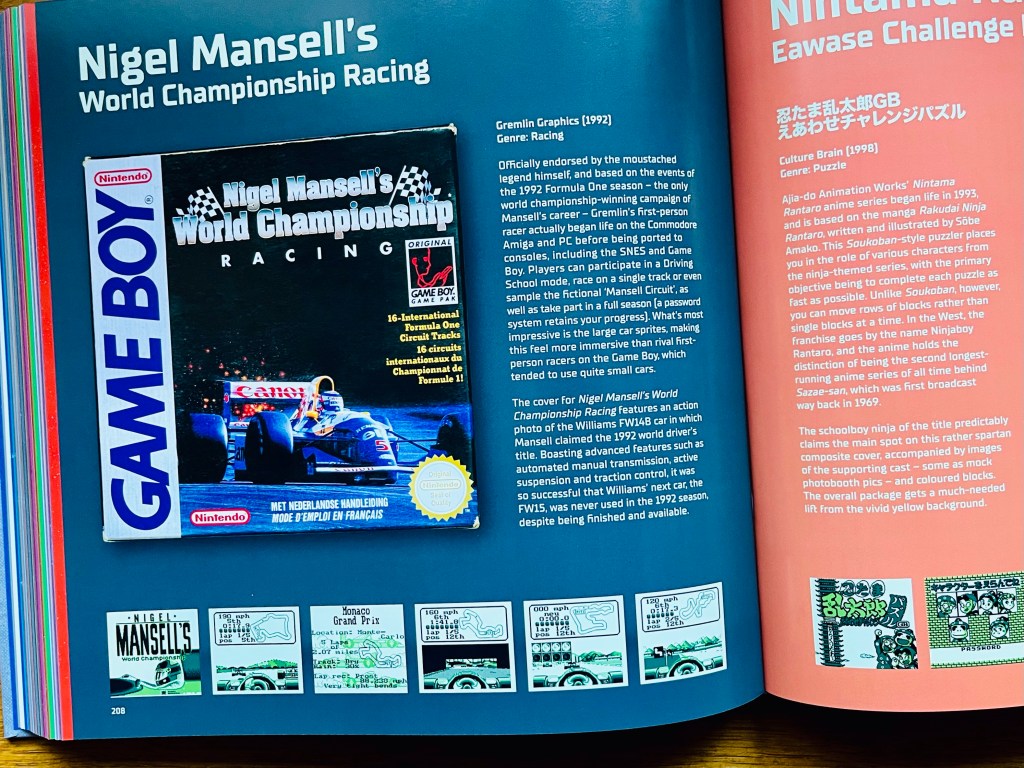
The main attraction of that game was actually the handful of screenshots included in the book, rather than its box art or any of the reading material that accompanied it – it looked almost as good as the SNES version I had played before! It came from Gremlin Graphics in 1992, and was released in one form or another on everything else too. On the Game Boy version specifically though, you can take part in a driving school, race a single track, have the maestro perform a track in Mansell Circuit or do a password-saved full season, which is what I eventually did do. However, despite that stunning cockpit view, and the scale of everything, and more realism than I’d ever seen elsewhere on the Game Boy, I just didn’t really click with it! Plays fine but if I’m going to write thousands of words about a game then it needs a bit more than that… So what you’re reading now is falling back on the game I didn’t know at all instead!

I do have a bit of an ulterior motive though… Back in August 2023, I succumbed to a bit of an extravagance while I was on holiday in Cornwall, although I’ve been after a replacement Game Boy since my launch day console died back in 2017! The contrast wheel is a bit temperamental and there are a couple of specks of dust under the screen glass but everything else is working perfectly and the unit is still in good cosmetic shape overall. And as much as I immediately had a blast playing through my old cartridges again too, I couldn’t resist getting a couple more to celebrate being back in business with it again! After recently discovering the Game Boy port of geometry-based action-puzzler Qix solved all the colourblindness issues that had stopped me falling in love with the arcade original back in 1981 (and sporadically ever since), I definitely needed my own copy of that! And obviously I had a gander at the eBay seller’s other items while I was there, which is where I also came across Revenge of the ‘Gator at a very nice price…

Having been a lover of the pinball game all the way back to Pinball Wizard on the VIC-20, it’s no great surprise that of all the games in the Game Boy book that were new to me, it was a decent one in that genre that jumped out! And as we were talking box art in particular, no surprise either it was Pinball: 66 Piki no Wani Daikoushin, to use its original Japanese name also used in the book, by the Kirby people at HAL Laboratory in 1989. What a cover! As you flick through the book, it’s immediately noticeable that the Japanese ones are generally more colourful, and this one has a whole rainbow backing up the cute alligators prowling the tropical pinball table! We’ll switch to its full Western name, Pinball: Revenge of the ‘Gator, or just plain old Revenge of the ‘Gator from now onwards, but given the choice I’d stick with the Japanese box art because the Western release’s was decidedly mundane in comparison!

It’s by no means terrible though, and that’s where I’m going to head to to get the rundown on what we’re looking at here from the back of the box… “’Gators galore! Eight scrolling screens – secret entrances to bonus areas – hungry ‘Gators that unexpectedly swallow your ball and move it to a new screen – all in a package you can slip into a pocket and take with you anywhere. You’d need a pinball machine the size of the Everglades to hold all this excitement! King of the Bayou or ‘Gator bait – this pinball game’s got all the options!” Certainly looks like it from the exquisite screenshots we saw in the box art book from earlier, even if the definition of “scrolling” here, as well as the number of screens, is debatable, but maybe I’ll have a recount of the seven I think are there later! At this point I’d possibly look to the instructions for confirmation, but mine didn’t come with any (understandable given the total haul cost of £8 including postage) and there’s a distinct lack of any scanned copies on the internet. I reckon I’ve played enough now to talk you through it though, so let’s take a look at the game itself.

I’d forgotten what a nightmare it is getting decent photos of a game in action on actual Game Boy hardware, so I’ll quickly mention any further screenshots here are coming from emulation, but any gameplay described is on the original console! Anyway, Revenge of the ‘Gator is very much an evolution of what we’d seen from HAL in their Pinball on the NES back in 1984, which itself was based on Nintendo Game & Watch Pinball from a year before. As such, it’s not exactly fully-featured as we’d know a pinball game now, with A to pull and release the plunger to fire the ball into play, then either A or B for the right flipper and any direction for the left. The lack of tilt was initially a bit of a disappointment to me, especially when the Select button has absolutely nothing better to do, but the game was built with (or without) this in mind, and you soon get used to it.
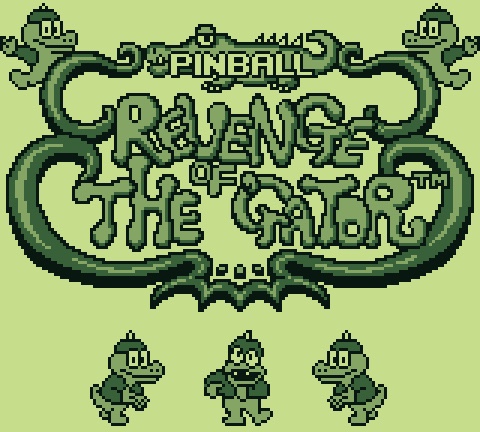
Before we take the plunge, I also have to mention the title screen, playing a jaunty chip tune behind a very reptilian take on the game’s logo, but if you leave it long enough you’ll get a trio of alligators appearing at the bottom of the screen and doing a fully animated old-time music hall dance routine while another pair wave down from the top corners. Really nice touch! The music throughout is really nice too, and while not especially complex or layered, either here or in-game, the melodies are memorable enough and set the mood perfectly, especially with the density of chirps and whistles and beeps and boings appearing non-stop over the top of them! Back to the title screen, and pressing start advances us to the game menu, and we can choose to play single or two player, where you take turns passing a single Game Boy back and forth when you lose a ball. We’ve also got two match play modes, one for beginners and the other for experts, which both requires two players and two Game Boys linked together. I haven’t been able to try this but it sounds like you can see the other player’s side of the screen, where you need to hit targets to reduce their score to zero before hitting the ‘gator and crossbones to win. Seems to be very well fleshed out, with various power-ups and power plays to find and unlock, but I’m afraid we’re stuck with the single player game for now!

Whacking the ball with your plunger is going to fire it into the second of four main gameplay screens, with one below and two above… Actually, I’ve just worked out where that mysterious eighth screen from the back of the box came from – if the ball gets dropped between the flippers on the bottom one, there’s an alligator waiting to eat it on the screen below, which, together with the three bonus screens, would make eight. Sneaky regardless, but not as sneaky as calling them scrolling screens because, as alluded to earlier, they don’t scroll at all! It’s all flip-screen, which is absolutely adequate, and apart from the one at the top, each has at least one way to progress upwards to the next, while you can fall down via gulleys as well as through the flippers. In both cases it’s possible to stop your descent using or unlocking savers, which can take a certain number of hits by the ball to disappear or will do so after a certain period of time.
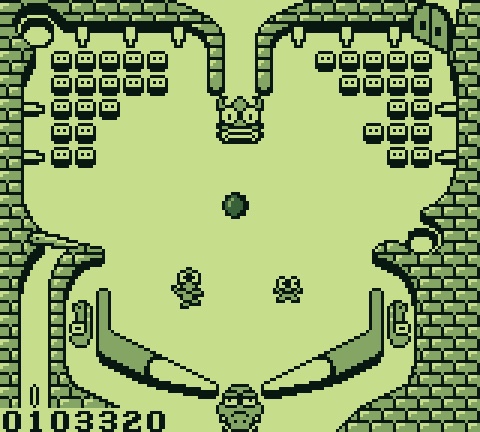
There’s not really any control over the plunger even if it’s not quite binary – release too soon and it won’t make it over the wall and into the play area, or pull it back further (or fully) and it will be carried into play with the same initial velocity regardless. Unlike the very floaty ball physics of something like Pinball Dreams on the Game Boy (or anywhere else, for that matter), the ball here has an excellent and surprisingly realistic weight to it, feeling as heavy as it’s dark metallic-effect “colouring” makes it look. The visual presentation overall is top-notch, similarly detailed beyond normal expectations for a pinball game on a Game Boy everywhere you look, which more than makes up for the plain backgrounds, which probably couldn’t be any other way given how much stuff is on top of some of them! The table is given structure by very textured, almost organic brickwork, which I guess represents a sewer because that’s where alligators definitely live, contrasting with patterned-tiles in the bonus areas, both housing the menagerie of comically animated alligators and other Hungry Hippos-type critters, creating a living theme that’s full of character that also extends to many of the various bumpers and targets, while others are more traditional but also full of movement or light. There’s a really cool fruit machine display on one of the screens too, but coolest of all is the big-eyed, alarmingly jolly alligator waiting at the very bottom screen for a ball to eat that almost makes your eventual demise less painful! So many different alligators too, each with their own personality, and given the distinct lack of colour afforded by the Game Boy’s monochrome display, the devs have done a remarkable job with shading to almost make you forget that’s the case!
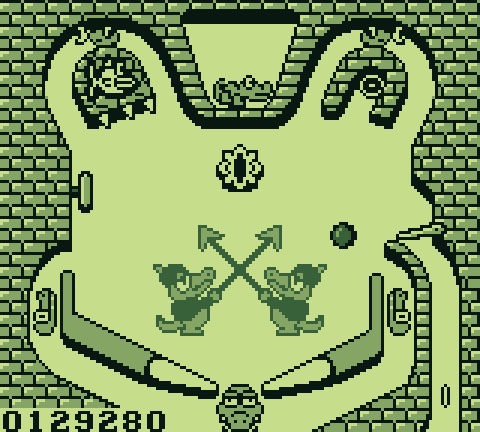
As good as it looks, almost all of that stuff also serves a purpose, with tons of features to sink your teeth into, and none more so than on that screen the ball first emerges into, which would have been a fully-fledged pinball game in its own right not that long before! You’ve got lanes along the top that will introduce a saver to stop you falling if you travel through all of them to light the hearts in each, and there’s that fruit machine that spins if you get behind the alligator nearby, rewarding you with multipliers and savers, or, if your unlucky, taking multipliers away. There’s also the big bumper in the middle that gives even more points if you can make the lights around it turn on, and finally there’s three targets on the wall you need to hit to open the gate to the screen above. This one is almost like a game of Breakout, where if you clear all the blocks on one side you’ll enter a bonus screen, and on the other you can open the gate go up again. There’s also a puzzle here involving three alligators getting big or small as you hit them, revealing or removing various savers. Reach the top screen and there’s loads of opportunities for points, but the centrepiece is an alligator right at the top that you have to feed enough fish to (while being hassled by two alligator angels) to make it grow, when you then need to hit it before it starts moving to the bottom and away through the flippers to get an extra life.
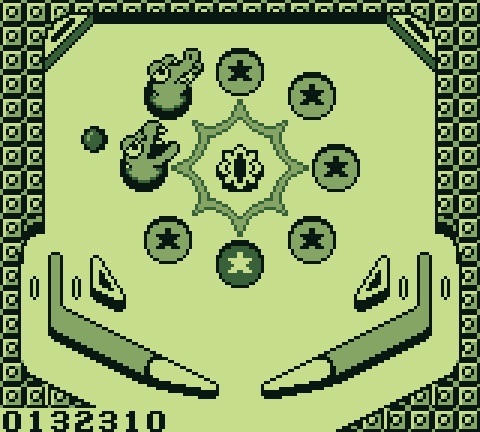
While those three screens are where we want to be, there’s one more at the bottom that isn’t just about trying to escape upwards through one of the three opening and closing animal mouths in the middle, but you can also access a bonus screen from another or return to the plunger from the third. There’s a load of other smaller gators to interact with here too, as well as your impending doom between those flippers, but let me quickly mention the three bonus screens. The first one looks a bit like Space Invaders but the only thing moving is the alligator patrolling above its eggs, which you need to hit with the ball to make a hole big enough for it to crawl through so you can then try and hit that for big points. The second one has five eggs on it that gradually crack as you hit them to reveal a baby alligator with wings, which you also want to hit for points when they leave the egg. The third is a bit like Whac-A-Mole, except you have to hit one of eight targets to make an alligator’s head appear out of it, and if you can hit it before it disappears again, it will disappear for good. Hit all of them and it’s huge bonus time, although this one is definitely the hardest to complete, as well as the hardest to reach.

As relatively simple as the table might be, I was really blown away by the depth of the pinball on offer here, and despite possibly identifying that eighth screen from the back of the box after all, I’m still not sure I’ve seen all of what’s on offer, but I think I’ve seen enough to say it’s an absolute shining light of the genre on any handheld machine, let alone just the Game Boy, where it’s now also a shining light in my cartridge collection! While it might now have peaked, HAL’s pinball journey on the Game Boy didn’t end there though, with Kirby’s Pinball Land following in 1993, but while the lineage is clear, I don’t think there’s as much to the visuals or the gameplay. And the same is true of 1999’s Pokémon Pinball for the Game Boy Color, which shared the same engine, but what it gained in colour (or color), I think it lost with even fewer pinball features and floatier ball physics; that said, I go back with that game and it’s fast and fun all the same! Back to Pinball: Revenge of the ‘Gator though, things might have evolved almost unrecognisably since then, with the likes of Demon’s Tilt or the Pinball FX games delivering both stunning realism and jaw dropping presentation all at once, but there’s always a place for timeless, arcade-like simplicity alongside them, and that’s exactly what this new old cartridge in this new old machine will hopefully be giving me for a long time to come.
 Retro Arcadia