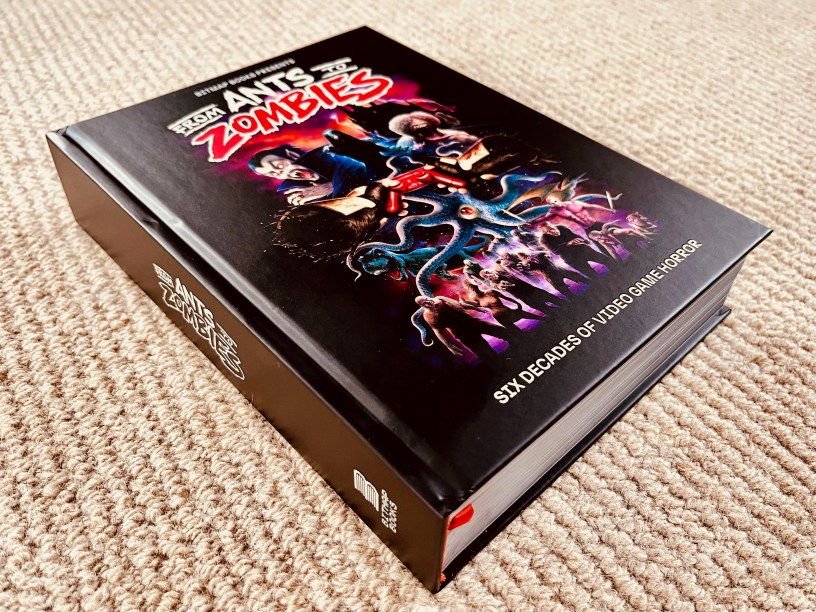
I’ve amassed a lot of Bitmap Books’ retro gaming stuff over the last few years – extensive visual compendiums and visual histories, lavish cover art collections, enormous reference guides about beat ‘em ups and point-and-clicks and NeoGeos, and not forgetting the fascinating The Games That Weren’t, the review of which is, to this day, the most-read thing I’ve ever written here! That’s certainly not why I review them though, when I choose to do so; I just have a passion for books like I have a passion for retro games and systems, and writing about the two is something I enjoy about all else… Well, except when you throw my passion for all things horror into the mix too!
As such, I’ve been looking forward to From Ants to Zombies: Six Decades of Video Game Horror since it was announced a couple of months ago, placing my order the second the notification email hit my inbox – appropriately – on October 31st 2023. And yes, just for transparency, when I review something I always mention when I’ve been given a copy for the purpose, but in this case I was more than happy to spend the £32.49 myself. And while that is a premium price, as always with Bitmap Books, the first thing I’ll tell you here is that you’re getting another premium product with this one, which I’ll come back to in a sec but first I should tell you what that product is! From Ants to Zombies is a showcase for horror in gaming, spanning over seventy hardware platforms, from the ZX81 to Xbox Series X, and six decades, from the 1970s to the 2020s, and I’ll tell you something else – I’ve been like a pig in muck since the second its premium packaging to match what’s inside landed on my doorstep!
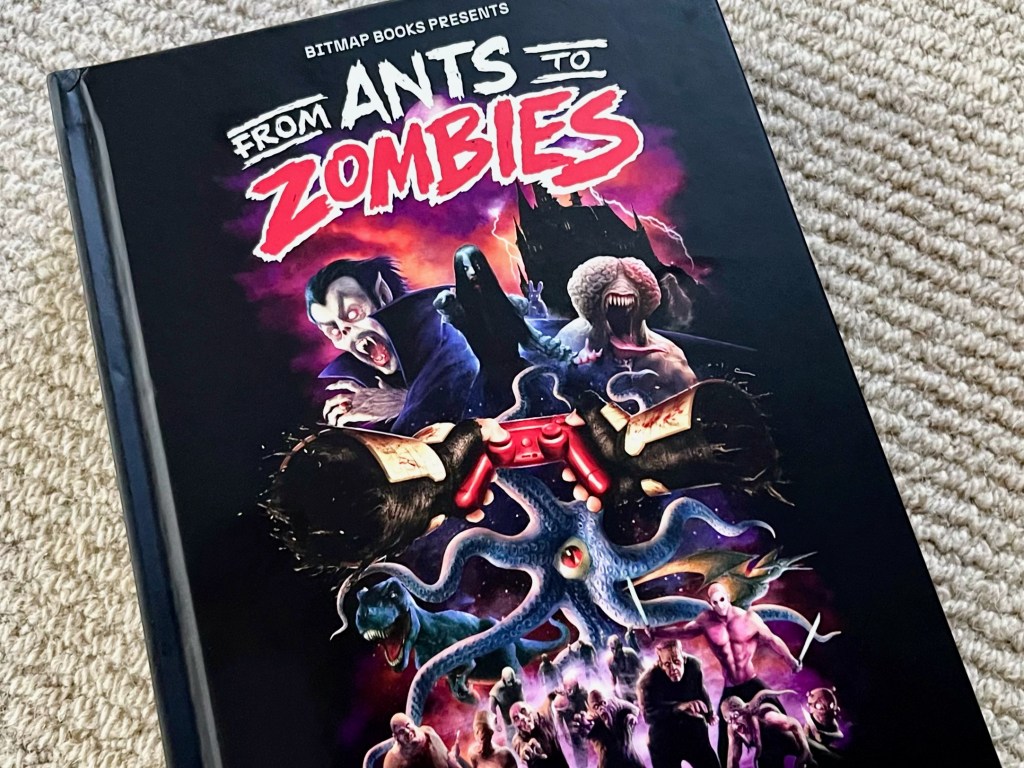
Landed with quite the thud too… This thing is a beast, weighing in at 2.5kg, with 664 pages nestled inside its hardback cover, and sewn binding so it goes the distance and opens pretty flat on a table too, for when your arms and legs have given up the (literal) ghost holding it! (You do also get a convenient PDF version for on the move reading too). Edge-to-edge lithographic printing gets the most out of its beautifully illustrated pages, which in turn presents the games covered in the best possible light, and speaking of light, I love the glow-in-the-dark logo and text on the very b-movie cover almost as much as I appreciate the coloured bookmark ribbon attached to the book! Inside, you’ve got a preface by the author, Alexander Chatziioannou, and foreword by author and journalist Joel Couture, followed by an extensive but easy-to-read introduction covering the concepts of horror, horror in gaming and the history of gaming as a horror medium, and then we’re into the main event – thirteen thematically-divided chapters covering more than 130 horror titles over a variety of gaming genres, from rail shooters to open-world RPGs, and also over a number of horror genres, from haunted house to psychological dread to just plain nasty…
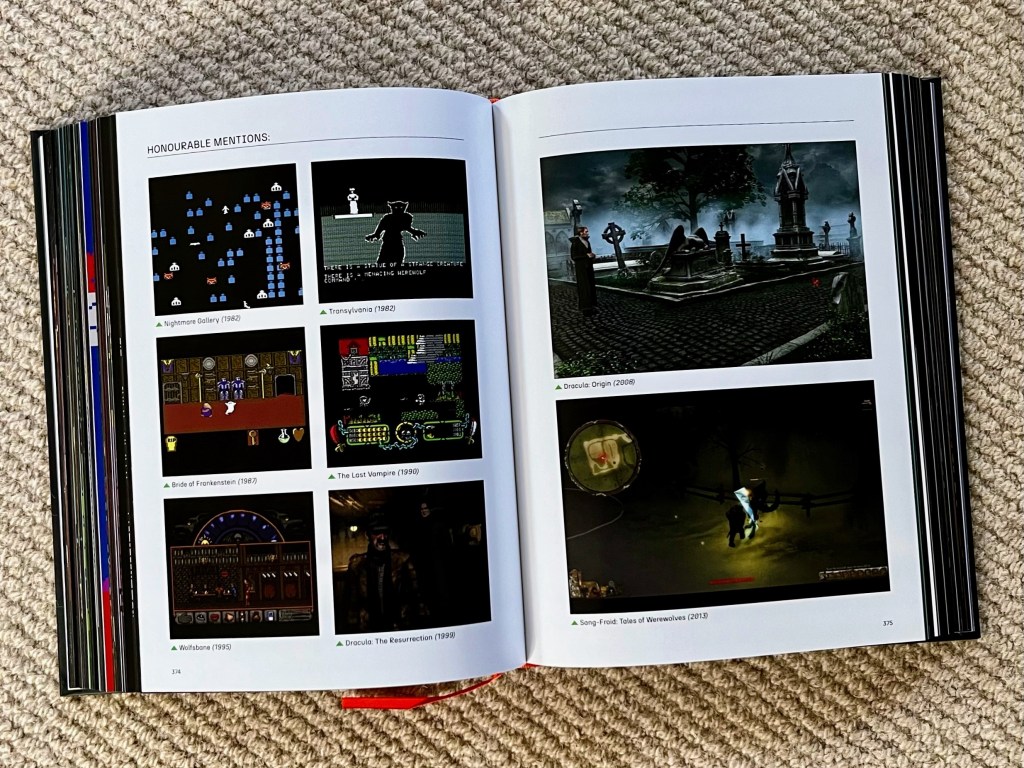
There’s space horror, dark forests, wayward children, creepy mansions, relentless pursuers, terrors of the abyss and loads more besides, as well as the specific game types, such as survival horror, text adventures, interactive movies and so on. Inside each you’ll then find in-depth commentary and analysis on an enthusiastically curated selection of pioneers, big-hitters and hidden gems, and the non-linear way it’s all laid out leads to some really nice discussion and inter-connections, making it feel very natural, drawing you into the author’s passion for the subject. As well as that, you’ve also got additional colour from some pioneering horror devs, such as Keiichiro Toyama from Silent Hill and Graeme Devine from The 7th Guest to name just two of many. The thematic rather than chronological organisation does lead to some gaps or lack of coverage of some venerated classics where they can’t be pigeonholed but that’s the price you pay for the diversity here, which the author does explain in detail, but all the same, with all kinds of nods and honourable mentions it’s pretty comprehensive even if it’s not a checklist for everything ever!

Which is a good place to get a flavour of what you’ll find in the book by having a look at a few of the games that do get the big treatment, and as always with these things, I’ll do that by featuring something I’m very familiar with, one I’ve heard of but never played, one I’ve never heard of and one I feel inspired to play as a result of coming across it here. That will then ideally be followed-up with its own deep-dive in the near future, although the last time I did that, with Bitmap Books’ Game Boy: The Box Art Collection, I decided I didn’t fancy writing about the Nigel Mansell game I originally chose after all, and instead went for a Namco compilation that included a baseball game, something I had no clue about but finding out how to play spiralled into a genuine obsession with my new favourite sport ever since!
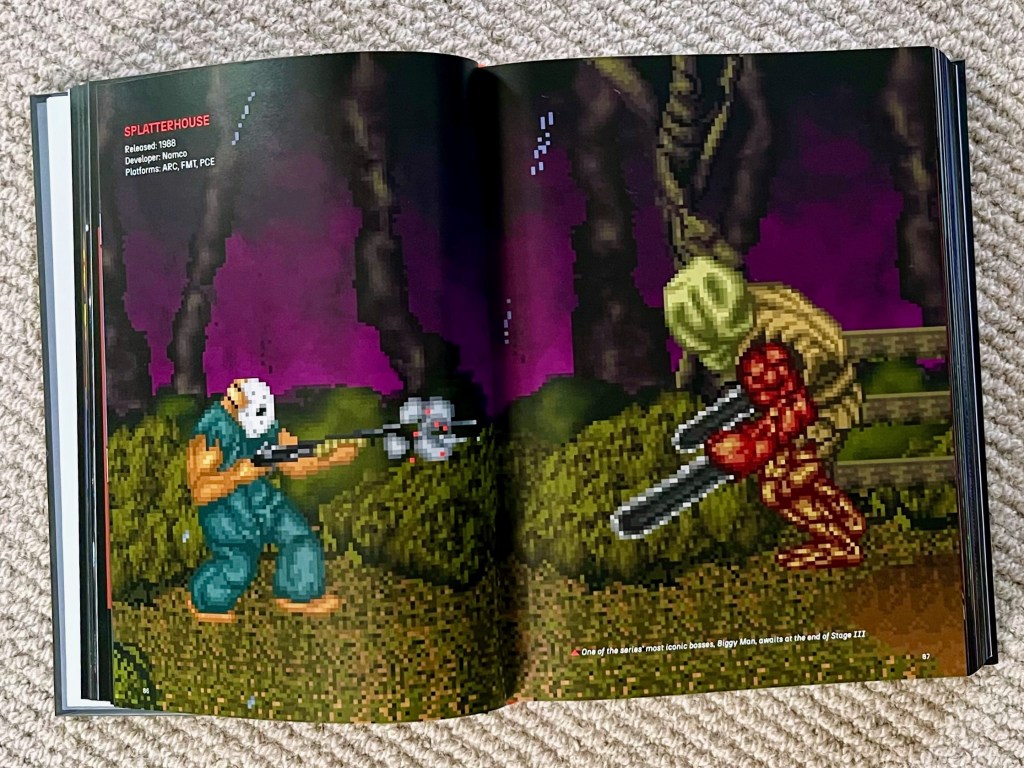
Anyway, if you’re interested in hearing lots more about that unexpected journey, take a look at my recent feature on R.B.I. Baseball on the NES, otherwise we’ll continue here with an old favourite of mine, Splatterhouse, and what a way to share some of that incredible edge-to-edge illustration I mentioned earlier, with this gorgeous image of the iconic dual-chainsaw-wielding third stage boss, Biggy Man! It is, of course, captured from the 1998 side-scrolling, Friday the 13th (among other things)-infused arcade beat ‘em up by Namco, where relatively straightforward gameplay is amplified by the sheer joy of its violence and gruesome settings and enemies, which were all quite the shocker at the time too! It doesn’t get a huge amount of coverage in the book compared to something like the aforementioned The 7th Guest that immediately follows it, but the imagery included tells its own story, with four screenshots highlighting the variety of scary locations, together with one of the great ending screens from any genre of game! And that’s what you’ll get throughout, however deep the coverage for each game, but in particular you’ll want to look out for those big double-page images we started with though, always carefully selected to put you right in the game, and none more so than this one!
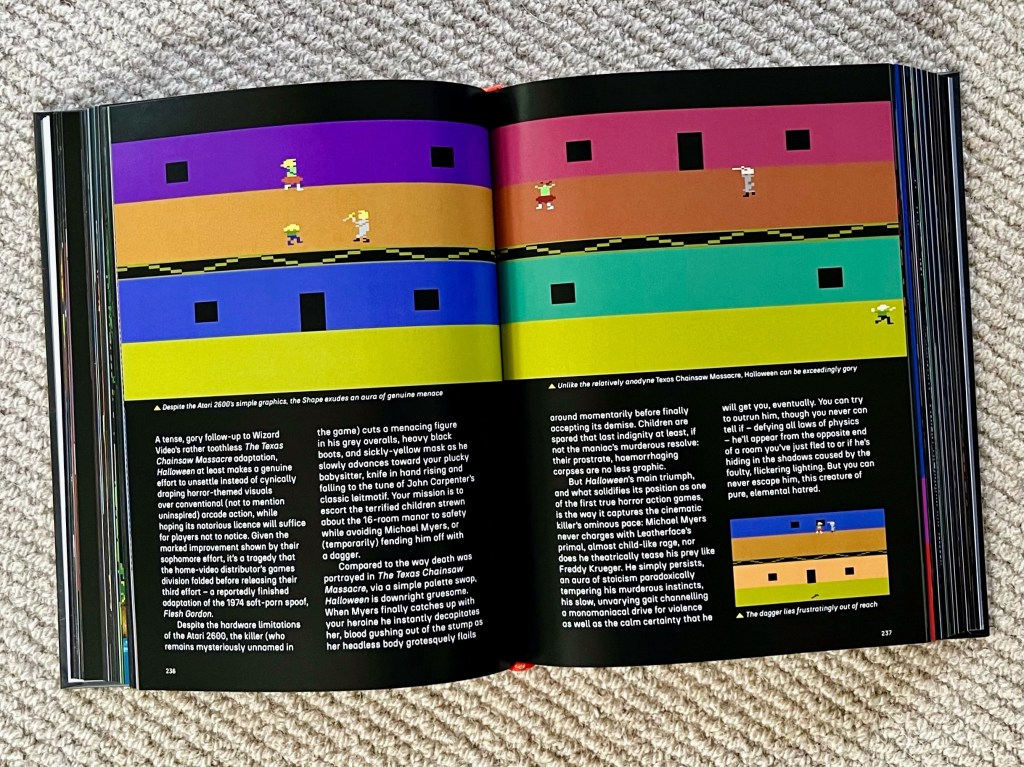
Next up a game I’ve heard of but never played, which is an absolute disgrace coming from a self-confessed mega-fan of both the platform and the movie series it’s based! I’m talking about Halloween for the Atari 2600 by VCC in 1983, and one of things I really enjoyed about this book is how it embraces these really early games (not to mention really early movie licenses!), giving them equal billing with some of the big-budget blockbusters that followed much later, and the way it’s laid out means you never know when you’re going to come across one, although this does sit nicely in similar company in the “Relentless Pursuers” chapter, neatly following the miraculous 3D Monster Maze on ZX81! The bold blocks of colour that make up Haddonfield’s suburbia look great in the plentiful screenshots on black backgrounds here, and something else I really like is that as prehistoric as all that seems today, the writing celebrates these games as they were at the time rather than as old relics reliant on a huge dollop of imagination today. By the way, I’ve made a note to cover this in next year’s Halloween Special (and do check out this year’s from last week as I write, Scooby Doo Mystery on the Sega Genesis, if you haven’t already)!

Right, a game I’ve never heard of now, which was far easier to decide upon than I thought it would be, although not so much down to more or less choice (which I’ll come back to) but because from the very first time I flicked through the book, one image has absolutely enthralled me over anything else I’ve seen in there, and that’s the double-page spread introducing the none-more-PS1 Echo Night by FromSoftware in 1998! The lure of a pretty ghost aside, because it’s a subject I’m mostly really familiar with, and because it’s curated rather than exhaustive, I really wasn’t sure about this book’s potential for discovery, which is something I’ve always looked forward to in Bitmap Books’ books, but I needn’t have worried because if there’s one thing we’ll never run out of, it’s new old games, and it turns out that’s true of the horror ones too! If I’m being generous to myself I probably know about 70% of what’s included here, which I couldn’t be happier about, and while I’m about to cover the game I’ve been most inspired to play by the book, this Titanic-inspired, vaguely-Lovecraftian supernatural mystery sounds like it would also have fitted the bill and won’t be far behind! It’s certainly not Dark Souls either, with what the book eloquently sells as a precursor to the walking simulator, with a bit of back and forth puzzling at a nice measured pace, and a load of ghosts that look like Silent Hill’s more glamourous cousins!
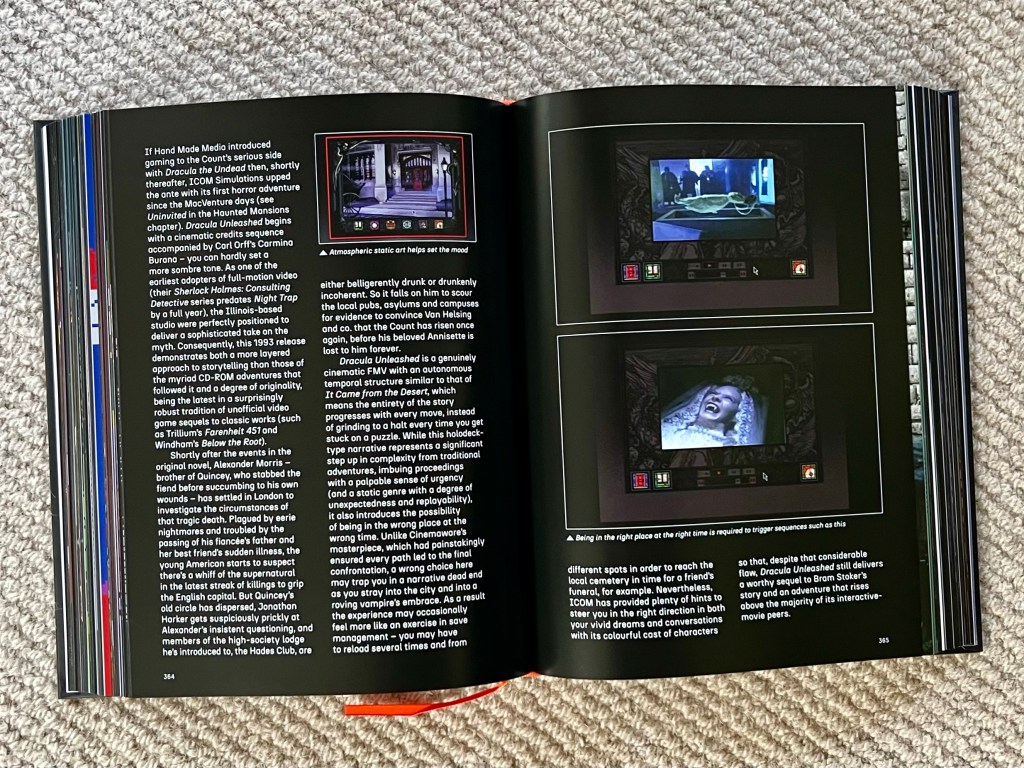
For the last game on our quick taster tour, I’ve gone for Dracula Unleashed as that game I’ve been inspired to play as a result of coming across it here, and I’ve also taken the liberty of having a quick go of the Mega-CD (or Sega-CD) version, just to make sure there’s no repeats of the Nigel Mansell incident! In reality though, I’ve liked the look of this one for a very long time, and while it’s not the book’s primary objective, it’s one of many games – together with Echo Night and Halloween – that I’ve scribbled down on a big list of stuff I want to find out more about now I’ve been given the hint! Like the book itself, I know the non-linear way I’ve approached this review has left a few gaps, and I’m not sure I’ve done justice to other areas, such as some of the modern games or those developer insights I mentioned earlier or how much I loved seeing Ghouls ‘n Ghosts alongside Forbidden Siren in the Dark Forests chapter, but one thing I don’t want to miss out is how well researched (and played) it all is, and by total coincidence this is a really nice example! Full motion video (or FMV) was all the rage when CD-ROMs came along to enable it, but this game upped the ante with not only such a well-known subject, set as it is just after the events of Bram Stoker’s novel, but also its approach to the narrative and how it was delivered, creating one of the first truly cinematic gaming experiences that wasn’t interrupted by your inability to solve a puzzle, for example. And the author does a fantastic job of not only explaining this in the context of what came before and after, but also speaks with authority on the tech that enabled it, as well as how it turned out to play in reality. Which means I’ve got my work cut out if I do end up doing a deep-dive into Dracula Unleashed, so don’t discount another last-minute switch to something simpler like Rampage or Cauldron or even Echo Night instead!
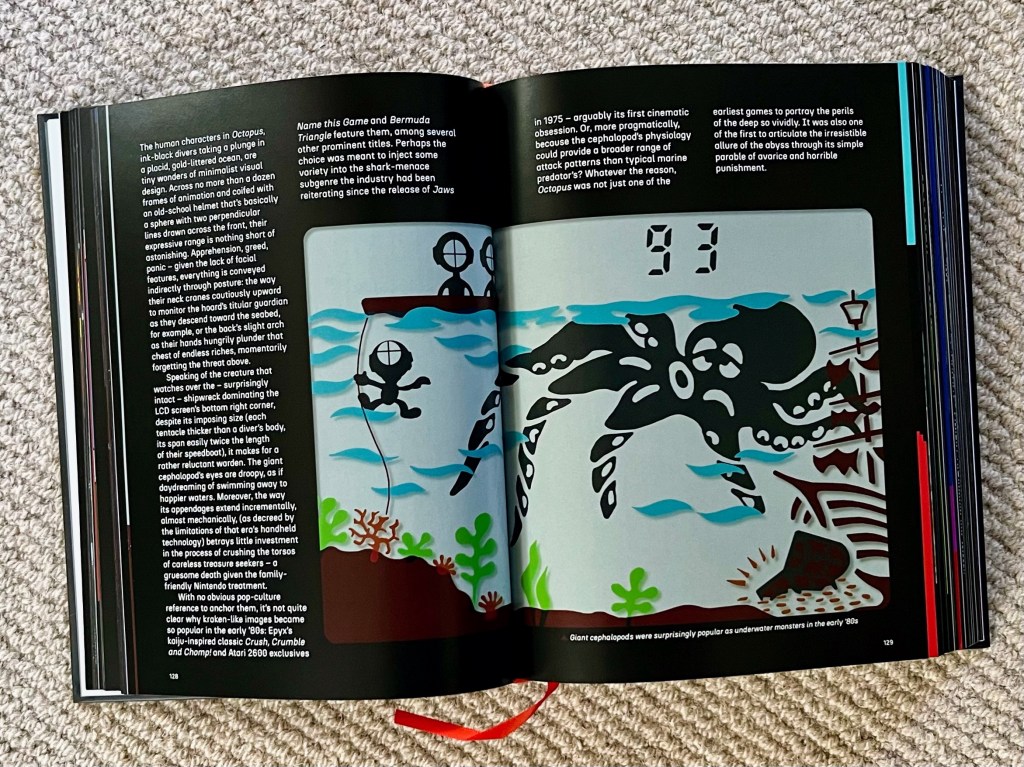
I could go on and on with these but hopefully I’ve given you enough to know what you’re in for! Which reminds me, something I didn’t think about being in for beforehand but so far might have been the biggest thrill I’ve got from this book is an outcome of that diversity the author said he was aiming for right at the outset – I’ve loved coming across stuff I love but wasn’t necessarily expecting here, like arcade fighter Darkstalkers: The Night Warriors, or Scuba Dive on the ZX Spectrum, or the Octopus Nintendo Game & Watch… To a lesser extent there was also a sense of vindication for some of the more out-there games I’ve already covered with their own deep-dives (to a greater or lesser extent depending on when they were written) such as Frankenstein’s Monster on the Atari 2600 or Friday the 13th on the Commodore 64 (but the less said about the Spectrum version the better)! And I think there’s a similar element of surprise, as well as that warm feeling inside, waiting for any other fans of horror in gaming or the history of gaming as a whole, which, on top of the quality and the illustrations and the depth and the 600+ pages of stuff you’ll know and – most excitingly – stuff you might not know here, is the main reason I recommend you take a look at From Ants to Zombies for yourself!
 Retro Arcadia
I’m glad they included Ecco in here. Literally one of the scariest games ever made that is critically analysed as a non-horror. Perhaps rightly so of course but so many people experienced the palpable fear of diving deep with limited oxygen.
LikeLiked by 1 person
Absolutely right!
LikeLike