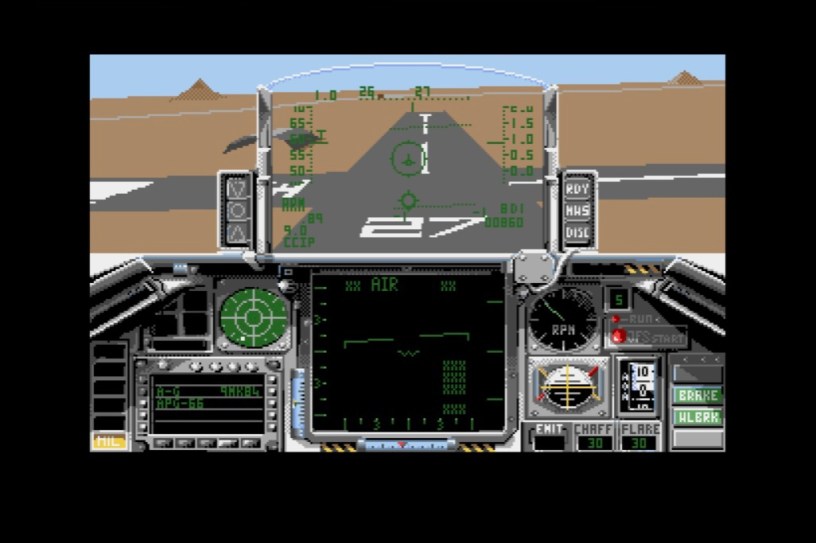
Was there ever a genre that said “16-bit home computer” more than the flight simulator? I genuinely don’t know! I mean, thinking out loud, there were the truly cinematic Cinemaware games like Defender of the Crown and It Came From The Desert, although I’m not sure they really count as a “genre” in their own right. Text adventures, such as The Pawn, do though, with their breathtaking, as good as photo-realistic art, even if in reality their success was still all about the words; there’s point-and-click adventures too, although you’d soon get those everywhere so maybe not. As incredible as some of them were, same for sports games and driving games, shoot ‘em ups and top-down shooters, platformers and RPGs. I guess there were some epic strategy games like Populous that appeared everywhere else too but never really worked the same without a mouse, and the same for those first-person dungeon-crawlers like Dungeon Master. And how could I almost forget those grand 3D adventures like Carrier Command and Midwinter and even Castle Master? No doubt there was innovation everywhere, and eye-watering sights and sounds to boot, but I’m really struggling to get beyond the flight sim as the generation’s most iconic genre!
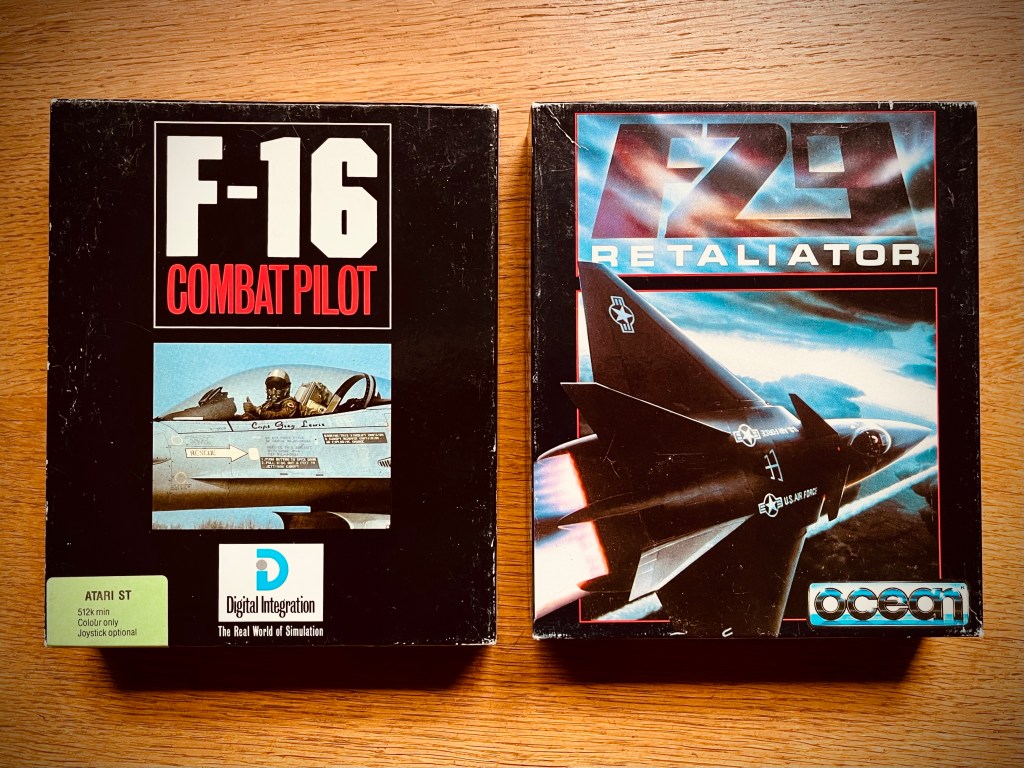
The best part of four decades on, though, what I can definitely tell you is that it’s the most intimidating to try and go back to today, with all its knobs and dials, bells and whistles, keyboard overlays, great big boxes and hundred-page manuals! We’ll come back to those, but what I also wanted to try and capture is the impact these things had at the time. For me at least, it was primarily the full-colour, filled-in 3D graphics that, with a bit of late-eighties imagination, were like looking out of a real plane, where only four or five years earlier I’d been fully immersed and absolutely thrilled by numbers on a screen telling me I’d taken off or was approaching the runway to land in my Commodore VIC-20 Boing 737! This was genuinely every boys’ dream of flying a plane come true, and more often than not it wasn’t any old plane either; we’re talking Tom Cruise in Top Gun fighter jets or insane helicopter gunships that put Airwolf to shame, together with the inherent exhilaration that’s way out of almost everyone’s reach in real life. And all that complexity that demanded hundreds of pages of manual wasn’t intimidating at all at the time either – it just added to this incredible immersion! And in reality, now I’m past the intimidation factor, I can tell you it was actually a pretty accessible realism after all! And I think that all worked to make the relatively early ones like Falcon and Gunship do well enough to spawn dozens of the things that would continue to raise the bar in realism, complexity, immersion and plain old cool graphics throughout the generation, all the way to stuff like NightHawk F-117A Stealth Fighter 2.0 and B-17 Flying Fortress.

I’m not keeping count but “Microprose” is springing to mind a lot while I’m thinking about those games too, although possibly because of the big signed pic above my head as I type! When I finally get around to Gunship maybe we’ll get into them and all their flight sims and Pirates and Civilizations a bit more. They did Kennedy Approach too, an air traffic control game I’ve fancied since 1985, so maybe we’ll come back to that sometime too! Anyway, I’ll conclude our little preamble here just by recapping where I dipped into those dozens of 16-bit flight sims, by fair means or foul, on the Atari ST during the late eighties and early nineties, until the PlayStation came along and put an end to all that proper flying fun! I think the first one was a copy of Flight Simulator II, which might not have had the glamour of the later combat sims we’ve mostly talked about so far, but was head and shoulders above any of the lazy 8-bit ports of stuff like Jump Jet also released around the same time. Okay, it chugs a bit today, but before stuff like framerates were invented, gadding around that huge map was like nothing you’d seen before! From there, it was Gunship, which I’d already played to death on the Spectrum but again, this was something else – like the actual Apache flight sim I flew in when I won that Your Sinclair competition… I think from there it was probably Falcon, which we’ll come back to, then F-29 Retaliator and F-16 Combat Pilot, which both came out in 1989 but I think I picked up a bit later, and presumably with a bit of a gap between them. Which then muddies the timing for 1990’s F-19 Stealth Fighter, which I don’t think has ever been surpassed for pure glamour!
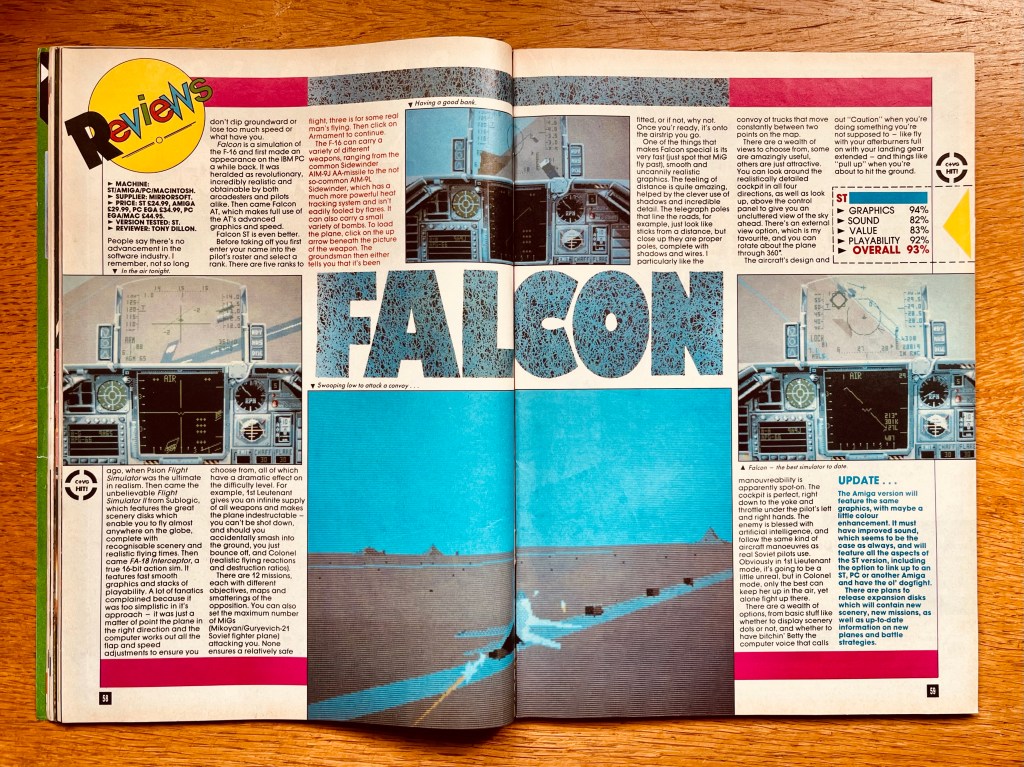
I’m sure there was one more I had too, which remains shrouded in mystery because it disappeared in a box with my original copies of the aforementioned Gunship as well as Stunt Car Racer, but if I get a chance I’ll flick through some old issues of Computer & Video Games magazine and see if I can’t remind myself before we finish here! In the meantime, let’s jump to Falcon, which might not have been the first for either me nor the wider genre, but I reckon was the one that kickstarted the whole hardcore flight sim craze on the ST and Amiga when it first appeared at the very tail end of 1988! Actually, I should probably say it was out on the Apple Macintosh and IBM PC well before either of those, but no one really cares, and when it did arrive on the non-pervy machines, it was simply like nothing you’d seen before! You might have seen an F-16 before though, had you seen Louis Gossett Jr’s 1986 classic Iron Eagle! Thinking man’s Top Gun that is, but anyway, just to properly set the scene, the F-16 is an American fixed-wing, supersonic, single-engine, multi-role fighter plane, first introduced in 1978 by General Dynamics for the US Air Force. It was crazy manouverable at crazy high speeds, full of guns and had a nice frameless canopy so you could look all around you without interruption. It’s still in production today, as far as I know, and having been sold to twenty-five other countries is the most widely used combat aircraft in military service. And as Spinal Tap might say, it’s two more than Top Gun’s F-14 too!
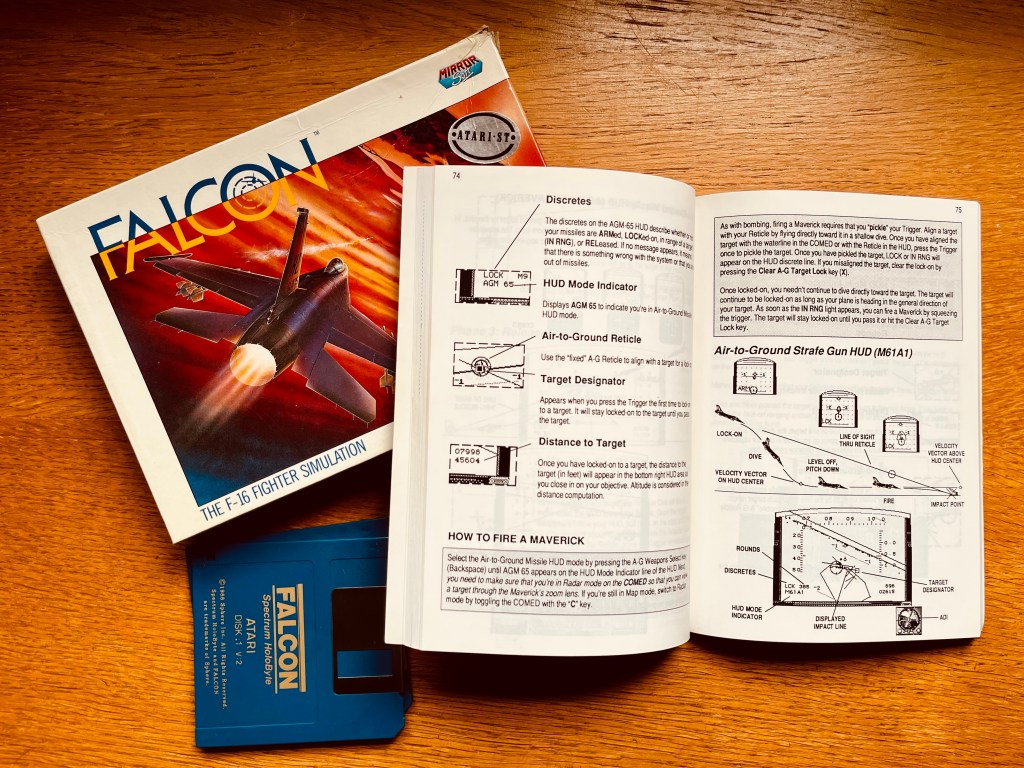
Onto the game then, and that came from Spectrum Holobyte, which had been founded in Colorado in 1983. There were a few releases before Falcon, such as the submarine sim GATO, but honestly not a lot else before or since that ever really jumped out at me, unless you’re counting the first ever release of Tetris outside of the Soviet Union! They’d always be best known for their sims though, eventually merging into Microprose and in turn Hasbro. Before that, though, they’d also merged with Sphere Inc, the original developer for the MAC and PC versions of Falcon, while the ST and Amiga versions were ported by British outfit Rowan Software, another sim specialist who’d been behind the original 8-bit releases of Strike Force Harrier in 1986.
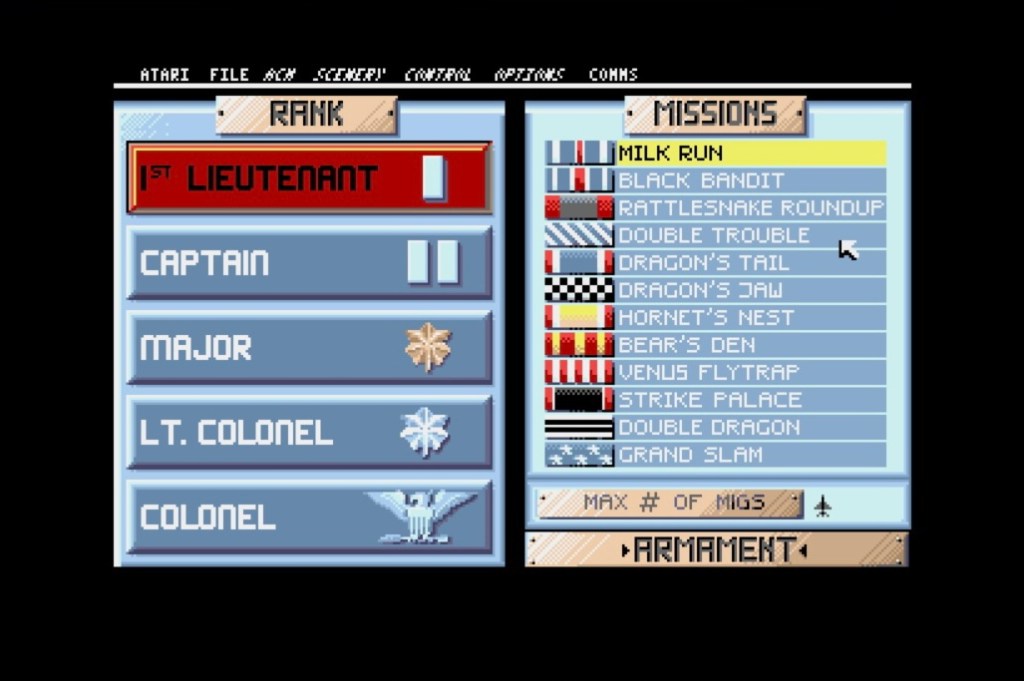
Either way, the game “was designed to be a highly realistic simulation of the F-16, yet you have the opportunity to fly this powerful jet with tremendous ease.” And that’s where that 150-page manual comes in, but don’t worry, it’s not all that bad! As realistic as things eventually get, you’re not being dropped in at the deep end at all, and the manual does a masterful job of getting you going, getting a feel for the basics of flying, then getting you feeling comfortable over the course of a few introductory flights, with the plane’s true characteristics dialled down a bit, and also making it impossible to crash or get shot down. From there, you’ll gradually be exposed to everything the plane’s got to offer (which is where the manual really goes to town!) as your rank increases, from First Lieutenant to Colonel, and those are also going to dictate the realism, making the plane harder to fly (and easier to crash), the enemy harder to shoot down (and more of them), limitations on fuel, increased armament weight and drag influence, and so on. An ejecting pilot being captured or getting killed also becomes a very real eventuality the higher your rank too!
We’ll come back to getting in the air, but it’s probably a good time to mention the game structure… There’s a total of twelve missions available, including a training one, then a variety of air-to-air, air-to-ground and a bit of both. They all take place over a common fictional theatre of war consisting of seven enemy territory quadrants on the map plus two friendly ones, where you’ll also find your airfield. The enemy is never really identified but they fly MiGs so probably not too much of a stretch to work out! Missions vary in complexity and difficulty, but range from the Milk Run, where you’re bombing some practice buildings in friendly territory, which is ideal for getting to grips with flying in a combat situation or really pushing your own envelope at higher ranks, then there’s shooting down a problematic enemy ace pilot, destroying multiple surface-to-air missile sites or enemy planes, bombing various strategic ground targets like bridges and runways, or, as said, a bit of everything. Once a mission is done, one way or another, you’ll be taken to a debrief screen with a series of snapshot images showing the outcome, for example, illustrations of a missile hit to eject to “good chute” to rescue if that’s what happened, or the road to a court martial if you screwed up your landing, or your funeral if things get really bad! Ideally though, you’ve completed your objectives and brought the plane back in one piece, so you’ll be presented with some decorations and medals for getting the job done, from mission completion ribbons to a Purple Heart for coming back hurt, all the way up to a Medal of Honor for going way beyond the call of duty at Colonel rank.
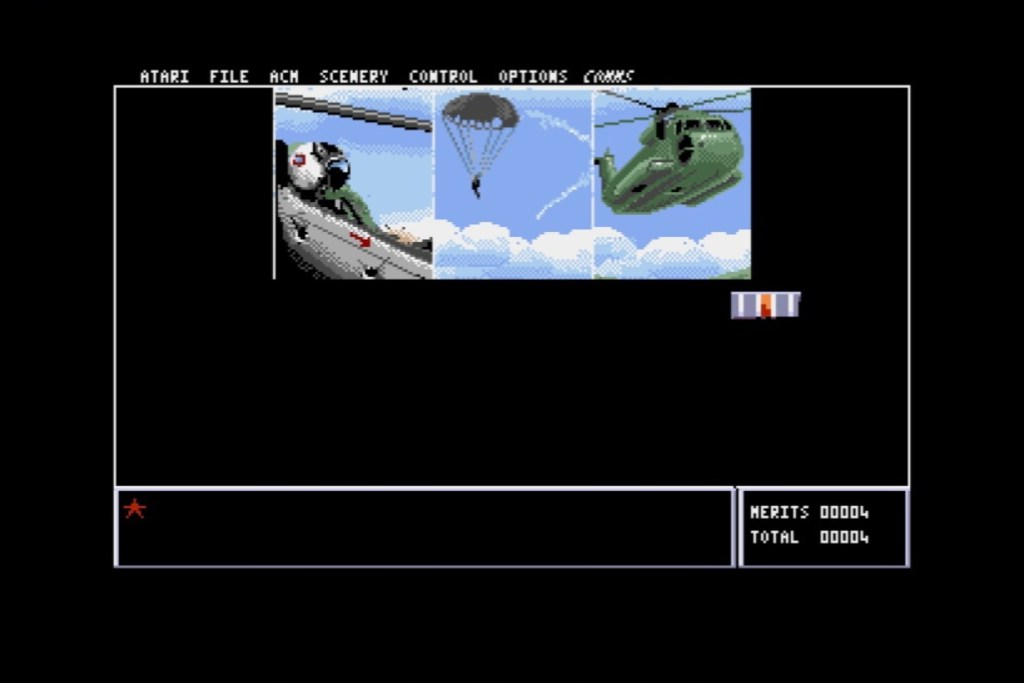
Once you’ve been playing a while, these medals are what the game is all about, although there’s a real sense of achievement in simply landing your plane, let alone getting a new medal for it, bizarrely like you’ve just done it for real! There is a real sense of attachment to “your pilot” though, that quickly evolves through competing these missions, which was particularly evident when I first went back to the game recently and realised my thirty year-old duty roster was still waiting for me once it loaded! I’m going to hang around in that very moment next too because that’s where you’re going to find the game’s ultimate high – actually getting in the air for the first time and flying this thing, which is, without doubt, one of the most exhilarating things I’ve ever done in a game, and really took me by surprise when I got a second chance at experiencing it, given how much I played it all those years ago! I guess going back to almost any game, not least a complex flight sim, is going to feel like the first time again after a gap like that though, so I’ll quickly talk you through that Milk Run mission to get a flavour of what’s here.
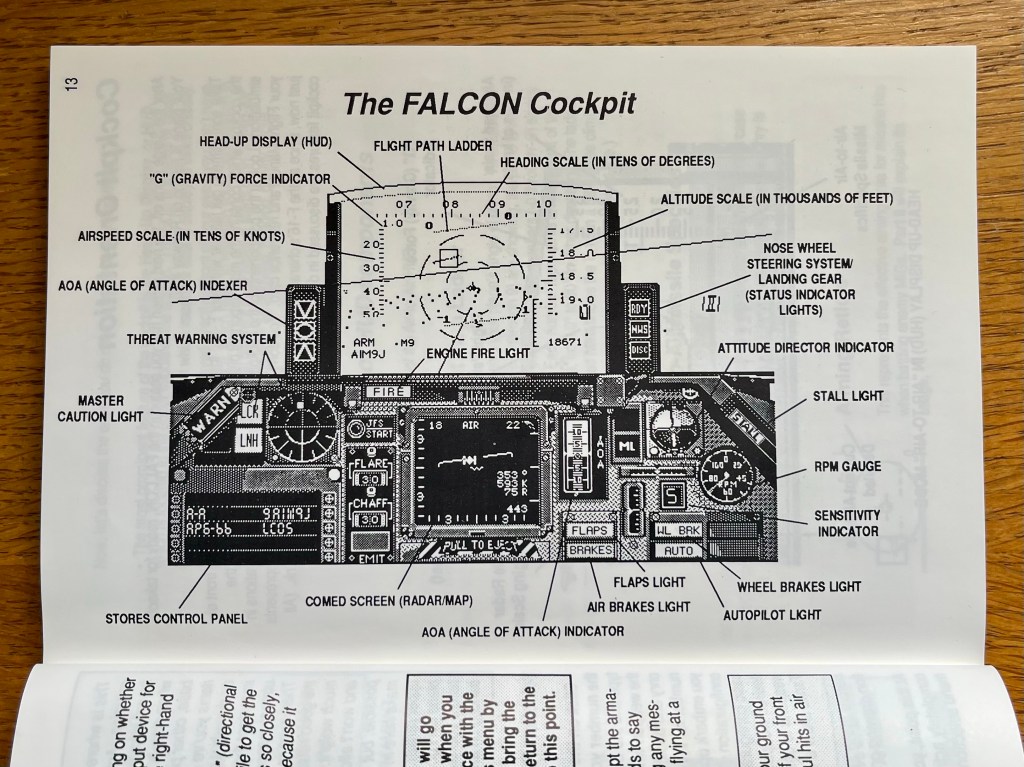
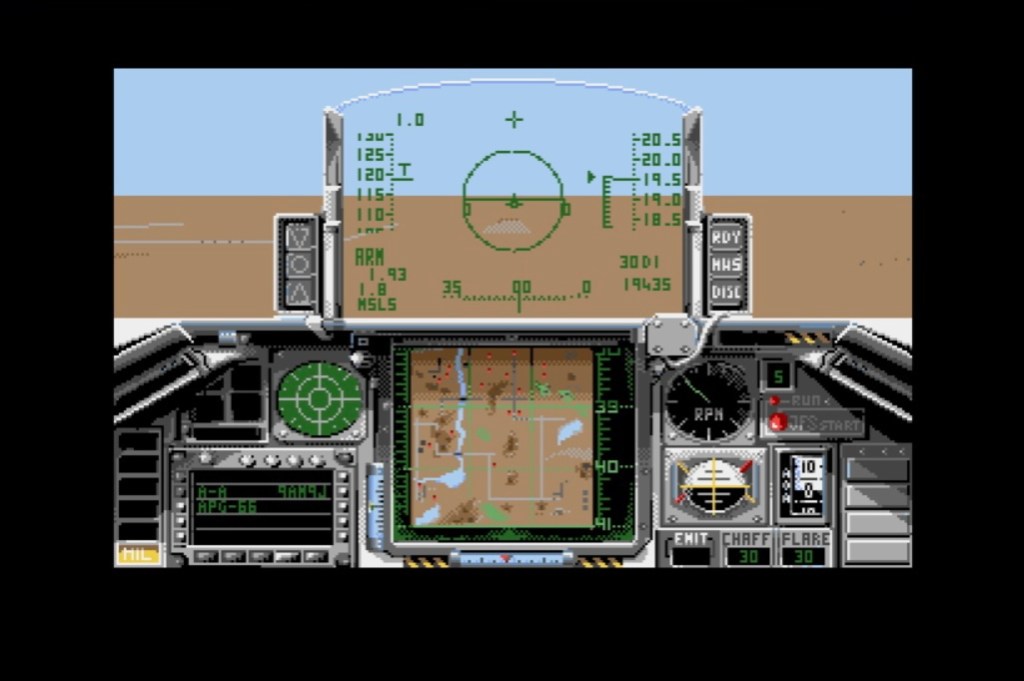
Once you’re sat in the cockpit, and you’ve got over the shock of the bewildering number of dials, gauges, numbers and fancy displays in front of you, there are just a few things you need to be aware of initially, then the rest will come as you start to move through the ranks and take active control of more features. The Head-Up Display (or HUD) is a good place to start as it’s right in your face and contains the most important information you need, which is why it’s right in your face so you can concentrate on battles and stuff rather than looking all over the cockpit. This glass display can be switched to show different electronic information depending on your current situation, but by default it’s in air-to-air mode, showing essentials like airspeed, heading, gravity forces, altitude and your flight path ladder, which shows your angle of climb or descent. You’ve also got an aiming reticle and specifics on your current missile loadout (air-to-air for dogfighting in this view), a compass and a five-mile radar ranging scale, which tells you any local enemy aircraft distance. The other HUD modes are air-to-ground for ground strike missions and a landing one that I’ll come back to shortly.
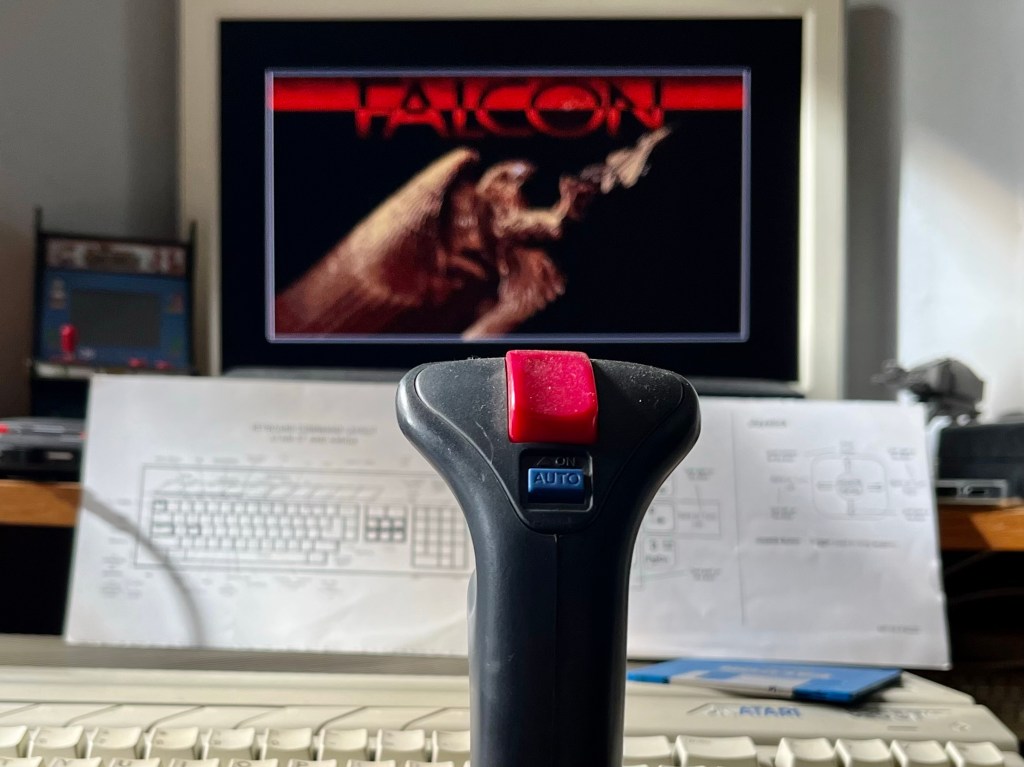
The rest of the cockpit has various indexers for landing and fighting at higher ranks, jet fuel and afterburner information, a combined radar and map screen, also with selectable modes, RPM gauges, attitude director indicators, lights for brakes, wheels, flaps, autopilot and so on, various warning signals, weapon store control and all sorts of other stuff! For now though, I just want to give you an idea of getting airborne, flying about a bit and landing because, as said just now, that in itself is a really beautiful thing! For the purpose of doing this, I’m going to use a combination of my trusty QuickShot joystick and keyboard controls on original hardware, although I’ll quickly mention that avoid too many crappy phone pictures of my crappy TV, I’ll mostly be grabbing any screenshots using emulation on a PC. Right, disclaimers out of the way, and we find ourselves on the runway, still totally overwhelmed by the cockpit but also enjoying the various outside views available to you on the number keys! Once you’ve taken in your surroundings, a quick check to make sure the wheel brake light is on and you’re ready to light up the engines by activating the Jet Fuel System with a press of +, and once the JFS light is also lit, you’ll see the engines automatically rev up to 60% maximum RPM. While it’s not necessary to taxi in this Milk Run mission, as long as the landing gear light is on the then Nose Wheel Steering system will be too, and you’re free to drive around if you fancy taking off from the other runway, where you’re going to be landing later. A little bit more revs and a press of W to release the wheel brakes and you’ll start moving, but keep it below 90 knots or that NWS light is going to turn off and you won’t be able to steer anymore!
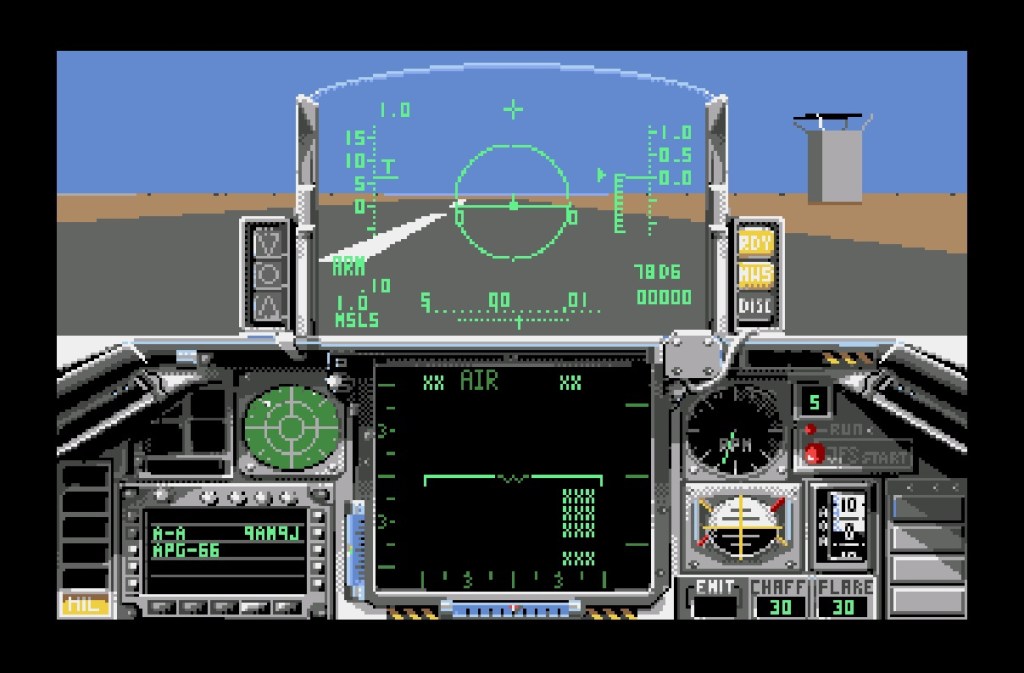
Assuming we’ve still got a runway in front of us though, it’s time to stop rolling around the airfield and try to take off, so we’re going to give the revs some welly all the way up to 100%, keep an eye on the HUD until the airspeed reaches 150 knots (or 15 on the display) then very gently ease back on the stick until the climb angle display tells us we’re at around ten degrees; you’ll also notice the disconnect light on that NWS / landing gear system illuminating as soon as you’re off the ground, meaning hit G to retract your landing gear, and if you’ve done that successfully, a quick look to the left view with a press of 4 will see all three wheel indicator lights now black, and likewise, switching back to front view with a press of 3, you’ll also see those NWS and landing gear lights off there too. Oh yeah, if you want a really quick take off or faster climb rate, whack the / button and you’ll turn on the afterburners! But now it’s time to stop looking at instruments and pressing buttons because we’re in the air and should be admiring all that heavenly glory! Well, at least that white sun that appears if you’re being particularly aggressive with our climb angle! Being facetious with a pair of 2023 eyes aside, what’s outside the window when you look down is still as thrilling to me as it was when I first laid eyes on this thing, so before we climb up to 25,000 feet to start hunting down our targets but are too high up to see anything, I’ll take a quick detour to talk about the graphics!
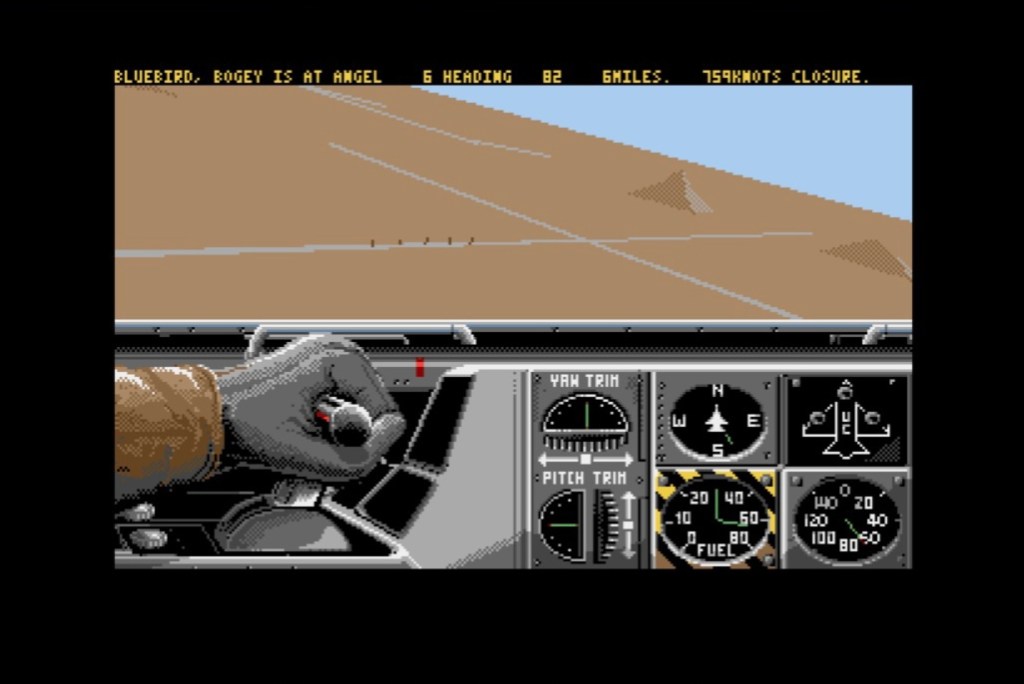
Inside the cockpit, it’s all as authentic as you could ever have wished for, with those spectacular metallics that were another hallmark of the new 16-bit generation encasing so much stuff going on in all those realistic instruments all at the same time; and so many different flavours, from traditional dials to digital displays to what still looks like science fiction on the glass of your HUD! Everything has a purpose too, and more so the more you play, then there’s the other views, with more instruments left and right where your hands are visible on the flight stick and throttle, depending on which way you’re looking. Looking backwards at the destruction you’ve just caused isn’t just another thrill but often a necessity to make sure you’ve hit your target because you’ve not going to get away with going back for another look in the heat of battle, and you can also look above you, allowing for almost 360 degree visual navigation or frantic searching for an enemy plane. If you want full 360 degree visuals, then another view from outside the plane allows for that, and a final one offers a view from the air traffic control tower, which, unless you happen to be flying right by, is just going to show a dot for wherever you are. Very cool for the time all the same though, and you can really get a feel for how pioneering this was if you compare it to what was possible before and is still replicated in the genre to this day.
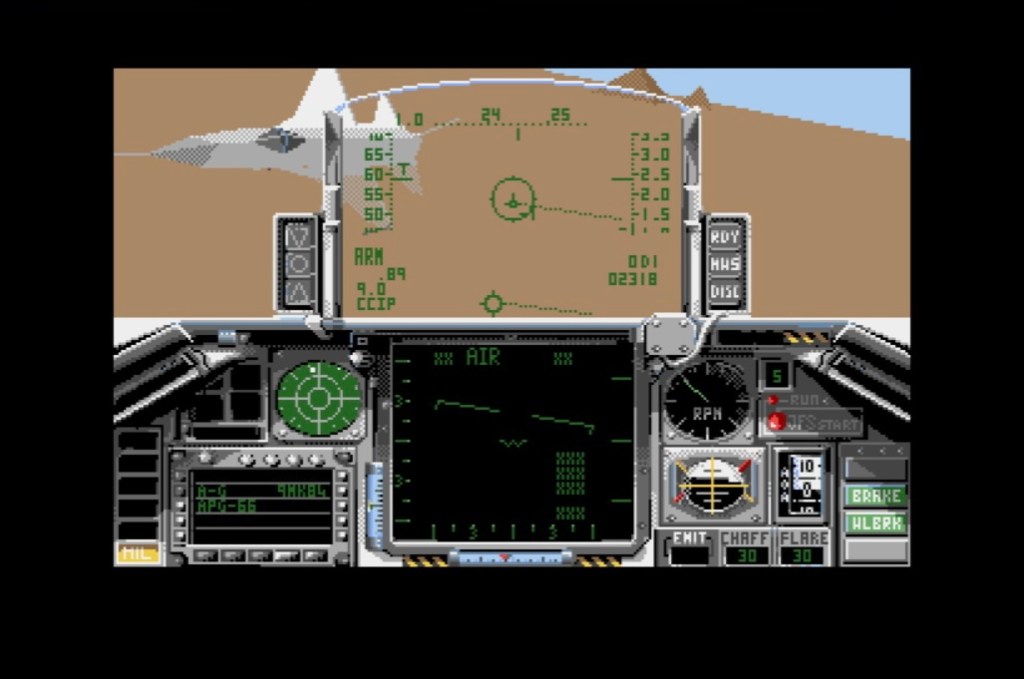
Unless you’re below 5000 feet, you’re only going to be identifying roads, rivers, mountains and the like, and maybe some bridges or what is likely to be a cluster of buildings, which is perfectly realistic too, I guess, but up close you’re going to see enough detail in the 3D polygons for your imagination to fill in any gaps required to identify a convoy of trucks or different kinds of buildings; that said, there are some real visual treats, like when get up close and personal with an enemy MiG, which needs no imagination to be terrifying, or the outside view of your own plane as it launches a missile, and the explosion when it finds its target. There’s also some great touches like telegraph poles lining the roads, and as the C&VG review also pointed out at the time, these start out as tiny lines in the distance but as you get closer you can see the wires they’re supporting and even their shadows on the ground. Fully deserving of their 94% rating for graphics! The wireframe vector representations as you switch from map view to your 3D radar view in the middle of the cockpit, while you’re seeing them approaching for real through the window, is also excellent, and absolutely necessary for successful targetting. Which would be a great place to jump back to finding our Milk Run targets, but while we’re talking graphics I should also mention what might be the elephant in the room to some, but coming from a time before framerates existed, I couldn’t care less about! Actually, when you compare it to contemporaries like Midwinter or Castle Master, which were also state of the art at the time, this thing isn’t moving badly at all, but in another very forward-thinking move, it allows you to kill all the unnecessary ground detail and speed things up with dots only, which you can do on the fly if you wish while you’re playing. I’ve genuinely never felt the need though – there’s hardly a density of stuff on the ground or enemy planes in the air, and while it might not be moving at the speed people expect of such things today, it’s doing so perfectly smoothly and perfectly fast enough to make me think I’m doing something I’ll never do in real life!
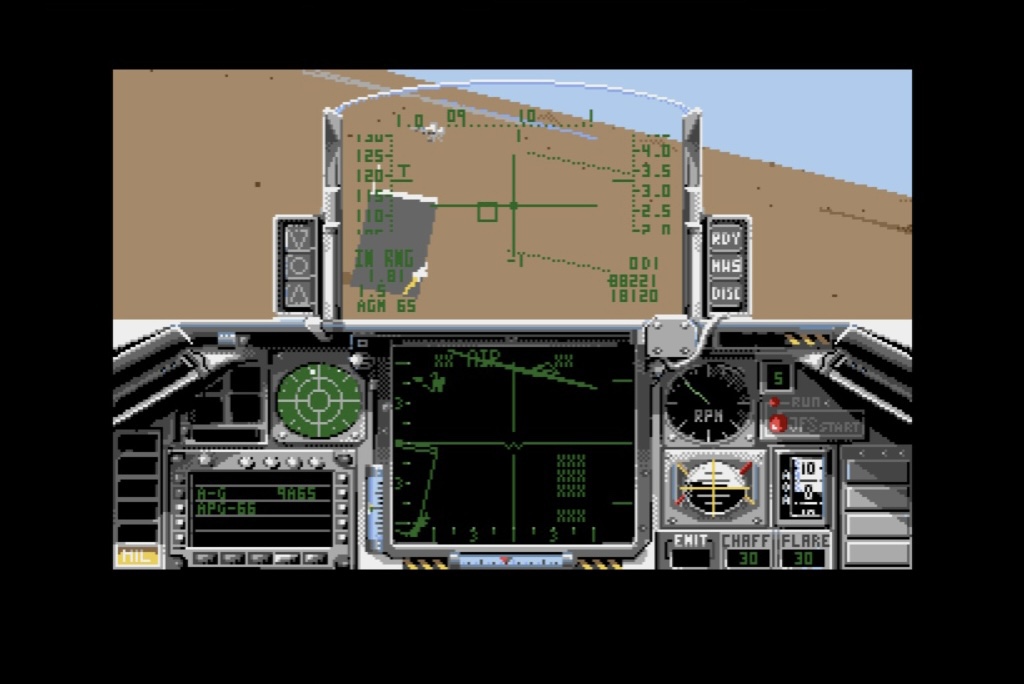
It was and, in many respects, still is a stunner to look at, and it sounds pretty good too – no music or anything necessary, but you are getting a load of sampled sound effects, like the roar of the afterburner over the undulating sound of your jet engine; the rattle of machine guns and soaring missile launch; and the relentless spoken warnings about everything you’re doing wrong! Exactly what you want from a flight sim, so with that established, let’s get back to blowing things up, which also has a nice sound effect! Right, if you recall, we were in the process of climbing to 25,000 feet so we could turn our attention to bombing the hell out of three buildings, and once we’re there we’re going to knock the revs down to about 70%, level out the nose and switch that 3D radar view I just mentioned to the map one showing the Falcon landscape so we can work out where we’re headed. Navigating to your target takes several forms all at once, For example, there’s a good chance that if you’ve taken off and gone straight up to your cruising altitude, you’ve been heading north across the map and will need to turn to the indicated heading of 135 degrees. If you look out of the window, you’ll also notice some roads that, if you keep following the one going west to east, will then go north to south, right back towards your airfield which is then immediately west of your targets. Before long, you’ll get to know the map and where everything is so this will quickly become the most effective means of navigation in most circumstances. However, for even more accuracy, the mission briefings in that big manual also include waypoints, pre-programmed into your navigation system, so you can cycle through them as needed to set them, then follow another indicator, which also includes distance to target. And if you turn on autopilot, it will head for that too!
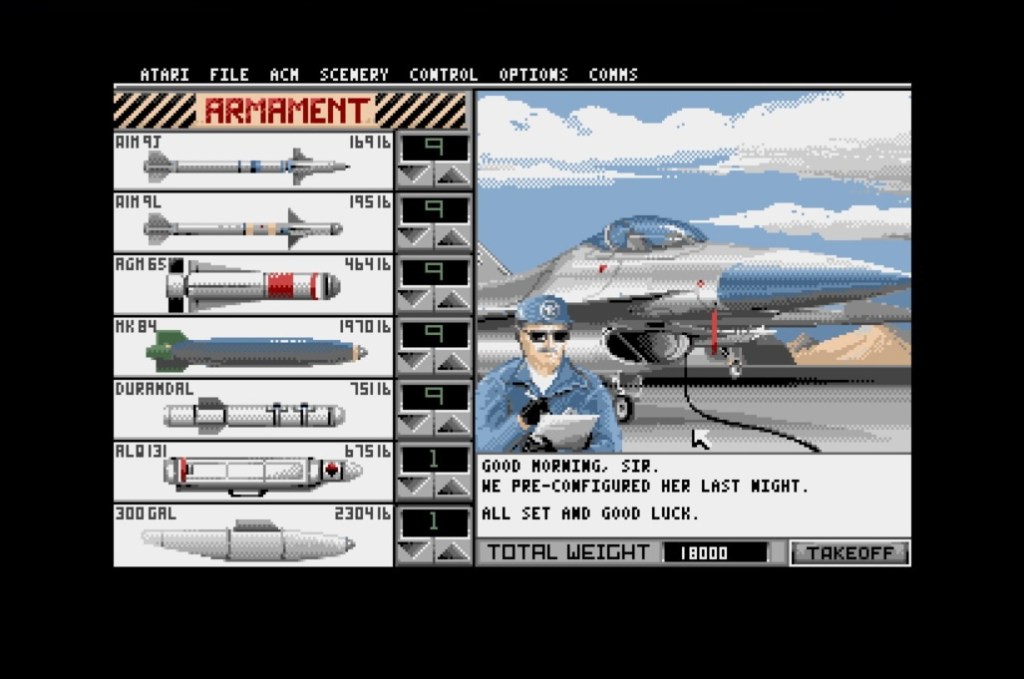
Now we need to think about selecting the right armaments, and hopefully by now you’ll have the right ones onboard for your current mission! These are either pre-configured or manually selected before takeoff, so in this case it’s just a case of cycling to the right one using backspace. I won’t go into detail on all the weapons, but as well as your M61 cannon, there’s several Sidewinder-type air-to-air missiles, air-to-ground Mavericks and various bombs. Some of the air-to-ground missions will also let you equip an ECM pod for jamming surface-to-air missile sites and preventing them getting a lock-on you, but as standard you’ve also got chaff to confuse them, or flares to try and do the same with heat-seeking missiles from enemy planes. For now though, we want the AGM-65B Maverick air-to-ground missiles, which are designed to be visually locked-on to their target using the wireframe TV image on your 3D radar as you approach, which may be apparent before the building can be properly made out using your cockpit crosshairs. Once the target is lined up, pressing fire (or space) will designate it, the HUD will change from ARM to LOCK, and a square will appear, then as soon as the HUD gives you the in range signal, fire again to launch that bad boy while you fire the afterburners and pull up to clear what will hopefully be a debris field behind you.
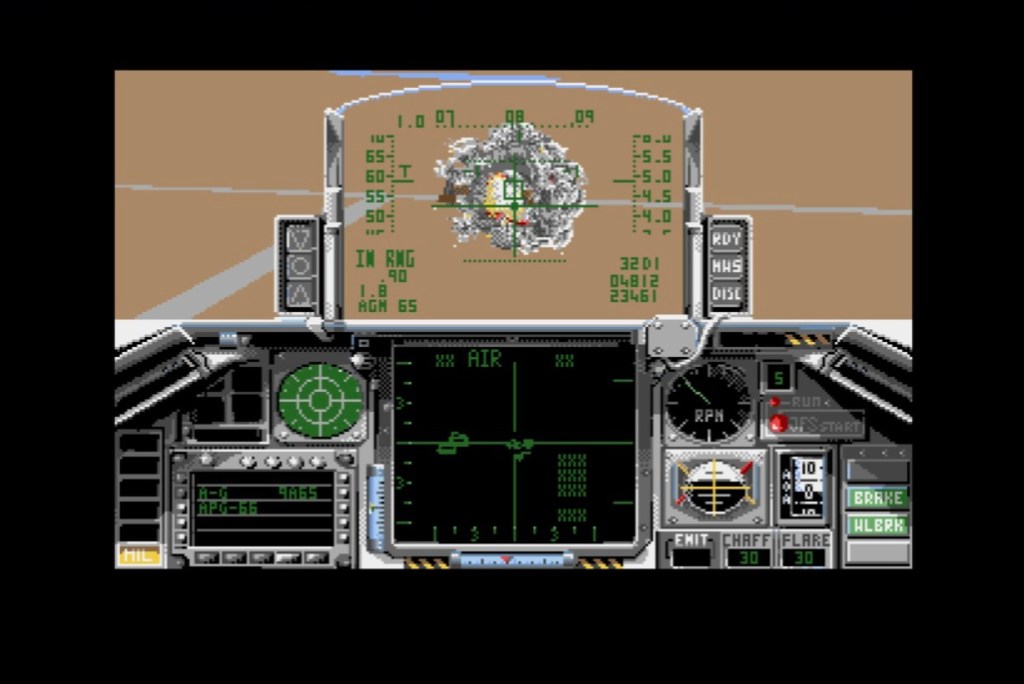
Mission just about accomplished apart from the small matter of landing! Half the battle now is lining up your approach to give you plenty of time and space to touch down beautifully, so you want to switch back to map, head all the way west and then vaguely position yourself at about 37,000 feet and start reducing your speed to around 300 knots, at which point you’ll then want to press F7 to turn on your Instrument Landing System (or ILS) HUD mode. This will assist in a smooth landing, and effectively projects an imaginary beam from the runway that you’re going to try and ride down using the left and right and up and down indexers, which are two lines that you want to get into a cross and keep them there as you approach. You’ll also be getting occasional prompts from the tower about your course, but, together with the map and a pair of eyes, as long as you’re throttling back to around 68% and using your air-brakes to get down to around 130 knots by the time you hit around 5,000 feet, it’s just a case of small adjustments (using trim control by pressing the Alternate key as you feather the joystick) then dropping the landing gear at 4,000 feet and keeping an eye on those indexers, altitude and airspeed as you bring it down onto the runway. Then it’s just a case of throttling down below 60%, applying the air-brakes, the flaps (with F) and then the wheel brakes until you come to a stop, and which point you press escape, end the mission and get out of there!
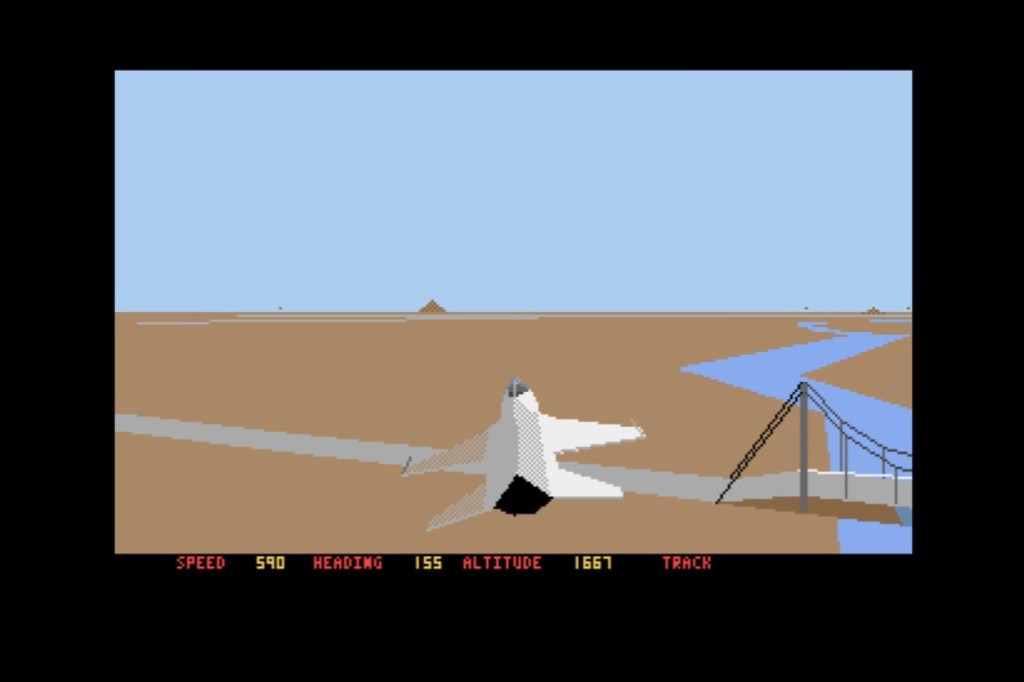
Okay, it might take a bit more practice than I’ve just implied, but that’s what the lower ranks and first missions are for. What a ride all the same! Every element, from take off to gingerly throwing it around in the air to landing is just so intense and such a buzz! Things get even more interesting a few ranks in too, and I’d really recommend ramping these up as soon as you’ve got the basics because you really want a bit of proper life-threatening tension to get the most out of Falcon! Actually, one of the most “tense” things it throws at you is when you’re dropping your landing gear but have taken damage, and a look to the wheel lights on the left view will suddenly confirm your worst fears that after all that fighting you also need to prepare for a crash landing any second now! The SAM sites become active at Captain, which is where things really get interesting as enemy pilot AI also really ramps up and you end up in a proper game of cat and mouse. This is the time to start reading the manual again too, and expanding your knowledge to air target selection, different aerial radar tracking modes, aspect angle indicators and different evasion techniques – as said earlier, you can return to the Milk Run to practice all this stuff in relative peace again too.
For a game that comes with a 150-page set of instructions, I think this kind of initial accessibility followed by a gradual evolution of realism – totally at your own pace – is Falcon’s greatest achievement, and why I chose to talk about it here over something like F-29 Retaliator or F-16 Combat Pilot, for example. By the way, I’ve put a bit of time into both of those over the course of playing Falcon recently and they’re still fantastic! As is Falcon. Interestingly though, for all three, there’s no doubt that the right way to play is on original hardware, using the fold-out guides and keyboard overlays that came with them, and a proper mouse and proper old joystick, and while there’s no denying that all feels great in itself, it’s mainly for practical reasons over some purist manifesto! I mentioned before that I was using emulation to grab some screenshots, which meant using my Switch Pro Controller, and it was twitchy as hell, on top of just feeling weird in comparison. There was also the keyboard mapping, which, at its most drastic, meant I couldn’t slow down because while + still revved up, – wasn’t revving down anymore, but there were loads of other examples too, like the [ and ] keys not letting me look up and down anymore. Then there’s all that instruction manual to deal with… Obviously there are ways and means around all of this but there’s no way I’d have been playing Falcon for weeks on end had I been playing this way, so no way you’d be reading this now either, which would be a shame all around because I’ve genuinely had few thrills in gaming like it, whether first time around or more recently as I write. And for something “designed to be a highly realistic simulation of the F-16” it’s a load of fun too!
 Retro Arcadia
I remember playing all of these as a teenager, Falcon, F29 & Gunship. Great fun.
LikeLiked by 1 person
Definitely! Those three are mr favourites!
LikeLike
Loved this post – heress my feedback –
Thanks for reading , Love The Blog !!
Thanks – TheDogGod pomeranianpuppies.uk Thanks – Pomeranian Puppies & Adult Dog Guides & Tips http://pomeranianpuppies.uk
LikeLike
The screenshot is F-16 Fighting Falcon but the box cover is F-16 Combat Pilot
LikeLike
There is a box pic of that where it’s mentioned in the text to set the scene. Same for F-29. The Falcon box is included later.
LikeLike
I loved this game with my whole heart. It touched me deeply to see the screenshots here today. Thank you for that. I had the chance to get in touch with an important part of me today.
LikeLiked by 1 person
Amazimg game, brings back so many memories playing it with my dad. we spent so many hours on this.
time to dig out my Atari St and get it running again!
Thanks for that.
LikeLiked by 1 person
Fantastic! And good luck with the ST!
LikeLike