Was there ever a game I spent more time messing around with but never learning to play properly than Impossible Mission on the Commodore 64? As I write I’ve actually no idea, so give me a second to think about it! Okay, I’ve come up with a couple of obvious ones, and they both seem to be on the original PlayStation… First up, Resident Evil, which I bought day one back in 1997 and can very distinctly remember loading up for the first time and being totally blown away by that zombie guy turning around and staring at you near the start, not to mention those dogs coming through the windows when I eventually got there! I was already a huge horror nut back then, and the realism in this pioneering survival horror game from Capcom was like nothing I’d ever seen before. The trouble is, neither were the puzzles, or that inventory management nonsense, so I just stuck to aimlessly exploring and stabbing zombies for a very, very long time. And I loved every second!

While I did eventually play Resident Evil properly, and the series went on to become a favourite, the total opposite is true for the next game, and that’s the very first Grand Theft Auto, which I picked up a couple of days after Christmas 1997, which I think was only a couple of weeks after it first released. I loved every second of that too, and have a similar memory of coming home with it and playing it to death in that week between Christmas and New Year, but mainly as a top-down murder simulator! I spent months doing that on and off too, running over Hare Krishna people with whatever car I’d just stolen, and it was a blast! At the time, though, I was completely oblivious to any great narrative, or even that there was more to it than the first city, but to this day I’ve never been back, and despite buying all the games up to Vice City, I had a similar experience with the rest too! At which point I think I finally decided GTA wasn’t my thing!
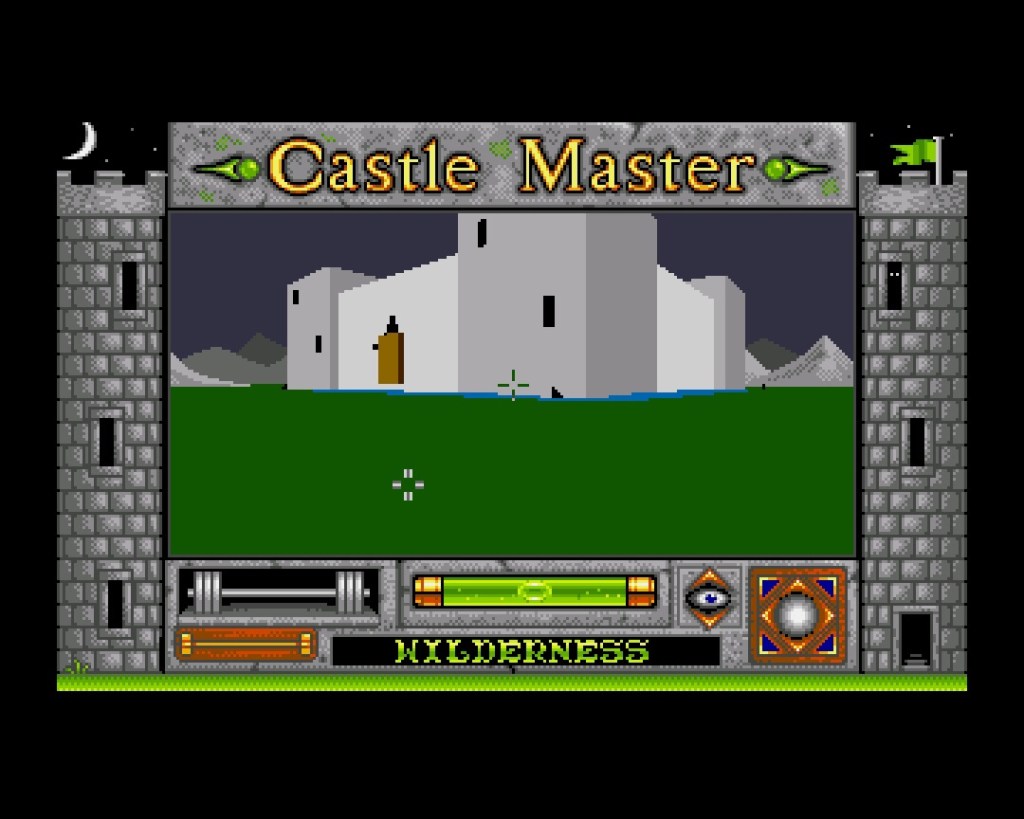
I just thought of a third one! Well, actually, I happened to look up at the shelves next to where I am and it was staring back at me… Castle Master on Atari ST! This was one of those Freescape solid 3D games from 1990, where you had to explore a big old castle full of puzzles, secret rooms and dangers (including its famous shark-infested moat!) in a bid to save your twin from the evil Magister the Castle Master. All of these Freescape rendering engine games were unreal (not Unreal) at the time, and not unlike Resident Evil, to me this thing was all about exploring this wonderful new world rather than solving stupid environmental puzzles – would be a very long time before I had any patience for those too! You know what, though? I might come back to Castle Master and have a look at it in its own right soon. Maybe I’ll think of a few more examples of this stuff by then too!
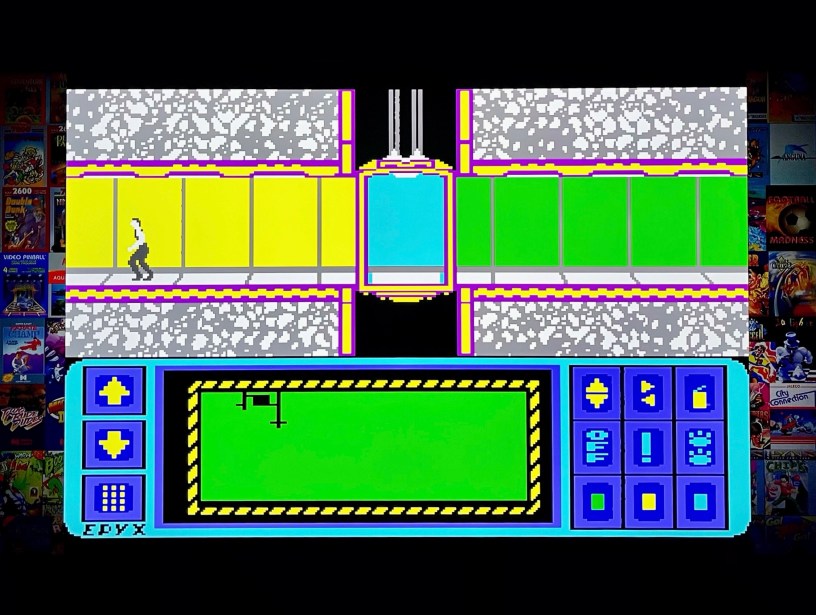
Coming back to Impossible Mission, in my defence, I didn’t own the Commodore 64 where I was happy just to be mesmerised by cool somersault animations and the thrill of using the lifts. Okay, now I’ve written that down I realise maybe you had to be there for the latter but I won’t hear a word about that jump not still being spectacular to this day… Even if it is often a bit excessive when you just want to cross a little gap! But we’ll get to all of that shortly! In the meantime, until The C64 Collection 1 cartridge for Evercade came along towards the end of 2022, apart from a quick couple of minutes when the C64 Mini arrived in 2017, I hadn’t touched Impossible Mission on the C64 for the best part of forty years, since around 1985 I guess, although I I had it on the Spectrum too, I think in U.S. Gold’s Summer Gold compilation. Not sure, doesn’t matter, and really wasn’t the same anyway, which we might also come back to later! Anyway, one of the great things about Evercade cartridges is they come with a lovely old-school instruction booklet, and they really went to town on Impossible Mission in this one, so I finally knew what I was doing and was maybe even able to properly appreciate what all those magazine reviews were raving about at the time – which I assume wasn’t just a nice lift! By the way, while I have been playing through Impossible Mission on my Evercade VS and biggest TV for maximum pleasure, it’s a nightmare getting decent photos on there when I’m balancing a phone camera in one hand and trying to manipulate the controller in the other, so for the purpose of some pretty screenshots I’ve just grabbed them separately from emulation using VICE on a PC instead!
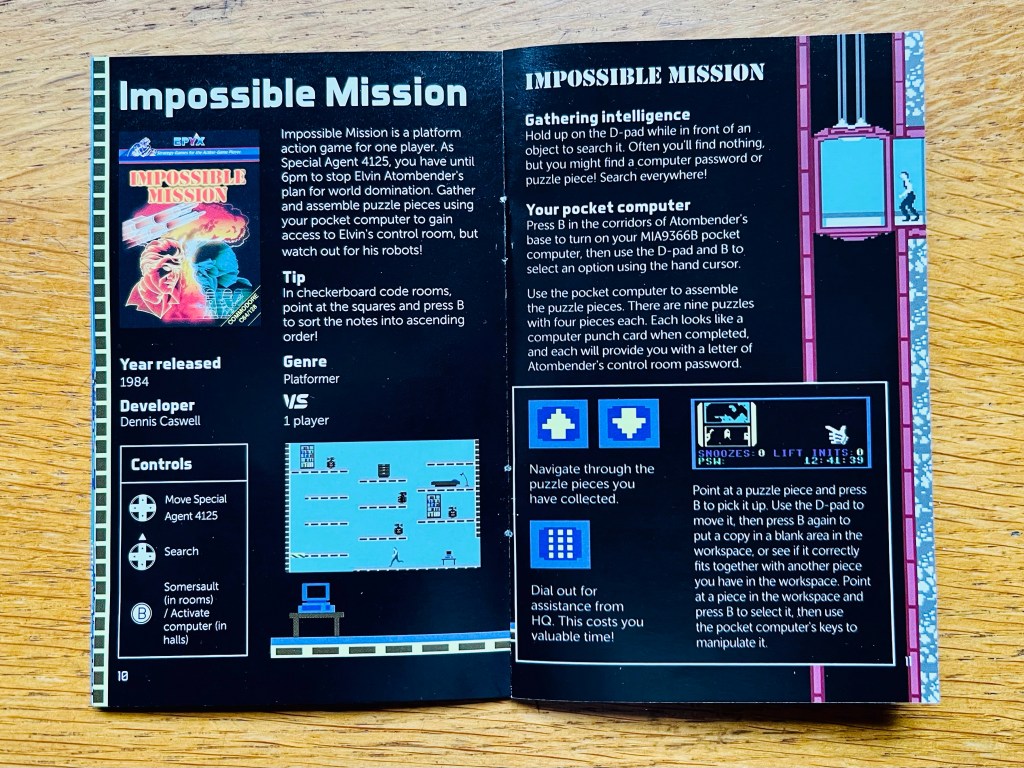
As well as the similarly convenient instructions that come with the game, on the Evercade website you’ll also find the scanned original instructions in full, and I have to say, I’m not surprised I only ever messed around with this game until now – these are some of the most intimidating instructions I’ve ever read! Maybe we’ll jump back to the truncated ones inside the cartridge case in a sec instead, but while we’re here we can at least cover the story… During the past three days, key military computer installations belonging to every major world power have reported security failures. I wonder who to? Global IT? Anyway, in each case, some miscreant has gained access to a primary missile attack computer, and there’s only one miscreant that fits the bill, he being Professor Elvin Atombender! Sounds like he’s trying to crack the computers’ launch codes, and once he does, he plans to trigger a missile attack that will destroy the world. Which is where you come in! You, Special Agent 4125, need to penetrate his underground stronghold, evade his robot guards, “break” his own security code and find his control centre to shut it down. Unfortunately, it sounds like the powers that be in your organisation seem to have the same aversion to any proper weapons as the ones who planned the presidential rescue at the end of Combat School, so you’re only armed with a MIA9366B pocket computer and your keen analytical mind with which to save the world!

There’s a load more nonsense backstory about Elvin before we learn that using the fortune he amassed from hacking into various financial institutions, Elvin constructed a vast underground lair packed with all his computer equipment (as well as a few favourite items of furniture), and from there he spent the last four years breaching the world’s military computer installations, which he now seems to be all done with because you now have just six hours to prevent the big missile attack. By “vast” the instructions mean a total of thirty-two rooms, which, to their credit, seems far more vast than that when you’re playing! Some of these are just living quarters and some are computer rooms, but each will usually have a series of floors or catwalks that are connected by lifts (but not the cool lifts I mentioned earlier!), and these contain the items you’ll need to negotiate your way to and search one way or another, as well as Elvin’s killer robots, and as such the rooms themselves present the game’s first puzzle because, of course, you’re not necessarily going to find a lift on the floor you really want it to be on!
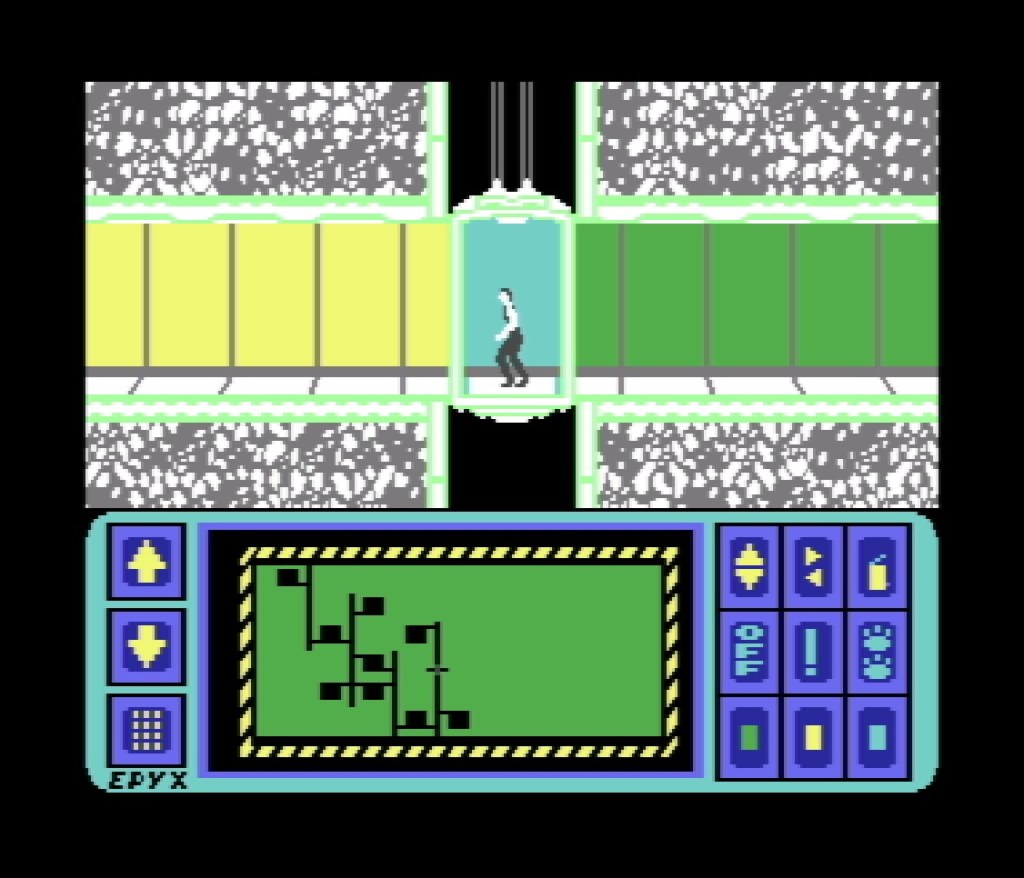
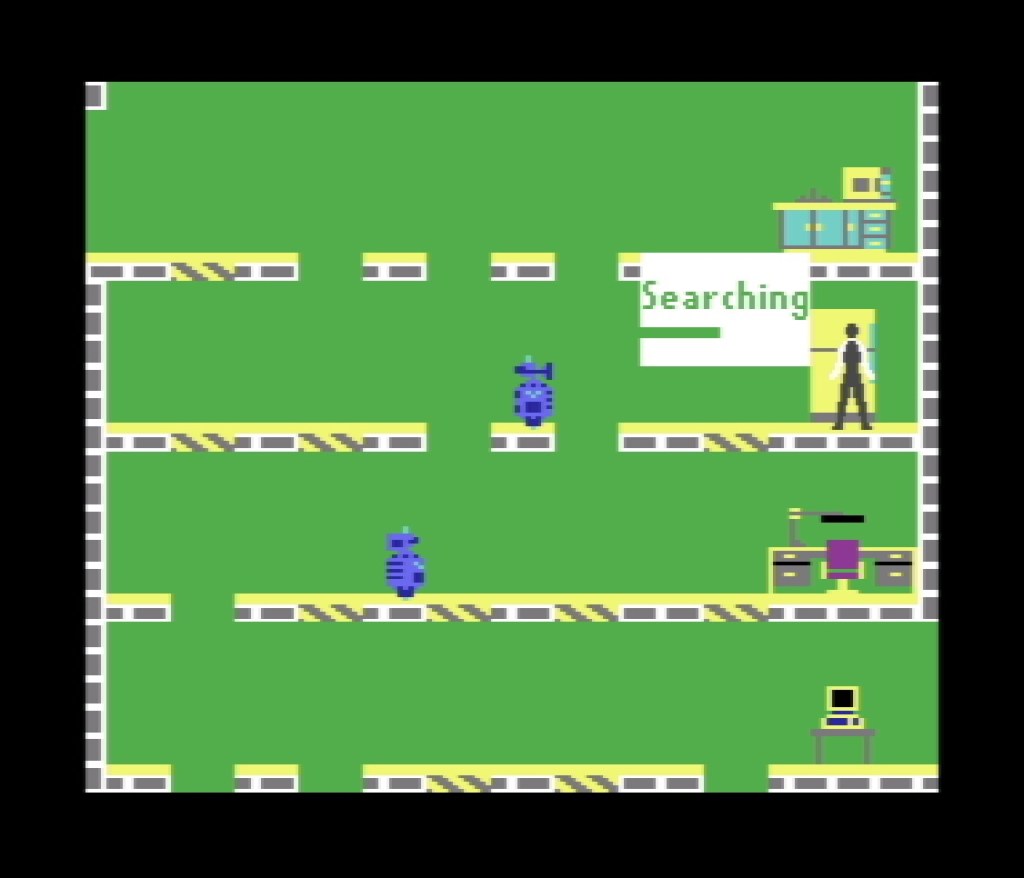
You might be able to get one there though, because on your travels you’re going to come across three kinds of codes as you scour the platforms; one will deactivate the robots and their particularly nasty high-voltage electrodes, one overrides the lifts and the other will be a puzzle piece to help unlock the control room at the end, although you’ll need to find loads of these then match them all up to form a code before you can do that! We’ll come back to that later, but in the meantime, the absent-minded Elvin, who seemingly can’t remember any of these, has left them scattered around his lair, secreted in his stereos, sofas, toilets and other furniture, and as a result you’ll need to search absolutely everything you walk in front of by holding up on the D-pad until it’s complete, and how long that takes depends on the size of the furniture. Most of the time there’s nothing there, but you never know, and playing cat and mouse around the platforms with the various robots while you try and complete a search is one of the game’s real joys! In summary, then, what I know now is that rather than just aimlessly (but very stylishly!) jumping about and enjoying the big lifts, the idea is to explore the rooms and tunnels of Elvin’s underground stronghold, avoid his robots and find the puzzle pieces that will allow you to enter his control room and put a stop to his plans. That’s not all though, because finding puzzle pieces will score you points, as will putting them together and getting to the control room as fast as possible, and the faster you do that, the more points you then get. What’s really cool, though, is that the rooms and robots are rearranged in every game, as are the puzzles, and that’s not something you’ll notice until you play properly. Mind blown!

Something else you quickly realise is that behind the game’s cool, James Bond (rather than stuffy Mission: Impossible pre-Cruise TV series) demeanour, the real draw is actually its complexity, and remember, we’re talking mid-eighties! This is a good point to come back to that pocket computer, but let me give you a really quick example of just how forward-thinking this thing is too… “Some rooms are harder than others. If a room seems too hard (presumably because you don’t have any passwords to reset the lifts and turn off the robots), come back to it after you’ve acquired some passwords.” Having spent so long with Elden Ring back in 2022, I just can’t help the comparison! There’s also surprising intelligence in those robots, with some running different programs to others, for example machine vision or noise detection on top of those electric shocks. Even the platforming – yes, from that period that would put the supposed brutality of Elden Ring to shame – features some quality of life conveniences that are way ahead of their time, like not really having to somersault over the smaller gaps in the floor, but stepping across them instead, although if you stop pointing in the right direction too soon you’ll still fall! And if you’re going across a bigger gap, you can time your jump so one foot is already over the abyss and you get just enough extra distance to make it over.
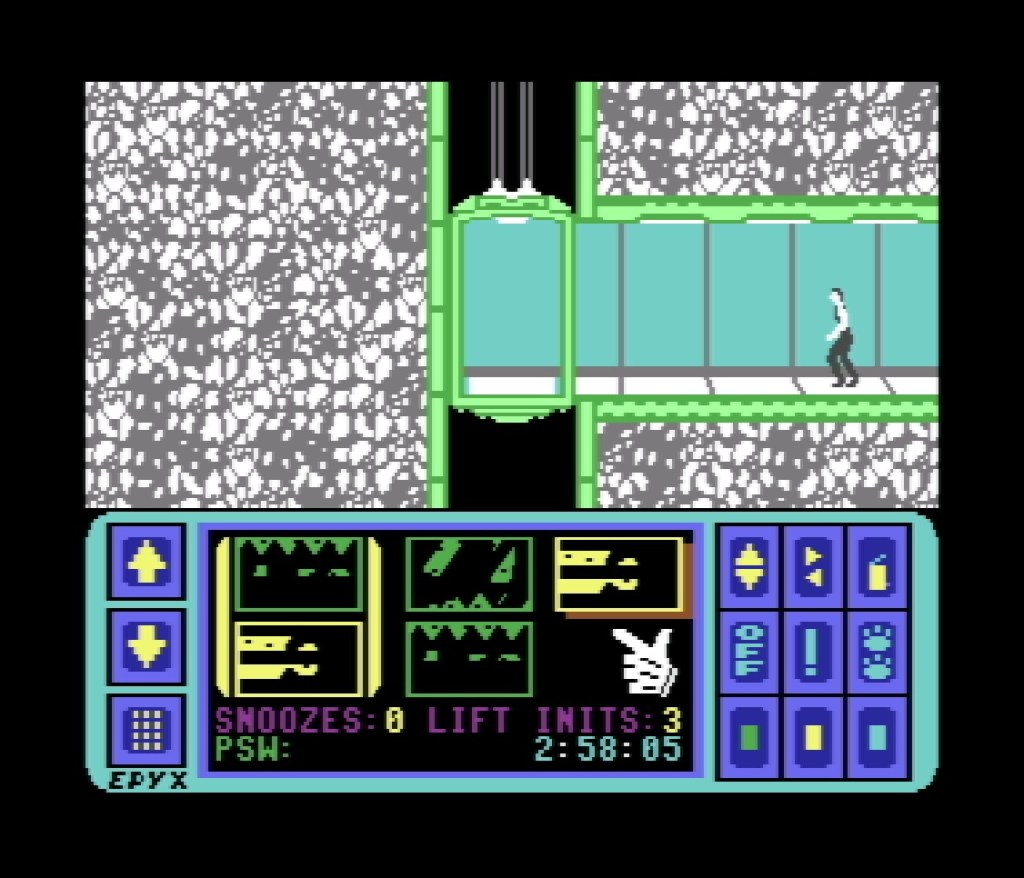
Right, pocket computer… There’s more to the corridors connecting these rooms than brilliant subterranean textures and impressive lift shafts because if you press B on the Evercade controller (or just context-sensitive fire on the original game) while you’re in one, you’ll turn on your MIA9366B pocket computer, and this is where you’re going to assemble all those individual puzzle pieces into something more meaningful! There are nine puzzles in total, each made up of four pieces, and when completed you’re going to have something like an antiquated computer punch card that will provide you with a letter from Elvin’s control room password. Once the computer is activated, you’ll get a new window with a white glove on it, and you’re going to use this like a mouse pointer from before any of us knew what a mouse pointer was to manipulate the puzzle pieces, while various icons will allow you to navigate around them, put up to two of them into “memory” (kind of like a Tetris piece preview) then manipulate the various selected pieces in the main workspace into recognisable pattern, which the computer will then assemble at the bottom of the screen as it emerges. Apart from that, you’ve got icons for flipping the puzzle pieces horizontally or vertically, changing the colour (because sometimes just matching shapes isn’t quite enough), resetting, undoing and so on. There’s even an icon with two animal paws on for pausing the game. Paws. Very clever!
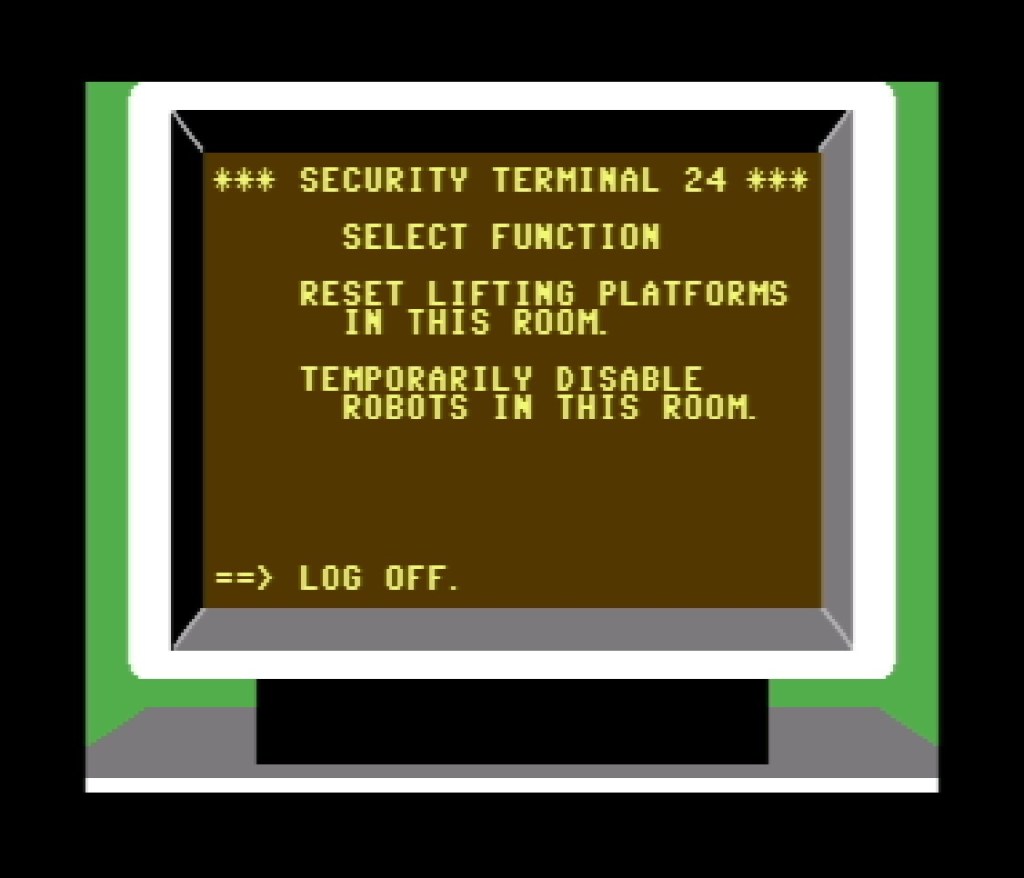
These puzzles are really something! Obviously, I knew they were there even if I didn’t know why, but again, the sophistication is incredible now I know it’s also there, especially as it’s so accessible once you know what you’re doing! That’s not to say they’re not also totally bewildering until you start connecting a few dots, but once you’ve worked out which pieces go with which to make up the four, and flipped them around and matched the colours, and you’ve done that nine times, you’ll have all the letters of the control room password at the bottom of the screen and you’re good to look for a blue door and finish the game! I’ve always loved the tile-sliding puzzles you used to get before electronic games, and this scratches the same itch, but if you do get stuck then there’s still hope because there’s also an icon in your pocket computer that lets you phone a friend back at HQ! Calling up your agency computer will give you a couple of choices – first, it will correct the orientation of any puzzle pieces in the memory window for you, or second, it will look at the first piece in memory and tell you if you’ve already found the other three needed to solve that puzzle. However, it all comes at a cost of two game minutes for every call, so emergency use only! Before we close our pocket computer (another icon!) I’ll quickly come back to those other codes for making the robot guards temporarily take a snooze and resetting the lifts, which are also recorded next to the solved password letter display… As you wander about, you’ll come across a couple of special code rooms, which will let you earn these codes by interacting with the giant console in front of you. It works the same way as searching an object, by walking up to it and pushing up, but this time you’re going to see a sequence of big squares flashing on the checkerboard wall, together with a musical note. Once they’ve played, you need to use your little white glove pointer to touch each square in a sequence so the notes are sorted in audio order, from low to high. If only I’d known it was that and not a game of Simon for all these years! Anyway, get the sequence right and the wall will flash and reward you with a SNOOZE or LIFT INIT password. You can then try again if you wish, but this time the sequence will be longer, but there’s no limit other than that so fill your wellies!
And with that, I do believe that after thirty-nine years at the time of writing, I’m finally equipped to have a proper go at Impossible Mission and put an end to Professor Elvin Atombender! Well, easier said than done, but this game is an absolute joy regardless, and one of those that isn’t just hard to out down but also hard to stop thinking about when you’re not playing. There are just so many flavours here to savour – the methodical expansion of the little lair map as you travel between interconnecting rooms and passageways; the moments of observation as you work out possible routes, lift patterns and individual robot behaviours before the often frantic platforming around each room; and then there’s the quiet but mind-bending concentration demanded by the puzzles you’ve collected – something for every bit of your brain all at once! And you can read all the instructions you want but this is not an easy game, with every time you get frazzled or fall down a hole accelerating the clock rather than losing lives, as well as putting you back to square one in the room where you died. The passing of time is also a constant threat, so while rushing in to anything is a total no-go in the majority of the rooms you’ll discover, you’re always painfully aware that the longer you dally, the less chance you’ll have of getting anywhere. And once you’re on the move and negotiating all those platforms and robots, that fancy somersault jump is accurate but takes a very long time to become predictable, and you’re going to get fried by robots one way or another a lot because of it!
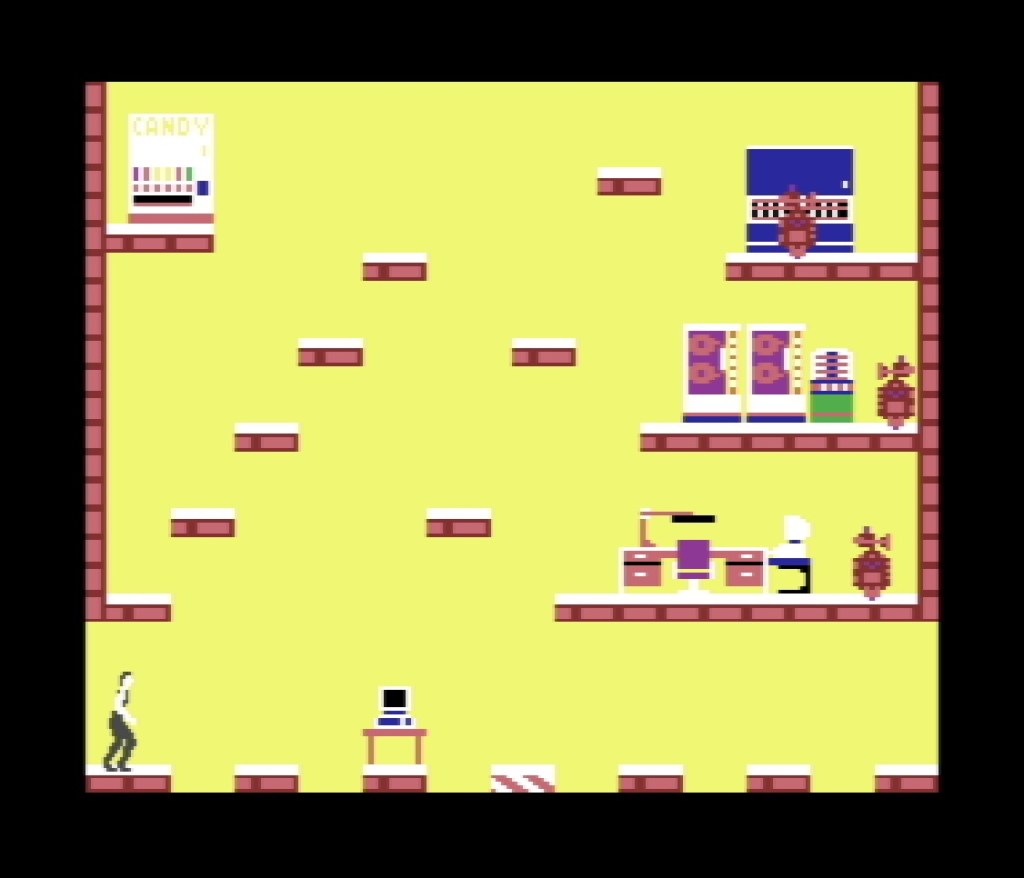
That said, as I’ve alluded to many times already, the jumping animation never gets old, and however much it ramps up the difficulty I wouldn’t have it any other way! Same with any aspect of your character’s movement; it’s a simple two colour sprite but there’s a realism to it that supports this super-smooth motion. I think “smooth” can be applied to everything else too – those big lifts between floors feel so great to move up and down, and likewise the smaller ones in each room, and even the action the pushing up to search items of furniture just feels strangely good! A lot of that is down to individual sound effects too, which are another real highlight in a game that’s full of them! In fact, they can be so dense in a room full of electronic robot warbles and grating electrode sirens that while I was playing my wife (as she often does) walked in and asked how I could sit and listen to that awful music! Then there’s the metallic echo of your footsteps providing a constant white noise rhythm, and the almost soothing sounds of the big lifts at full speed, but the real star of the show is undoubtedly the speech synthesis! “Another visitor! Stay a while. Stay forever!” And it being understandably primitive only adds to how sinister Elvin’s various regular interruptions are!
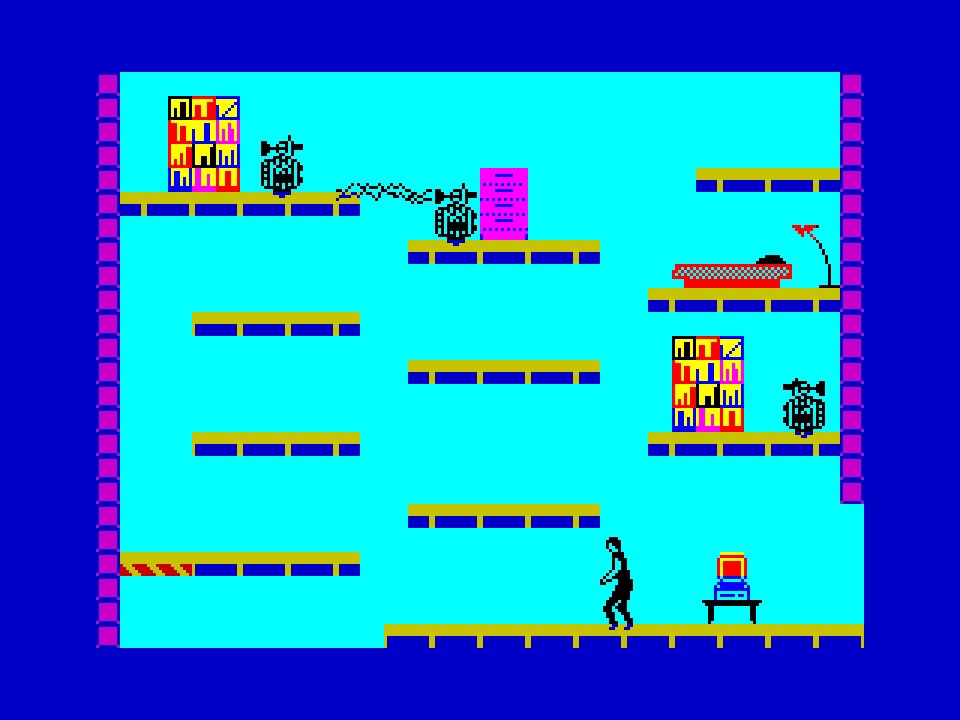
As well as sound everywhere, you’ve also got loads of colour – it’s funny, as I write I was just looking at the Spectrum port of Golden Axe, and the colour schemes here often take a similarly bonkers approach, although it works a lot better here when it goes off the beaten track a bit, with the full C64 repertoire at play in the walls, the superb rocky textures the lift shafts are cut into, and the impressively recognisable and quite extensive repertoire of furniture! While we’re talking Spectrum versions of stuff though, let’s quickly jump over there because, as said earlier, that’s another place I spent a lot of time not playing most of the game a couple of years later! The Spectrum port of Impossible Mission is a lot like the Winter Games one on there – if you didn’t know any better it would be fine, but when you do then it’s very much supermarket’s own-brand ketchup or cola! It plays alright though, and the somersault looks good, but there’s no escaping what little sound there is will quickly have you reaching for the volume knob, and everything is black on garish, even by Spectrum standards… The yellow and magenta rock textures are really something to behold!

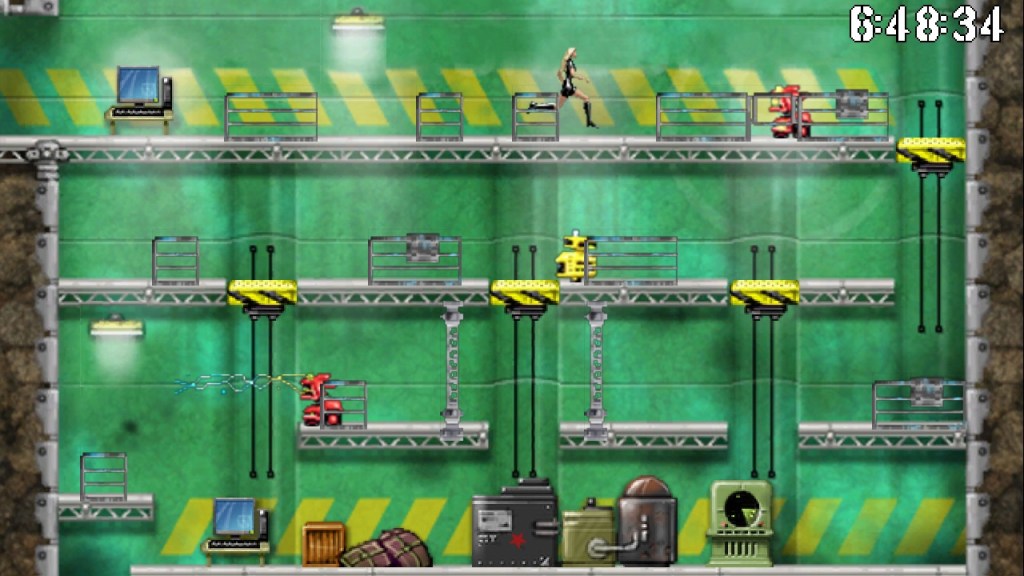
As well as the Spectrum version, there were ports for the Amstrad CPC, BBC and Electron, Apple II, Atari 7800 and Sega Master System. I do have a bit of a soft spot for the 7800 version, which I only discovered after reading about it in Bitmap Books’ fantastic Atari 2600/7800: a visual compendium, which explains that while it’s missing the speech, the gameplay is intact, and I really like its take on the graphics. A sequel, Impossible Mission II, then arrived in 1988, with the Atari ST, Amiga, NES and DOS also getting in on the action this time. It’s loads more of the same, and while the graphical overhaul is nice and everything that made the first game so special is all present and correct, it really is just loads more of the same. In 1994, the various forms of Amiga around by then (and almost the Mega Drive and SNES) got another sequel, Impossible Mission 2025, set in the far-distant sci-fi future and still revolving around similar gameplay but in much bigger, scrolling environments. It seems alright but for all the graphical and audio enhancements I can’t help but feel it’s better suited to the more compact format of the original. Closing out the tale, a revamp of the original appeared on PSP in 2007, followed by Wii and US-exclusive Nintendo DS versions, which also got an outing on Switch in 2019. I like this one a lot, with its atmospheric modern take on Elvin’s lair, as well as an original C64 graphics filter and one that kind of merges the two. Definitely worth seeking out on the Switch if you’ve got one!
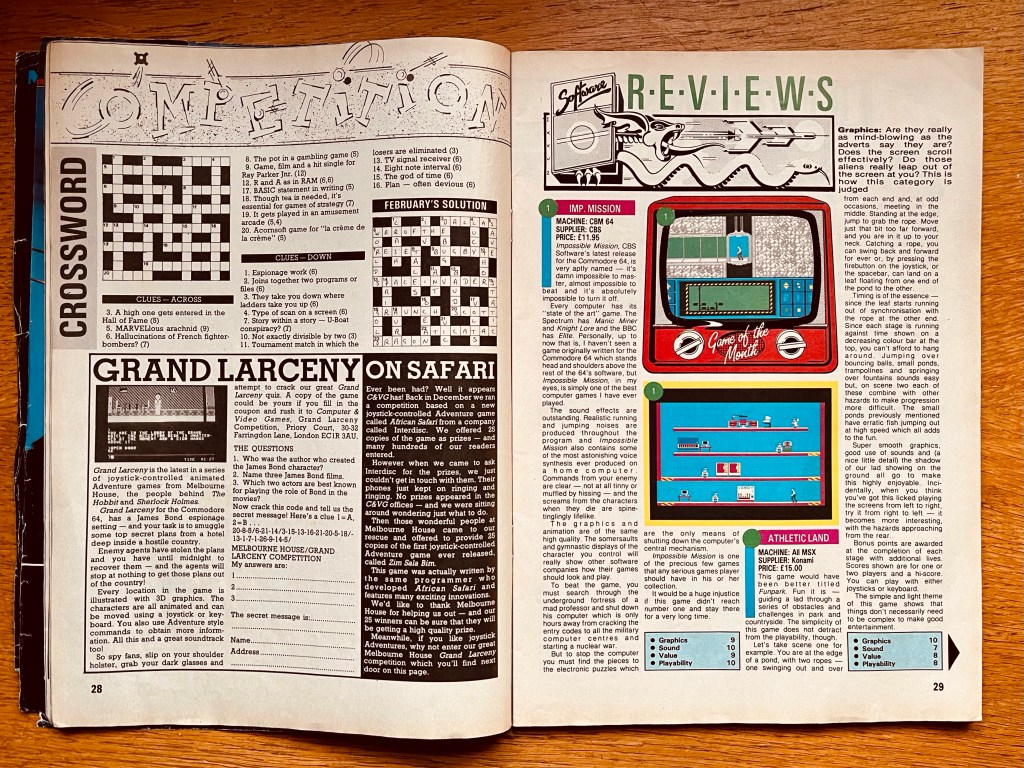
You know a game is something special when you can just mess around with it for hours and hours, and then on and off for decades, having as much fun as I have without really having a clue what’s going on! And now I do, Impossible Mission is even more special! I think the passage of time has probably helped me appreciate it even more than that though. When it came out, all that speech and the animation and even the complexity, assuming you made the effort, were ground-breaking, and visibly so to anyone who came into contact with it, regardless of their level of engagement, but none of us could have any idea quite how forward-thinking it was, and quite how influential it would become. Graphics 9. Sound 10. Value 9. Playability 10. That C&VG review from earlier wasn’t far wrong!
 Retro Arcadia